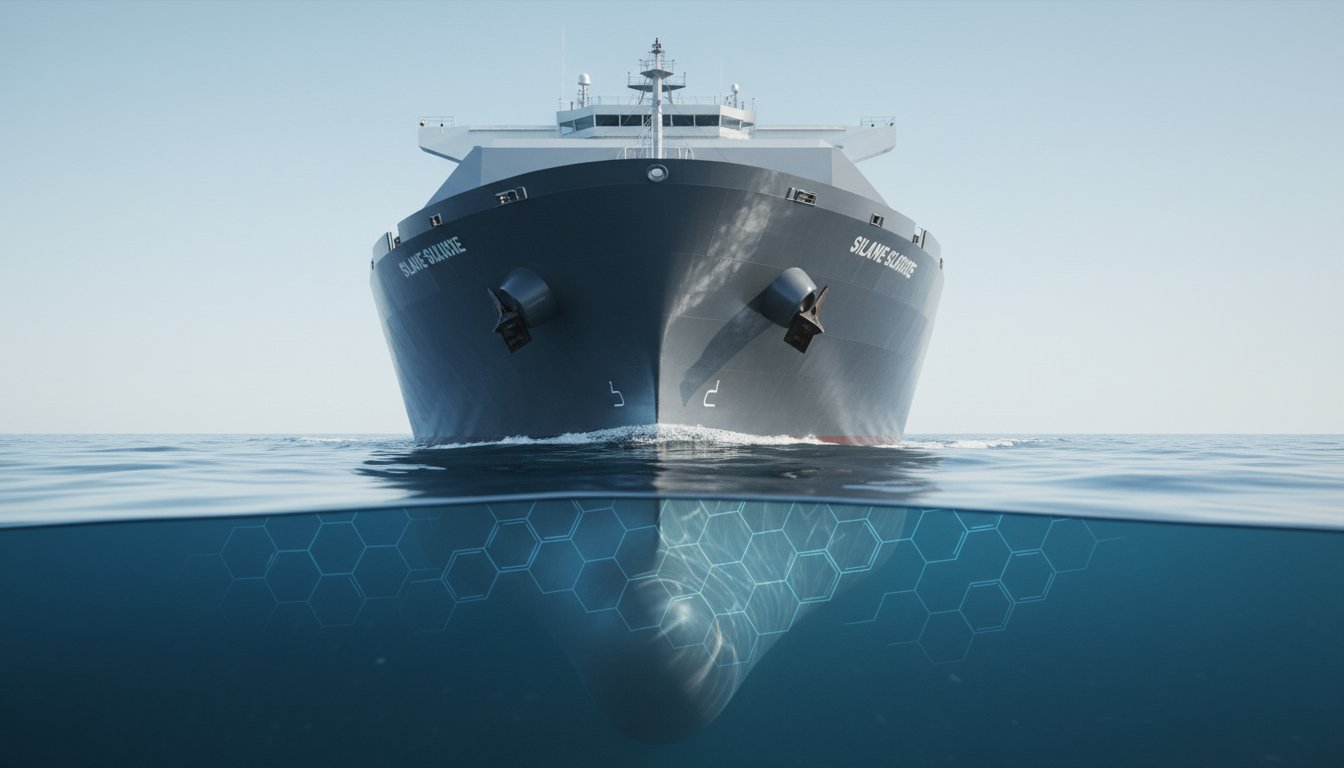
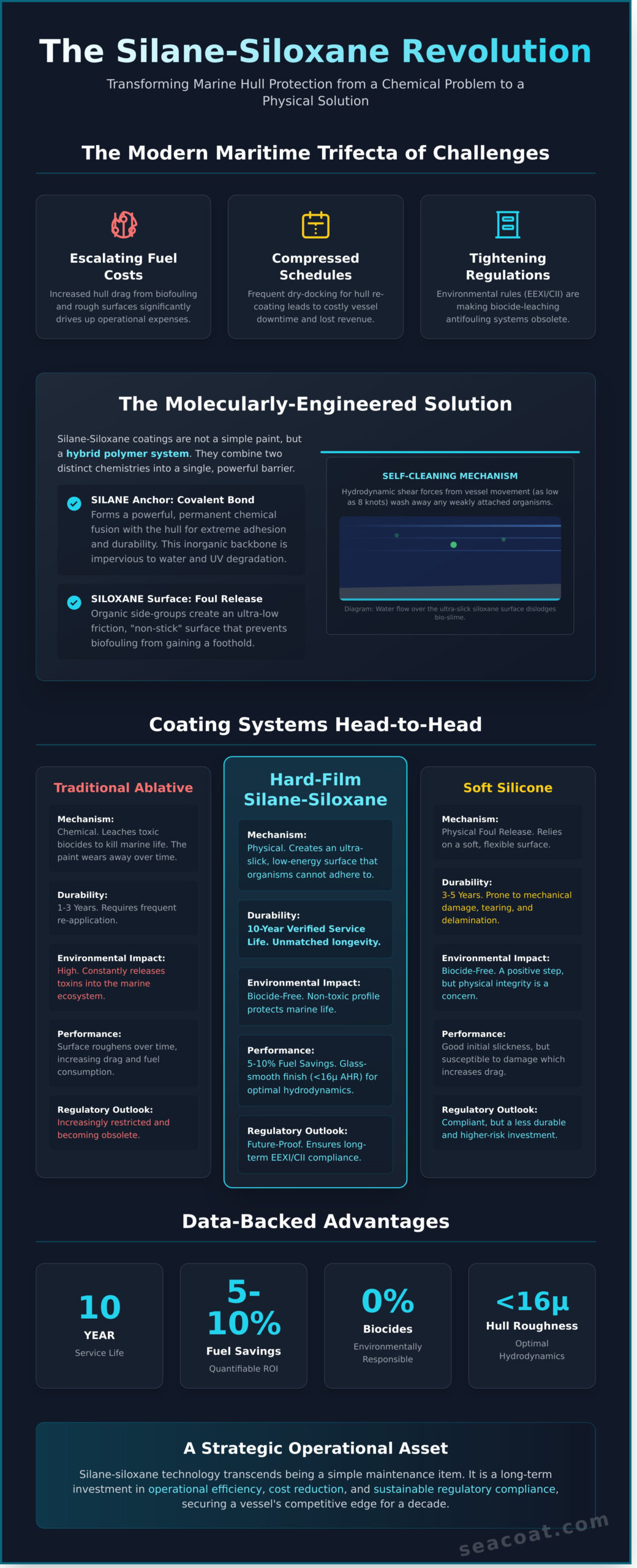
In an era where operational efficiency and environmental stewardship are no longer optional but essential, the maritime industry faces a trifecta of challenges: escalating fuel costs driven by hull drag, compressed dry-docking schedules, and tightening regulations that render traditional anti-fouling systems obsolete. The solution lies not in incremental improvements but in a fundamental shift in surface chemistry. A sophisticated silane-siloxane marine coating represents this paradigm shift, engineered to address these pressures head-on through advanced material science that delivers both extreme durability and a biocide-free profile.
This comprehensive technical guide unpacks the science behind this hybrid technology. We will explore the molecular mechanics that create an ultra-low friction, non-toxic foul release surface, demonstrating how it delivers a verifiable 10-year service life. Discover the data-backed case for achieving significant fuel savings of 5-10% and ensuring your fleet’s long-term EEXI/CII compliance, transforming a maintenance requirement into a strategic operational asset.
Key Takeaways
- Understand how the unique molecular structure of a silane-siloxane marine coating creates a permanent, high-strength bond for unmatched 10-year durability.
- Analyze the critical relationship between hull surface roughness and hydrodynamic drag to quantify significant, long-term fuel savings for your fleet.
- Identify the inherent performance and environmental limitations of traditional ablative and soft silicone paints to make a more informed coating decision.
- Calculate the 10-year Total Cost of Ownership (TCO) for your vessel by factoring in reduced maintenance cycles and enhanced operational efficiency.
Understanding the Molecular Hybrid: What is Silane-Siloxane?
At the core of advanced marine protection lies a sophisticated molecular architecture: the silane-siloxane hybrid polymer. This is not a simple mixture but a single, co-polymerized system that synergistically combines the best attributes of organic and inorganic chemistry. The result is a high-performance silane-siloxane marine coating engineered to overcome the inherent weaknesses of traditional single-component resins, such as epoxies or pure silicones. While silanes provide a tenacious, chemical anchor to the vessel’s hull, the siloxane component delivers the ultra-low surface energy required for superior foul-release and hydrodynamic efficiency.
This dual-functionality creates a durable, non-toxic barrier that physically prevents biofouling adhesion and mitigates corrosion without resorting to biocides. The hybrid structure ensures that the coating’s protective qualities and its performance-enhancing slickness are not compromised over its extended service life, offering a strategic asset for long-term vessel management.
The Chemistry of the Covalent Bond
The unparalleled adhesion of a silane-siloxane coating is achieved at the molecular level. The silane functional groups are specifically designed to react with hydroxyl groups (–OH) present on prepared metal or fiberglass substrates. This reaction forms powerful covalent bonds—a true chemical fusion between the coating and the hull. The subsequent curing process creates a dense, three-dimensional cross-linked network that is virtually impervious to water ingress and blistering. In essence, a silane-siloxane marine coating is a molecularly engineered barrier against ionic transport.
Inorganic vs. Organic Properties
The exceptional resilience of this polymer system stems from its hybrid nature. The “backbone” of the coating is composed of repeating silicon-oxygen bonds (Si-O-Si), which are structurally similar to quartz. This inorganic foundation, explored in detail within the science of siloxanes, provides immense thermal stability and resistance to UV degradation, preventing the chalking and embrittlement that plagues carbon-based polymers. Attached to this robust backbone are organic side groups (e.g., methyl groups) that orient themselves at the surface, creating the hydrophobic, low-friction finish essential for foul-release and drag reduction.</
Hydrodynamics and the Physics of Foul Release
The operational efficiency of any vessel is fundamentally tied to the physics of its hull moving through water. Traditional antifouling paints address biofouling by leaching biocides—a chemical solution to a biological problem. In contrast, a silane-siloxane marine coating operates on a completely different principle: it modifies the physics of the hull surface to prevent adhesion in the first place. This transition from a chemical to a physical defense mechanism is central to understanding the technology’s performance and environmental benefits. The core objective is not to kill marine organisms, but to create a surface so slick that they cannot gain a permanent foothold.
Reducing Frictional Resistance
Frictional drag, which can account for up to 70% of a vessel’s total resistance, is directly proportional to its Average Hull Roughness (AHR). By creating a “glass-smooth” finish with an AHR of less than 16 microns, silane-siloxane coatings significantly enhance laminar flow across the hull. This ultra-low friction surface allows the vessel to achieve target speeds at a lower RPM, delivering quantifiable fuel savings. The “slickness” is a function of the coating’s extremely low surface energy (typically 21-23 mN/m), which is confirmed by high water contact angle measurements. This low-energy state makes it energetically unfavorable for marine life to adhere, while the same robust chemistry that provides this feature also ensures the long-term corrosion resistance of silane coatings, protecting the hull’s integrity.
The Self-Cleaning Mechanism
The foul release properties of a silane-siloxane marine coating are activated by the vessel’s own movement. As the ship gets underway, the hydrodynamic shear forces generated by water flowing across the hull are strong enough to detach and wash away any weakly attached bio-slime or organisms. The coating’s inherent hydrophobicity prevents marine life from establishing deep “roots,” ensuring their bond to the surface remains tenuous. This self-cleaning effect is not limited to high-speed vessels; documented case studies have demonstrated effective foul release on vessels operating at sustained speeds as low as 8 knots, making this technology a viable, high-performance solution for a wide range of maritime assets.
Hard-Film Silane-Siloxane vs. Traditional Coating Systems
To fully appreciate the technological leap represented by hard-film silane-siloxane foul-release systems, it is essential to analyze the inherent limitations of legacy coating technologies. Traditional antifouling solutions, broadly categorized as ablative paints and soft silicone coatings, operate on principles that introduce significant compromises in performance, environmental compliance, and operational longevity. These systems present challenges that a modern silane-siloxane marine coating is specifically engineered to overcome.
Ablative Antifouling: The Toxic Legacy
The mechanism of ablative paints is sacrificial by design, continuously leaching biocides like cuprous oxide into marine ecosystems to poison fouling organisms. This constant erosion not only poses a significant environmental threat but also creates a compounding “roughness penalty.” As the coating depletes and flakes, it increases hydrodynamic drag and fuel consumption. Faced with escalating global regulations and demonstrable operational inefficiencies, the maritime industry is systematically moving beyond this outdated, toxic methodology.
Soft Silicone: Performance with Fragility
While offering effective foul-release properties through a low-energy surface, soft silicone coatings possess a critical operational vulnerability: low mechanical resistance. These fragile films are easily damaged by routine operations such as dock strikes, fender rub, or navigation in ice-prone waters. Subsequent repairs are complex and risk “silicone contamination” in shipyards, which can compromise future coating adhesion. Hard-film silane-siloxane delivers equivalent surface slickness with epoxy-like toughness, eliminating this trade-off between performance and durability.
The fundamental distinction lies in the coating’s structural integrity. Unlike sacrificial paints, a hard-film silane-siloxane marine coating does not rely on depleting components. Instead, its chemistry forms a dense, highly cross-linked polymer matrix that chemically bonds with the hull’s primer system. This process creates a permanent, non-porous, low-energy surface that is both inert and exceptionally durable. Its service life is not measured in seasons but in years, engineered to align with a vessel’s ten-year drydocking cycle.
This durability directly translates into a more flexible and cost-effective maintenance strategy. The mechanical fragility of soft silicones often precludes the use of robust in-water cleaning methods, such as rotating brushes, for fear of damaging the film. In contrast, the hard, resilient surface of a silane-siloxane system is fully compatible with aggressive in-water hull cleaning. This allows vessel operators to manage biofouling proactively and maintain optimal hydrodynamic efficiency without the immense expense and operational downtime of premature drydocking.
Operational ROI: Fuel Savings and Regulatory Compliance
While the initial investment for an advanced foul-release system is higher than traditional antifouling paints, the long-term operational returns deliver a significantly lower 10-year Total Cost of Ownership (TCO). The financial calculus shifts from a recurring maintenance expense to a strategic investment in vessel efficiency, with benefits compounding over the asset’s entire service life. This ROI is realized through direct fuel savings, extended service intervals, and simplified regulatory compliance.
The primary economic driver is the quantifiable reduction in fuel consumption. The ultra-smooth, low-friction surface created by a silane-siloxane marine coating minimizes hydrodynamic drag, directly translating to a sustained fuel efficiency gain of 5-12% over the docking cycle. For a vessel with significant annual fuel expenditure, this reduction provides a rapid and compelling payback period, fundamentally optimizing its operational budget.
Decarbonization and the EEXI/CII Framework
Reduced hydrodynamic drag directly lowers a vessel’s Carbon Intensity Indicator (CII) rating by decreasing the fuel burned per nautical mile. This performance enhancement enables operators to meet stringent IMO 2023 targets and achieve Energy Efficiency Existing Ship Index (EEXI) compliance through hull optimization, often negating the need for less desirable measures like Engine Power Limitation (EPL). For existing fleets, optimizing hull smoothness is the most cost-effective “green” upgrade available.
Long-Term Maintenance Savings
The operational advantages extend well beyond fuel and emissions. The robust, non-depleting nature of silane-siloxane chemistry allows for a strategic shift in maintenance cycles, moving from a standard 2-year schedule to 5-year or even 10-year dry-docking intervals. This transition generates substantial savings through:
- Elimination of repetitive blasting: The durable film integrity means a full blast-and-recoat is not required at every docking, only a wash and touch-up.
- Reduced underwater cleaning: Superior foul-release properties significantly decrease the frequency and intensity of in-water hull cleaning services.
- Enhanced hull preservation: The inert, impermeable barrier provides exceptional long-term protection against corrosion and electrolysis, preserving the steel for the life of the vessel.
Ultimately, the adoption of a high-performance silane-siloxane marine coating redefines vessel maintenance as a proactive strategy for enhancing profitability and ensuring environmental stewardship. To analyze the specific TCO for your fleet, explore our performance modeling tools.
Implementing Sea-Speed V 10 X: The Industry Standard
Sea-Speed V 10 X Ultra represents the pinnacle of silane-siloxane technology, engineered for superior hydrodynamic performance and a service life exceeding ten years. Its primary operational advantage lies in its single-coat application, which significantly reduces dry-dock time and associated labor costs—a critical factor in fleet management. This advanced system demonstrates exceptional adhesion and versatility across diverse substrates, including steel, aluminum, and fiberglass, making it a universal solution for modern maritime assets.
Transitioning from legacy ablative or biocide-based antifouling systems to a permanent foul-release coating requires a methodical approach. The process involves the complete removal of the old, soft paint layers to expose a solid, prepared surface. This ensures the new system can establish a permanent, covalent bond, transforming the hull into a long-term, low-maintenance asset rather than a recurring operational expense.
Surface Preparation and Primer Systems
The integrity of the entire coating system is founded upon meticulous surface preparation and the application of Seapoxy 73. This high-build epoxy primer creates a robust, impermeable tie-coat. Achieving the specified surface profile (typically SA 2.5 for steel) is non-negotiable, as it provides the necessary anchor for the siloxane molecules to bond covalently. Optimal curing of the silane-siloxane marine coating is dependent on strict adherence to environmental controls for temperature and humidity, ensuring maximum cross-linking and film hardness.
Performance Monitoring and Support
SeaCoat SCT provides comprehensive global technical support to ensure flawless application on large-scale projects, from shipyards in Asia to dry-docks in Europe. Post-application, we assist vessel operators in monitoring hull performance and fuel efficiency gains by analyzing operational data, such as noon-reports. This data-driven approach provides verifiable proof of the coating’s impact on reducing drag and operational expenditures over its entire service life.
The implementation of Sea-Speed V 10 X is a strategic investment in vessel efficiency, environmental compliance, and long-term operational stability. By moving beyond temporary antifouling measures, fleet operators can secure a decade or more of predictable, high-performance hull protection. To understand the full economic and environmental benefits for your fleet, we recommend you consult with SeaCoat SCT experts for a fleet-wide ROI analysis.
The Future of Hull Performance: A Strategic Conclusion
The maritime industry is at a critical juncture where operational efficiency and environmental stewardship are no longer mutually exclusive. As we have explored, the unique molecular architecture of a hard-film silane-siloxane marine coating provides a definitive advantage, shifting the paradigm from toxic anti-fouling to advanced, hydrodynamic foul release. This technology translates directly into quantifiable gains—mitigating drag, reducing fuel consumption, and ensuring compliance with increasingly stringent global regulations.
The Sea-Speed V 10 X system is the commercial embodiment of this science. With a proven track record in commercial use since 2001, it delivers an unparalleled 10-year lifecycle. Its zero VOC, non-toxic, and biocide-free formulation represents a commitment to marine preservation, while its ability to reduce hull roughness to less than 16 microns offers a new standard in performance. We invite you to transition from conventional maintenance cycles to a decade of optimized performance. Explore the Sea-Speed V 10 X Ultra product line for your vessel and invest in a more sustainable and profitable future for your fleet.
Frequently Asked Questions About Silane-Siloxane Marine Coatings
Is silane-siloxane coating completely biocide-free?
Yes, our silane-siloxane formulations are fundamentally biocide-free. Unlike traditional antifouling paints that leach toxic cuprous oxide or other biocides into the marine environment, our coatings operate on a foul-release principle. The extremely low surface energy of the siloxane matrix prevents marine organisms from forming a strong bond. This innovative, non-toxic mechanism ensures full compliance with environmental regulations while offering superior, long-term performance without introducing chemical pollutants into marine ecosystems.
How long does a silane-siloxane marine coating last compared to ablative paint?
A key performance differentiator is longevity. While conventional ablative paints are designed to wear away over 1-3 years, a professionally applied silane-siloxane marine coating forms a durable, non-depleting hard film. This results in a service life that routinely exceeds ten years. This extended operational cycle significantly reduces the frequency of dry-docking for repainting, delivering a substantial return on investment through minimized maintenance costs and maximized vessel availability.
Can silane-siloxane be applied over existing bottom paint?
No, direct application over existing antifouling paint is not recommended and will compromise coating integrity. For optimal performance and the guaranteed ten-year lifespan, our silane-siloxane system requires a direct chemical bond to a properly prepared and primed substrate. All previous coatings must be completely removed to the bare hull or a sound, compatible primer system. This foundational step is critical to ensure the molecular adhesion necessary for long-term durability and foul-release efficacy.
What is the minimum speed required for the self-cleaning effect to work?
The foul-release mechanism is activated by hydrodynamic forces. While significant self-cleaning typically begins as the vessel approaches 8-10 knots, the low-adhesion properties are effective at all times. Even at lower speeds or during periods at anchor, any accumulated slime or bio-fouling forms only a weak attachment. This makes it easily removable by gentle water pressure or the vessel’s subsequent movement, maintaining a hydrodynamically smooth hull for optimal efficiency.
Is silane-siloxane safe for aluminum hulls?
Absolutely. Our silane-siloxane coatings are chemically inert and contain no copper or other metallic biocides, making them the superior choice for aluminum hulls and outdrives. Traditional copper-based antifouling paints induce galvanic corrosion when applied to aluminum, leading to severe pitting and structural damage. By eliminating this metallic component, our coating provides exceptional foul-release performance while completely mitigating the risk of electrochemical degradation, thereby preserving the integrity of the vessel’s structure.
How much fuel can a commercial vessel save by switching to silane-siloxane?
Documented case studies on commercial vessels demonstrate fuel consumption reductions ranging from 6% to over 10% after converting to our silane-siloxane system. This significant operational saving is a direct result of the coating’s extremely low surface roughness, which minimizes hydrodynamic drag. By maintaining a clean, smooth hull for extended periods, the system reduces the engine power required to maintain a given speed, translating directly into lower fuel costs and a reduced carbon footprint.
Does a hard-film coating require special underwater cleaning tools?
No, and in fact, aggressive tools must be strictly avoided. The integrity of the hard-film, low-energy surface is paramount. If in-water grooming is required, it should only be performed using non-abrasive methods, such as soft-bristled rotary brushes or silicone squeegees. The use of harsh, abrasive brushes or metal scrapers designed for traditional hard paints can permanently damage the siloxane surface, impairing its foul-release properties and voiding its performance guarantee.
What are the VOC levels in Sea-Speed silane-siloxane coatings?
A core tenet of our product design is environmental stewardship and applicator safety. Our Sea-Speed V 10 X and CLEAR silane-siloxane coatings are formulated with 100% solids and contain zero Volatile Organic Compounds (VOCs). This not only ensures compliance with the most stringent air quality regulations worldwide but also eliminates harmful solvent exposure for application teams. This zero-VOC profile underscores our commitment to developing high-performance solutions that are both sustainable and responsible.