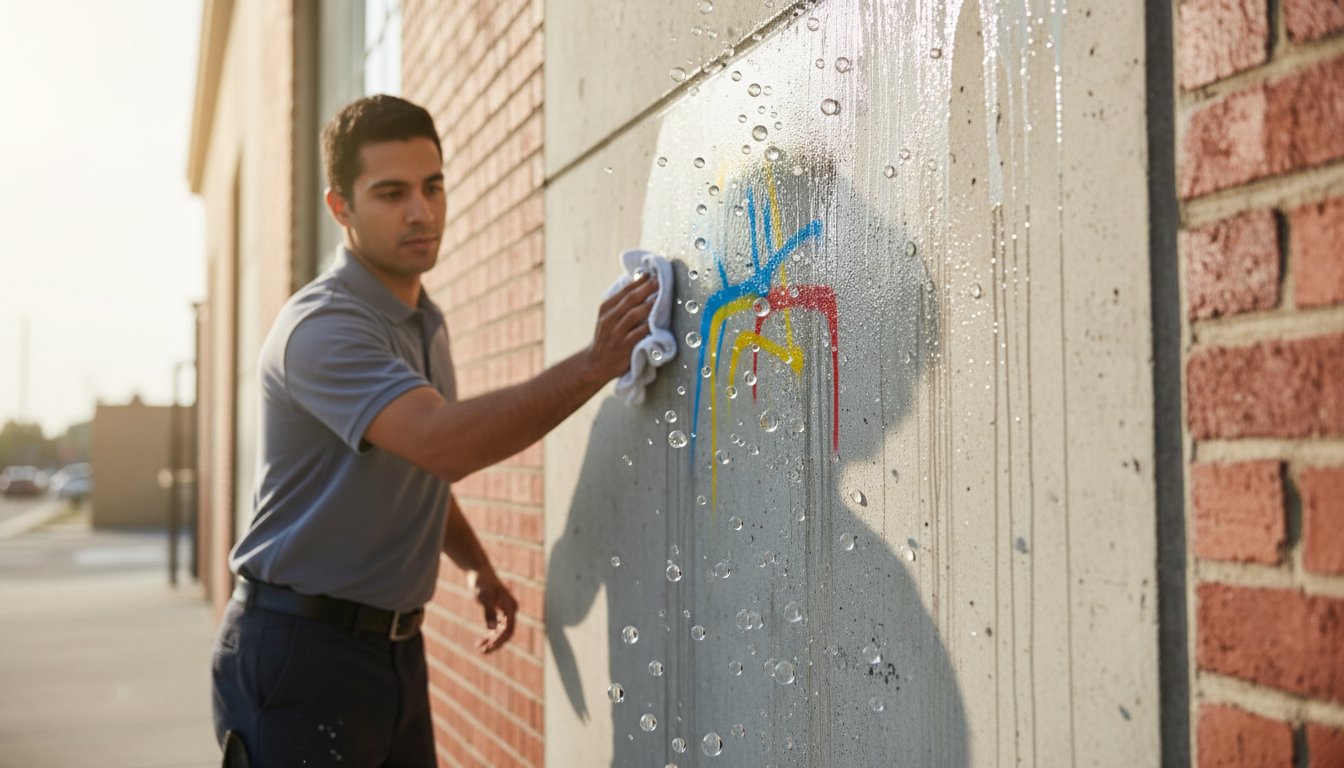
For asset managers, the repetitive cycle of graffiti removal represents a significant operational drain-a recurring expenditure of time, labor, and capital that degrades surfaces through harsh chemical cleaning. This constant mitigation effort diminishes not only the aesthetic value of a property but also its long-term structural integrity. While conventional methods offer temporary relief, a truly permanent solution requires a fundamental shift in surface protection strategy, moving beyond simple paint-overs to advanced anti graffiti paint formulations.
The most robust of these innovations, however, did not originate in urban development but in one of the planet’s most demanding environments: the open ocean. This definitive guide deconstructs the science behind next-generation surface coatings, revealing how foul-release technology engineered for harsh marine applications provides the ultimate solution for terrestrial asset protection. We will explore the specific polymer chemistry that creates an impermeable, non-stick barrier, allowing for effortless graffiti removal without damaging the underlying substrate. Prepare to move beyond reactive maintenance and implement a ‘one-and-done’ strategy for lasting preservation.
Key Takeaways
- Discover why advanced non-stick chemistry, originally developed to protect ship hulls from harsh marine environments, offers the most durable defense against graffiti.
- Learn to differentiate between sacrificial and permanent anti graffiti paint systems to select a solution based on lifecycle cost and durability, not just initial price.
- Master a two-step evaluation process for your specific substrate and environmental conditions to ensure maximum coating performance and longevity.
- Understand how silane-siloxane polymer technology is setting a new standard for protecting critical infrastructure by delivering military-grade resilience.
Understanding Anti-Graffiti Coatings: A Strategic Overview
In high-stakes operational environments, surface integrity is paramount to asset longevity and mission readiness. Vandalism, particularly graffiti, represents more than a cosmetic issue; it imposes significant economic burdens through recurring cleaning labor, harsh chemical use, and potential substrate degradation. An anti graffiti paint is not merely a layer of paint but a sophisticated chemical barrier engineered to prevent aerosol paints, permanent markers, and other defacements from bonding to a protected surface. The core value proposition is a strategic reduction in maintenance cycles and operational costs. By creating a low-energy or sacrificial surface, these coatings transform a costly, labor-intensive remediation process into a simple, rapid cleaning procedure, thereby preserving the underlying asset’s structural and aesthetic integrity.
The market offers two distinct technological approaches to this challenge, each with different performance characteristics and long-term economic implications. A comprehensive technical review of Understanding Anti-Graffiti Coatings further details these classifications, which are fundamentally divided into sacrificial and permanent systems. The selection of an appropriate system is critical for optimizing return on investment and ensuring reliable performance.
Sacrificial vs. Permanent Systems
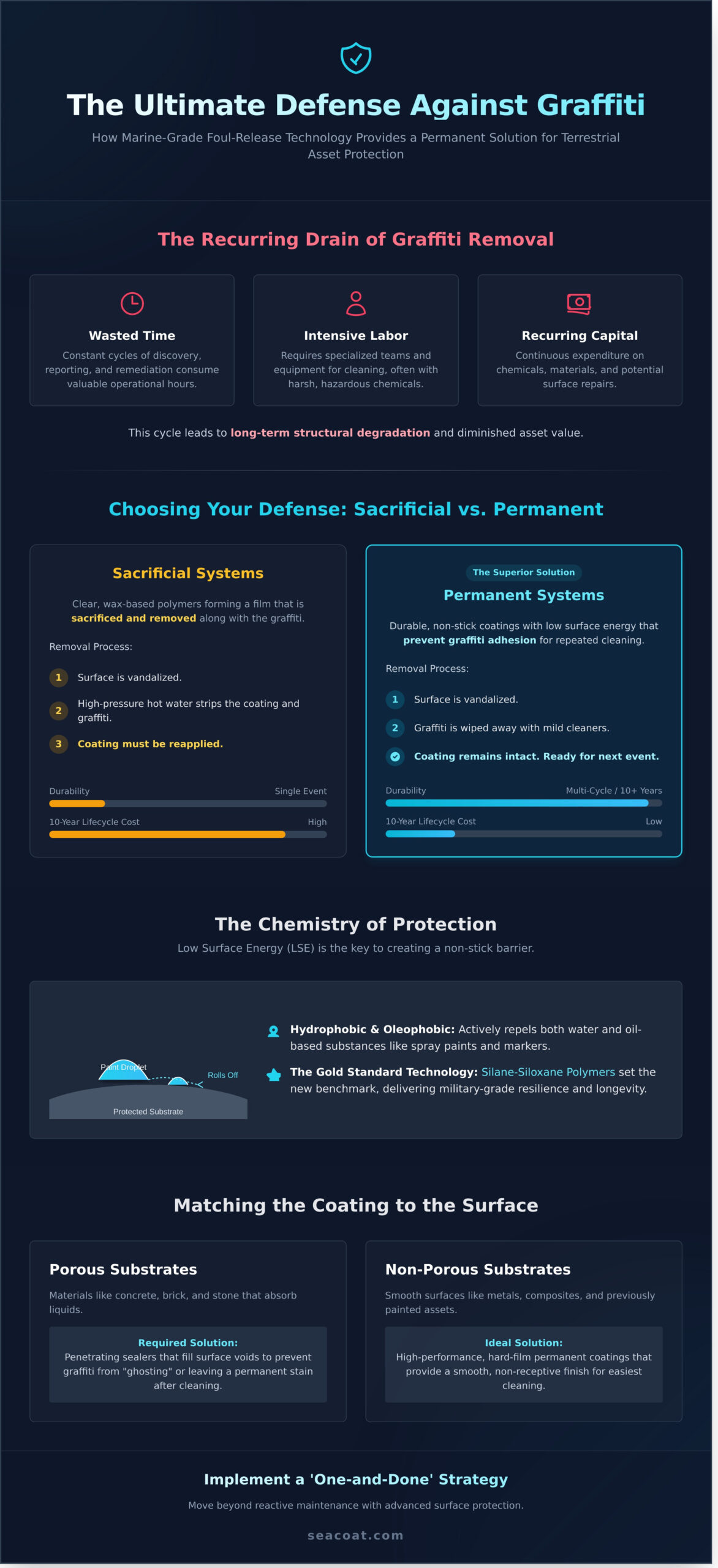
Sacrificial coatings are typically clear, wax-based polymers that form a transparent film over the substrate. When vandalized, the coating itself is sacrificed; high-pressure hot water is used to strip the wax layer, taking the graffiti with it. This system necessitates reapplication after each cleaning event, introducing a recurring material and labor cost. In contrast, permanent anti-graffiti paint systems are engineered for multi-cycle durability. These are non-stick, low surface energy coatings, often based on polyurethane or siloxane chemistry, that create a durable finish to which paint cannot effectively adhere. Contaminants can be removed repeatedly using mild solvents or cleaners without compromising the protective film, offering a superior ten-year life cycle and a significantly lower total cost of ownership.
Key Environments and Substrates
The efficacy of any coating is directly linked to its compatibility with the intended substrate and operational environment. While commonly specified for public infrastructure such as bridges, transit vehicles, and commercial buildings, the principles apply directly to high-value maritime and military assets. The critical distinction lies in substrate porosity.
- Porous Substrates: Materials like concrete, brick, and stone require penetrating sealers that fill surface voids to prevent graffiti from “ghosting” or leaving a permanent stain after cleaning.
- Non-Porous Substrates: Metals, composites, and previously painted surfaces are ideal for high-performance, hard-film permanent coatings that provide a smooth, non-receptive finish. This category also includes specialty glass installations, like those from Jeske Glass, where maintaining a flawless appearance is critical.
For glass surfaces in particular, which are frequent targets for etching and paint, specialized anti-graffiti films offer a sacrificial but easily replaceable barrier. This approach protects the expensive glass itself from permanent damage. Companies like Prodigy Window Solutions specialize in these types of protective window film solutions for both commercial and residential properties.
Matching the coating system to the surface profile and its exposure level-to UV radiation, abrasion, and chemical agents-is a fundamental requirement for achieving optimized, long-term asset protection.
When considering mobile assets like transit vehicles, a comprehensive protection strategy often extends beyond surface coatings. To safeguard the asset itself from theft, many managers also explore Insurance Approved Vehicle Trackers as a crucial layer of security, ensuring both preservation and recovery.
Of course, there are situations where a vehicle is damaged beyond what surface coatings can address, whether from vandalism, accidents, or simple decay. In these end-of-life scenarios, the asset management strategy shifts to value recovery. For those managing vehicle fleets who need to dispose of such assets, it can be useful to explore Cash for Junk Cars for a straightforward way to handle value recovery.
The Chemistry of Protection: How Different Anti-Graffiti Paints Work
The efficacy of any anti-graffiti coating is fundamentally governed by its surface chemistry, specifically its ‘surface energy.’ A low surface energy (LSE) surface is hydrophobic and oleophobic, meaning it actively repels both water- and oil-based substances, including spray paints and markers. This principle prevents the graffiti from forming a strong chemical bond with the substrate, allowing for significantly easier removal. The goal is not merely to cover the asset, but to create a functionally non-stick surface at a microscopic level. Different coating technologies achieve this with varying degrees of permanence and operational efficiency.
To clarify the strategic trade-offs between available systems, the following table compares the primary categories of anti-graffiti coatings based on critical performance and economic metrics:
| Coating Type | Durability | Cleanability | Required Maintenance | Lifecycle Cost |
|---|---|---|---|---|
| Sacrificial | Low (Single-use) | High (Coating is removed) | Re-application after every cleaning | High (Labor & material intensive) |
| Semi-Permanent | Moderate (5-10 cleaning cycles) | Moderate (Requires specific cleaners) | Periodic re-application | Moderate |
| Permanent (Polyurethane) | High (100+ cycles) | Good (Solvent-based cleaners) | Minimal | Low |
| Permanent (Siloxane) | Very High (1000+ cycles) | Excellent (Mild cleaners) | Near-zero | Very Low (Optimized) |
Polyurethane and Fluoropolymer Systems
Common permanent coatings, such as two-component polyurethanes and fluoropolymers, function by curing into a hard, non-porous film. This dense, cross-linked polymeric matrix is impermeable to pigments, preventing them from penetrating the substrate. While effective for numerous cleaning cycles, their chemical resistance is not absolute. Certain aggressive solvents used in paint thinners can soften or damage the coating over time. Furthermore, many legacy formulations contain isocyanates and high levels of volatile organic compounds (VOCs), posing environmental and occupational health concerns that are incompatible with modern maritime standards.
The Limitations of Conventional Approaches
A significant operational failure of lesser systems is the phenomenon of ‘ghosting,’ where a faint outline of the graffiti remains embedded in the coating even after cleaning. This occurs when pigment particles partially penetrate a weakened or porous surface. Repeated cleaning with harsh chemicals exacerbates this issue, degrading not only the protective film but also the integrity of the underlying hull. This cycle of damage underscores the importance of a systems-based approach, a concept detailed in this practical guide to selecting anti-graffiti systems from the U.S. Department of Justice. Many conventional anti graffiti paint formulations ultimately fail due to poor adhesion or rapid degradation from UV radiation, compromising asset protection and increasing long-term maintenance costs.
From Ship Hulls to City Walls: Why Marine-Grade Technology Excels
The world’s most advanced non-stick surfaces were not developed for cityscapes, but for the unforgiving environment of the open ocean. In the maritime industry, the primary challenge is mitigating biofouling-the aggressive adhesion of marine organisms like barnacles and algae to a ship’s hull. This problem is a direct parallel to urban graffiti; both are fundamentally issues of unwanted adhesion that degrade asset performance and require costly removal. The solution pioneered for the former provides a superior technological answer for the latter.
The core principle is simple: a surface engineered to shed marine life with hydrodynamic force alone is exceptionally effective at preventing the adhesion of spray paint, markers, and posters. This is the foundation of foul-release technology, which has now been optimized as a premier anti graffiti paint for terrestrial assets.
The Science of Silane-Siloxane Coatings
Our coatings are built upon a cross-linked silane-siloxane polymer backbone. The silane component forms a tenacious covalent bond with the substrate, ensuring extreme adhesion and durability, while the siloxane component creates an ultra-low-energy, chemically inert surface. This molecular architecture, a key focus in research on The Chemistry of Anti-Graffiti Paints, is what provides such robust chemical resistance. Unlike soft, easily damaged silicones, these are hard-film coatings engineered for physical resilience against abrasion and impact. Key performance characteristics include:
- Non-Toxic Formulation: Entirely free of biocides and other harmful leachable compounds.
- Zero VOCs: Environmentally responsible application with no release of volatile organic compounds.
- Extreme Longevity: Chemically stable and UV-resistant, delivering a performance life cycle exceeding 10 years.
Translating Marine Performance to Urban Environments
A coating formulated to withstand constant saltwater immersion, extreme UV exposure, and the immense hydrodynamic pressures of a moving vessel is, by definition, over-engineered for static, terrestrial use. This over-engineering is precisely what guarantees its unparalleled performance in urban settings. The chemical and physical stressors on a city wall or bridge are negligible compared to those faced by a naval ship’s hull. Just as carbon fiber developed for aerospace provides superior strength in consumer products, marine-grade coating technology delivers a new benchmark for longevity and effectiveness in asset protection. This translates to a drastic reduction in maintenance cycles and a higher long-term return on investment for infrastructure management.
A Practical Guide to Selecting and Applying Anti-Graffiti Systems
Specifying an effective anti-graffiti coating system extends beyond the product data sheet. It requires a methodical analysis of the asset’s substrate, its operational environment, and the total cost of ownership over its service life. This strategic approach ensures that the chosen system delivers not just surface protection, but long-term operational readiness and economic value.
This comprehensive approach to asset protection often includes other critical elements like durable facility signage and safety markings. Companies specializing in industrial graphics, such as Graphic Cabin, offer custom solutions designed to complement surface protection strategies by ensuring clear, long-lasting visual communication in demanding environments.
Surface Preparation: The Foundation of Durability
The performance of any advanced coating is fundamentally dependent on its bond with the substrate. Industry data indicates that up to 90% of coating failures are attributable to inadequate surface preparation. A precise protocol is non-negotiable and must include:
- Cleaning and Degreasing: All surface contaminants, including oils, salts, and biological matter, must be completely removed.
- Abrasion: A light mechanical abrasion may be required to create a surface profile that promotes optimal adhesion.
- Priming: Porous substrates like concrete or weathered composites require a specialized sealer or primer to create a uniform, non-absorbent surface, preventing the topcoat from failing.
Calculating Lifecycle Cost vs. Upfront Price
A procurement decision based solely on initial cost per gallon is a critical error. The true investment is measured by the total lifecycle cost. A simple calculation to determine this is: (Initial Cost + (Annual Cleaning & Maintenance Cost x Years)) / Years = True Annual Cost. For example, a low-cost sacrificial anti graffiti paint may require complete reapplication annually, whereas a permanent, non-sacrificial siloxane system offers a 10-year service life with minimal cleaning costs. The higher initial investment in superior technology consistently yields significant long-term savings and reduces maintenance downtime.
Application Best Practices
Proper application is the final critical step in ensuring system integrity. While coatings can be applied via brush, roller, or spray, the chosen method must achieve the specified dry film thickness (DFT) without defects. Environmental conditions are paramount; application must occur within the manufacturer’s recommended temperature and humidity range to ensure proper curing and film formation. For mission-critical assets, where failure is not an option, consult with a coating technology specialist to ensure proper system selection and application protocol.
Seacoat Technology: Advanced Defense for Critical Infrastructure
The same advanced chemistry engineered to protect military and commercial marine assets from the harshest oceanic conditions is now being deployed to defend critical terrestrial infrastructure. Seacoat SCT, LLC’s proprietary silane-siloxane technology, embodied in products like Armor-Sil R/G, offers a paradigm shift in surface protection. This technology moves beyond temporary, sacrificial coatings to provide a permanent, non-porous barrier that integrates with the substrate itself, delivering unparalleled durability and simplified maintenance for high-value assets.
Armor-Sil R/G: The Permanent Solution
Armor-Sil R/G is a clear, penetrating, hard-film coating that cures to form a highly durable, chemically inert surface without altering the original appearance of the substrate. Its formulation is engineered for exceptional adhesion to a wide array of materials, including concrete, masonry, steel, and aluminum. This versatility, combined with its extreme resistance to chemicals, makes it the definitive anti graffiti paint solution, rendering surfaces impervious to spray paints, permanent markers, and even acids, which can be wiped away with simple solvents without damaging the coating.
The core differentiators of this technology represent a significant advancement over conventional surface protection systems:
- 10+ Year Lifespan: A single application provides over a decade of documented protection, drastically reducing the total cost of ownership and eliminating the need for frequent recoating cycles.
- Hard-Film Durability: Unlike softer sacrificial coatings, Armor-Sil R/G forms a robust, abrasion-resistant film that withstands aggressive cleaning protocols and environmental wear.
- Environmental Responsibility: Formulated as a non-toxic, zero-VOC system, it ensures compliance with the most stringent environmental regulations and enhances applicator safety.
Case Study: Proven Performance in Harsh Conditions
The operational efficacy of Seacoat SCT, LLC’s siloxane technology is not theoretical; it is backed by decades of proven performance on naval vessels and commercial ships navigating the world’s most corrosive marine environments. This track record provides an unparalleled level of confidence for asset managers. The same chemistry that prevents biofouling and corrosion on a ship’s hull offers a robust defense against urban decay and vandalism, effectively de-risking your maintenance budget and ensuring permanent asset protection for bridges, transit facilities, and public structures.
By leveraging military-grade technology, organizations can transition from a reactive maintenance posture to a proactive strategy of long-term preservation. To learn more about how our advanced coatings can secure your infrastructure, visit us at seacoat.com.
Transitioning from Reactive Maintenance to Proactive Asset Preservation
Protecting critical infrastructure in 2026 requires a decisive shift from temporary fixes to permanent, high-performance solutions. As this guide has detailed, the resilience of marine-grade coatings, originally engineered for the harshest maritime environments, offers a superior defense for terrestrial assets. Selecting the right anti graffiti paint is not merely a maintenance decision; it is a strategic investment in the longevity and operational integrity of your property, where advanced surface chemistry dictates long-term performance and ROI.
SeaCoat’s Armor-Sil system exemplifies this forward-thinking approach. Our technology is proven on commercial and military marine vessels, delivering an expected service life of 10+ years without compromising environmental standards, thanks to its zero-VOC, non-toxic formulation. To determine how this level of protection can be optimized for your specific operational needs, we invite you to request a technical consultation on Armor-Sil for your project.
Take the definitive step toward securing your assets for the next decade and beyond.
Frequently Asked Questions
How much does professional anti-graffiti paint cost per square foot?
The total cost of ownership, rather than the per-square-foot price, provides a more accurate metric for high-performance coatings. While a professional anti graffiti paint system has a higher initial material cost, its extended service life and minimal maintenance requirements deliver a significantly lower lifecycle cost. Project variables such as substrate preparation, required dry film thickness (DFT), and environmental compliance dictate the final investment, which is optimized for long-term asset protection and superior return on investment.
Can anti-graffiti paint be applied over an existing painted surface?
Application over existing coatings is feasible, provided a rigorous surface analysis and preparation protocol is followed. The integrity of the underlying system is paramount; it must be sound, well-adhered, and free of contaminants. Proper surface preparation, often involving solvent wiping and mechanical abrasion, is critical to establish a strong interfacial bond. In some cases, a specialized tie-coat may be required to ensure chemical compatibility and guarantee the performance of the new protective topcoat.
How long does a permanent anti-graffiti coating last?
The operational service life of a non-sacrificial, permanent coating is engineered to be extensive, typically exceeding a ten-year cycle under specified operational conditions. Unlike sacrificial coatings that degrade with each cleaning, these advanced systems are designed to withstand repeated cleaning cycles without compromising film integrity or performance. This durability minimizes the need for reapplication, ensuring continuous asset protection and predictable maintenance intervals, which is critical for long-term operational efficiency.
Is anti-graffiti paint completely invisible once applied?
High-performance clear coatings are formulated to be optically transparent, preserving the original color and appearance of the substrate. However, the application will create a continuous, non-porous film that may alter the surface’s light-reflective properties, often imparting a satin or gloss finish. While the coating itself is not visible, this change in sheen is a functional characteristic of the protective layer that creates the easy-clean, low-adhesion surface required for effective performance.
Can I apply anti-graffiti paint myself or do I need a professional?
Professional application by certified technicians is mandatory to ensure the coating system performs to its engineered specifications. Achieving the required surface profile, managing atmospheric conditions like humidity and dew point, and applying the coating to a precise dry film thickness (DFT) requires specialized equipment and expertise. Professional installation is essential for warranty compliance and to guarantee the coating’s projected ten-year service life, ensuring the asset receives maximum protection. For an example of a company providing these specialized services, you can visit Performance Painting.
What is the best way to clean graffiti off a coated surface?
The low surface energy of the coating prevents strong adhesion, allowing for simplified cleaning protocols. Most graffiti can be removed using a soft cloth and an approved, mild solvent or biodegradable cleaner, followed by a low-pressure water rinse. This method effectively lifts contaminants without the need for harsh abrasives or high-pressure blasting, which could compromise the coating’s surface profile. This non-destructive cleaning process preserves the integrity and longevity of the protective film.
While these coatings simplify removal, managing large or multiple properties often benefits from scheduled professional cleaning to maintain aesthetic standards and ensure the coating’s longevity. If you’re looking for such a service, you can visit Maid for Geelong to see how they handle various property needs.
Are anti-graffiti coatings environmentally safe?
Our advanced coating systems are engineered with environmental stewardship as a core principle. They are formulated with zero or near-zero Volatile Organic Compounds (VOCs), eliminating the release of harmful solvents into the atmosphere during application and curing. Furthermore, their non-toxic, biocide-free composition ensures they do not leach harmful substances. The exceptional durability also reduces the frequency of repainting, which significantly lowers the overall environmental footprint by minimizing waste and resource consumption over the asset’s lifespan.
Does anti-graffiti paint work on porous surfaces like brick or concrete?
Yes, but effective application on porous substrates like brick or concrete requires a multi-step system. A penetrating sealer or primer must first be applied to fill the substrate’s microporous structure, creating a stable and uniform foundation. This initial step prevents the topcoat from being absorbed unevenly and ensures the formation of a continuous, pinhole-free protective film. This systematic approach is critical to achieving the coating’s designed longevity and foul-release performance on such surfaces.