The decision to recoat your vessel’s hull is a high-stakes calculation, balancing operational costs, regulatory pressures, and the persistent fear that a modern eco-friendly yacht bottom paint will compromise performance. Conflicting claims and a lexicon of complex terms-from ‘ablative’ to ‘biocide-free’-often obscure the path to a truly effective, long-term solution, leaving owners questioning the durability and ROI of newer, non-toxic technologies and the high cost of frequent haul-outs.
This 2026 performance buyer’s guide moves beyond marketing terminology to provide a clear, data-driven framework for your decision-making process. We will deconstruct the science behind today’s leading foul-release and hard-film coatings, enabling you to select a system that not only meets stringent environmental standards but also delivers quantifiable gains in hydrodynamic efficiency and dramatically extends service intervals. Prepare to make a confident, cost-effective investment in your vessel’s operational future for the next decade.
Key Takeaways
- Understand how to evaluate a paint’s total environmental impact, moving beyond simple “biocide-free” labels to include VOCs and microplastic pollution.
- Compare the three primary non-toxic coating technologies to determine which system best aligns with your vessel’s specific usage and performance requirements.
- Shift your analysis from initial price-per-gallon to a 10-year Total Cost of Ownership model to accurately assess the long-term financial benefits of advanced coatings.
- Utilize a comprehensive selection checklist to confidently choose the most effective and cost-efficient eco-friendly yacht bottom paint for your operational needs.
Beyond ‘Biocide-Free’: What Defines a Truly Eco-Friendly Hull Paint?
The term ‘eco-friendly’ in the marine coating industry often oversimplifies a complex set of environmental considerations. While being biocide-free is a critical first step, a genuinely sustainable solution must address the total impact of a coating throughout its entire lifecycle. The ideal eco-friendly yacht bottom paint delivers superior hull protection while actively safeguarding marine ecosystems and optimizing the vessel’s operational efficiency. This requires moving beyond traditional antifouling philosophies toward advanced material science that considers not just biocides, but also Volatile Organic Compounds (VOCs) and microplastic pollution. The two primary strategies emerging from this are controlled biocide-release systems and, more advanced, non-stick foul-release technologies.
The Hidden Environmental Costs of Traditional Antifouling
For centuries, the primary method for combating biofouling has involved coatings that actively leach toxic substances. The history of antifouling paint is dominated by the use of biocides like copper and zinc, which are designed to poison marine organisms. While effective at preventing growth, these compounds continuously dissolve into the water, accumulating in sediment and harming non-target species from plankton to shellfish. This constant chemical discharge is compounded by two other significant environmental vectors:
- Volatile Organic Compounds (VOCs): Many conventional paints release high levels of VOCs during application, contributing to air pollution and posing health risks to applicators.
- Microplastic Pollution: So-called “soft” or ablative paints are engineered to slough off over time, a mechanism that releases not only their biocidal payload but also a steady stream of microplastic paint particles into the marine environment.
The Modern Standard for a Sustainable Marine Coating
A truly modern marine coating is evaluated on its full lifecycle performance-from the environmental footprint of its manufacturing to its in-service efficiency and eventual removal. Longevity is a cornerstone of this new standard; a coating with a service life of 10 years or more dramatically reduces the resource consumption, waste, and costs associated with frequent haul-outs and reapplications. Furthermore, sustainability is intrinsically linked to hydrodynamic performance. An advanced foul-release coating creates an ultra-smooth, low-drag surface to which bio-organisms cannot adhere. This not only prevents fouling without toxins but significantly reduces fuel consumption, which in turn mitigates the vessel’s greenhouse gas emissions-a direct benefit for the environment and the owner’s operational budget.
This principle of lifecycle sustainability and innovative design is not confined to the marine industry. Similar forward-thinking approaches are emerging in other high-value asset sectors, such as luxury real estate. Developments like Vela Bay showcase how modern construction and long-term planning are creating future-proof investments, mirroring the strategic asset protection discussed in advanced hull coatings.
Comparing Technologies: The 3 Main Types of Eco-Friendly Bottom Paint
Navigating the market for eco-friendly yacht bottom paint requires a clear understanding of the core technologies available. Each system approaches the persistent challenge of biofouling with a distinct scientific principle, leading to significant differences in performance, durability, and long-term maintenance. An informed decision hinges on aligning a coating’s mechanism with your vessel’s specific operational profile and environmental objectives. This section provides an authoritative overview of the three primary categories, establishing a framework for direct comparison.
Category 1: Copper-Free Ablative / Self-Polishing Paints
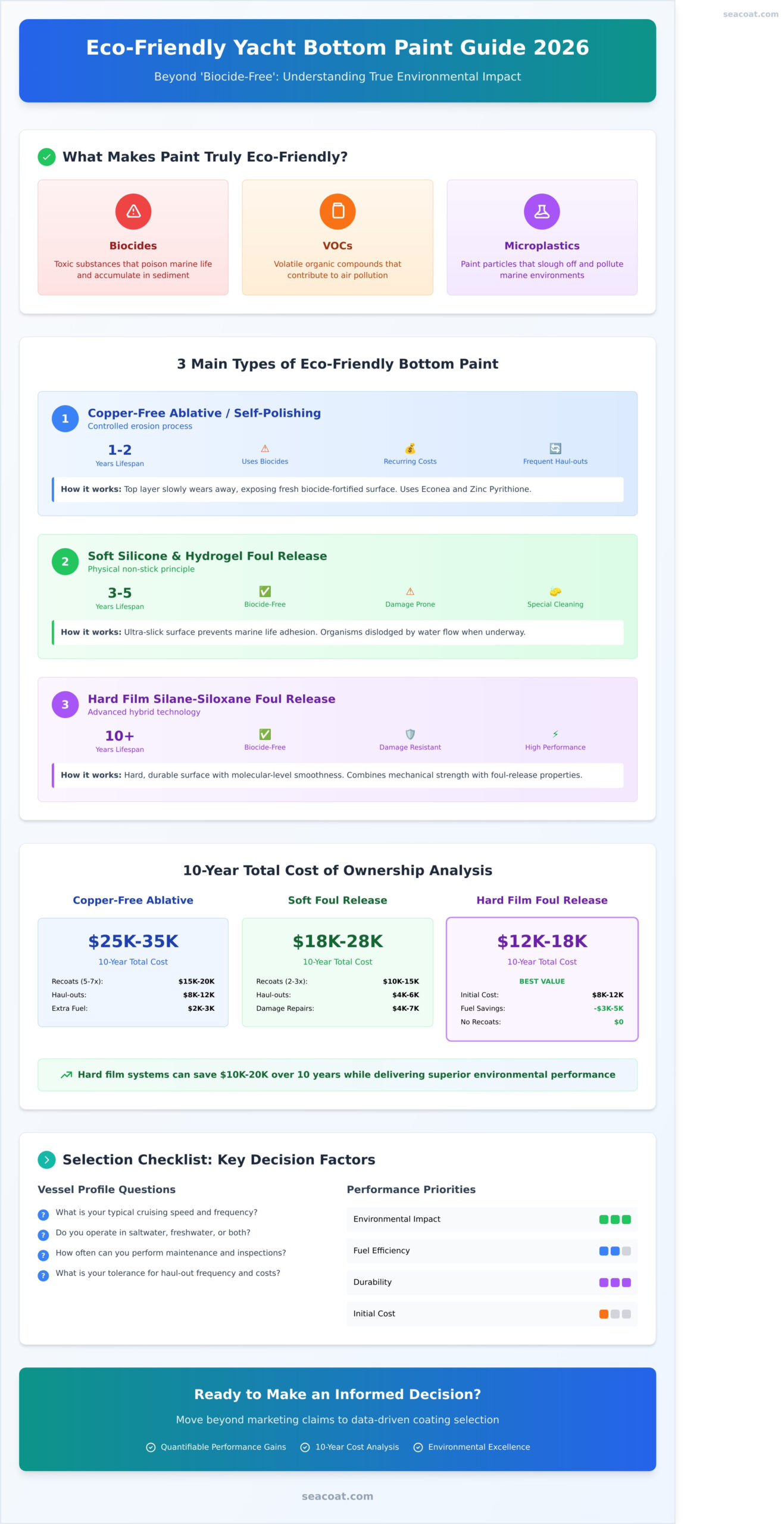
These coatings function through a controlled erosion process. As the vessel moves, the top layer of paint slowly wears away, or ablates, continuously exposing a fresh surface fortified with non-toxic biocides. The industry standard biocides in these formulas are Econea (tralopyril) and Zinc Pyrithione, which effectively deter fouling organisms without the harmful environmental persistence of heavy metals. The primary operational characteristic of this technology is its finite lifespan; the ablative process necessitates complete reapplication every one to two seasons, representing a recurring maintenance cost and haul-out requirement.
Category 2: Soft Silicone & Hydrogel Foul Release Coatings
Foul release coatings operate on a physical, rather than chemical, principle. Soft silicone and hydrogel systems create an extremely slick, low-surface-energy hull that prevents marine life from adhering firmly. Any organisms that manage a weak attachment are typically dislodged by the hydrodynamic forces generated when the vessel is underway. While this approach is completely biocide-free, its defining trait is a soft, pliant surface. This texture makes the coating highly susceptible to mechanical damage from debris, grounding, or even improper cleaning, demanding specialized, non-abrasive maintenance protocols.
Category 3: Hard Film Silane-Siloxane Foul Release Systems
Representing a significant advancement in foul release durability, hard film systems integrate silane-siloxane chemistry to create a robust, non-stick surface. This technology combines the low surface energy of silicone with a tough, cross-linked polymer structure that can withstand both mechanical abrasion and regular in-water cleaning. Instead of relying on biocides or a delicate outer layer, these coatings present a permanent, slick barrier. This type of innovative antifouling technology is engineered for extreme longevity, with a functional service life that can exceed ten years. This fundamentally alters a vessel’s maintenance schedule and total cost of ownership, shifting focus from frequent repainting to long-term asset protection and performance optimization.
Performance vs. Price: A 10-Year Cost of Ownership Analysis
The initial investment for an advanced, biocide-free foul release coating is demonstrably higher than that of traditional ablative paints. However, a price-per-gallon analysis is fundamentally flawed, as it overlooks the primary drivers of long-term expense: reapplication cycles, operational downtime, and fuel consumption. A Total Cost of Ownership (TCO) model provides a more accurate framework for evaluating the true lifetime cost of hull protection.
Durability and Reapplication Cycles
Conventional ablative paints require haul-outs and complete repainting every 1-2 years. Over a decade, this equates to 5-10 separate yard visits, each incurring significant costs for labor, materials, and vessel downtime. Furthermore, the constant layering of ablative paint leads to heavy buildup, eventually necessitating a costly and labor-intensive stripping process. In contrast, a single, properly applied hard foul release coating is engineered to perform for up to 10 years, eliminating the cycle of repetitive maintenance entirely.
Hydrodynamics and Fuel Efficiency
Ablative paints are designed to slough off, creating a microscopically rough surface that increases hydrodynamic drag. This friction directly translates to higher fuel consumption. An ultra-smooth, low-friction foul release surface, however, optimizes water flow across the hull. Independent studies and vessel data consistently show a 5-10% improvement in fuel efficiency. This sustained reduction in fuel burn represents a direct, ongoing return on the initial coating investment.
To illustrate the financial impact, consider this simplified 10-year TCO model for a hypothetical 45-foot yacht:
Scenario 1: Traditional Ablative Paint
- Initial Application Cost: $5,000
- Reapplications (4x over 10 years @ $4,500 each): $18,000
- Estimated Fuel Penalty (due to increased drag): +$6,000
- Estimated 10-Year TCO: $29,000
Scenario 2: Advanced Eco-Friendly Yacht Bottom Paint (Foul Release)
- Initial Application Cost: $12,000
- Reapplications: $0
- Periodic In-Water Cleaning (10x @ $300 each): $3,000
- Estimated Fuel Savings (5-10%): -$7,000
- Estimated 10-Year TCO: $8,000
The data is conclusive. The long-term economic and operational benefits-minimized downtime, eliminated repaint cycles, and significant fuel savings-far outweigh the initial expenditure. Investing in a premium, long-lasting eco-friendly yacht bottom paint is not a maintenance expense; it is a strategic decision that enhances asset value and operational efficiency for a decade or more.
Selection Checklist: How to Choose the Right Paint for Your Yacht
Selecting the optimal hull coating is a strategic decision that directly impacts your yacht’s operational efficiency, long-term costs, and environmental stewardship. This checklist translates complex technical specifications into a practical framework, empowering you to choose the right eco-friendly yacht bottom paint for your specific operational profile and performance objectives.
Step 1: Evaluate Your Boating Profile
Your vessel’s environment and usage patterns are the primary determinants of anti-fouling requirements. A precise assessment is the foundation of a successful coating strategy. Consider the following variables:
- Operating Waters: Do you primarily navigate in high-fouling tropical environments where bio-adhesion pressure is extreme, or in cooler, temperate zones with moderate growth?
- Vessel Activity: Is your yacht frequently underway, where water flow can activate the self-cleaning properties of a foul release coating, or does it sit idle for extended periods, requiring superior static foul resistance?
- Mission Profile: Are you a competitive racer demanding minimal hydrodynamic drag, a long-distance cruiser prioritizing multi-year reliability, or a weekender seeking simplified maintenance?
Step 2: Define Your Performance & Maintenance Priorities
Aligning your coating choice with your performance goals and maintenance tolerance is critical for achieving long-term value. Traditional ablative paints necessitate a recurring cycle of haul-outs and labor, whereas advanced hard coatings offer a fundamentally different ownership model.
- Performance vs. Passivity: Is your primary objective maximizing speed and fuel efficiency through a low-friction, hydrodynamic surface, or simply preventing hard growth?
- Maintenance Cycle: What is your tolerance for the annual haul-out, sanding, and reapplication cycle versus a single application designed for a 10-year service life?
- Economic Model: Is your decision driven by the lowest initial application cost, or by the superior long-term ROI that results from eliminating frequent repainting and mitigating fuel consumption?
Step 3: Consider Future Regulatory and Resale Value
A forward-thinking approach to hull coatings considers not only today’s performance but also tomorrow’s regulatory landscape and asset value. With environmental regulations on biocides becoming increasingly stringent worldwide, choosing a completely biocide-free, foul release system is a future-proof investment. This strategic choice mitigates the risk of mandated removal and re-coating down the line. Furthermore, a premium, long-life coating system documented in your vessel’s logbook becomes a significant asset, enhancing its resale value by demonstrating a commitment to advanced, low-maintenance, and globally compliant technology.
A thorough analysis of these factors will guide you toward a solution that offers both peak performance and peace of mind. To explore the economic and performance data of advanced foul release coatings, learn more about our technology.
The Seacoat Solution: The Apex of Hard Foul Release Technology
Throughout this guide, we have explored the complex requirements for an effective marine coating: durability, hydrodynamic performance, and genuine environmental stewardship. The logical conclusion of this journey leads to a technology that synthesizes these needs into a single, lasting solution. Seacoat SCT, LLC’s Sea-Speed V 10 X represents the pinnacle of hard foul release systems, engineered to move beyond the cycle of reapplication and environmental compromise.
Unmatched Durability: The Silane-Siloxane Hard Film Advantage
The core of the Sea-Speed system is its advanced silane-siloxane chemistry, which cross-links to form an exceptionally hard, non-porous surface. Unlike soft, pliant silicone coatings that are susceptible to abrasion and damage during routine cleaning or minor impacts, our hard film technology provides a robust, armor-like finish. This structural integrity is the foundation of its longevity, delivering an expected service life of 10 years or more with only minimal in-water cleaning required. This mitigates the operational downtime and material waste associated with frequent dry-docking and repainting.
Peak Performance and Proven ROI
A vessel’s efficiency is directly tied to the hydrodynamic properties of its hull. The ultra-smooth finish of Sea-Speed V 10 X significantly reduces frictional drag, a claim substantiated by case studies showing fuel consumption reductions of 8-12% and corresponding increases in speed. This performance enhancement translates into a compelling return on investment. While the initial application is a strategic capital expenditure, the total cost of ownership is dramatically lower than traditional antifouling paints due to the elimination of biennial repainting costs over its decade-long lifespan. Furthermore, as a zero VOC, non-toxic formulation, Sea-Speed is a genuinely sustainable eco-friendly yacht bottom paint that ensures compliance with the most stringent environmental regulations worldwide.
Is Sea-Speed Right for Your Vessel?
Optimizing a hull coating is a technical discipline that requires consideration of your vessel’s specific operational profile, substrate, and performance goals. We believe in providing solutions, not just products. To determine if this advanced coating is the correct strategic asset for your yacht, we recommend a direct consultation with our technical experts.
Take the final step in protecting your investment and the marine environment. Request a technical consultation to optimize your hull’s performance.
Optimizing Your Vessel: The Confluence of Performance and Sustainability
The selection of a hull coating has evolved from a routine maintenance task into a critical strategic decision impacting both profitability and environmental compliance. As this guide has detailed, the most effective solutions are defined not just by what they lack-namely, biocides and VOCs-but by the superior performance they deliver. A comprehensive 10-year cost of ownership analysis consistently reveals that longevity and optimized hydrodynamic efficiency are the true drivers of long-term value. Choosing the right eco-friendly yacht bottom paint therefore requires a sophisticated evaluation of your vessel’s operational profile against the advanced foul release technologies now available in the market.
The apex of this technology is a hard, in-water cleanable surface that provides a proven 10+ year service life while delivering documented fuel savings of 5-10%. This is performance without compromise-a solution that enhances vessel efficiency while protecting marine ecosystems. To determine how this advanced system can be calibrated to your specific hull and operating conditions, we invite you to request a technical consultation for your vessel.
Make the strategic investment in a future where operational excellence and marine stewardship sail together.
Frequently Asked Questions
Are eco-friendly bottom paints as effective as traditional copper paints?
High-performance foul release coatings are not only as effective but offer a superior, more durable solution. Unlike biocide-leaching copper paints that lose efficacy over time, foul release systems create a permanent, low-energy surface that marine growth cannot firmly attach to. This physical deterrence mechanism provides consistent performance throughout the coating’s entire service life, mitigating the environmental impact associated with traditional ablative paints while ensuring reliable protection for your vessel’s hull.
How long does a high-performance eco-friendly yacht paint last?
The operational lifespan of a premium eco-friendly coating is a key component of its value proposition. While traditional antifouling paints require reapplication every 1-3 years, a professionally applied hard foul release system like Seacoat is engineered to last for up to ten years. This exceptional durability significantly reduces haul-out frequency, maintenance labor, and material costs, delivering a superior long-term return on investment and minimizing the vessel’s operational downtime.
Can I apply a hard foul release coating like Seacoat over my old paint?
No, a hard foul release coating cannot be applied over existing bottom paint. The integrity and performance of the system are critically dependent on a direct bond with a properly prepared and primed substrate. To achieve the required surface profile and chemical adhesion, all previous layers of antifouling paint must be completely removed down to the gelcoat or barrier coat. This foundational step is essential for guaranteeing the coating’s ten-year performance and hydrodynamic efficiency.
How do you clean a yacht hull with a foul release coating?
Cleaning a hull with a foul release coating is a simple, non-abrasive process. Because organisms have a very tenuous grip on the slick surface, they are easily removed with soft tools like sponges, microfiber cloths, or a gentle pressure wash. For vessels in regular use, the motion of the water itself often provides sufficient cleaning action. This maintenance method avoids the harsh scrubbing that damages traditional paints and releases harmful biocides into the marine environment.
Is eco-friendly bottom paint significantly more expensive upfront?
While the initial material and application cost for an advanced eco-friendly yacht bottom paint can be higher than for traditional products, the total cost of ownership is substantially lower. Factoring in a ten-year service life eliminates the recurring costs of haul-outs, stripping, and reapplication every few seasons. When combined with documented fuel savings from reduced hull friction, the long-term economic benefit makes a high-performance foul release system the more financially sound investment.
What is the real difference between ‘foul release’ and ‘antifouling’?
The distinction lies in their fundamental mechanism of action. Traditional ‘antifouling’ is a chemical process that relies on biocides, like copper oxide, leaching into the water to poison and kill marine organisms. In contrast, ‘foul release’ is a physical, non-toxic technology. It creates an ultra-smooth, low-friction surface that prevents organisms from establishing a firm attachment, allowing them to be easily washed away by water flow or simple cleaning without harming the marine ecosystem.
Does Seacoat’s technology work in both high-fouling saltwater and freshwater?
Yes, the efficacy of our siloxane-based foul release technology is independent of water type. The system’s performance is based on creating a low-energy physical surface barrier, not a chemical reaction that varies with salinity or local biology. This makes it a universally effective solution for preventing biofouling in any marine environment, from tropical saltwater with aggressive growth to inland freshwater lakes, ensuring consistent hull protection and hydrodynamic performance globally.
Will a hard coating like Seacoat make my yacht faster?
Yes, a hard, smooth foul release coating measurably improves vessel performance. The extremely low surface roughness of the Seacoat system significantly reduces hydrodynamic drag compared to conventional bottom paints. This reduction in friction translates directly into either an increase in speed at a given power setting or a notable decrease in fuel consumption to maintain cruising speed. This makes the coating a strategic asset for optimizing both performance and operational efficiency.