
In an era defined by the dual pressures of stringent environmental regulations and unpredictable operational expenditures, the strategic selection of a vessel’s hull coating has transitioned from a maintenance line item to a pivotal factor in fleet viability. The immense challenge of navigating EEXI and CII mandates while mitigating volatile fuel costs places unprecedented focus on the hydrodynamic performance of every asset. Choosing the right commercial vessel coating systems is no longer just about corrosion protection; it is a critical, data-driven decision that directly impacts regulatory compliance, fuel efficiency, and long-term profitability.
This 2026 strategic guide is engineered to provide clarity in this high-stakes environment. We will dissect the technical and financial variables that determine a coating’s true value, moving beyond marketing claims to focus on performance metrics and lifecycle ROI. You will gain a comprehensive framework to evaluate, select, and implement a complete marine coating system that enhances vessel performance, extends dry-docking intervals, and secures your fleet’s competitive and compliant position for the decade ahead.
Key Takeaways
- Move beyond a topcoat-only mindset by understanding how each layer-primer, tie-coat, and functional topcoat-contributes to long-term vessel protection and performance.
- Distinguish between biocidal antifouling and non-toxic foul release mechanisms to select a technology that aligns with both performance goals and environmental regulations.
- Implement a 5-point evaluation framework to objectively assess commercial vessel coating systems, ensuring your selection is driven by critical KPIs like hydrodynamic performance and long-term ROI.
- Recognize how the success of any advanced coating is fundamentally linked to correct surface preparation, and learn the standards required for guaranteed adhesion and longevity.
Beyond Paint: Defining a Modern Commercial Coating System
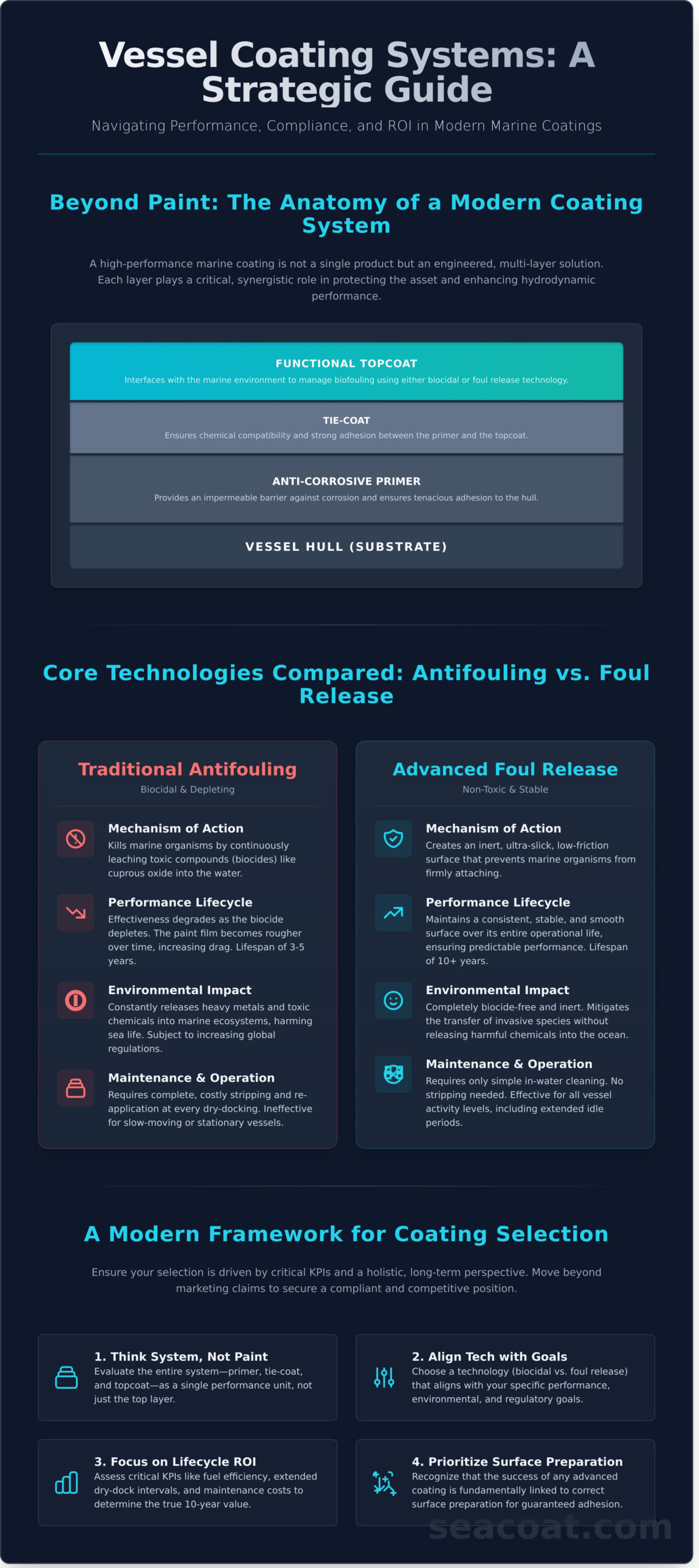
In modern maritime operations, viewing a vessel’s hull protection as mere “paint” is a fundamentally outdated perspective. A high-performance marine coating is not a single product but an engineered, multi-layer solution designed for a specific operational profile and environment. The strategic shift is clear: we are moving from treating coatings as a recurring maintenance liability to leveraging them as a critical performance-enhancing asset. The selection of advanced commercial vessel coating systems directly impacts key operational metrics, including fuel efficiency, speed sustainment, and emissions mitigation, turning the hull surface into a significant driver of profitability and regulatory compliance.
This integrated system works by assigning distinct, synergistic roles to each layer. From the substrate outwards, each component is engineered to ensure the longevity and hydrodynamic performance of the entire application. The result is a system that not only protects the capital asset but actively reduces operational expenditure over a ten-year cycle.
The Foundation: Primers and Anti-Corrosive Layers
The integrity of any coating system begins at the substrate. The primer layer serves a dual critical function: ensuring tenacious adhesion to the hull’s surface and providing an impermeable anti-corrosive barrier to prevent steel or aluminum degradation. High-solids epoxy primers are the industry standard, offering exceptional chemical and water resistance. Improper surface preparation or primer selection inevitably leads to systemic failure, including delamination and blistering, compromising the entire investment and forcing premature, costly dry-docking.
The Functional Topcoat: The Technology that Touches the Water
The outermost layer is the functional topcoat, the technology that directly interfaces with the marine environment to manage biofouling. This critical technology is broadly divided into two distinct categories. The first includes traditional biocide-based systems, where antifouling paint leaches chemical compounds to poison marine life. The second, more advanced category is biocide-free foul release technology, which creates an ultra-slick, low-energy surface that organisms cannot firmly adhere to, allowing them to be removed by the vessel’s own movement.
Core Technologies Compared: Antifouling vs. Foul Release Systems
The selection of an appropriate hull coating is a critical strategic decision in vessel management, directly influencing operational efficiency, environmental compliance, and long-term maintenance expenditures. At the highest level, the market for commercial vessel coating systems is defined by two fundamentally different philosophies for mitigating biofouling: traditional biocidal antifouling and advanced, biocide-free foul release. Understanding the core distinctions in their mechanism, lifecycle, and impact is essential for making an informed investment.
.comparison-table { width: 100%; overflow-x: auto; }
.comparison-table table { width: 100%; border-collapse: collapse; margin: 20px 0; font-family: sans-serif; }
.comparison-table th, .comparison-table td { border: 1px solid #dddddd; text-align: left; padding: 12px; }
.comparison-table th { background-color: #f2f2f2; font-weight: bold; }
.comparison-table tr:nth-child(even) { background-color: #f9f9f9; }
| Feature | Traditional Antifouling Systems | Advanced Foul Release Systems |
|---|---|---|
| Mechanism of Action | Biocidal: Actively kills marine organisms by leaching toxic compounds (e.g., cuprous oxide). | Non-toxic: Creates an inert, low-friction surface that prevents organisms from firmly adhering. |
| Performance Lifecycle | Degrades over time as the biocide depletes, leading to reduced effectiveness and increased roughness. | Maintains consistent performance and a stable, smooth surface over its entire operational life. |
| Environmental Impact | Continuous leaching of heavy metals and toxins into marine ecosystems. Subject to increasing regulation. | Biocide-free and inert. Mitigates the transfer of invasive species without releasing harmful chemicals. |
| Maintenance | Requires complete stripping and re-application every 3-5 years. Ineffective for stationary vessels. | Designed for a 10-year service life. Maintained through simple in-water cleaning. Effective at all speeds. |
Traditional Antifouling (Ablative and Hard)
Conventional antifouling paints operate on a biocidal principle, continuously releasing toxic agents like cuprous oxide to poison marine life attempting to attach to the hull. Ablative variants are designed to wear away, exposing fresh layers of biocide but simultaneously increasing surface roughness and hydrodynamic drag over time. This limited effective lifespan, coupled with growing regulatory pressure from bodies like the International Maritime Organization (IMO) to restrict harmful biocides, positions this technology as an increasingly unsustainable solution for modern fleets.
Advanced Foul Release (Silicone and Silane-Siloxane)
Foul release technology represents a paradigm shift from killing organisms to preventing their adhesion. These systems utilize low surface energy chemistry to create an ultra-smooth, non-stick surface. Organisms may settle but cannot form a strong bond, and are typically removed by the vessel’s own movement through water. The primary advantage is a consistently smooth hull, which optimizes hydrodynamic efficiency and significantly reduces fuel consumption. While early soft silicone systems were susceptible to mechanical damage, modern hard-film foul release coatings offer superior durability and abrasion resistance, providing a long-term strategic asset for vessel performance.
Evaluation Framework: 5 KPIs for Your Next Coating System
Selecting the optimal coating for a commercial fleet requires a strategic evaluation that extends far beyond the initial cost per gallon. A truly effective decision-making process is grounded in data-backed performance metrics that quantify long-term value and operational efficiency. To properly assess modern commercial vessel coating systems, we recommend a framework built on five key performance indicators (KPIs) that together reveal the true impact on your assets and bottom line.
- Hydrodynamic Performance & Fuel Savings: Evaluate the coating’s ability to create an ultra-smooth hull surface, thereby minimizing frictional drag. Quantify this through projected fuel consumption reduction, as even a minor percentage decrease yields substantial savings over the vessel’s operational life.
- Durability & Service Life: Assess the coating’s mechanical resilience and expected lifespan. A superior system should offer a ten-year performance cycle, significantly extending the interval between costly and disruptive dry-docking procedures.
- Regulatory Compliance: The system must ensure compliance with current and forthcoming environmental mandates, including IMO regulations on biocides and greenhouse gas emissions. This includes its direct contribution to achieving EEXI and CII targets.
- Environmental Impact: Beyond compliance, analyze the coating’s chemical composition. Prioritize biocide-free, non-toxic formulations with zero Volatile Organic Compounds (VOCs) to mitigate environmental harm and protect marine ecosystems.
- Total Cost of Ownership (TCO): A comprehensive financial analysis that factors in all associated costs and savings over the coating’s full service life, providing the most accurate measure of investment value.
Calculating Total Cost of Ownership (TCO)
A sophisticated TCO model moves beyond procurement price to provide a holistic financial picture. This calculation must integrate the initial application cost with the projected fuel savings from enhanced hydrodynamic efficiency and the significant cost avoidance achieved by reducing dry-docking frequency. A coating with a higher upfront investment often demonstrates a profoundly lower TCO when its long-term performance and maintenance mitigation benefits are accurately quantified, transforming it from an expense into a strategic asset.
Meeting EEXI and CII Regulations
In the current regulatory landscape, a low-friction hull coating is a proven and highly effective tool for improving a vessel’s energy efficiency. Advanced foul-release and hard film commercial vessel coating systems directly lower hull resistance, which in turn reduces the engine power required to maintain speed. This enhancement is critical for achieving and maintaining compliance with the Energy Efficiency Existing Ship Index (EEXI) and Carbon Intensity Indicator (CII). Learn more about what EEXI is and how coatings provide a pathway to compliance.
The Critical Role of Surface Preparation and Application
The performance of advanced commercial vessel coating systems is not determined by chemical formulation alone; it is fundamentally dependent on the precision of surface preparation and application. Even the most sophisticated hard film, foul-release coating will prematurely fail if the substrate is not meticulously prepared and the system applied under controlled conditions. This phase is not a preliminary step but the foundational pillar upon which the system’s 10+ year performance promise and hydrodynamic efficiency are built.
Success requires executing every stage within stringent operational parameters, including strict climate control. Monitoring dew point, relative humidity, and steel temperature is critical to prevent microscopic moisture from compromising the substrate, which can lead to catastrophic adhesion failure.
Achieving the Optimal Surface Profile
The bond between a coating and a steel hull is primarily mechanical. To achieve this, abrasive blasting is employed to remove all previous coatings, mill scale, and corrosion. This process creates a specific surface roughness, or “profile,” of microscopic peaks and valleys. This profile, specified to a globally recognized standard such as Sa 2.5 (Near-White Metal Blast Cleaning), provides the anchor for the primer to grip. The period between blasting and priming is a critical window; any contamination from atmospheric humidity or industrial fallout can compromise this bond, jeopardizing the entire system and its warranty compliance.
Quality Control and Inspection
Verifiable quality control is non-negotiable for realizing the long-term value of your investment. This is why independent, NACE or FROSIO certified inspectors are integral to any high-performance coating project. Acting as the vessel owner’s quality assurance representatives, they document and verify every critical stage of the process.
- Surface Profile Verification: Using specialized gauges to confirm the blasted surface meets the specified roughness for optimal mechanical adhesion.
- Climatic Condition Logging: Continuously monitoring temperature, humidity, and dew point to ensure they remain within the coating manufacturer’s strict application window.
- Dry Film Thickness (DFT) Checks: Systematically measuring each layer to ensure it is applied within the specified thickness range. Too little provides inadequate protection, while too much can lead to solvent entrapment and cracking.
- Adhesion Testing: Performing quantitative pull-off tests (e.g., ASTM D4541) to objectively measure the bond strength between the coating system and the hull.
This rigorous, documented oversight transforms a coating application from a standard maintenance task into a strategic asset installation. It is the essential mechanism that ensures the coating’s theoretical longevity and performance benefits are fully realized in the harsh marine environment.
This focus on precision and long-term asset value mirrors trends in other industrial sectors. For instance, in manufacturing and logistics, while some specialists provide complete automated systems, the underlying reliability often comes from quality parts. To that end, you can discover VidoAir for premium pneumatic components or look to system integrators like Choice Bagging Equipment for complete solutions.
The Seacoat Advantage: A Hard-Film Foul Release System
The evolution of marine coatings culminates in a system that addresses the core operational KPIs of the modern maritime industry: durability, hydrodynamic efficiency, and guaranteed environmental compliance. Seacoat SCT, LLC’s silane-siloxane foul release technology represents this apex, engineered to deliver sustained performance and a superior return on investment. Unlike traditional anti-fouling paints or soft silicone alternatives, our hard-film system provides a robust, non-toxic solution built for the demanding realities of commercial operations.
This technology is not a temporary barrier but a strategic asset. Our portfolio of case studies demonstrates a proven 10+ year service life with documented fuel savings between 8-15%. The exceptionally low surface energy of the coating prevents biofouling adhesion, while its durable, hard-film nature allows for proactive in-water cleaning without the risk of damage. This synergy of features makes it one of the most effective and economically sound commercial vessel coating systems available.
Engineered for Durability and Performance
The foundation of our system is its advanced silane-siloxane chemistry, which cross-links to form a highly durable, non-porous surface. This slick, robust finish is fundamentally different from soft silicone coatings that are prone to mechanical damage, delamination, and abrasion. Seacoat SCT, LLC’s resilience makes it the ideal specification for a wide range of vessels, from high-activity ferries and workboats to large tankers and container ships that demand long-term reliability. Learn more about The Science of Silane-Siloxane and its impact on vessel performance.
Specify a System for Your Fleet
Integrating Seacoat SCT, LLC technology into your fleet management strategy yields significant, measurable benefits across the vessel’s operational lifecycle. Our systems are engineered to optimize performance and reduce long-term expenditures.
- Lower Total Cost of Ownership (TCO): A 10+ year lifespan dramatically reduces the frequency and cost of dry-docking cycles.
- Guaranteed Compliance: Our biocide-free, zero-VOC formulation ensures adherence to the most stringent current and future environmental regulations.
- Enhanced Operational Efficiency: A consistently smooth, foul-free hull minimizes hydrodynamic drag, directly translating to lower fuel consumption and improved vessel speed.
Choosing the right coating is a critical decision. Contact our technical experts to engineer a coating system for your vessel’s operational profile.
Charting a Course for Long-Term Operational Excellence
The strategic selection of commercial vessel coating systems has fundamentally evolved from a maintenance line item to a critical component of fleet optimization. As this guide has detailed, modern systems are defined by their long-term performance metrics and their environmental profile, not just their initial application cost. The industry’s pivot toward non-toxic, durable technologies like hard-film foul release systems underscores a new operational paradigm-one where hydrodynamic efficiency and regulatory compliance are achieved in synergy.
SeaCoat’s Sea-Speed technology embodies this forward-thinking approach. With a proven 10+ year service life, documented fuel savings of 8-15%, and full compliance with global biocide regulations, it represents a definitive investment in your fleet’s future. To understand the precise financial and operational impact for your assets, we invite you to request a technical consultation to calculate the long-term ROI of a Sea-Speed system for your fleet.
Protecting your assets while enhancing performance is the cornerstone of modern maritime strategy. The right coating technology is not an expense; it is a competitive advantage.
Frequently Asked Questions About Commercial Vessel Coating Systems
What is the average lifespan of a commercial vessel coating system?
Traditional antifouling paints typically require replacement every 3-5 years. In contrast, advanced commercial vessel coating systems, particularly hard-film foul release technologies, are engineered for significantly longer service intervals. These systems are designed to deliver optimal performance for up to 10 years with proper maintenance and in-water cleaning protocols. This extended lifespan provides a substantial return on investment by minimizing dry-docking frequency and associated operational downtime, representing a strategic asset for long-term fleet management.
How much fuel can a modern foul release coating system actually save?
A modern foul release coating system can deliver verifiable fuel savings ranging from 4% to 8%, depending on vessel type, operational profile, and route. By creating an ultra-smooth, low-friction surface, these coatings mitigate the hydrodynamic drag caused by biofouling. This enhanced hull efficiency directly translates into reduced fuel consumption and, consequently, a significant reduction in CO2 emissions. The performance gains are measurable and provide a compelling economic and environmental case for adoption.
Is a foul release system harder to apply than traditional antifouling paint?
Yes, the application of a foul release system is a more technically demanding process than applying traditional antifouling paint. It requires stringent surface preparation to achieve the specified surface profile and cleanliness, as adhesion is critical to long-term performance. Application must occur in a controlled environment by certified applicators to manage film thickness and curing conditions precisely. This meticulous process ensures the coating’s integrity and hydrodynamic properties are fully realized for its entire service life.
How do hard-film foul release coatings handle mechanical damage or abrasion?
Hard-film foul release coatings, such as those based on silane-siloxane chemistry, exhibit excellent mechanical durability and abrasion resistance, far exceeding that of soft silicone alternatives. In the event of localized mechanical damage from impacts or grounding, these robust systems can typically be repaired. The damaged area can be prepared and recoated without requiring a full blast and reapplication of the entire system, preserving the vessel’s operational schedule and mitigating extensive maintenance costs.
What are the key differences between soft silicone and hard silane-siloxane foul release coatings?
The primary difference lies in their physical properties and mechanism. Soft silicone coatings are low-modulus, flexible films that release fouling as it grows through surface movement and water flow, but they are susceptible to mechanical damage. In contrast, hard silane-siloxane foul release coatings form a smooth, dense, non-stick surface with very low surface energy. Organisms have difficulty attaching firmly and are easily removed by water flow or gentle cleaning, offering superior durability and cleanability.
Can you apply a foul release system over an existing antifouling paint?
No, a foul release system cannot be applied over existing antifouling paint. The underlying antifouling coating is chemically incompatible and lacks the surface integrity required for proper adhesion of the foul release tie-coat and topcoat. To ensure performance and longevity, the old coating must be completely removed down to a sound, prepared substrate or primer system. This foundational step is non-negotiable for achieving the system’s specified ten-year performance cycle and adhesion guarantees.
What environmental regulations do non-toxic coating systems help meet?
Biocide-free coating systems are instrumental in helping fleets meet stringent environmental regulations. They ensure compliance with the IMO’s International Convention on the Control of Harmful Anti-fouling Systems (AFS Convention), which bans organotins and controls other biocides. Furthermore, they align with regional mandates such as the U.S. EPA’s Vessel General Permit (VGP) and EU Biocidal Products Regulation (BPR), which place strict limits on the discharge of harmful substances into marine ecosystems.