The most durable and efficient PPG bottom paint alternative available in 2026 isn’t another biocidal formulation, and it isn’t a soft silicone coating either. It’s a fundamentally different class of technology, one that treats hull maintenance not as a recurring consumable expense but as a permanent performance asset.
If you’re managing a commercial fleet, you already understand the compounding costs of this problem: fuel consumption climbs as frictional drag increases between dry-docking cycles, sacrificial coatings erode on a schedule that ignores your operational calendar, and in-water cleaning aggressive enough to restore performance often destroys the coating itself. Meanwhile, regulatory frameworks around vessel energy efficiency are tightening, and biocidal chemistries that were standard practice for decades are facing increasing scrutiny.
Hard-film silane-siloxane technology, developed and refined in commercial marine service since 2001, addresses each of these failure points through a single, coherent material science approach. This guide examines exactly how that technology works, why it outperforms both traditional PPG biocidal systems and conventional silicone foul release coatings on technical and economic grounds, and what operators need to evaluate before making the transition.
Key Takeaways
- Hard-film silane-siloxane technology represents a fundamentally different class of hull protection — one engineered for permanence rather than periodic replacement — making it the most technically rigorous ppg bottom paint alternative available to commercial operators in 2026.
- Unlike biocidal ablatives that erode on a fixed schedule, silane-siloxane coatings form a covalent bond with the substrate, meaning performance does not degrade between dry-docking cycles the way sacrificial systems do.
- Hull smoothness has direct regulatory implications: this guide explains how a hard-film foul release system affects both EEXI compliance and CII ratings, two metrics that are increasingly central to commercial fleet management.
- Durability is where conventional silicone foul release coatings fail in real-world service — and where hard-film technology holds a measurable advantage in Shore D hardness and impact resistance that operators need to understand before specifying any coating system.
- Transitioning from an existing PPG primer system does not require a full strip-back: this article details how Sea-Speed V 10 X Ultra can be applied over compatible existing substrates using Seapoxy 73, reducing conversion costs significantly.
Why Vessel Owners are Seeking PPG Bottom Paint Alternatives in 2026
The commercial marine coatings market has operated on a familiar logic for decades: apply a biocidal paint, watch it erode, reapply. PPG’s portfolio, which evolved from its SigmaCoatings acquisition into products like SigmaGlide, represents the industry’s most sophisticated attempt to refine that cycle rather than break it. But refinement has limits, and in 2026, those limits are becoming operationally and regulatorily expensive in ways that are pushing fleet managers to evaluate every credible ppg bottom paint alternative with genuine urgency.
The pressure is coming from three directions simultaneously: tightening international restrictions on biocidal chemistries, the inherent mechanical fragility of soft silicone foul release systems, and a growing recognition that the “maintenance cycle” model of hull protection is itself the problem, not simply a feature of the category.
The Limits of Traditional Biocidal Antifouling
Copper-based antifouling paints function through a straightforward but self-defeating mechanism: the coating leaches a toxic boundary layer that prevents biological settlement, but as that layer depletes, both the protective effect and the hull’s hydrodynamic smoothness degrade in parallel. The coating isn’t failing at the end of its service life; it’s failing continuously from the moment it enters the water. Each day between dry-docking cycles, frictional drag increases as the surface profile roughens, and fuel consumption rises accordingly. For a vessel operating on thin margins, that’s not a theoretical concern.
The regulatory dimension compounds this. Tributyltin was the first major casualty of international biocide restrictions, but it hasn’t been the last. Specific copper compound formulations and co-biocides including certain isothiazolone compounds face active scrutiny under frameworks governing vessel operations in sensitive marine environments, with restrictions varying across jurisdictions in ways that directly affect global trade route compliance. A coating specification that clears port in one region may create a compliance liability in another.
The Fragility of Soft Silicone Foul Release
PPG SigmaGlide and comparable soft silicone systems represent a genuine conceptual advance over biocidal antifouling: rather than killing fouling organisms, they create a low surface-energy film that prevents adhesion. The chemistry is sound. The mechanical durability is not.
Soft silicone films are precisely that: soft. Shore A hardness ratings in this category mean the coating is vulnerable to impact, abrasion, and the routine mechanical contact that commercial vessels experience in port operations and shallow-water transits. The critical failure point, however, is cleaning. When barnacle settlement does occur, as it will during slow-steaming periods or extended port stays, removal requires physical intervention. Soft silicone films routinely tear during this process, creating a situation where the only cleaning method aggressive enough to restore hull performance also destroys the coating that makes that performance possible. Underwater repair of a soft silicone film is technically demanding and costly, and it rarely restores the original surface integrity.
For commercial fleet operators, this isn’t an edge case. It’s a predictable failure mode built into the product category. Identifying a viable ppg bottom paint alternative means finding a system that resolves both the chemical dependency of biocidal antifouling and the mechanical vulnerability of conventional silicone foul release, not simply trading one set of limitations for another.
The Technical Shift: Silane-Siloxane Chemistry vs. Biocidal Mechanisms
Silane-siloxane is a hard-film, non-leaching polymer matrix that forms a permanent covalent bond with the substrate rather than sitting on top of it as a sacrificial layer. That single distinction separates it from every biocidal antifouling system on the market, and understanding the molecular basis of that distinction is essential for any fleet operator evaluating a credible ppg bottom paint alternative.
At the molecular level, silane-siloxane chemistry works through a condensation reaction between silanol groups and the hydroxyl groups present on the substrate surface. The result is a Si-O-Si backbone, a siloxane linkage, that is chemically integrated with the hull material rather than mechanically adhered to it. This isn’t a coating that bonds; it’s a coating that becomes part of the surface. The polymer matrix itself is inherently non-polar, which means it presents an extremely low surface energy to anything attempting to adhere to it, biological or otherwise.
Biocidal systems operate through an entirely different logic: they kill fouling organisms through chemical toxicity. Foul release systems prevent adhesion through surface physics. These are not variations on the same theme. They are categorically different mechanisms, and that difference has direct consequences for performance, durability, and regulatory standing.
Because silane-siloxane doesn’t function by depleting a biocidal reservoir, there’s nothing to exhaust. The surface energy that makes it non-adhesive is a property of the polymer matrix itself, not a consumable boundary layer. This is why the technology doesn’t “wear off” the way PPG ablatives do. The performance envelope doesn’t shrink between dry-docking cycles; it remains stable for service windows measured in years, not months.
Hydrodynamic Efficiency and Frictional Drag
Surface energy, measured in millinewtons per meter, is the primary determinant of how easily fouling organisms can establish adhesion to a hull. Lower surface energy means lower adhesion force, which means less biological settlement and, critically, a smoother hydrodynamic profile maintained over time. Hard-film silane-siloxane coatings achieve surface energy values that preserve laminar flow characteristics across extended service windows, something that biocidal systems cannot replicate because their surface profile degrades continuously as the coating erodes. Sea-Speed V 10 X Ultra is engineered specifically to maintain this low-energy surface over a 10-plus year service life, a performance characteristic that directly affects fuel consumption calculations across an entire fleet cycle.
Non-Toxic Compliance for Global Operations
Zero biocides and zero VOC emissions aren’t marketing positions. They’re the direct chemical consequence of how silane-siloxane works. Because fouling prevention is achieved physically rather than chemically, there’s no toxic boundary layer to leach into the water column, which eliminates the “toxic plume” that biocidal systems generate during in-water cleaning operations. That matters for port compliance in sensitive marine environments and for operators managing vessels across multiple regulatory jurisdictions simultaneously. The broader implications of this shift are examined in detail in our analysis of environmental marine coatings and the 2026 regulatory transition. For fleet managers building a long-term coating specification, this compliance profile isn’t a secondary benefit; it’s a core operational asset.
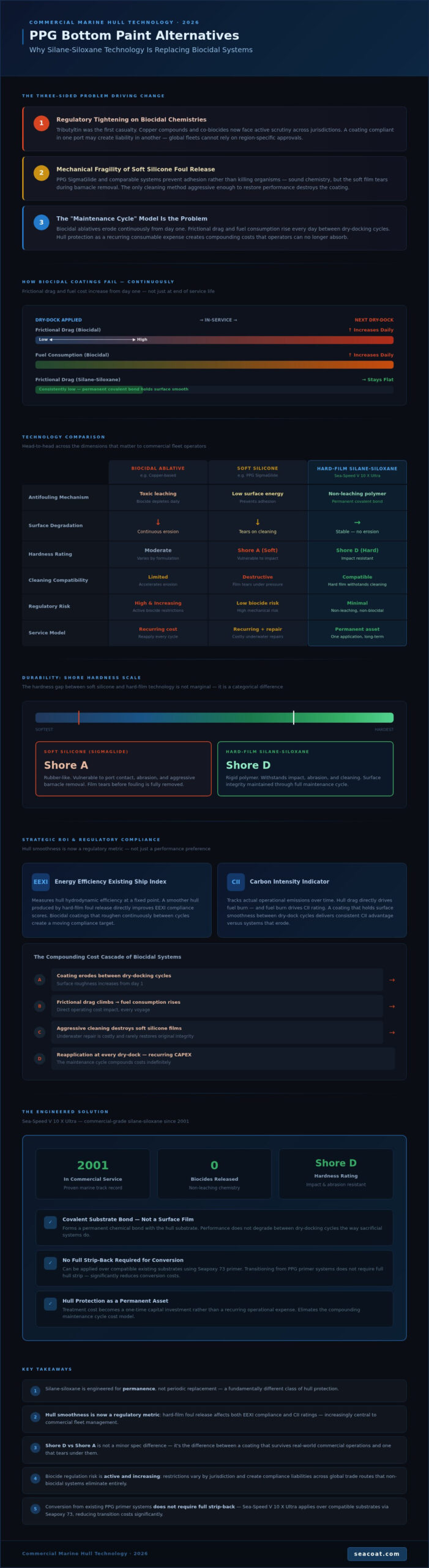
Durability Benchmarks: Hard-Film vs. PPG SigmaGlide Silicone
Performance on paper and performance in service are two different things. PPG SigmaGlide’s foul release chemistry is technically sound; its mechanical durability profile is not. Understanding where that gap opens, and how hard-film silane-siloxane technology closes it, is central to evaluating any credible ppg bottom paint alternative for commercial service.
The most direct comparison is hardness. Soft silicone foul release coatings are measured on the Shore A scale, the same scale used for rubber and flexible elastomers. Hard-film silane-siloxane coatings like Sea-Speed V 10 X Ultra are measured on the Shore D scale, which applies to rigid polymers and engineering plastics. These aren’t adjacent points on a single continuum; they’re different scales for categorically different materials. A Shore D rating indicates a coating that resists indentation, impact, and abrasion at a fundamentally different order of magnitude than any Shore A-rated silicone film.
That hardness differential has direct operational consequences. Commercial hulls encounter debris, fender contact, dock lines, and bottom contact in shallow-water transits as routine events, not exceptional ones. A soft silicone film absorbs these contacts by deforming, and deformation at the microscopic level means surface energy disruption, adhesion point creation, and the beginning of delamination. A hard-film coating deflects the same contact without permanent surface change.
Mechanical Resistance in Harsh Environments
High-traffic port operations and shallow-water transits are where soft silicone systems accumulate damage that isn’t always visible until the next dry-docking inspection reveals widespread substrate exposure. For ice-class vessels, the comparison isn’t even close: soft silicone films have no credible service record in ice-contact conditions, while hard-film silane-siloxane coatings, bonded covalently to the substrate rather than sitting on top of it, maintain integrity under the kind of abrasive loading that would strip a conventional foul release system entirely. Commercial fleet operators who have run Sea-Speed V 10 X Ultra across five-year operational cycles in demanding coastal and port environments report coating integrity that soft silicone systems simply don’t achieve past the 18-to-24-month mark.
The Hidden Costs of Silicone Maintenance
The cleaning problem is where the economics of soft silicone break down most visibly. Maintaining a soft silicone foul release coating in service requires dedicated diver teams using ultra-soft brushes on a frequent schedule, because any tool aggressive enough to remove established fouling is also aggressive enough to tear the film. That constraint doesn’t disappear; it compounds. Each cleaning event carries delamination risk, and a nicked or scratched soft silicone film can’t be spot-repaired underwater without compromising surface energy uniformity across the repair boundary.
The cumulative cost of this maintenance model, factoring in diver time, specialized equipment, and the accelerating recoating schedule as the film degrades, routinely exceeds the upfront cost differential between soft silicone and hard-film systems well before the five-year mark. Sea-Speed V 10 X Ultra’s Shore D hardness allows for conventional brush cleaning without coating loss, eliminating the “gentle cleaning” constraint entirely and extending the service window to ten-plus years without recoating. For fleet managers calculating total cost of ownership rather than line-item coating cost, that’s not a marginal advantage. It’s a structural one.
Service life expectancy tells the same story in aggregate: soft silicone systems in commercial service typically require full recoating on a three-to-five-year cycle under optimal conditions, and considerably sooner in demanding operational profiles. Hard-film silane-siloxane coatings, given the covalent substrate bond that previous sections of this guide have detailed, are engineered for a ten-to-fifteen-year service window. That’s not a marketing claim. It’s a direct consequence of how the polymer matrix integrates with the hull rather than sitting on top of it.
Strategic ROI: Fuel Efficiency, EEXI, and Maintenance Cycles
Hull coatings and regulatory compliance have historically occupied separate conversations in fleet management. That separation is no longer operationally viable. The IMO’s Energy Efficiency Existing Ship Index (EEXI) and Carbon Intensity Indicator (CII) frameworks have made hull hydrodynamic performance a direct input to a vessel’s regulatory standing, which means coating specification decisions now carry consequences that extend well beyond the dry-dock budget line.
Decarbonization Through Hull Optimization
The attained EEXI of an existing vessel is calculated from its technical energy efficiency at a defined reference speed. What that calculation doesn’t always make visible is how significantly biofouling degrades that figure in service. A hull operating with even moderate fouling accumulation between dry-docking cycles carries measurably higher frictional resistance than its EEXI baseline assumes, which means the vessel’s real-world carbon intensity diverges upward from its rated value continuously across the operational cycle. For older vessels already operating close to their EEXI compliance thresholds, that divergence isn’t an abstraction; it’s a compliance liability that compounds with every month of biofouling accumulation.
Hard-film silane-siloxane coatings address this directly. Because the surface energy profile of the polymer matrix doesn’t degrade between dry-docking intervals the way a biocidal ablative does, the hydrodynamic baseline established at application is the baseline the vessel operates against throughout the service window. That stability has a direct bearing on CII ratings, which are assessed annually and penalize vessels whose carbon intensity rises relative to their reference line. A coating system that maintains hull smoothness across a multi-year service window isn’t just a maintenance asset; it’s a CII management tool. The full performance and science context for this relationship is developed in our definitive guide to boat hull paint performance and ROI.
Fuel savings in this category are real and operationally significant. Industry data consistently points to frictional drag as the dominant variable in propulsive fuel consumption, with biofouling-related drag increases responsible for measurable fuel penalties that accumulate across a vessel’s operational calendar. Operators transitioning from standard biocidal antifouling to hard-film foul release technology have reported fuel consumption reductions in the range of 4 to 12 percent, depending on vessel type, operational profile, and the condition of the hull at conversion. For any commercial fleet manager evaluating a credible ppg bottom paint alternative, those figures need to be run against actual fleet fuel spend to understand the annual value at stake.
Life Cycle Costing (LCC) Analysis
Initial application cost is the wrong metric for comparing coating systems. The relevant figure is ten-year total cost of ownership, and that calculation looks structurally different for hard-film silane-siloxane versus conventional biocidal or soft silicone systems.
A standard biocidal antifouling specification typically requires full recoating on a two-to-three-year dry-docking cycle, with associated haul-out costs, surface preparation, and application labor recurring on that schedule. Soft silicone systems extend that interval modestly but introduce the cleaning cost burden detailed in previous sections. A hard-film system applied over a compatible existing substrate using a product like Seapoxy 73 as the interface layer carries a higher upfront material cost but eliminates recoating events across a ten-plus-year service window. When dry-docking costs, cleaning frequency, fuel penalties from hull degradation, and regulatory compliance risk are all factored in, the crossover point where a premium hard-film system has paid for itself typically arrives well before the five-year mark for vessels with meaningful annual fuel spend.
The compounding factor is the fuel savings trajectory. Unlike a one-time cost avoidance, the fuel efficiency benefit of a maintained, smooth hard-film hull surface accumulates annually across the entire service life. For fleet operators managing multiple vessels, that trajectory makes the LCC case for hard-film technology not just competitive with conventional systems, but structurally superior. Evaluating ppg bottom paint alternatives on initial cost alone means leaving that compounded value entirely out of the analysis.
To understand how Sea-Speed V 10 X Ultra fits your fleet’s specific operational profile and cost structure, speak with the Seacoat SCT team about a fleet-level ROI assessment.
Sea-Speed V 10 X Ultra: The Engineered Alternative to PPG
Everything discussed in this guide converges on a single practical question: which product actually delivers the hard-film silane-siloxane performance that makes a credible ppg bottom paint alternative viable for commercial, military, and pleasure craft operators? Sea-Speed V 10 X Ultra is that product. It’s not a reformulated antifouling or a harder variant of conventional silicone foul release. It’s a purpose-engineered silane-siloxane system built around the covalent bonding chemistry, Shore D hardness profile, and ten-plus-year service window that the preceding sections of this guide have established as the technical standard worth meeting.
The coating has been in active commercial marine service since 2001, a deployment record that provides something no laboratory specification sheet can: real-world validation across diverse vessel types, operational profiles, and environmental conditions. That history matters when you’re specifying a coating system intended to outlast multiple dry-docking cycles.
The Sea-Speed Product Ecosystem
Sea-Speed V 10 X Ultra isn’t a standalone product; it’s the core of a coordinated coating system designed to address the full range of hull substrate and operational requirements that commercial operators actually encounter. The product range includes:
- Sea-Speed V 10 X Ultra: The primary hard-film foul release coating for commercial, naval, and workboat applications, engineered for the Shore D hardness and surface energy stability detailed throughout this guide.
- Sea-Speed V 10 X Ultra Clear: A transparent formulation developed for racing and performance applications where hydrodynamic smoothness is the primary specification driver and coating visibility is a secondary concern.
- Armor-Sil R/G: A specialized protective formulation designed for applications requiring enhanced resistance in high-abrasion or impact-intensive service environments, including areas of a hull that experience concentrated mechanical loading.
- Seapoxy 73: The interface layer that makes conversion from existing primer systems, including PPG primers, technically viable without a full strip-back. Seapoxy 73 establishes the adhesion foundation that allows Sea-Speed V 10 X Ultra to achieve its covalent bond to the substrate through a compatible existing coating system, which directly reduces conversion costs for fleet operators.
Substrate compatibility spans aluminum, steel, and fiberglass hulls. The specific preparation protocol and Seapoxy 73 application parameters vary by substrate type, and getting those details right is the foundation of the service life the system is engineered to deliver.
Transitioning Your Fleet to Hard-Film Technology
Surface preparation is where a ten-year coating is either built or undermined. The conversion process from an existing PPG biocidal or primer system to Sea-Speed V 10 X Ultra follows a defined sequence: substrate assessment, mechanical preparation to the specified surface profile, Seapoxy 73 application as the bonding interface, and Sea-Speed V 10 X Ultra topcoat application within the specified recoat window. Each step has technical tolerances that determine whether the covalent bond forms correctly, and those tolerances aren’t negotiable. A coating that’s engineered for a decade of service requires a preparation standard that matches that ambition.
For fleet managers evaluating this transition, the right starting point is a technical assessment calibrated to your specific vessels, operational profiles, and existing substrate conditions. To get fleet-specific technical specifications and a structured conversion assessment, contact the Seacoat SCT team directly. The conversation starts with your hull, not a generic product brochure, which is precisely the difference between a ppg bottom paint alternative that performs in service and one that looks credible only on paper.
The Case for Hard-Film Technology Is Built on Evidence, Not Promises
Evaluating a credible ppg bottom paint alternative means holding every candidate system to the same standard: does it resolve the underlying failure modes of biocidal antifouling, or does it simply trade one set of limitations for another? The evidence developed throughout this guide points consistently in one direction. Silane-siloxane technology, proven in commercial service since 2001, addresses the mechanical fragility of soft silicone foul release, the regulatory exposure of biocidal chemistry, and the compounding fuel penalties of hull degradation through a single, coherent material science approach.
Two points deserve emphasis as you move from evaluation to specification. Hard-film durability means aggressive mechanical cleaning is viable without coating loss, which eliminates the maintenance constraint that quietly undermines soft silicone economics. And because surface energy stability is a property of the polymer matrix itself, the hydrodynamic performance your vessel achieves at application is the performance it maintains across the service window, which has direct implications for EEXI and CII compliance.
The next step is a technical assessment calibrated to your fleet. Upgrade your vessel’s performance with Sea-Speed V 10 X Ultra and speak with the Seacoat SCT team about what a conversion looks like for your specific hull, operational profile, and compliance requirements.
Frequently Asked Questions About PPG Bottom Paint Alternatives
Is Sea-Speed V 10 X Ultra compatible with existing PPG primers?
Yes. Sea-Speed V 10 X Ultra can be applied over compatible existing substrates, including PPG primer systems, using Seapoxy 73 as the bonding interface layer. This means a full strip-back isn’t required in most conversion scenarios, which directly reduces dry-dock time and labor costs. The Seapoxy 73 application parameters vary depending on the existing substrate condition, so a technical assessment of your specific hull is the correct starting point before specifying the conversion sequence.
How does hard-film foul release differ from PPG SigmaGlide silicone?
The core difference is mechanical hardness. PPG SigmaGlide is a soft silicone film rated on the Shore A scale, making it vulnerable to impact, abrasion, and the physical contact that commercial hulls experience routinely. Sea-Speed V 10 X Ultra is rated on the Shore D scale, the scale used for rigid engineering polymers. Both systems use surface physics rather than biocides to prevent fouling adhesion, but only the hard-film variant maintains coating integrity under the mechanical loading and cleaning demands of real-world commercial service.
Can hard-film bottom paint be cleaned underwater without damaging the coating?
Yes, and this is one of the most operationally significant differences between hard-film silane-siloxane and soft silicone systems. Sea-Speed V 10 X Ultra’s Shore D hardness means conventional brush cleaning tools won’t damage the coating surface, so dive teams aren’t restricted to ultra-soft implements that can only address light fouling. Established fouling can be removed without the delamination risk that makes in-water cleaning of soft silicone films so operationally constrained and economically costly.
What are the fuel savings benefits of switching to a silane-siloxane coating?
Operators transitioning from standard biocidal antifouling to hard-film foul release technology have reported fuel consumption reductions in the range of 4 to 12 percent, depending on vessel type, operational profile, and hull condition at conversion. The mechanism is straightforward: because the surface energy profile of the silane-siloxane polymer matrix doesn’t degrade between dry-docking intervals, the hydrodynamic baseline established at application is maintained across the service window rather than deteriorating continuously the way an ablative coating does.
How does Sea-Speed help with EEXI and CII regulatory compliance in 2026?
A vessel’s real-world carbon intensity diverges upward from its rated EEXI baseline as biofouling accumulates between dry-docking cycles. Because Sea-Speed V 10 X Ultra maintains surface energy stability across a multi-year service window, the hull’s hydrodynamic performance doesn’t drift the way it does under a biocidal ablative specification. That stability directly supports CII ratings, which are assessed annually. For vessels already operating close to their EEXI compliance thresholds, a coating that holds its performance baseline isn’t a secondary benefit; it’s a compliance management tool.
Does a biocide-free coating really work in high-fouling tropical waters?
It does, but the mechanism needs to be understood clearly. Silane-siloxane foul release doesn’t kill fouling organisms; it prevents them from achieving meaningful adhesion through low surface energy physics. In high-fouling tropical environments, this means that organisms which do settle during slow-steaming periods or extended port stays are held only weakly to the surface and can be removed through normal vessel operation or routine cleaning. The coating’s effectiveness in these conditions is a function of surface energy maintenance, not biocidal depletion, so it doesn’t diminish the way a copper-based system does in warm, biologically active water.
What is the expected service life of a hard-film siloxane coating compared to ablative paint?
Sea-Speed V 10 X Ultra is engineered for a service window of ten or more years. Standard biocidal ablative systems in commercial service typically require full recoating on a two-to-three-year dry-docking cycle, with soft silicone foul release systems extending that interval modestly but introducing cleaning and delamination costs that erode the economic case. The extended service life of hard-film technology is a direct consequence of the covalent Si-O-Si bond it forms with the substrate; the coating doesn’t erode or deplete because its performance mechanism isn’t consumable.
Is Sea-Speed suitable for both aluminum and fiberglass hulls?
Yes. Sea-Speed V 10 X Ultra is compatible with aluminum, steel, and fiberglass substrates. The surface preparation protocol and Seapoxy 73 application parameters differ by substrate type, and getting those specifications right is foundational to achieving the service life the system is engineered to deliver. Operators evaluating this ppg bottom paint alternative for a mixed fleet should request a substrate-specific technical assessment rather than applying a single preparation protocol across different hull materials.