Most aluminum hull failures aren’t caused by the water, but by the very paint intended to protect them. Understanding how to prep aluminum boat for bottom paint is a technical necessity because aluminum is a highly reactive metal. When you introduce copper-based biocides to an aluminum surface, you aren’t just painting; you’re essentially building a battery that accelerates hull degradation. It’s frustrating to see a professional coating peel or fail due to poor adhesion or improper chemical etching. You want a solution that respects the material science of your vessel while meeting modern environmental regulations like the 2026 restrictions on toxic antifouling agents.
This guide provides a scientifically grounded approach to mastering aluminum hull preparation, ensuring maximum coating adhesion and long-term protection against corrosion. We’ll examine the critical sequence of mechanical abrasion, chemical cleaning, and the application of specialized primers like Seapoxy 73 to create a permanent, low-drag finish. By following these evidence-based steps, you can achieve extended service intervals and superior operational efficiency for your maritime assets. This methodical approach transforms a standard maintenance task into a strategic asset management protocol.
Key Takeaways
- Identify the specific material risks of aluminum, including why copper-based systems act as a catalyst for galvanic corrosion and rapid hull degradation.
- Master the mechanical cleaning and de-greasing protocols essential for understanding how to prep aluminum boat for bottom paint while ensuring a contaminant-free surface.
- Learn to neutralize the microscopic oxide layer through chemical etching to create the chemically active profile required for superior coating adhesion.
- Implement a high-build barrier strategy using Seapoxy 73 to isolate the aluminum hull from environmental stressors and prevent coating failure.
- Understand the operational advantages of hard-film foul release technology, which offers reduced frictional drag and extended service intervals compared to traditional soft coatings.
The Unique Challenges of Preparing Aluminum Hulls
Aluminum is a reactive substrate. Unlike fiberglass or carbon steel, it possesses a unique electrochemical profile that dictates how it interacts with coatings and the marine environment. The primary hurdle in learning how to prep aluminum boat for bottom paint is managing the metal’s inherent tendency to oxidize. While this oxide layer provides a natural barrier against atmospheric corrosion, it’s a poor foundation for most paints. It’s loosely bound at a microscopic level, meaning any coating applied directly to it’s likely to delaminate as the oxide layer shifts or thickens over time.
To achieve a successful application, one must understand that aluminum preparation is a race against chemistry. The moment a surface is cleaned or sanded, the oxidation process begins again. This requires a workflow where cleaning, etching, and priming occur in a tightly controlled sequence. The goal isn’t just a clean surface, but a stable, high-energy substrate that can support a long-term protective system. By mastering these variables, operators can transition from temporary maintenance cycles to permanent foul release solutions that enhance vessel performance and protect the underlying metal from environmental degradation.
Galvanic Corrosion and Substrate Integrity
The most significant threat to an aluminum hull is galvanic corrosion, which occurs when dissimilar metals like copper and aluminum meet in an electrolyte like seawater. Because aluminum is highly anodic, it’ll sacrifice itself to more noble metals, leading to severe pitting and structural failure. Understanding Aluminum alloy properties clarifies why copper-based antifouling is fundamentally incompatible with these vessels. Modern industry standards favor non-toxic, copper-free systems like Sea-Speed V 10 X Ultra to preserve hull integrity and ensure regulatory compliance.
The Science of Adhesion on Non-Ferrous Metals
Adhesion on non-ferrous metals relies on surface energy and mechanical interlocking. Raw aluminum often repels liquid coatings, causing “beading” that prevents a uniform film. A mechanical bond in the context of aluminum hull preparation refers to the physical interlocking of a coating within the microscopic peaks and valleys created by controlled abrasion. Without this texture and the removal of surface contaminants, the coating’s bond remains superficial and prone to failure under hydraulic pressure. Learning how to prep aluminum boat for bottom paint ensures these technical requirements are met for maximum longevity.
Mechanical Preparation: Cleaning and Surface Abrasion
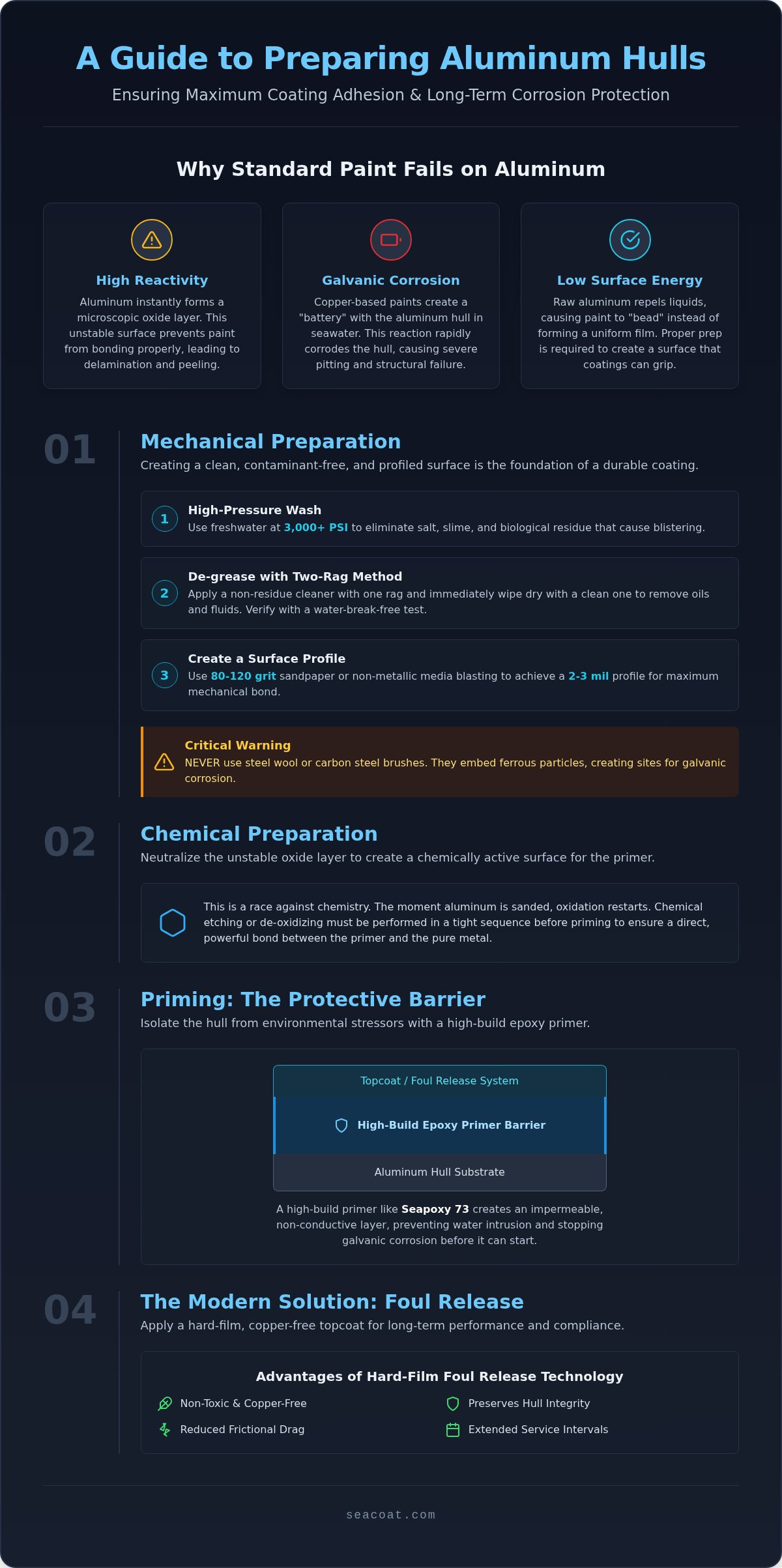
Mechanical preparation is the foundation of any coating system’s return on investment. It starts with high-pressure freshwater washing, typically at 3,000 PSI or higher, to eliminate salt crystals and biological residue. Even microscopic salt trapped under a new coating will draw moisture through the film via osmosis, causing blistering and premature delamination. Once the hull is dry, the focus shifts to removing chemical barriers that are often invisible to the naked eye. Mastering how to prep aluminum boat for bottom paint begins with this rigorous mechanical protocol to ensure the substrate is truly “bare” before chemical intervention.
De-greasing and Contaminant Removal
Fuels, hydraulic fluids, and even skin oils disrupt the molecular bond of the primer. The “two-rag” method is the industrial standard for ensuring these contaminants are removed rather than redistributed. Technicians apply a marine-grade, non-residue cleaner with one cloth and immediately wipe it away with a second, clean cloth before the solvent can evaporate. This process is repeated until the surface passes a water-break-free test. If water sheets off the metal uniformly without “beading,” the surface is chemically ready for the profiling stage. Identifying these invisible contaminants early prevents the catastrophic adhesion failures that plague less methodical applications.
Sanding and Profiling for Maximum Bond
Achieving a 2-3 mil surface profile is non-negotiable for long-term coating durability. For aluminum hulls, this typically requires 80 to 120 grit sandpaper used with a random orbital sander. On commercial-scale projects or heavy industrial vessels, media blasting with non-metallic abrasives like crushed glass or garnet is preferred to ensure a uniform, high-energy surface. It’s vital to avoid steel wool or carbon steel brushes; these tools can embed ferrous particles into the aluminum, which triggers the galvanic corrosion discussed in the previous section.
Safety is a primary concern during this phase. Aluminum dust is not only a respiratory hazard but can be highly combustible in concentrated amounts. Operators should use vacuum-integrated sanders and appropriate PPE to mitigate these environmental and health risks. This methodical abrasion creates the microscopic “teeth” necessary for the primer to achieve a permanent mechanical bond.
The most critical factor in how to prep aluminum boat for bottom paint is the timing between sanding and the next phase. Aluminum begins to re-oxidize within minutes of exposure to oxygen. To ensure maximum adhesion, the cleaning and profiling must be followed immediately by the priming stage. For those seeking a complete, high-performance system, integrating a specialized foul release primer immediately after profiling creates the necessary barrier to lock out oxygen and moisture. This tight window of operation is what separates a standard maintenance task from a professional-grade industrial asset protection strategy.
Chemical Preparation: De-oxidizing and Etching
Mechanical profiling creates the physical “teeth” for adhesion, but it doesn’t address the chemical reactivity of the substrate. Aluminum begins to oxidize the instant it’s exposed to air, forming a thin, passive film that can interfere with the molecular bond of high-performance primers. Mastering how to prep aluminum boat for bottom paint requires an acid-etching step to strip this oxide layer and create a chemically active, high-energy surface. This process ensures that the subsequent primer layer bonds directly to the metallic aluminum rather than a loose layer of corrosion. This chemical transformation is what guarantees the longevity of the entire coating system.
Acid etching involves the application of specialized phosphoric acid solutions that microscopically roughen the metal while removing deep-seated contaminants. This isn’t merely a cleaning task; it’s a controlled chemical reaction that prepares the metal for a permanent bond. In a professional shipyard setting, environmental stewardship is a primary concern. Acidic runoff must be carefully managed and neutralized to prevent contamination of local waterways. This commitment to ecological safety is a core value for modern operations, ensuring that heavy industrial maintenance doesn’t come at the cost of natural ecosystem health.
Acid Etching vs. Conversion Coatings
Phosphoric acid cleaners are the preferred choice for preparing aluminum because they provide a dual-action benefit of de-oxidizing and etching in a single step. While some DIY methods suggest milder alternatives, professional-grade industrial prep relies on specific concentrations to achieve consistent results. A critical technical requirement during this phase is keeping the surface wet with the etching solution. If the acid’s allowed to dry on the hull, it can leave behind phosphate salts that are difficult to remove and will inevitably lead to coating delamination. The surface must remain saturated for the duration of the dwell time before being thoroughly rinsed with fresh water.
Post-Etch Inspection and Readiness
Once the etching solution’s rinsed, the hull should exhibit a uniform, dull matte finish. Any shiny spots indicate areas where the oxide layer remains or where contaminants weren’t fully removed. To verify the success of the neutralization process, technicians often use pH test strips on the final rinse water; a neutral reading ensures no residual acid remains to react with the primer. The final validation is the “white glove” test. Wiping a clean, white cloth across the dried surface should yield no grey or black residue. If the cloth stays clean, the substrate’s officially ready for the barrier coating. This meticulous verification is essential for ensuring the long-term return on investment of the entire foul release system.
Priming Strategy: Building the Protective Barrier
Once the chemical etching process is complete, the aluminum substrate is at its most receptive and most vulnerable state. This is the pivotal moment in how to prep aluminum boat for bottom paint. Applying a high-performance primer immediately locks in the chemically active surface and prevents the rapid return of the passive oxide layer. It’s about more than just color; it’s about chemistry. A high-build epoxy barrier is the only way to ensure the metal remains isolated from the surrounding electrolyte, preventing the electrochemical reactions that lead to corrosion.
Seapoxy 73 is the industrial standard for this application. As a two-part polyamide epoxy, it requires precise mixing and a dedicated induction time. Technicians must allow the mixed resin and hardener to sit for approximately 20 to 30 minutes before application. This induction period allows the chemical reaction to stabilize, ensuring the coating achieves its full cross-link density and chemical resistance. Skipping this step often results in inconsistent curing or a film that fails to reach its intended hardness, compromising the entire system’s integrity.
The application sequence begins with a “mist” coat. This thin, low-volume pass is designed to ensure complete wet-out of the microscopic surface profile created during the etching phase. Once the mist coat has tacked off, subsequent full coats are applied to build the required dry film thickness (DFT). Achieving the manufacturer-specified DFT is essential for creating a continuous, pinhole-free barrier. Managing the overcoat windows is the final technical hurdle; the foul release topcoat must be applied while the primer is still “green” to ensure a chemical bond between the layers.
Selecting the Right Primer for Aluminum
Polyamide epoxies are superior for marine environments because they offer better flexibility and moisture tolerance than standard amine-cured epoxies. They provide a resilient foundation that can withstand the natural flexing of an aluminum hull under hydrodynamic loads. For a deeper look at compatible systems, consult our guide on the Best Boat Paint for Aluminum Boats. Using Seapoxy 73 ensures that the Sea-Speed topcoat has the ultimate foundation for long-term adhesion.
Environmental Control During Application
Atmospheric conditions during the priming phase can dictate the success of the entire project. If the substrate temperature is within 5 degrees of the dew point, moisture will condense on the metal, leading to “blushing” or adhesion loss. This amine bloom creates an oily surface film that must be removed before any topcoat can be applied. Maintaining a specific dry film thickness ensures a continuous dielectric barrier that prevents the flow of electrons between the aluminum hull and any noble metals in the vicinity, effectively achieving galvanic isolation.
To ensure your vessel is protected by the highest industrial standards, secure your hull’s foundation with Seapoxy 73 barrier coating today.
The Modern Solution: Sea-Speed V 10 X Ultra
The culmination of a rigorous preparation sequence is the application of a high-performance topcoat. While knowing how to prep aluminum boat for bottom paint constitutes the majority of the labor, the choice of final coating determines the vessel’s operational future. Sea-Speed V 10 X Ultra represents a departure from traditional ablative technologies. It’s a silane-siloxane system that transitions the hull from a state of mere protection to one of optimized performance. By applying this hard-film foul release system over a properly prepared and primed substrate, operators secure a durable finish that resists mechanical damage while maintaining a low-drag profile.
Unlike soft silicone coatings that are notoriously fragile and prone to tearing during fender contact or routine cleaning, Sea-Speed provides a robust, glass-like surface. This durability is critical for aluminum vessels that operate in demanding environments. The technology doesn’t rely on the sloughing off of toxic layers; instead, it creates a surface energy so low that biofouling cannot maintain a permanent grip. This results in a hull that stays cleaner longer and can be restored to a “like-new” state with simple underwater wiping. The 10-year service life potential of this system fundamentally changes the return on investment calculation for commercial and private fleets alike.
Why Silane-Siloxane Wins on Aluminum
Aluminum’s sensitivity to heavy metals makes Sea-Speed the safest choice for the hull. It contains zero copper and zero toxic biocides, eliminating the risk of the galvanic battery effect discussed in earlier sections. The slick, non-stick surface significantly reduces frictional drag, which translates directly to increased top speed and reduced fuel consumption. Understanding the science of foul release systems reveals how this molecular structure provides a permanent barrier that traditional paints simply cannot match. It’s a strategic asset for those concerned with both operational efficiency and environmental stewardship.
Long-Term ROI and Performance Metrics
The economic impact of a low-drag aluminum hull is measurable. By reducing the energy required to overcome surface friction, Sea-Speed V 10 X Ultra can lower fuel costs and extend the range of the vessel. The non-ablative nature of the film means it doesn’t thin over time, which drastically reduces the frequency of dry-docking and re-coating. Once you’ve mastered how to prep aluminum boat for bottom paint, the final application of a silane-siloxane system ensures that your effort results in a decade of high-performance service. Use the following checklist to verify your project’s readiness:
- Mechanical Integrity: Hull pressure washed and sanded to a uniform 80-120 grit profile.
- Chemical Purity: Surface de-greased and acid-etched with no remaining oxide dust.
- Barrier Foundation: Seapoxy 73 primer applied to the correct dry film thickness (DFT).
- Environmental Compliance: All runoff managed and application conducted within dew point safety margins.
- Performance Layer: Sea-Speed V 10 X Ultra applied within the primer’s overcoat window for a permanent chemical bond.
Advancing Aluminum Hull Performance for the Next Decade
Mastering how to prep aluminum boat for bottom paint is the most critical investment an operator can make in their vessel’s lifecycle. By following a methodical sequence of mechanical abrasion and chemical etching, you transform a reactive metal surface into a stable foundation for long-term protection. This process ensures that subsequent barrier coats bond at a molecular level, preventing the delamination and galvanic corrosion that plague standard applications. Transitioning to a copper-free, non-toxic system isn’t just a regulatory necessity; it’s a strategic move toward superior operational efficiency.
The Sea-Speed V 10 X Ultra system offers a permanent solution that moves beyond temporary fixes. With military-grade durability and a non-toxic, copper-free composition, it protects both your asset and the marine environment. This silane-siloxane technology is proven to deliver fuel savings of up to 12% by minimizing frictional drag. Discover the Sea-Speed V 10 X Ultra system for your aluminum vessel and experience the benefits of a hard-film foul release that lasts. Your commitment to precise preparation today ensures a high-performance, low-maintenance future for your maritime operations.
Frequently Asked Questions
Can I use copper-based bottom paint on an aluminum boat?
No, you shouldn’t use copper-based paints because they trigger destructive galvanic corrosion. Copper is a noble metal compared to aluminum; when they’re connected in saltwater, the hull becomes the anode and dissolves. This leads to structural pitting and potential hull failure. Modern industry standards require copper-free solutions to preserve the integrity of the aluminum alloy and ensure long-term safety for the vessel.
What is the best primer for an aluminum boat hull?
A high-build polyamide epoxy primer like Seapoxy 73 is the superior choice for aluminum hulls. This primer provides the necessary dielectric barrier to isolate the metal from the marine environment. It’s specifically engineered to bond with non-ferrous substrates, creating a resilient foundation for the topcoat. Its chemical structure resists moisture penetration, which is vital for preventing subsurface corrosion and ensuring the longevity of the entire system.
Do I need to sand my aluminum boat before painting?
Yes, mechanical abrasion is a non-negotiable step in how to prep aluminum boat for bottom paint. Sanding with 80 to 120 grit sandpaper creates the microscopic surface profile required for a permanent mechanical bond. Without this texture, primers can’t achieve sufficient grip, leading to delamination under hydraulic pressure. Always use non-metallic abrasives to avoid embedding ferrous particles that cause rust and compromise the substrate.
What is acid etching and is it necessary for aluminum?
Acid etching is a chemical treatment that strips away the microscopic oxide layer that forms instantly on raw aluminum. It’s an essential step because it creates a chemically active surface with high surface energy. Primers bond far more effectively to etched metal than to passive oxide films. This process ensures that the coating system becomes a permanent part of the hull rather than a temporary, superficial layer.
How long does a foul release coating last on an aluminum boat?
A professional-grade foul release system like Sea-Speed V 10 X Ultra can provide a service life of up to 10 years. This longevity is due to its hard-film silane-siloxane chemistry, which doesn’t wear away like traditional ablative paints. By maintaining its thickness and slickness over a decade, it reduces the need for frequent re-coating and dry-docking, providing a superior return on investment for vessel owners.
How do I know if my aluminum hull has galvanic corrosion?
Galvanic corrosion typically manifests as localized pitting or the formation of white, crusty aluminum oxide deposits on the hull. You’ll often find these signs near stainless steel hardware or where copper-based paints were previously applied. If left unaddressed, these pits can compromise the structural thickness of the metal. Regular inspections are necessary to identify these electrochemical reactions before they lead to costly repairs or total hull failure.
Can I apply Sea-Speed V 10 X Ultra over old bottom paint?
Sea-Speed V 10 X Ultra shouldn’t be applied over existing bottom paint. For the system to function as designed, the hull must be stripped to bare metal so that the Seapoxy 73 primer can establish a direct bond. Applying new technology over old, failing paint creates a weak link in the system. Removing old coatings is a fundamental part of how to prep aluminum boat for bottom paint to ensure maximum durability.
What are the environmental benefits of using non-toxic coatings on aluminum?
Non-toxic coatings eliminate the leaching of heavy metals like copper into the water column, protecting sensitive marine ecosystems. These systems are also VOC-compliant, reducing the release of harmful volatile organic compounds during the application process. By choosing biocide-free technology, operators meet the highest environmental standards for 2026 while improving fuel efficiency. This synergy between performance and ecology is the hallmark of modern marine engineering.