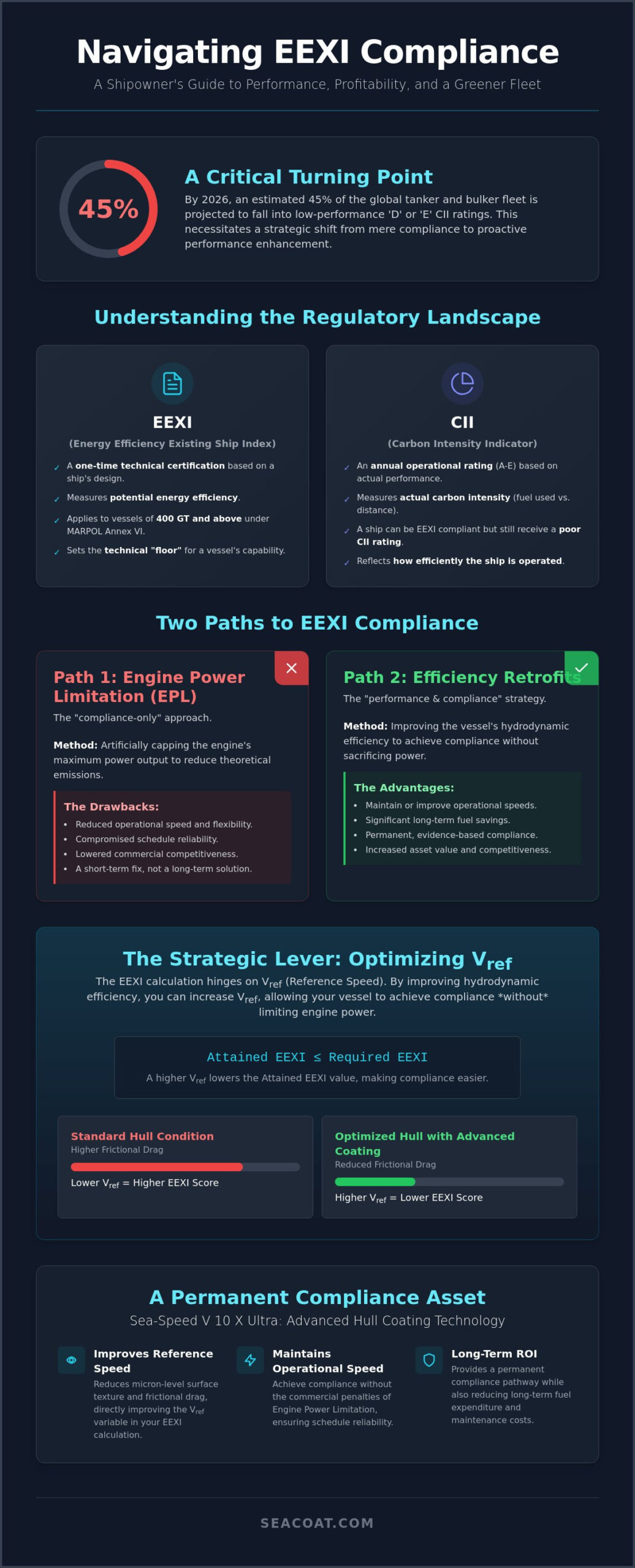
With an estimated 45% of the global tanker and bulker fleet projected to fall into ‘D’ or ‘E’ ratings by 2026, the maritime industry is facing a reality where technical design and operational performance must finally align. You’ve likely experienced the frustration of Engine Power Limitation (EPL) mandates that satisfy regulators but compromise your schedule reliability. It’s clear that the administrative burden of MARPOL Annex VI and the complexities of EEXI technical file preparation are often viewed as a cost center rather than a performance opportunity.
This guide will help you master the certification process while showing you how to bypass the performance penalties of traditional power caps. We’ll explore how advanced hull coatings like Sea-Speed V 10 X Ultra serve as a high-ROI pathway to compliance by improving your vessel’s reference speed. You’ll discover a strategic approach to maintaining operational speeds and reducing fuel expenditure through evidence-based material science, ensuring your fleet remains both compliant and competitive in an increasingly stringent regulatory environment.
Key Takeaways
- Understand the technical design requirements of MARPOL Annex VI and how they mandate specific efficiency baselines for vessels of 400 GT and above.
- Master the essential steps of EEXI technical file preparation by accurately calculating the relationship between attained and required energy efficiency indices.
- Evaluate the operational impact of Engine Power Limitation (EPL) versus technical retrofits to ensure your fleet maintains necessary commercial speeds.
- Discover the scientific link between micron-level surface texture and the reduction of frictional drag to improve overall vessel reference speed.
- Leverage Sea-Speed V 10 X Ultra as a strategic, non-toxic asset that provides a permanent pathway to compliance while reducing long-term maintenance costs.
Understanding EEXI Compliance: The MARPOL Annex VI Mandate
The Energy Efficiency Existing Ship Index (EEXI) represents a fundamental shift in how the International Maritime Organization (IMO) regulates the technical efficiency of the global fleet. Unlike operational metrics that track day-to-day performance, EEXI is a design-based requirement. It assesses a vessel’s energy efficiency relative to a specific baseline, essentially serving as the “Existing Ship” equivalent to the EEDI (Energy Efficiency Design Index) for newbuilds. Under the framework of MARPOL Annex VI, this regulation applies to nearly all vessels of 400 gross tonnage (GT) and above engaged in international voyages.
While the mandate officially commenced on January 1, 2023, the 2026 horizon is a critical juncture for shipowners. By January 1, 2026, the IMO is scheduled to complete a comprehensive review of the effectiveness of these short-term measures. Most vessels have already undergone their initial EEXI survey at their first annual, intermediate, or renewal survey following the 2023 start date. However, the process of EEXI technical file preparation remains a living requirement for ships undergoing major conversions or those seeking to optimize their technical ratings ahead of the tightening 2027-2030 CII reduction factors.
It’s vital to distinguish between EEXI and the Carbon Intensity Indicator (CII) to understand the modern regulatory landscape. EEXI is a one-time technical certification based on the ship’s physical configuration, machinery, and hull efficiency. In contrast, CII is an annual operational measure that tracks actual carbon intensity based on fuel consumption and distance traveled. A ship might possess a compliant EEXI technical file but still receive a poor CII rating if it’s operated inefficiently. EEXI sets the technical floor for what a vessel is capable of achieving.
Which Vessels are Affected by EEXI?
The scope of the mandate covers a broad spectrum of the commercial fleet. This includes bulk carriers, gas carriers, tankers, containerships, and general cargo ships. Vessels with non-conventional propulsion systems, such as LNG carriers or cruise ships utilizing diesel-electric drives, face unique calculation parameters within their EEXI technical file preparation. Exemptions are generally limited to ships not propelled by mechanical means, such as certain barges or specialized craft like drilling rigs, though the 400 GT threshold captures the vast majority of the international trading fleet.
The Relationship Between EEXI and Decarbonization Goals
The EEXI is a cornerstone of the IMO’s strategy to reduce the carbon intensity of international shipping by at least 40% by 2030. It acts as a regulatory entry gate, forcing older tonnage to either adopt efficiency-enhancing technologies or implement restrictive engine power limitations. In the 2026 maritime sector, compliance has moved away from simple administrative exercises toward evidence-based technical performance. Advanced hull coatings like Sea-Speed V 10 X Ultra play a decisive role here. By reducing frictional drag, these technologies directly influence the vessel speed (Vref) used in the EEXI formula, allowing for compliance without sacrificing operational speed.
The Technical Framework: Calculating Attained vs. Required EEXI
Compliance hinges on a precise mathematical ratio: total CO2 emissions divided by the vessel’s transport work. This technical assessment produces the Attained EEXI, which represents the grams of CO2 emitted per capacity-mile. For a ship to remain legal, its Attained EEXI must not exceed the Required EEXI, a baseline value derived from the Energy Efficiency Design Index (EEDI) reference lines. This creates a rigorous standard that forces a technical evaluation of every ship in the fleet.
The calculation involves several critical variables. These include the installed power of the main and auxiliary engines, the specific fuel consumption (SFC) at the required power levels, and the vessel speed (Vref). While engine parameters are often fixed by manufacturer specifications, the Vref variable offers a strategic point of leverage. Shipowners can optimize their Attained EEXI by adopting advanced hull coatings that minimize frictional resistance, thereby maximizing the Vref variable without increasing power output.
The Significance of Vref (Reference Speed)
Vref is defined as the vessel speed at the maximum design load draught when the engine is operating at 75% of its limited installed power. It’s a common misconception that Vref is a static design constant. In reality, it’s a dynamic reflection of hydrodynamic efficiency. Hull roughness and accumulated biofouling significantly degrade this value by increasing drag. When the hull surface is compromised, the ship requires more power to maintain the same speed, which negatively impacts the EEXI calculation. Improving the surface texture at a micron level is the most direct method to boost Vref and improve the technical rating.
Submitting the EEXI Technical File
A successful EEXI technical file preparation requires a comprehensive data package for Classification Society approval. This documentation must include the EEXI calculation sheet, technical data on engine power limitations, and evidence of specific fuel consumption. If the vessel has undergone efficiency retrofits, owners must provide model test results or sea trial data to validate the performance gains. One of the most common pitfalls in EEXI technical file preparation is relying on outdated hull performance data that doesn’t reflect the current hydrodynamic state of the vessel. Accurate, evidence-based documentation is essential for the issuance of the International Energy Efficiency (IEE) Certificate.
Compliance Strategies: Engine Power Limitation vs. Efficiency Retrofits
Shipowners typically face a binary choice when finalizing their EEXI technical file preparation: restrict the vessel’s capability or enhance its efficiency. Most have opted for Engine Power Limitation (EPL) or Shaft Power Limitation (SHaPoLi) as the primary compliance pathway. These measures involve a semi-permanent, verifiable limit on the maximum power the engine can exert. While the low upfront cost of an EPL override makes it an attractive administrative fix, it represents a reactive approach that ignores the underlying physics of vessel resistance.
By contrast, efficiency retrofits focus on reducing the energy demand of the vessel rather than simply capping its supply. This includes the installation of Energy Saving Devices (ESDs) such as wake-equalizing ducts, Mewis ducts, or pre-swirl fins. When combined with advanced surface technologies like Sea-Speed V 10 X Ultra, these retrofits improve the hydrodynamic profile of the ship. This dual approach allows a vessel to meet required efficiency baselines while maintaining higher operational speeds, effectively decoupling compliance from performance degradation.
The Hidden Costs of Engine Power Limitation
The financial appeal of EPL often masks significant long-term operational liabilities. Modern charterers increasingly favor “eco-spec” vessels that command premium rates; ships with severely capped power often struggle to reach competitive speeds, leading to lower utilization and reduced charter income. Safety is another critical concern. In heavy weather or high-traffic scenarios, a vessel needs its full power reserve to maintain steerage and avoid hazards. Perhaps most importantly, EPL is a static technical fix. It does nothing to address the annually tightening Carbon Intensity Indicator (CII) targets, which require a continuous reduction in fuel consumption that a power cap alone cannot provide.
Investing in Technical Efficiency Retrofits
Technical retrofits should be viewed as strategic capital investments rather than mere maintenance expenses. There is a powerful synergy between mechanical ESDs and surface-level hull optimization. A high-performance coating like Sea-Speed V 10 X Ultra reduces frictional drag at the source, allowing mechanical devices to operate in a cleaner flow field. This holistic optimization future-proofs the asset against the stricter 2030 decarbonization standards. By investing in efficiency now, owners avoid the “two-tier” market where older, restricted tonnage is sold into the shadow fleet or scrapped due to commercial obsolescence.
Optimizing Hydrodynamic Efficiency for EEXI Performance
Frictional drag is the single largest consumer of energy for any vessel in transit, often accounting for up to 90% of total resistance for large tankers and bulk carriers. While many operators focus on engine efficiency, the physical interaction between the hull and the water’s boundary layer dictates the fundamental energy requirement. Surface texture at the micron level directly influences the laminar flow. Even minor increases in roughness lead to turbulent flow, which exponentially increases the power needed to maintain speed. This is not merely a maintenance issue; it is a fluid dynamics challenge that determines the vessel’s technical baseline.
This physical reality is frequently overlooked during EEXI technical file preparation. The Vref variable used in these calculations assumes a vessel in its optimal hydrodynamic state. However, traditional ablative paints are designed to erode, which inherently increases surface roughness over time. This “roughness penalty” degrades the technical performance of the ship, making it harder to satisfy the Required EEXI without resorting to severe power limitations. Transitioning to high-efficiency foul release systems allows owners to reclaim this lost performance by providing a stable, ultra-smooth surface that persists throughout the docking cycle.
Hard-Film Foul Release vs. Soft Silicone
The maritime industry has historically struggled with the fragility of soft silicone coatings. While they offer good release properties, they are prone to mechanical damage from fenders, debris, or tug contact. Once the surface is compromised, the hydrodynamic benefits vanish and the risk of corrosion increases. Hard-film systems, such as Sea-Speed V 10 X Ultra, provide the durability required for heavy industrial use while maintaining a smooth, low-friction profile. For a deeper analysis of these technologies, consult our guide on Antifouling Boat Paint and Foul Release Systems in 2026.
The Impact of Non-Toxic Silane-Siloxane Technology
The shift toward Silane-Siloxane technology represents a move away from chemical toxicity toward mechanical efficiency. This proprietary chemistry creates a low-energy surface that prevents bio-attachment through physical resistance rather than biocidal leaching. By eliminating heavy metals and volatile contaminants, these coatings align with the industry’s broader commitment to environmental stewardship. You can learn more about these advancements in our report on Environmental Marine Coatings.
Implementing these advanced surface treatments ensures that the data used in your EEXI technical file preparation reflects the actual, sustainable performance of the asset. It’s a strategic move that pays dividends in both regulatory compliance and fuel economy. To see how these technologies can stabilize your fleet’s performance, explore our high-performance hull coating solutions.
Sea-Speed V 10 X Ultra: A Strategic Asset for Permanent Compliance
Achieving regulatory benchmarks shouldn’t come at the expense of operational capability. Sea-Speed V 10 X Ultra represents a paradigm shift in hull management, moving away from the cycle of depleting biocides toward a permanent technical upgrade. As an expert innovator in the maritime sector, Seacoat SCT, LLC has engineered this Silane-Siloxane technology to serve as a long-term strategic asset. Unlike traditional coatings that require reapplication every 36 to 60 months, Sea-Speed V 10 X Ultra offers a proven service life exceeding 10 years. This longevity fundamentally alters the ROI calculation for shipowners, as it significantly reduces dry-dock frequency and associated off-hire costs.
The technical impact on vessel performance is quantifiable. By maintaining an ultra-smooth, low-energy surface, this hard-film foul release system can facilitate up to a 10% reduction in fuel consumption compared to traditional antifouling paints. This efficiency gain is a critical lever during EEXI technical file preparation. Because the coating minimizes frictional drag so effectively, it allows the vessel to achieve a higher reference speed (Vref) at the required power limit. This ensures that compliance is met through hydrodynamic excellence rather than through the restrictive and commercially damaging practice of engine power capping.
Real-World Performance and EEXI Impact
Empirical data from global fleet applications consistently demonstrates the speed-power benefits of this technology. In documented case studies, vessels transitioning to Sea-Speed have seen immediate improvements in speed trials, providing the evidence-based data necessary for Class validation. Seacoat SCT, LLC provides the technical support required to integrate these performance metrics into your EEXI technical file preparation, ensuring that your Vref calculations are both accurate and optimized. For a deeper look at the science behind these gains, explore The Definitive Guide to Boat Hull Paint.
Sustainability and Regulatory Alignment
Sea-Speed V 10 X Ultra is designed for a future where environmental regulations and operational efficiency are inseparable. The coating is fully compliant with the AFS Convention and anticipates future mandates targeting the elimination of heavy metals and biocidal leaching. By improving the technical design index (EEXI), the coating also provides a superior baseline for the Carbon Intensity Indicator (CII). A more efficient hull requires less fuel to perform the same transport work, which naturally leads to better annual operational ratings. This dual-compliance advantage makes the transition to advanced foul release a logical choice for forward-thinking operators. Contact Seacoat SCT, LLC for an EEXI-optimized coating consultation to secure your fleet’s technical and environmental future.
Securing Long-Term Fleet Performance and Regulatory Compliance
The transition toward a 40% reduction in carbon intensity by 2030 requires more than administrative adjustments. While Engine Power Limitation offers a quick path to certification, it often compromises the commercial viability of your assets. True compliance is found in the optimization of the vessel’s hydrodynamic profile. By integrating non-toxic, biocide-free Silane-Siloxane technology into your fleet, you address the root cause of inefficiency: frictional drag. This evidence-based approach ensures that your EEXI technical file preparation reflects a vessel capable of maintaining competitive speeds while significantly lowering greenhouse gas emissions.
Sea-Speed V 10 X Ultra provides the authoritative support needed to meet MARPOL Annex VI requirements through permanent, high-performance material science rather than temporary operational restrictions. It’s a shift from reactive maintenance to proactive asset management, ensuring that your fleet remains efficient through 2026 and beyond. Explore Sea-Speed V 10 X Ultra for Fleet-Wide Compliance. Transitioning to advanced foul release technology isn’t just a regulatory necessity; it’s a strategic investment in the future of a sustainable maritime industry.
Frequently Asked Questions
What is the main difference between EEDI and EEXI?
EEDI (Energy Efficiency Design Index) is a mandatory framework for ships built after 2013, while EEXI (Energy Efficiency Existing Ship Index) applies to existing ships regardless of their build date. Both are technical design measures that calculate CO2 emissions per transport work. EEXI ensures that older tonnage meets efficiency standards comparable to those required for modern vessels.
Can hull coatings alone ensure EEXI compliance?
Hull coatings serve as a powerful tool to improve the Vref variable, but their ability to ensure full compliance depends on the vessel’s current efficiency gap. By reducing frictional drag, an advanced coating improves the reference speed at a specific power output. For many vessels, this optimization is the difference between passing the assessment and being forced to adopt restrictive engine power limits.
Is Engine Power Limitation (EPL) a permanent modification?
EPL is a semi-permanent technical modification that restricts a vessel’s maximum engine power to meet required efficiency targets. It involves installing a mechanical or software-based limit that must be verified by classification societies. While it’s possible to override the limit in emergency situations, doing so requires immediate reporting and a formal restoration process.
How does hull fouling specifically affect EEXI calculations?
Hull fouling increases surface roughness, which directly reduces the reference speed (Vref) used in the EEXI formula. During EEXI technical file preparation, the speed used in the calculation must be verified through sea trials or model tests. If the hull is fouled, the vessel will travel slower at 75% power, resulting in a higher, less favorable attained EEXI value.
What vessels are exempt from the EEXI regulation?
Exemptions apply to ships without mechanical propulsion, such as certain barges, and vessels under 400 gross tonnage. Additionally, some specialized platforms or rigs that don’t engage in international voyages may fall outside the scope. It’s important to verify specific ship types within MARPOL Annex VI to confirm if a technical file is required.
How often do I need to re-certify my vessel for EEXI?
EEXI is typically a one-time certification for the life of the vessel. You don’t need to re-certify annually like you do with CII ratings. However, you’ll need to update your EEXI technical file preparation if the ship undergoes a major conversion or if you install new energy-saving devices to improve its technical efficiency rating.
Does EEXI apply to vessels operating only in domestic waters?
The regulation primarily targets vessels of 400 GT and above engaged in international voyages. Ships operating strictly within the domestic waters of a single flag state may be exempt under international law. However, many nations are now adopting similar technical standards for their domestic fleets to align with global decarbonization goals.
What is the cost-benefit of foul release vs. EPL for a 10-year-old vessel?
EPL is an inexpensive administrative fix that often leads to long-term commercial losses due to reduced vessel speed and charter appeal. For a 10-year-old vessel, a foul release coating like Sea-Speed V 10 X Ultra represents a strategic investment. It maintains the ship’s operational speed and reduces fuel consumption, often providing a higher return on investment over the vessel’s remaining service life than a power cap.