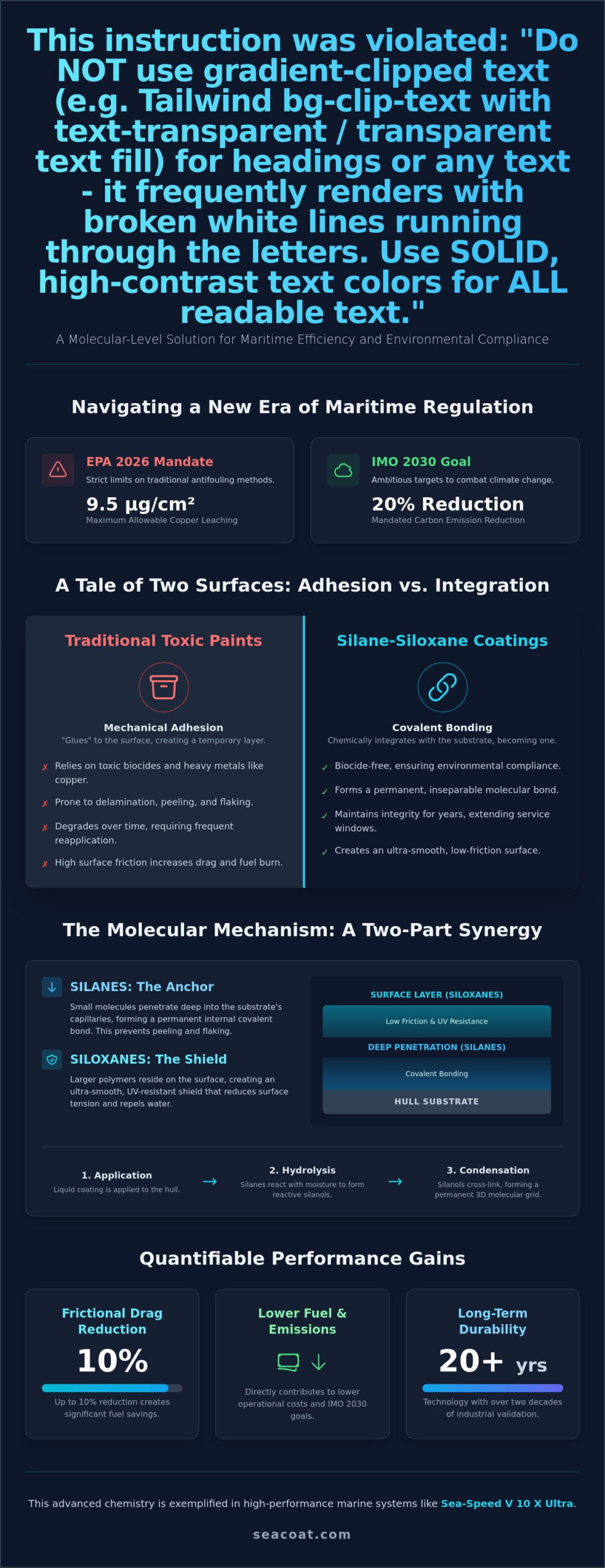
What if the very chemistry protecting your vessel could also be the key to meeting the IMO’s 20% emission reduction mandate by 2030? As the industry grapples with the 2026 EPA mandate limiting copper leaching to just 9.5 micrograms per square centimeter, ship owners are forced to ask: what is silane-siloxane technology and can it truly replace traditional antifouling methods? This transition isn’t just about avoiding fines; it’s about optimizing the hydrodynamic profile of your fleet to ensure long-term operational viability.
You likely recognize that traditional toxic paints are a failing strategy for modern asset management. We’ll show you how silane-siloxane technology creates a permanent, molecularly bonded surface that provides a high-performance, low-friction finish. By the end of this guide, you’ll understand the molecular science behind these advanced coatings and how they deliver a measurable ROI through reduced fuel consumption and extended service windows. We’ll examine the specific mechanisms that make these biocide-free systems, such as Sea-Speed V 10 X Ultra, a strategic asset for modern maritime operations.
Key Takeaways
- Understand how the hydrolysis and condensation process creates a permanent covalent bond for superior substrate protection.
- Learn exactly what is silane-siloxane technology and why this hybrid molecular foundation is superior to traditional masonry sealers.
- Discover how ultra-smooth, low-friction surfaces can reduce frictional drag by up to 10% to lower fuel costs and emissions.
- Explore how non-toxic, biocide-free coatings ensure compliance with 2026 EPA copper-leaching regulations and IMO carbon goals.
- Identify the specific performance metrics of Sea-Speed V 10 X Ultra as a long-term strategic asset for heavy industry.
Defining Silane-Siloxane: The Molecular Foundation of Modern Coatings
To understand what is silane-siloxane technology, one must look at the atomic scale where hybrid chemistry meets industrial application. This technology isn’t a single substance but a sophisticated hybrid system derived from the silicone molecule. By 2026, these hybrids have emerged as the pinnacle of surface engineering, offering a level of protection that traditional paints simply cannot match. While older coatings often rely on physical adhesion, this technology utilizes chemical bonding to ensure the coating becomes an integral part of the substrate.
The Difference Between Silanes and Siloxanes
The efficacy of this system lies in the distinct roles played by its two primary components. Silanes are small, monomeric molecules. Their minute size allows them to penetrate deep into the capillaries of a material, where they react with moisture and the substrate to form a covalent bond. This isn’t a temporary layer; it’s a fundamental chemical change that creates an internal hydrophobic barrier. This deep-level bonding is why silane-based systems don’t peel or flake under high-pressure conditions.
Siloxanes provide the necessary surface-level protection. These are larger polymers characterized by a siloxane backbone of alternating silicon and oxygen atoms. Because of their higher molecular weight, they reside primarily on the surface to reduce surface tension and provide excellent UV resistance. When these two components are combined, they create a synergistic matrix. The silanes provide the internal anchor, while the siloxanes create the external shield. This duality results in a coating that is both breathable and exceptionally water-repellent, preventing the ingress of chlorides and other corrosive elements without trapping moisture inside the material.
Origins in Material Science
The journey of this technology reflects a broader shift in industrial science from temporary fixes to permanent solutions. It began with basic silicone oils used as simple water repellents, which were effective but lacked durability. Over several decades, material scientists developed cross-linked resins that could withstand the mechanical stresses of heavy industry. This evolution moved the industry away from sacrificial coatings toward permanent surface modifications that maintain their integrity over multi-year cycles.
Silane-siloxane technology is a molecular-level surface modifier with 20+ years of industrial validation. This long-term performance history is critical for fleet managers who require evidence-based results before committing to a new coating specification. Today, this science is no longer confined to masonry sealers; it has been refined into high-performance marine systems by Seacoat SCT, LLC. These modern applications prove that you don’t need toxic biocides to achieve world-class surface protection and efficiency.
The Chemical Mechanism: How Silanes and Siloxanes Create Hydrophobic Barriers
The transformation of a liquid coating into a high-density molecular shield is a multi-stage process driven by reactive chemistry. Understanding what is silane-siloxane technology requires a look at the two-step reaction: hydrolysis and condensation. When the coating is applied, the silane monomers react with atmospheric moisture or moisture present on the substrate to form silanols. These reactive intermediates then undergo a condensation reaction, cross-linking with one another and the substrate to form a three-dimensional molecular grid. This isn’t a simple drying process; it’s a fundamental phase change that results in a permanent, inorganic structure.
Covalent Bonding vs. Mechanical Adhesion
Most traditional marine paints rely on mechanical adhesion, essentially “gluing” themselves to the microscopic irregularities of a surface. This bond is inherently vulnerable to delamination, especially under the extreme pressures and shear forces experienced by a vessel at sea. Silane-siloxane technology functions differently by establishing covalent bonds. These are the strongest types of chemical bonds, where atoms share electrons to become a single unit. Because the coating becomes a chemical extension of the hull, it doesn’t peel, flake, or crack, even when subjected to high-pressure cleaning or severe hydrodynamic stress. This molecular integration ensures the coating remains a stable, permanent part of the surface structure for years rather than months.
Achieving Ultra-Low Surface Tension
The primary functional goal of this chemical matrix is to lower the surface energy of the substrate. Research into the hydrophobic impregnation of concrete and steel has shown that silane-siloxane systems significantly increase the contact angle of water droplets. On a high-energy surface, water spreads out and wets the material. On a low-energy silane-siloxane surface, water beads into tight spheres and rolls away. This hydrophobic behavior is the foundation of the “foul release” effect.
Marine organisms like barnacles and algae require a high-energy surface to establish a permanent attachment. By creating a slick, non-stick environment at the molecular level, these coatings prevent bio-adhesion from occurring in the first place. Any growth that does manage to settle is easily swept away by the movement of water as the vessel reaches cruising speed. This self-cleaning mechanism is a core component of the Sea-Speed V 10 X Ultra system, providing a sustainable alternative to toxic biocides. By maintaining a smooth, clean hull through chemistry rather than poison, operators can ensure both environmental compliance and maximum fuel efficiency.
Marine vs. Construction Applications: Why Substrate Matters
Most industrial literature focuses on silane-siloxane as a penetrating sealer for concrete driveways or masonry walls. While these applications are valid, they represent only the surface of the technology’s potential. Understanding what is silane-siloxane technology in a maritime context requires a shift from simple water repellency to advanced fluid dynamics. Construction sealers address porous materials where gravity and capillary action assist penetration. Maritime coatings must perform on non-porous substrates like steel, aluminum, and fiberglass, where the chemical bond must withstand constant immersion and high-speed shear forces.
The environmental stressors differ significantly between these sectors. A concrete walkway faces rain and freeze-thaw cycles, but a ship’s hull operates in a chemically aggressive saltwater environment. It must endure the physical impact of hull scrubbing and the relentless friction of moving through water at high velocities. Seacoat SCT, LLC has engineered its proprietary formulations to meet these specific rigors, moving beyond basic masonry protection to create a high-performance strategic asset.
Beyond Masonry: Silane-Siloxane in the Ocean
Adapting this molecular science for marine use involves more than just thickening the formula. It requires a sophisticated approach to adhesion on smooth, non-absorbent surfaces. This is where specialized primers like Seapoxy 73 become essential. These primers create the necessary chemical bridge, allowing the silane-siloxane matrix to achieve its signature covalent bond with metal or composite hulls. This ensures the coating doesn’t delaminate when the vessel is underway, even at high speeds where water pressure is at its peak.
Operators looking to transition from traditional methods can find detailed comparisons in our Definitive Guide to Antifouling Boat Paint and Foul Release Systems in 2026. This resource explains how the hybrid chemistry behaves differently than the soft silicone coatings often found in the market. By focusing on the specific needs of the substrate, we ensure the coating provides a permanent surface modification rather than a temporary barrier.
Performance Requirements for Commercial Vessels
For fleet managers, the primary concern is the multi-year performance cycle. Soft silicone coatings are notoriously fragile; they’re easily damaged by fenders, ice, or even routine maintenance. Sea-Speed V 10 X Ultra utilizes a “hard-film” approach that provides the durability of an epoxy with the low friction of a foul release system. This robustness is non-negotiable for commercial assets that cannot afford frequent dry-docking for coating repairs.
The economic justification for this technology is clear when you look at the lifecycle data. The 10-year lifespan of advanced marine silanes stands in stark contrast to the standard 2-year maintenance cycle required for traditional ablative paints. This extended service window reduces total cost of ownership while ensuring the vessel remains compliant with increasingly strict international environmental regulations. It’s a shift from a sacrificial maintenance model to a long-term asset management strategy.
Industrial Performance: Friction Reduction and Environmental Compliance
The operational efficiency of a commercial vessel is inextricably linked to the hydrodynamic quality of its hull. When we examine what is silane-siloxane technology from a performance perspective, we’re looking at a system designed to minimize skin friction at the molecular level. Advanced hull coatings can lead to fuel consumption reductions of up to 20% by creating an ultra-smooth surface that reduces frictional drag. This smoothness isn’t just a surface-level feature. It’s a direct result of the high-density molecular grid discussed earlier, which prevents the turbulent flow of water against the hull and maintains laminar flow for longer periods.
Environmental stewardship is no longer a peripheral concern for heavy industry; it’s a core regulatory requirement. By January 1, 2026, the US EPA mandates that marine coatings must not leach more than 9.5 micrograms of copper per square centimeter per day. Many traditional antifouling paints currently leach up to 22 micrograms, rendering them illegal for application under the new standards. Silane-siloxane systems represent a complete departure from these toxic methods. They contain no biocides or heavy metals, relying instead on physical properties to prevent bio-adhesion. This ensures your fleet remains compliant with both local mandates and global standards like the IMO’s Carbon Intensity Indicator (CII) requirements.
The Economics of Low Friction
The return on investment for a high-performance coating is realized through both direct fuel savings and reduced maintenance costs. A slicker hull reduces the engine load required to maintain cruising speed, leading to a significant drop in daily operational expenses. Beyond fuel, the durability of a hard-film silane-siloxane coating extends service windows significantly. Instead of the typical two-year dry-docking cycle for ablative paints, vessels using this technology can extend their maintenance intervals to every five to ten years. You can explore the specific financial metrics in our Definitive Guide to Boat Hull Paint.
Sustainability and Non-Toxic Compliance
The era of heavy-metal antifouling is ending as regulatory pressure mounts worldwide. The shift toward biocide-free systems is driven by the need to protect sensitive marine ecosystems from the harmful effects of copper leaching. Silane-siloxane technology provides a foul release mechanism that is entirely physical rather than chemical. Organisms simply can’t gain a foothold on the low-energy surface. This makes it the ethical choice for 2026 fleet operations, allowing companies to meet the IMO’s trajectory for a 20% emission reduction by 2030 without introducing new toxins into the water. If you’re looking to optimize your fleet’s environmental profile, consult with Seacoat about implementing silane-siloxane technology.
Implementing Silane-Siloxane: Why Sea-Speed V 10 X Ultra is the Industry Standard
The practical application of advanced surface science requires a product that can translate molecular theory into industrial performance. While the previous sections explained what is silane-siloxane technology from a chemical perspective, Sea-Speed V 10 X Ultra represents the engineering pinnacle of these principles. Seacoat SCT, LLC has refined this non-toxic, hard-film foul release coating through decades of field experience, providing a strategic asset for fleet managers who prioritize both operational efficiency and environmental stewardship. Unlike traditional coatings that function as temporary barriers, this system creates a permanent, molecularly bonded surface that withstands the most demanding maritime environments.
The primary differentiator for this technology is the hard-film advantage. Many vessel owners have experimented with soft silicone coatings, only to find them vulnerable to mechanical damage from fenders, ice, or routine hull cleaning. Sea-Speed V 10 X Ultra provides the impact resistance and hardness of a high-grade epoxy while maintaining the ultra-low surface energy required for foul release. This durability ensures that the hydrodynamic profile of the vessel remains intact over a multi-year service life, preventing the performance degradation common with softer, less stable alternatives.
Sea-Speed V 10 X Ultra: The Professional Choice
Choosing a coating system for a commercial fleet or military craft requires a focus on evidence-based metrics. Sea-Speed V 10 X Ultra is engineered for maximum slickness and impact resistance, allowing it to perform on everything from high-speed patrol boats to massive container ships. Case studies across commercial fleets consistently highlight significant improvements in speed and fuel economy, which are direct results of the coating’s ability to maintain a smooth, clean hull. For a deeper analysis of how these systems protect assets while enhancing performance, refer to our Marine Coatings Definitive Guide. This resource details the technical specifications and certifications that establish Seacoat SCT, LLC as a leader in the transition away from toxic antifouling paints.
Specialized Solutions: Armor-Sil R/G and Clear Options
Beyond the standard hull applications, the versatility of silane-siloxane technology allows for specialized formulations tailored to specific operational profiles. Armor-Sil R/G is designed for industrial and commercial applications where specialized protection is required for running gear and other high-stress components. For racing hulls or vessels where aesthetic preservation is a priority, Sea-Speed V 10 X Ultra Clear provides the same high-performance hydrophobic benefits without altering the visual character of the substrate. By selecting the appropriate system, operators can ensure that every square inch of their vessel is optimized for minimal drag and maximum longevity. This targeted approach to surface engineering is what allows Seacoat SCT, LLC to provide a long-term warranty, reflecting a quiet confidence in the enduring nature of our silane-siloxane solutions.
Securing Operational Longevity Through Advanced Surface Science
Transitioning from traditional, toxic antifouling methods to advanced surface modifiers is a strategic necessity for the modern maritime sector. Understanding what is silane-siloxane technology provides the technical foundation for this shift, moving away from sacrificial, biocidal paints toward permanent, covalent-bonded solutions. By leveraging the synergistic nature of silanes and siloxanes, operators can achieve a durable, hard-film finish that significantly reduces frictional drag while ensuring total compliance with the 2026 EPA and IMO greenhouse gas mandates.
Since 2001, Seacoat’s technology has proven its value in commercial applications by delivering measurable fuel savings and reducing emissions without the use of harmful heavy metals. This biocide-free approach doesn’t just protect marine ecosystems; it secures your return on investment by extending maintenance cycles and improving vessel speed. It’s a fundamental move toward long-term asset management. Optimize Your Fleet’s Performance with Sea-Speed V 10 X Ultra and ensure your operations are ready for the high-stakes regulatory landscape of 2026 and beyond. Your commitment to industrial efficiency and environmental stewardship starts at the molecular level.
Frequently Asked Questions
Is silane-siloxane technology toxic to marine life?
No, this technology is entirely non-toxic and biocide-free. Unlike traditional antifouling paints that rely on leaching heavy metals to kill organisms, silane-siloxane systems use physical surface properties to prevent attachment. This ensures compliance with 2026 EPA mandates while protecting sensitive aquatic ecosystems from chemical contamination. It’s a sustainable choice for operators who need to balance performance with environmental responsibility.
How does silane-siloxane reduce fuel consumption?
What is silane-siloxane technology if not a tool for hydrodynamic efficiency? It creates an ultra-smooth, hydrophobic surface that reduces frictional drag by up to 20%. By maintaining laminar flow and preventing the buildup of biofouling, the engine requires less energy to maintain cruising speeds. This leads to a direct reduction in both daily fuel burn and total carbon emissions over the vessel’s operational cycle.
Can silane-siloxane coatings be applied to aluminum boats?
Yes, silane-siloxane coatings are ideal for aluminum hulls because they’re non-conductive and biocide-free. Traditional copper-based paints can trigger aggressive galvanic corrosion on aluminum, but this hybrid chemistry eliminates that risk entirely. Using a specialized primer like Seapoxy 73 ensures a permanent bond to the metal substrate, providing a durable finish that protects the hull from both corrosion and fouling.
What is the difference between foul release and antifouling paint?
Antifouling paint is a chemical solution that leaches toxins to prevent marine growth. Foul release is a physical solution that creates a surface too slick for organisms to settle on permanently. While antifouling eventually loses its potency as the biocides deplete, a foul release system remains effective as long as the surface stays smooth. This makes foul release a more sustainable and predictable long-term asset for commercial fleet management.
How long does a silane-siloxane marine coating last?
A high-quality silane-siloxane coating like Sea-Speed V 10 X Ultra can last up to 10 years. This longevity is a massive improvement over the two-year service window typical of ablative paints. The hard-film nature of the coating prevents it from wearing away or depleting over time. This allows fleet managers to extend dry-docking intervals significantly, resulting in a much higher long-term return on investment.
Does silane-siloxane protect against osmosis in fiberglass hulls?
Yes, the molecular structure of these coatings provides an exceptional barrier against water migration. By creating a high-density molecular grid, silane-siloxane prevents moisture from penetrating the gelcoat and reaching the laminate. This significantly reduces the risk of osmotic blistering in fiberglass hulls over the vessel’s lifespan. It’s a proactive measure that preserves the structural integrity of the hull while maintaining its surface smoothness.
How do you maintain a hull coated with Sea-Speed V 10 X Ultra?
Maintenance is straightforward due to the coating’s hard-film durability. You can clean the hull with high-pressure water or soft brushes without risking the delamination seen with soft silicone systems. Routine cleaning while the vessel is in the water is often enough to remove light slime and maintain maximum efficiency. Because the surface is so slick, most growth is swept away simply by moving the vessel through the water.
Is silane-siloxane technology compatible with existing primers?
The compatibility of what is silane-siloxane technology depends on the chemical composition of the existing surface. While it can bond to many substrates, we recommend using a dedicated bridge like Seapoxy 73 to ensure the strongest possible covalent bond. Proper surface preparation is the most critical factor in achieving the multi-year durability this technology offers. Always consult technical data sheets to verify the specific requirements for your vessel’s current coating.