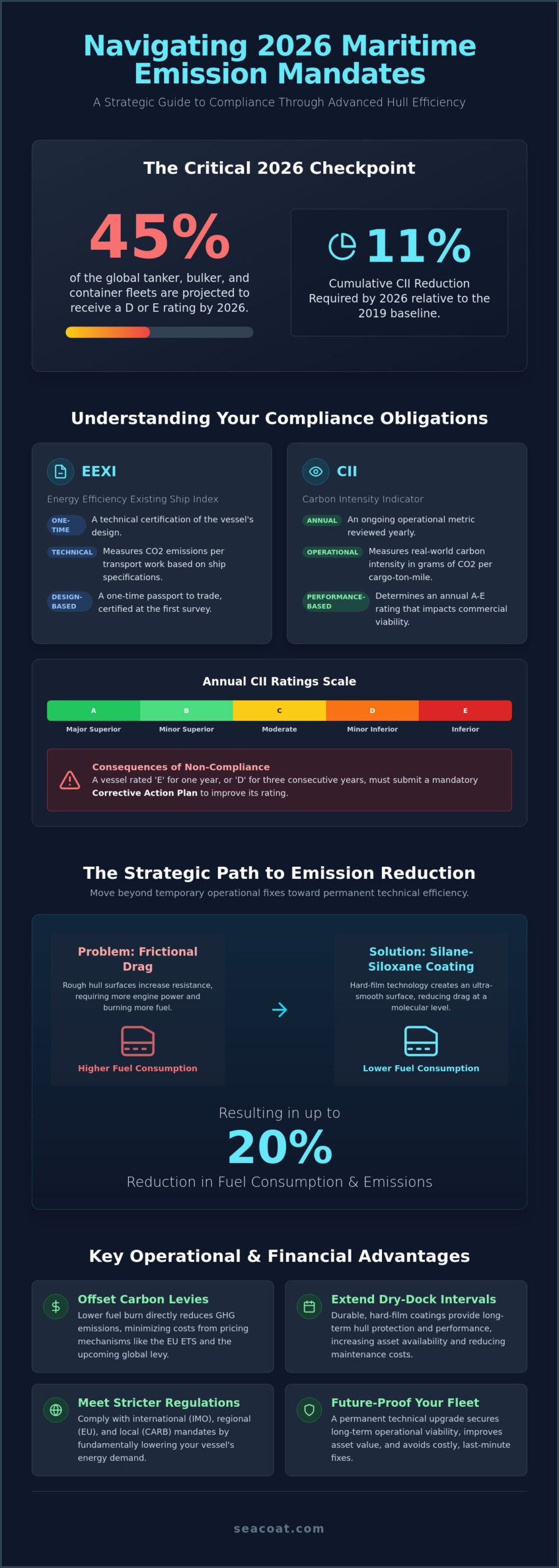
Nearly 45% of the global tanker, bulker, and container fleets are projected to receive a D or E rating by 2026 unless operators take immediate technical or operational action. This looming reality underscores the urgent need to understand how to comply with ship emission regulations as the IMO Net-Zero Framework moves toward adoption at MEPC 85. For ship owners, the challenge isn’t just about avoiding a corrective action plan; it’s about managing the financial impact of rising carbon levies and the operational constraints of mandatory speed limits. You’re likely already feeling the weight of these evolving standards and the complexity of maintaining Carbon Intensity Indicator (CII) ratings in a high-stakes market.
This strategic guide provides a clear roadmap to master the complex landscape of 2026 mandates and discover how advanced hull coatings provide a primary path to regulatory compliance. We’ll examine the shift toward an 11% cumulative CII reduction and explain how high-performance silane-siloxane technology reduces frictional drag to lower fuel consumption. By optimizing surface efficiency, you can offset greenhouse gas pricing and secure extended dry-dock intervals for your assets. From technical certification to long-term operational performance, we detail the evidence-based steps required to future-proof your fleet.
Key Takeaways
- Understand the transition to the IMO Net-Zero Framework and how the Greenhouse Gas Fuel Intensity (GFI) limits will impact your fleet’s operational viability starting in 2026.
- Discover how to comply with ship emission regulations by addressing frictional drag at the molecular level, moving beyond temporary operational fixes toward permanent technical efficiency.
- Differentiate between EEXI technical certifications and annual CII operational ratings to develop a multi-layered compliance strategy that avoids costly corrective action plans.
- Analyze the performance advantages of hard-film Silane-Siloxane technology, such as Sea-Speed V 10 X Ultra, which provides a biocide-free solution to meet stricter environmental discharge standards.
- Learn how to leverage advanced hull coatings to reduce fuel consumption by up to 20%, effectively offsetting rising carbon levies while extending your vessel’s dry-docking intervals.
The 2026 Regulatory Landscape: Navigating the IMO Net-Zero Framework
The maritime industry is currently experiencing a profound shift as the International Maritime Organization (IMO) transitions from aspirational targets to legally binding technical requirements. Central to this evolution is the IMO Net-Zero Framework, which aims for carbon neutrality by or around 2050. While that date seems distant, 2026 serves as a critical checkpoint for the adoption of measures that will dictate operational viability for decades. Under the IMO’s GHG Reduction Strategy, vessels must prepare for a 20% reduction in emissions by 2030, with a clear trajectory established during the MEPC 85 session in October 2026.
A cornerstone of this framework is the Greenhouse Gas Fuel Intensity (GFI) limit. This mandatory standard requires a phased reduction in the well-to-wake GHG intensity of marine fuels. Unlike previous tank-to-wake metrics, the GFI accounts for the entire lifecycle of energy sources, placing immense pressure on traditional fuel choices. For those determining how to comply with ship emission regulations, this means that technical efficiency is no longer optional. The framework also introduces a global GHG emissions pricing mechanism scheduled for 2027. This market-based measure will penalize ships exceeding intensity limits while rewarding high-performers with tradeable credits, fundamentally altering the economics of global shipping. For large ocean-going vessels over 5,000 GT, MARPOL Annex VI Chapter 5 now serves as the primary regulatory anchor for these operational benchmarks.
MARPOL Annex VI and Air Pollution Standards
Compliance isn’t limited to carbon alone. MARPOL Annex VI continues to enforce rigorous air pollution standards that intersect with GHG goals. NOx Tier III requirements remain a primary focus within Emission Control Areas (ECAs), demanding sophisticated engine tuning or after-treatment systems. Simultaneously, the 0.50% global sulphur cap remains the baseline for all operations outside ECAs. In 2026, reporting requirements for ozone-depleting substances will also tighten, requiring precise documentation of equipment maintenance and refrigerant handling to ensure full transparency during Port State Control inspections.
Global vs. Regional Emission Mandates
Vessel operators must also reconcile international IMO standards with aggressive regional mandates. The EU Emissions Trading System (ETS) already requires ships to purchase allowances for voyages to and from European ports, a cost that scales directly with carbon intensity. In North America, California’s CARB requirements mandate significant at-berth emission reductions, often requiring shore power or advanced capture technologies. These localized rules often outpace global standards, creating a complex patchwork of requirements that penalize inefficient vessels through both financial levies and restricted port access. Understanding how to comply with ship emission regulations at both levels involves a holistic view of energy demand, where every percentage of drag reduction translates into lower GHG intensity and reduced regional tax liabilities.
Meeting EEXI and CII Requirements Through Technical Efficiency
The Energy Efficiency Existing Ship Index (EEXI) and the Carbon Intensity Indicator (CII) represent the dual pillars of current maritime decarbonization. While EEXI is a one-time technical certification measuring a vessel’s design efficiency, the CII is an ongoing operational metric that determines a ship’s carbon intensity rating from A (major superior) to E (inferior). For operators determining how to comply with ship emission regulations, the distinction is vital. EEXI is a calculated ratio of CO2 emissions per transport work based on ship design, while CII measures how that hardware performs in real-world conditions. By 2026, the required cumulative improvement in CII will reach 11% relative to the 2019 baseline. Ships that fall into the “E” category in a single year, or “D” for three consecutive years, must submit a mandatory corrective action plan to Port State Control, often involving expensive technical retrofits or restricted operations.
As the IMO reviews “CII Correction Factors” during the MEPC 84 and 85 sessions, the flexibility for certain ship types may change. However, the core requirement remains clear: vessels must demonstrate a consistent reduction in carbon intensity. This is why understanding how to comply with ship emission regulations requires a shift from viewing compliance as a paperwork exercise to viewing it as a performance optimization challenge.
The Relationship Between Frictional Drag and CII Ratings
The “well-to-wake” approach increasingly used in efficiency metrics highlights that every kilogram of fuel saved at the engine translates to a significant reduction in total lifecycle emissions. Frictional drag is the primary thief of energy in this equation. As biofouling accumulates, a vessel’s hull roughness increases, forcing the propulsion system to consume more energy to maintain the same speed. This leads to the “CII slide,” where a ship’s rating degrades over its five-year dry-dock cycle. Advanced low-friction hull coatings can reduce a vessel’s fuel consumption by 12% to 20%, providing a critical buffer against this degradation. Adopting International Air Pollution Standards for Ships ensures that vessels meet MARPOL Annex VI requirements while simultaneously improving their operational carbon footprint.
Technical vs. Operational Compliance Measures
Operators often choose between operational fixes, like slow steaming, and technical upgrades. While slow steaming reduces emissions, it compromises schedule reliability and fleet capacity. Engine Power Limitation (EPL) offers a path to EEXI compliance but does nothing to address the underlying energy demand caused by hull resistance. In contrast, advanced hull coatings act as a “passive” technical measure that reduces the power required for any given speed. This allows for a more robust strategy for meeting targets without sacrificing commercial speed or cargo throughput. If you’re looking for long-term reliability, considering a transition to silane-siloxane hull systems provides a permanent technical advantage over temporary operational adjustments.
Hull Efficiency: The Strategic Path to Emission Reduction
Compliance is often framed as an “exhaust pipe” challenge, focusing exclusively on fuel transitions or carbon capture. However, emissions are fundamentally a function of energy demand. When a vessel’s hull is compromised by biofouling or surface roughness, the propulsion system must work harder to maintain speed, leading to a direct increase in fuel consumption and greenhouse gas emissions. For operators strategizing on how to comply with ship emission regulations, the most immediate gains aren’t found in the engine room, but in the interface between the hull and the water. Frictional drag can account for up to 90% of a vessel’s total resistance; addressing this at the source is the most cost-effective technical measure available.
Traditional ablative antifouling paints are increasingly inadequate for the 2026 regulatory landscape. These systems rely on the leaching of biocides and the physical wearing away of the paint film. This mechanism creates a porous, microscopically rough surface that increases frictional drag from the moment the vessel leaves dry-dock. As the paint depletes, the hull’s efficiency drops, causing a steady decline in CII ratings. In an era of mandatory carbon levies, this loss of efficiency represents a significant financial drain. Staying current with maritime shipping regulation and compliance means moving beyond these temporary fixes toward permanent technical solutions that optimize the vessel’s hydrodynamics and preserve its commercial value.
Foul Release vs. Traditional Antifouling Performance
Foul release technology operates on the principle of low surface energy. Instead of poisoning marine life, these coatings create a surface so slick that organisms can’t maintain a permanent bond. The science of surface tension is key; while traditional paints are designed to be rough to facilitate biocide leaching, silane-siloxane systems provide a hydrodynamically smooth finish. This slickness minimizes the laminar flow disruptions that lead to drag. To understand the technical nuances between these systems, operators should consult the Definitive Guide to Antifouling and Foul Release Systems, which details how surface morphology impacts long-term fuel economy.
Hard-Film Silane-Siloxane Technology
While soft silicone coatings were an early attempt at foul release, they’re often fragile and prone to mechanical damage during pier-side operations or hull cleanings. Hard-film silane-siloxane systems represent the next evolution in material science. These coatings provide the durability of an epoxy with the slickness of a high-end release system. This durability ensures that the hull remains smooth and efficient throughout the entire dry-dock cycle. By maintaining a low-friction surface, these systems directly lower the power required from the main engine (PME), which is a critical variable in the EEXI calculation. This technical advantage provides a reliable path for those determining how to comply with ship emission regulations while protecting the vessel’s operational ROI.
Implementation: Transitioning to Sustainable Hull Systems
Transitioning to a sustainable hull system is a methodical process that requires technical foresight and a clear understanding of your fleet’s current operational efficiency. The first step involves a comprehensive audit of CII rating trajectories across your assets. By identifying vessels at risk of falling into D or E categories, you can prioritize interventions that yield the highest impact on your fleet-wide carbon footprint. Establishing a precise baseline for hull roughness and frictional drag is essential; these metrics provide the empirical evidence needed to justify technical upgrades to stakeholders. This data-driven approach ensures that your investment in efficiency is targeted where it’s most needed to maintain commercial viability.
Selecting a coating system in 2026 requires balancing two distinct regulatory pressures. While you determine how to comply with ship emission regulations, you must also navigate increasing restrictions on biocidal discharges, such as the copper bans taking effect in Washington and California. Choosing a non-toxic, hard-film silane-siloxane system ensures that your environmental strategy is holistic, addressing both atmospheric emissions and marine ecosystem preservation. Coordinating this transition with scheduled dry-docking minimizes operational downtime and ensures that the application meets the rigorous standards required for long-term performance. It’s a strategic move that transforms a maintenance requirement into a performance-enhancing asset.
Preparing the Hull for Advanced Coatings
Successful implementation depends heavily on meticulous surface preparation. To achieve the molecular bonding necessary for silane-siloxane systems, you must completely remove legacy toxic layers and accumulated biofouling. Applying advanced coatings over depleted ablative paints leads to premature failure and compromised hydrodynamics. A robust coating stack often begins with a high-performance epoxy primer like Seapoxy 73, which provides an impermeable barrier and a stable foundation for the foul-release topcoat. For a detailed technical breakdown of these preparation standards, refer to our Guide to Hull Preparation.
Monitoring and Maintenance Post-Application
The transition doesn’t end at the shipyard. Maintaining the slickness of a hard-film foul release system involves periodic in-water cleaning, which is safe for these durable surfaces unlike soft silicone alternatives. Data-driven performance monitoring allows you to validate actual emission reductions and refine your strategy for how to comply with ship emission regulations over multiple years. For performance-critical vessels or racing hulls where visual inspection of the substrate is required, using a product like Sea-Speed V 10 X Ultra Clear provides the necessary transparency without sacrificing hydrodynamic efficiency. To begin your fleet’s transition toward a biocide-free, low-emission future, explore our technical specifications today.
Future-Proofing Your Fleet with Seacoat SCT, LLC Solutions
Vessel owners are no longer looking for mere maintenance products; they’re looking for strategic assets that stabilize operational costs. Sea-Speed V 10 X Ultra serves as a primary tool for those seeking how to comply with ship emission regulations while maintaining high-level profitability. This 100% non-toxic, biocide-free silane-siloxane technology represents a definitive shift away from sacrificial coatings. By reducing frictional drag at the molecular level, Sea-Speed V 10 X Ultra delivers fuel savings of up to 12%. These savings translate directly into improved Greenhouse Gas Fuel Intensity (GFI) and Carbon Intensity Indicator (CII) metrics. These aren’t just theoretical gains; they’re measurable performance improvements that help a vessel avoid the “CII slide” and stay within necessary rating brackets as 2026 requirements tighten.
The transition to a net-zero future requires solutions that offer both immediate impact and long-term durability. While traditional paints deplete over time, our hard-film system maintains its surface integrity throughout the entire dry-dock cycle. This longevity extends the service life of the vessel asset and ensures that the technical efficiency gains achieved on day one are still present in year five. It’s a reliable approach that treats the hull as a performance-enhancing tool rather than a maintenance burden. By establishing a permanent, low-energy surface, you create a decisive factor in how to comply with ship emission regulations over the long term.
Scientifically Proven Performance
Reliability in heavy industry is built on evidence. Our silane-siloxane technology has been in active use since 2001, providing a deep archive of performance metrics across diverse maritime environments. This proven history is essential as the industry navigates the Environmental Marine Coatings shift of 2026. Unlike many legacy systems, Seacoat SCT, LLC products contain zero VOCs and no heavy metals. We’ve eliminated the trade-off between physical durability and ecological safety, ensuring that your fleet meets both atmospheric emission standards and evolving water-quality mandates without compromise.
Strategic Asset Management for Global Fleets
By positioning Seacoat SCT, LLC as a partner in your decarbonization journey, you gain access to a sophisticated solution for net-zero shipping. The economic advantages are clear: lower drag leads to reduced fuel consumption, which in turn reduces the financial impact of carbon levies. Combined with reduced maintenance cycles and the elimination of toxic hull scrubbing residues, the return on investment becomes a core driver of fleet sustainability. We provide the technical precision required for modern asset management in a high-stakes regulatory environment. Consult with Seacoat SCT, LLC for a customized fleet compliance strategy and secure your operational future.
Securing Operational Excellence in a Net-Zero Era
The 2026 regulatory horizon demands a transition from reactive maintenance to proactive technical strategy. By addressing energy demand at the hull-water interface, operators can mitigate the financial impact of carbon pricing while ensuring their assets remain commercially competitive. High-performance silane-siloxane systems offer a scientifically proven method for reducing fuel consumption and greenhouse gas intensity without the environmental trade-offs of toxic biocides. Understanding how to comply with ship emission regulations isn’t just a matter of avoiding penalties; it’s an opportunity to optimize your fleet’s long-term return on investment through superior material science.
Adopting Sea-Speed V 10 X Ultra provides a biocide-free, 100% non-toxic solution that reduces frictional drag by up to 10-12%. This technical buffer directly supports your EEXI, CII, and GFI targets throughout the entire service life of the vessel. We invite you to Explore Sea-Speed V 10 X Ultra for Fleet-Wide Compliance and take control of your decarbonization roadmap. With the right technology in place, the path to net-zero shipping becomes a sustainable advantage for your global operations.
Frequently Asked Questions
How does hull coating affect EEXI compliance?
Hull coatings impact EEXI by lowering the technical power requirement needed to maintain a vessel’s design speed. Because the EEXI calculation incorporates the Power of the Main Engine (PME), reducing frictional drag allows a ship to operate more efficiently at its reference speed. High-performance coatings act as a passive technical measure, often allowing vessels to meet compliance without the need for aggressive engine power limitations.
What is the new Greenhouse Gas Fuel Intensity (GFI) standard for 2026?
The GFI standard is a mandatory goal-based requirement that limits the lifecycle greenhouse gas intensity of energy used on board. Expected to be adopted at MEPC 85 in October 2026, this standard shifts the focus from simple combustion to a well-to-wake assessment. Vessels exceeding these annual intensity limits will be required to purchase remedial units, making fuel efficiency a critical financial and regulatory priority.
Can foul release coatings replace scrubbers for emission compliance?
These technologies serve distinct but complementary roles in a fleet’s environmental strategy. While scrubbers remove sulphur oxides (SOx) and particulate matter from exhaust gases, foul release coatings address the underlying energy demand that generates carbon emissions. Reducing total fuel consumption is often a more direct and cost-effective path toward meeting carbon intensity targets than exhaust treatment alone, particularly for older assets.
How does the Carbon Intensity Indicator (CII) impact ship owners in 2026?
In 2026, the required cumulative CII reduction factor reaches 11% relative to the 2019 baseline. This stricter threshold means a higher percentage of the global fleet is at risk of falling into D or E rating categories. Owners must proactively manage their vessel’s operational efficiency to avoid mandatory corrective action plans and the potential for reduced charter rates in an increasingly two-tier market.
Are non-toxic coatings mandatory under new IMO regulations?
While the IMO hasn’t yet issued a global ban on all biocidal coatings, navigating how to comply with ship emission regulations often requires meeting regional non-toxic mandates. Port-specific rules in Washington and California already restrict copper-based paints, forcing operators toward biocide-free systems. Choosing a non-toxic silane-siloxane system ensures that your vessel remains compliant with both global air standards and local water quality regulations.
What is the difference between well-to-wake and tank-to-wake emissions?
Tank-to-wake metrics only account for greenhouse gases emitted during the combustion of fuel on the vessel. In contrast, well-to-wake assessments include the entire lifecycle of the fuel, from extraction and refining to transport and final use. The IMO’s shift toward well-to-wake reporting prevents “carbon shifting” and ensures that the total environmental footprint of alternative fuels is accurately represented in compliance data.
How much fuel can a high-performance foul release coating save?
Advanced silane-siloxane systems can reduce a vessel’s fuel consumption by 12% to 20% by significantly minimizing hydrodynamic resistance. This reduction in frictional drag is a primary technical lever for those determining how to comply with ship emission regulations while maintaining commercial transit speeds. These savings directly translate to lower greenhouse gas output and reduced exposure to regional carbon levies like the EU ETS.
Will my vessel need engine modifications to meet 2026 standards?
Engine modifications aren’t always necessary if technical efficiency targets can be met through other means. Many operators utilize Engine Power Limitation (EPL) or Shaft Power Limitation (ShaPoLi) to satisfy EEXI requirements. However, combining these with hull optimization measures often provides a more balanced solution, allowing the vessel to maintain its operational schedule without the significant capital expenditure of a full engine retrofit.