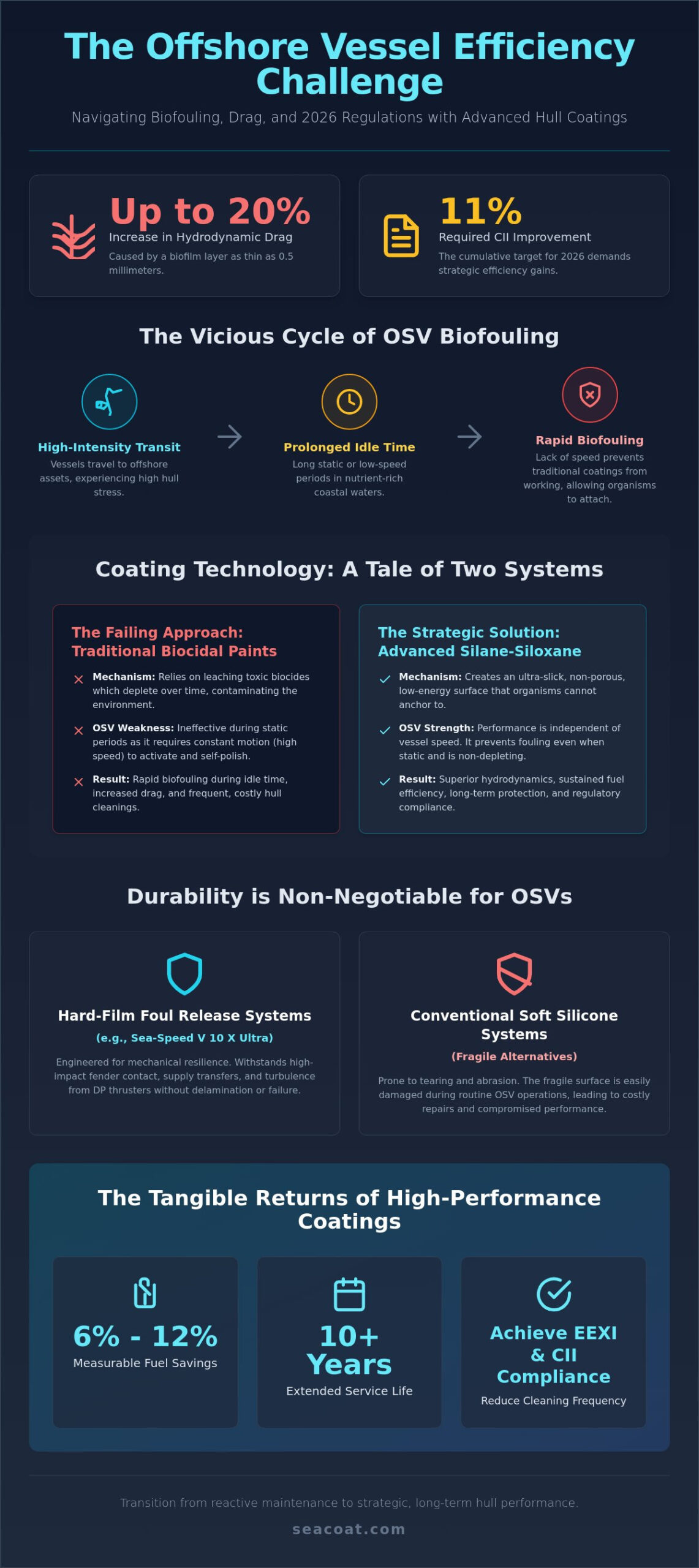
A biofilm layer as thin as 0.5 millimeters can increase hydrodynamic drag by up to 20%, a margin that often dictates the difference between a profitable charter and a regulatory failure. For fleet managers in 2026, the challenge isn’t just keeping hulls clean; it’s doing so while meeting the 11% cumulative CII improvement required this year. You’re likely aware that traditional biocidal paints and fragile silicone options aren’t sufficient, especially when fender contact and high-impact duty cycles are part of daily operations.
This article demonstrates how advanced silane-siloxane foul release technology serves as a strategic asset to optimize performance and reduce operational overhead. By choosing a high-performance marine coating for offshore support vessels, you can achieve measurable fuel savings of 6% to 12% and extend service life to over a decade. We’ll examine the technical superiority of hard-film systems like Sea-Speed V 10 X Ultra, detailing how they provide the durability needed for offshore work while ensuring compliance with EEXI and tightening international biosecurity standards.
Key Takeaways
- Analyze how the unique duty cycles of offshore vessels contribute to rapid static biofouling and learn the scientific mechanism for preventing this accumulation.
- Evaluate the technical advantages of silane-siloxane chemistry as a durable marine coating for offshore support vessels that outlasts traditional biocidal alternatives.
- Contrast the mechanical resilience of hard-film foul release systems with soft silicones to prevent coating failure during high-impact fender contact and supply transfers.
- Identify the strategic role of hull surface efficiency in achieving 2026 EEXI and CII compliance while significantly reducing the frequency of required hull cleanings.
- Plan a seamless fleet transition using Sea-Speed V 10 X Ultra and Seapoxy 73 to secure a 10-year service life and long-term operational cost reductions.
The Unique Biofouling Challenges for Offshore Support Vessels
Offshore support vessels (OSVs) operate within a demanding, hybrid duty cycle that standard merchant vessels rarely encounter. Their missions involve high-intensity transit to offshore assets, followed by prolonged periods of idling or station-keeping in nutrient-rich coastal waters. This operational pattern creates a perfect environment for Biofouling or biological fouling, where marine organisms rapidly colonize the hull surface during static intervals. Unlike ocean-going vessels that maintain consistent speeds to activate self-polishing mechanisms, OSVs often lack the necessary kinetic energy to shed accumulated growth. Consequently, selecting a specialized marine coating for offshore support vessels becomes a technical necessity rather than a simple maintenance choice. Traditional ablative paints, designed to wear away during transit, often fail in these scenarios because they require constant motion to remain effective.
Dynamic Positioning and Hull Stress
During Dynamic Positioning (DP) operations, the hull experiences extreme localized turbulence and shear stress. Constant thruster adjustments create high-velocity water movement that can cause traditional coatings to delaminate or wear prematurely under intense pressure. As the coating degrades, hull roughness increases, which directly raises the energy required to maintain station. This friction doesn’t just impact fuel consumption; it puts additional strain on the vessel’s propulsion system and reduces the overall operational window. A rougher hull surface requires more power to counteract environmental forces, leading to higher emissions and accelerated wear on mechanical components.
The Cost of Idle Time at Sea
“Waiting on weather” or platform availability isn’t just a scheduling delay; it’s an invitation for biological attachment. Traditional antifouling paints rely on a specific activation threshold that OSVs rarely meet. Critical fouling speed represents the minimum velocity required for a coating to activate its self-polishing or biocide-leaching properties, a threshold that OSVs frequently fail to meet during long standby periods. When a vessel sits below this speed, the hull acts as a static substrate for barnacles and tube worms. Because these vessels don’t spend enough time at high cruising speeds to clean the hull through water friction, the resulting drag persists throughout the next transit. This drag can inflate fuel costs significantly, making the ship less efficient for the remainder of its charter. In the high-stakes environment of 2026, where every gram of CO2 is tracked for CII compliance, this hidden efficiency drain is a liability that fleet managers can no longer ignore.
Advanced Silane-Siloxane Technology: The Science of Surface Efficiency
Silane-siloxane technology represents a fundamental departure from the sacrificial mechanisms of the past. Instead of relying on a chemical reservoir of toxins, this advanced marine coating for offshore support vessels utilizes a non-porous, extremely low-energy surface to inhibit biological attachment. At a molecular level, the silane-siloxane matrix creates a finish so smooth that marine organisms find no mechanical “anchor” to secure themselves. This “slickness” is more than an aesthetic quality; it’s a functional asset that reduces frictional drag by minimizing the turbulence within the water’s boundary layer. By optimizing the surface energy of the hull, we transition from a strategy of poisoning the environment to one of superior hydrodynamics.
Hard-Film vs. Leaching Systems
The industry is witnessing a decisive move toward environmental marine coatings as regulatory bodies tighten restrictions on biocide discharge. Traditional leaching systems lose effectiveness over time as their active ingredients deplete, leaving the hull vulnerable and the environment contaminated. In contrast, hard-film foul release systems are non-depleting. They rely on the physical properties of the surface rather than chemical exhaustion. According to a scientific review of marine coating properties, the durability and adhesion of these siloxane-based systems are superior because they don’t degrade through the leaching process. When an OSV accelerates, the hydrodynamic pressure simply washes away any loosely attached slime or biofilm. This ensures the vessel maintains its peak efficiency throughout its entire service life.
Sea-Speed V 10 X Ultra: A Technical Profile
Sea-Speed V 10 X Ultra is engineered specifically for the rigors of heavy industrial maritime use. Its formulation is entirely free of Volatile Organic Compounds (VOCs) and heavy metals, aligning operational goals with environmental stewardship. The coating provides a surface profile with a roughness of less than 5 microns, a metric that significantly outperforms traditional epoxy or silicone alternatives. This ultra-smooth finish allows water to flow over the hull with minimal resistance, a critical factor for vessels operating in Dynamic Positioning modes where every kilowatt of power saved translates to lower emissions.
The molecular bond of this system creates a resilient, hard-film barrier that resists physical abrasion during fender contact or supply transfers. While soft silicones often tear under mechanical stress, this technology remains intact. Fleet managers looking to future-proof their assets should consider how Sea-Speed V 10 X Ultra can transform hull maintenance from a recurring expense into a long-term strategic advantage. Because it’s non-leaching, its performance doesn’t plateau or decline, offering a consistent return on investment over a 10-year window.
Hard-Film Foul Release vs. Soft Silicones: Why OSVs Require Durability
Choosing a marine coating for offshore support vessels involves more than just evaluating drag reduction; it requires a realistic assessment of mechanical durability. Many fleet managers view foul release systems with skepticism due to the fragility of traditional soft silicones. These elastomeric coatings, typically measured on the Shore A hardness scale, are susceptible to catastrophic tearing when subjected to the friction of a fender or the impact of floating debris. In contrast, silane-siloxane technology provides a hard-film finish measured on the Shore D scale. This distinction is vital. While soft silicones offer impressive release properties in controlled environments, they lack the structural integrity required for the high-impact duty cycles of the offshore sector.
Soft silicones are a liability during ship-to-ship transfers. If a silicone coating is gouged or torn, it often requires the complete removal of the system because the material’s inherent “non-stick” nature makes spot repairs notoriously difficult. Hard-film systems function as a workboat-grade alternative, providing the resilience of a heavy-duty epoxy with the sophisticated surface energy of a foul release system. This creates a permanent, sophisticated barrier that doesn’t sacrifice protection for performance.
Mechanical Resistance and Fender Impact
Offshore operations demand constant maneuvering alongside platforms and other vessels, making fender impact an inevitability rather than a risk. Sea-Speed V 10 X Ultra is engineered to withstand this physical abrasion without delaminating. Its molecular bond to the substrate ensures that the coating remains intact even under the compressive forces of a fully loaded supply transfer. The role of boat hull paint in protecting the structural integrity of the steel hull is paramount; a compromised coating leads to localized corrosion and increased maintenance costs. By utilizing a hard-film system, operators ensure that the hull remains protected against both biological growth and mechanical wear.
Maintenance and In-Water Cleaning
Maintenance profiles differ significantly between hard-film and soft systems. Soft silicones are frequently damaged by standard hull cleaning brushes, which can leave micro-scratches that actually encourage future organism attachment. This forces divers to use extremely gentle, and often less effective, cleaning methods. A hard-film marine coating for offshore support vessels allows for more aggressive in-water cleaning if required. Because the film is physically tough, it survives multiple cleaning cycles over a 10-year period without losing its thickness or its release properties. This durability translates to a lower total cost of ownership and fewer emergency dry-dockings for coating repairs.
Regulatory Compliance: Navigating EEXI and CII in 2026
In 2026, the maritime industry has entered a stricter phase of the Carbon Intensity Indicator (CII) framework, requiring an 11% cumulative improvement in CO2 intensity relative to the 2019 baseline. For offshore operators, compliance is no longer a future target but a current operational necessity. While the Energy Efficiency Existing Ship Index (EEXI) addresses technical design, the CII evaluates how efficiently a vessel performs annually. Because hull and propeller deterioration accounts for approximately 10% of a fleet’s fuel costs and greenhouse gas emissions, the choice of a high-performance marine coating for offshore support vessels is a primary lever for maintaining a favorable rating.
This regulatory shift coincides with the “green charter” trend, where oil majors increasingly prioritize vessels with superior environmental performance for long-term contracts. An OSV with a poor CII grade risks becoming a stranded asset, as charterers seek to minimize their own scope 3 emissions. Selecting a durable marine coating for offshore support vessels provides a measurable path to compliance, offering fuel savings of 6% to 12%. These efficiencies directly reduce the carbon footprint of the vessel, ensuring it remains competitive in the modern offshore tender process.
Improving Carbon Intensity Ratings
A smoother hull surface reduces hydrodynamic drag, allowing for lower engine loads to achieve the same operational speeds. This reduction in power demand translates to a direct drop in fuel consumption and CO2 output. In sensitive offshore regions, the use of non-toxic marine coatings is equally critical, as biocide-free technology prevents the introduction of harmful chemicals into fragile marine ecosystems. Sea-Speed V 10 X Ultra contributes to a higher CII grade by maintaining a low-energy surface that prevents the 20% drag increase associated with even thin biofilm layers.
Operational ROI and Fuel Economy
The financial impact of fuel savings over a standard five-year dry-dock cycle is substantial, often offsetting the initial cost of the coating within the first year of service. Beyond fuel economy, advanced systems provide long-term asset protection by preventing the corrosion and pitting that occur in harsh offshore environments. Reducing greenhouse gas emissions through surface science gives operators a distinct advantage when bidding for international projects where environmental transparency is mandatory. To learn more about optimizing your fleet’s compliance strategy, you can explore our technical data on hull efficiency. Investing in surface efficiency ensures that OSVs meet the 2026 requirements of the EU Emissions Trading System (ETS) and the evolving biosecurity rules enforced in major maritime hubs.
Implementing Sea-Speed V 10 X Ultra for OSV Fleets
Transitioning a fleet to a silane-siloxane system is a strategic upgrade of an asset’s baseline performance. This process begins with the complete removal of existing, depleted antifouling layers to expose the substrate. Because Sea-Speed V 10 X Ultra is a hard-film system, it requires a stable, high-integrity foundation. This is where Seapoxy 73 plays a critical role. As a specialized epoxy primer, Seapoxy 73 ensures a tenacious bond between the steel hull and the foul release topcoat. This combination creates a unified barrier that prevents corrosion while maintaining the ultra-smooth surface profile necessary for hydrodynamic efficiency. The foundation matters. Without a high-performance primer, even the most advanced marine coating for offshore support vessels cannot reach its full 10-year potential.
Application Best Practices for Offshore Assets
Optimal performance depends on achieving the correct anchor profile during surface preparation. For offshore assets, this typically involves abrasive blasting to a Near-White Metal standard. The surface must be entirely free of contaminants to allow the silane-siloxane matrix to cross-link effectively at a molecular level. Environmental control is equally vital. Application should occur within specific temperature and humidity windows to ensure the coating cures to its maximum Shore D hardness. These rigorous standards are what allow the system to provide a service life that exceeds a decade. This longevity far surpasses the two or three-year cycles common with traditional, speed-dependent paints. Precision during the application phase dictates the ROI for the next ten years.
The Seacoat SCT, LLC Commitment to Performance
Seacoat SCT, LLC provides the technical expertise required to manage these transitions across global fleets. Through industrial supply contracts, we ensure that Sea-Speed V 10 X Ultra is available at major dry-docking hubs worldwide. This availability is backed by a commitment to scientific stewardship. We don’t provide temporary fixes. Instead, we offer a strategic asset that remains functional through multiple docking cycles. By eliminating the need for full coating removal every five years, fleet managers significantly reduce their long-term operational overhead and environmental footprint. Durability is not an option; it’s a requirement for modern offshore work. Efficiency pays for itself through reduced fuel burn and lower maintenance costs. To begin optimizing your fleet’s surface science, Contact Seacoat SCT, LLC for a technical consultation on your OSV fleet.
The move to hard-film foul release is the only logical step for operators navigating the complexities of 2026. Between tightening CII ratings and the physical demands of offshore work, the traditional approach to hull maintenance has become an expensive liability. A permanent, non-toxic marine coating for offshore support vessels offers the durability to survive fender impacts and the efficiency to meet decarbonization targets. It is a transition from reactive maintenance to proactive asset management.
Future-Proofing Offshore Fleet Operations through Surface Science
Integrating advanced surface technology is no longer just a maintenance preference; it’s a strategic necessity for remaining competitive in the 2026 offshore market. By transitioning to a hard-film silane-siloxane system, operators solve the dual challenge of mechanical durability during fender contact and the biological drag that compromises Carbon Intensity Indicator ratings. This transition ensures that your assets remain efficient, compliant, and ready for high-intensity charters, regardless of the operational environment. The shift toward non-toxic, biocide-free technology represents a commitment to both ecological stewardship and long-term asset integrity.
The evidence for this shift is clear in the performance metrics provided by modern material science. With documented fuel savings of 6% to 12% and a service life potential exceeding 10 years, the economic argument for a superior marine coating for offshore support vessels is undeniable. You can effectively mitigate environmental impact without sacrificing the rugged protection your workboats require for supply transfers and dynamic positioning. It’s time to move beyond temporary fixes and invest in a permanent solution for your fleet’s future. Optimize your OSV fleet with Sea-Speed V 10 X Ultra and secure a decade of operational excellence.
Frequently Asked Questions
Is Sea-Speed V 10 X Ultra compatible with aluminum OSV hulls?
Sea-Speed V 10 X Ultra is fully compatible with aluminum hulls because it contains no copper or other heavy metals that trigger galvanic corrosion. Traditional antifouling paints often require complex barrier coats to prevent metal degradation, but this non-toxic silane-siloxane formulation is chemically inert and safe for light-alloy structures. This makes it an ideal marine coating for offshore support vessels constructed from aluminum, providing long-term protection without compromising the hull’s structural integrity. Seacoat SCT, LLC has engineered this system to be a permanent solution for varied hull materials.
How much fuel can an offshore support vessel save by switching to a foul release coating?
Vessels typically achieve fuel savings between 6% and 12% after switching to a high-performance foul release system. These savings result from the ultra-smooth surface profile, which reduces hydrodynamic drag by minimizing the boundary layer of water around the hull. By preventing the 20% drag increase caused by even thin biofilm layers, the technology allows engines to maintain transit speeds at significantly lower RPMs, directly reducing operational overhead and emissions.
Does a non-toxic coating require more frequent hull cleaning than traditional paint?
Non-toxic foul release coatings actually reduce the frequency and intensity of required hull cleanings compared to traditional biocidal paints. Because the surface energy is extremely low, marine organisms can’t form a strong mechanical bond with the hull. Most accumulated slime simply washes away when the vessel reaches transit speed. If manual cleaning is necessary, it’s faster and doesn’t release toxic chemicals into the water during the process, facilitating easier compliance with tightening port biosecurity rules.
What is the expected service life of a silane-siloxane coating in offshore environments?
A properly applied silane-siloxane coating can provide a service life exceeding 10 years in demanding offshore environments. Unlike ablative or self-polishing paints that wear away over time, this hard-film system remains intact through multiple dry-dock cycles. Its performance doesn’t diminish as the coating ages because it doesn’t rely on a depleting reservoir of biocides. This longevity offers a superior return on investment for any marine coating for offshore support vessels intended for long-term fleet management.
Can Sea-Speed V 10 X Ultra be applied over existing epoxy primers?
While Sea-Speed V 10 X Ultra can be applied over high-quality epoxy primers, Seacoat SCT, LLC recommends using Seapoxy 73 to ensure the most resilient bond. The surface must be properly abraded and free of any old antifouling residue to achieve the necessary anchor profile. Using a unified system ensures chemical compatibility and maximizes the coating’s resistance to delamination during high-intensity maneuvering or station-keeping operations where water shear is at its peak.
How does hull coating performance affect a vessel’s CII rating in 2026?
Hull performance is a primary factor in determining a vessel’s Carbon Intensity Indicator (CII) rating, especially under the stricter 2026 Phase 2 regulations. By reducing frictional drag, the coating lowers the total CO2 emissions per cargo-carrying capacity. Maintaining a smooth hull surface is one of the most cost-effective ways to secure a high grade, which is essential for winning “green charters” from major energy companies that now prioritize lower carbon footprints in their supply chains.
Is the coating resistant to the chemical dispersants used in offshore oil spill response?
The silane-siloxane matrix is highly resistant to a wide range of chemicals, including the dispersants frequently used in oil spill response operations. Its non-porous structure prevents chemical absorption, which could otherwise soften or degrade traditional paint systems. This chemical stability ensures that the hull remains protected even when operating in contaminated waters. The coating’s integrity is maintained without risking surface failure or loss of its essential foul release properties.
What happens if the hard-film coating is scratched during a fender impact?
If the hard-film surface is scratched during a fender impact, the damage is typically localized and doesn’t lead to the widespread peeling common with soft silicones. Because the coating is physically tough, reaching a high Shore D hardness, it resists gouging from most mechanical contacts. Minor scratches can be easily spot-repaired during scheduled maintenance. This durability ensures the structural integrity of the steel hull remains protected even in the high-impact environment of ship-to-ship transfers.