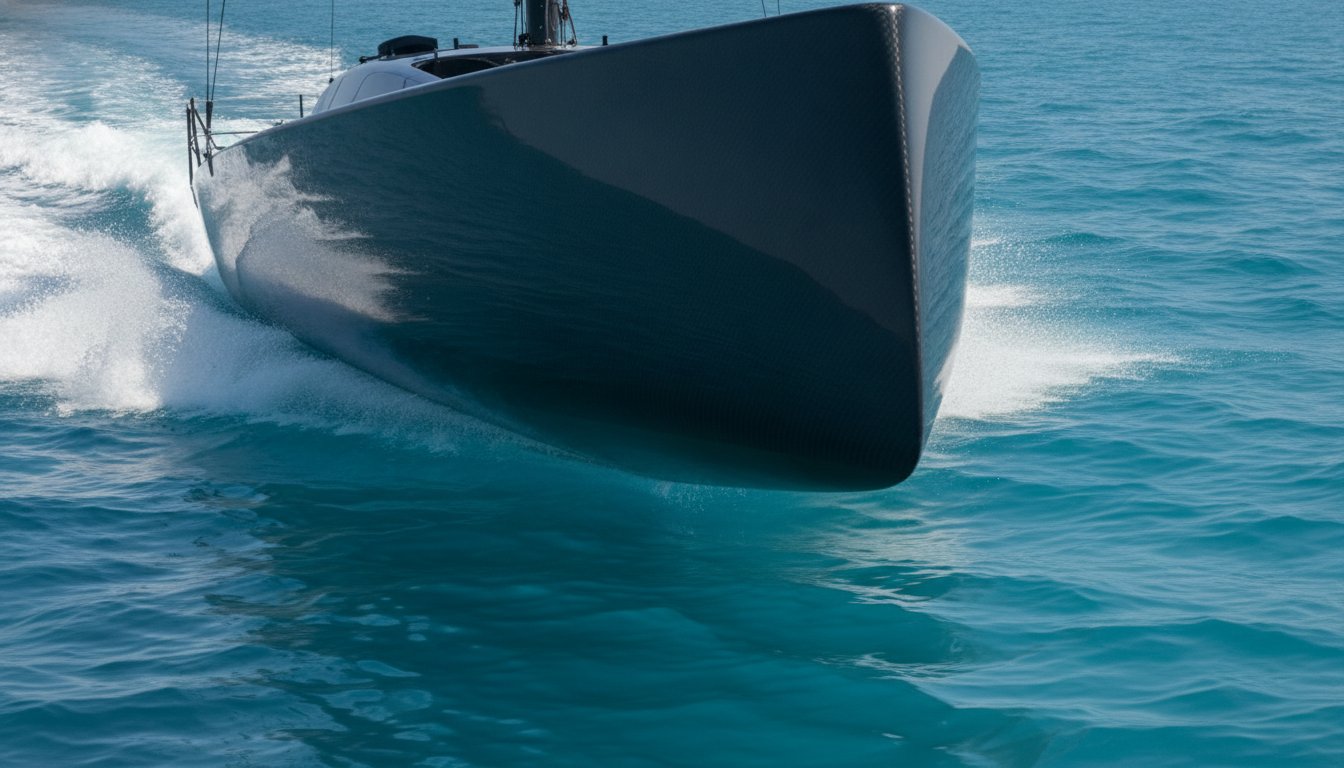
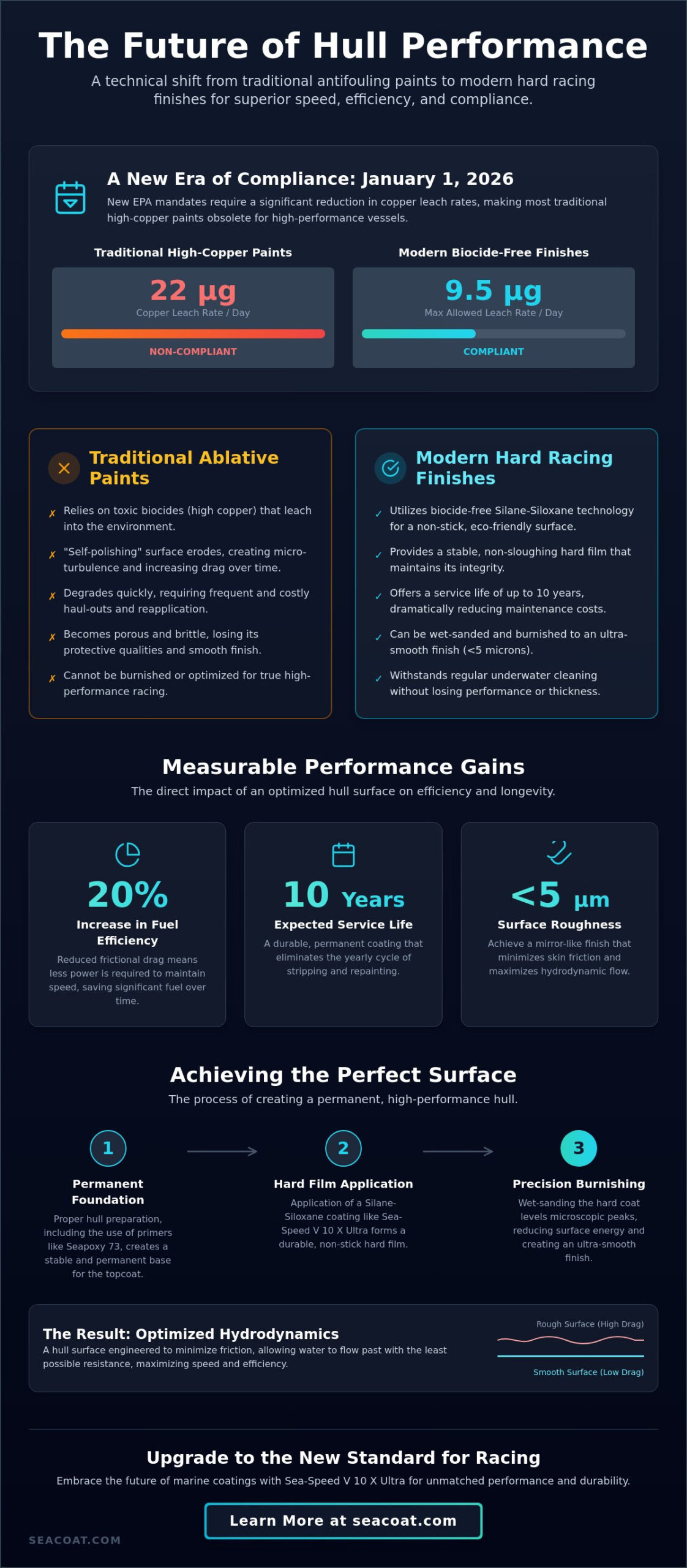
As of January 1, 2026, the maritime industry has reached a critical regulatory threshold where traditional high-copper antifouling paints, leaching up to 22 micrograms of copper daily, are no longer a viable option for high-performance vessels. You likely understand the frustration of watching your hull’s hydrodynamic efficiency degrade within months of application, forcing frequent hauls and abrasive scrubbing that strip away expensive coatings. This article demonstrates how transitioning to a modern hard racing finish boat paint, specifically biocide-free silane-siloxane technology, solves these operational bottlenecks by providing a surface roughness of less than five microns.
The pursuit of maximum velocity often feels like a constant battle against fluid dynamics and increasingly stringent environmental compliance. We’ll explore the technical shift toward hard-film coatings that meet the new EPA leach rate mandates of 9.5 micrograms while delivering an expected service life of up to ten years. By focusing on surface optimization rather than toxic chemical release, operators can realize fuel efficiency gains of up to 20 percent and maintain a durable, high-performance finish that withstands regular cleaning without loss of performance.
Key Takeaways
- Learn why a hard racing finish boat paint provides a superior hydrodynamic advantage over ablative coatings by allowing for precision sanding and burnishing.
- Understand the physics of frictional resistance and the specific mechanical properties that reduce the energy required to achieve higher top-end speeds.
- Examine the technical transition from toxic biocides to silane-siloxane systems that maintain compliance with 2026 environmental mandates.
- Discover how Sea-Speed V 10 X Ultra achieves a ten-year service life, significantly reducing long-term maintenance costs and hauling frequency.
- Identify the essential preparation techniques, including the use of Seapoxy 73, required to create a permanent and stable high-performance hull surface.
What Defines a Hard Racing Finish Boat Paint?
A What Defines a Hard Racing Finish Boat Paint? is a specialized coating system engineered for structural stability and mechanical optimization rather than chemical erosion. While traditional bottom paints often rely on the controlled release of biocides to deter marine growth, a hard racing finish prioritizes a non-sloughing, durable film that can be sanded and burnished to a precise level of smoothness. This technical distinction is critical for high-speed vessels where even microscopic surface irregularities lead to significant energy loss and increased skin friction.
Historically, the maritime industry relied on heavy copper loading to prevent biofouling. However; the evolution of material science has shifted the focus toward non-toxic, hard-film technologies such as silane-siloxane systems. These modern coatings don’t rely on leaching chemicals that eventually leave the paint film porous and brittle. Instead, they provide a permanent, non-stick surface that maintains its integrity over multiple seasons. This shift reflects a broader commitment to both operational efficiency and environmental stewardship, moving away from temporary fixes toward sophisticated, permanent solutions.
Hard vs. Ablative: Why Racing Demands Stability
Ablative paints are designed to wear away over time, a process often described as “self-polishing.” While this mechanism works for slow-moving coastal cruisers, it’s fundamentally detrimental to racing performance. As the paint sloughs off, it creates an uneven surface profile and micro-turbulence that disrupts the laminar flow of water around the hull. A hard racing finish boat paint provides several distinct advantages for performance-oriented owners:
- Structural Integrity: The coating does not thin out or “chalk” when the vessel is in motion or during transport.
- Mechanical Optimization: The hard film can be wet-sanded to an extremely fine grit, allowing for a mirror-like finish that minimizes drag.
- Maintenance Flexibility: Frequent underwater scrubbing to remove slime won’t deplete the coating’s thickness or effectiveness.
The Role of Surface Roughness in Vessel Speed
Hydrodynamic drag is largely a function of Average Hull Roughness (AHR). Even a hull that appears smooth to the naked eye contains microscopic peaks and valleys that disrupt water flow. These irregularities create friction; forcing the engine or sails to work harder to maintain velocity. By burnishing a hard coating, you effectively level these microscopic peaks. This process reduces the surface energy of the hull, making it harder for water molecules to “grip” the surface. For competitive sailors and powerboat racers, this translates into measurable gains in knot speed and a significant decrease in fuel consumption over long distances.
Performance Metrics: Friction, Drag, and the Physics of Speed
The operational efficiency of any high-speed vessel is fundamentally dictated by the interaction between its hull and the water column. To achieve peak velocity, one must address the Performance Metrics: Friction, Drag, and the Physics of Speed that govern maritime movement. Frictional resistance, or skin friction, accounts for a substantial portion of the total drag acting on a hull. When you apply a hard racing finish boat paint, you aren’t just adding a layer of protection; you’re re-engineering the hull’s interface with the ocean to facilitate a cleaner, more efficient release of water molecules.
Modern material science has moved beyond the limitations of traditional coatings. By utilizing silane-siloxane technology, such as Sea-Speed V 10 X Ultra, operators can achieve a surface roughness of less than five microns. This level of precision minimizes the microscopic turbulence that occurs within the boundary layer, allowing the vessel to maintain its momentum with less resistance. For those seeking to optimize their vessel’s profile, understanding the definitive guide to boat hull paint is essential for mapping technical specifications to real-world performance gains.
Hydrodynamic Drag and Frictional Resistance
The boundary layer is the thin region of fluid directly adjacent to the hull where velocity gradients are most extreme. In this zone, even minor surface irregularities act as tripwires, converting smooth laminar flow into chaotic, energy-consuming turbulence. Traditional ablative paints, which rely on a self-eroding mechanism, inherently possess a higher Average Hull Roughness (AHR) that increases drag over time. Conversely, a stabilized hard racing finish boat paint remains smooth and intact, ensuring that the hull’s hydrodynamic signature doesn’t degrade between maintenance cycles. A 10% reduction in drag can yield significant speed gains.
Calculating ROI Through Fuel and Time Savings
For commercial operators and competitive racers, the transition to high-performance coatings is a strategic financial decision. Because the engine doesn’t have to fight against excessive skin friction, fuel consumption is significantly reduced. Data indicates that optimizing hull smoothness can lead to fuel efficiency improvements of 12 to 20 percent. These savings, combined with a service life that can extend up to ten years, create a compelling return on investment that far exceeds the capabilities of standard antifouling products. If you’re ready to maximize your operational window, consider how advanced silane-siloxane systems can transform your asset’s performance. The reduction in engine load not only saves fuel but also extends the life of mechanical components, providing a multi-layered economic benefit that persists season after season.
Silane-Siloxane vs. Traditional Racing Antifouling
The maritime industry is currently witnessing the obsolescence of biocide-based coatings in favor of advanced mechanical systems. Traditional racing antifouling operates on a sacrificial principle; it leaches copper or other toxins into the water to prevent biofouling. This chemical depletion creates a significant performance paradox. As the biocide leaves the paint film, the coating becomes increasingly porous and microscopically rough. For a vessel relying on a hard racing finish boat paint, this degradation is unacceptable, as it introduces the very drag that the coating was intended to eliminate.
Silane-siloxane technology represents a fundamental departure from this leaching cycle. Rather than poisoning marine life, these coatings create a hard, permanent film with extremely low surface energy. This mechanical approach ensures that the hull remains smooth and hydrodynamically consistent throughout its entire service life. Because there is no chemical to deplete, the performance you measure on day one is the same performance you’ll experience years later. It’s a move from a temporary maintenance requirement to a permanent strategic asset.
The End of Toxic Antifouling
Global regulatory bodies are accelerating the transition away from high-leach coatings. Specifically, new EPA mandates effective January 1, 2026, target the toxic antifouling paint ban by limiting copper leach rates to 9.5 micrograms per square centimeter per day. This regulatory pressure is especially intense in racing harbors and sensitive marine ecosystems where accumulated toxins have historically damaged local biodiversity. Switching to a zero-leach silane-siloxane system isn’t just about compliance; it’s about securing a long-term operational license in an increasingly scrutinized industry.
Mechanical Foul Release: The Slicker Alternative
A silane-siloxane finish works by making the hull too slick for organisms to maintain a permanent bond. This low-surface-energy environment prevents the “glue” produced by barnacles and grass from adhering effectively to the hard racing finish boat paint. At speeds typically exceeding 10 knots, the hydrodynamic pressure of the water moving across the hull is enough to wash away any nascent colonization. This “self-cleaning” effect is a strategic advantage for racing vessels, ensuring the hull stays optimized without the need for aggressive mechanical scrubbing that can damage softer, traditional paints. The result is a cleaner hull that maintains its top-end speed without constant intervention.
Achieving the Perfect Surface: Application and Burnishing
The mechanical advantage of a hard racing finish boat paint is realized through precision application. It isn’t a standard maintenance task; it’s a structural upgrade to the hull’s hydrodynamic profile. If you apply a high-performance hard-film coating over old, soft ablative layers, the system will eventually fail. The underlying soft paint lacks the structural integrity to support a rigid topcoat, leading to cracking and delamination. True performance begins with a clean, fair substrate that allows the new coating to function as a permanent part of the vessel.
While spray application typically yields the most uniform film thickness, a meticulous roll-and-tip method can still achieve elite results. The goal is to minimize “orange peel” texture during the initial lay-down. By starting with a smooth application, you reduce the labor required during the critical burnishing phase. For those seeking the ultimate competitive edge, the final surface must be worked until it achieves a mirror-like quality that facilitates laminar flow.
Hull Preparation for Hard Coatings
Preparation is 90% of the finish. Stripping the hull back to the original gelcoat or a stable epoxy barrier is non-negotiable for racing vessels. Once the surface is bare and fair, applying a high-build epoxy primer like Seapoxy 73 ensures a superior chemical bond. This primer creates a stable, non-porous foundation that prevents the topcoat from being compromised by moisture or substrate imperfections. Ensuring the hull is perfectly fair before the topcoat is applied prevents microscopic turbulence that can negate the benefits of a low-friction finish.
The 5-Step Burnishing Protocol for Racing
Burnishing is the process of mechanically leveling the coating to achieve maximum slickness. This protocol transforms a standard application into a hard racing finish boat paint that out-performs any traditional alternative.
- Step 1: Perform an initial wet-sand with 400-grit abrasive to remove any surface irregularities or application texture.
- Step 2: Progress to 600-grit for secondary surface leveling, ensuring the entire hull has a uniform matte appearance.
- Step 3: Use 800 to 1200-grit abrasives to transition from a matte finish to a semi-gloss, ultra-smooth state.
- Step 4: Final burnishing with specialized polishing pads further reduces surface energy and increases slickness.
- Step 5: Inspect the hull for uniformity and surface energy consistency, ensuring there are no “dry” spots that could trap water molecules.
This methodical approach ensures that the hull remains optimized for multiple seasons. Unlike soft paints that wear away, a burnished hard finish provides a stable, repeatable performance platform that can be maintained with simple underwater wiping.
Sea-Speed V 10 X Ultra: The New Standard for Racing
Sea-Speed V 10 X Ultra represents the practical culmination of advanced material science applied to maritime performance. While previous sections detailed the physics of drag and the necessity of proper preparation, this silane-siloxane system functions as the specific tool to achieve those benchmarks. It provides the industry’s most sophisticated hard racing finish boat paint, delivering a surface roughness of less than five microns. This technical precision ensures that the vessel’s hull remains optimized for laminar flow, meeting the 2026 EPA mandates by eliminating toxic leaching entirely. It’s a strategic asset for operators who prioritize long-term return on investment over the repetitive cycle of annual maintenance.
The transition to a biocide-free, hard-film system is no longer a luxury but a regulatory and operational necessity. By moving away from copper-based antifouling, owners protect both the marine ecosystem and their vessel’s top-end speed. The technology doesn’t just meet current standards; it anticipates the future of heavy industry where environmental stewardship and maximum efficiency are inseparable. It is a reliable, no-nonsense solution for a high-stakes sector.
Extreme Durability and Longevity
The economic impact of coating choice is most visible in the service life window. Traditional racing paints typically require reapplication every 12 to 24 months as the biocide leaches out and the film becomes porous. Sea-Speed V 10 X Ultra provides a ten-year service life, fundamentally changing the asset management cycle. Because it’s a non-depleting hard-film, it doesn’t lose its physical or hydrodynamic properties over time. You can scrub the hull in-water as frequently as needed to remove slime without releasing toxins or thinning the coating. For a deeper technical comparison of these mechanisms, see our analysis of Foul Release vs. Antifouling Paint. This durability ensures that the hull’s performance profile remains consistent from the first day of application to the end of the decade.
The Competitive Edge for Racers
For competitive sailors and powerboat racers, every fraction of a knot is a decisive factor. Case studies across various racing classes demonstrate that the low-friction surface of Sea-Speed leads to measurable speed gains and reduced fuel consumption. The availability of Sea-Speed V 10 X Ultra Clear offers a unique advantage for high-performance hulls, such as those constructed from carbon fiber, by allowing for continuous visual inspection of the substrate without compromising protection. This transparency is vital for identifying structural issues early in high-stress racing environments. If you are ready to optimize your vessel for the 2026 season and beyond, contact Seacoat SCT, LLC for a custom quote on Sea-Speed V 10 X Ultra. Investing in a superior hard racing finish boat paint provides a permanent mechanical advantage that traditional, toxic alternatives simply cannot replicate.
Securing Your Competitive Edge in a Regulatory Future
The maritime landscape of 2026 demands a fundamental shift in how we approach hull performance. By prioritizing mechanical smoothness over chemical toxicity, you aren’t just meeting new environmental mandates; you’re securing a permanent hydrodynamic advantage. This transition to a high-performance hard racing finish boat paint ensures that your vessel maintains its top-end speed and fuel efficiency without the performance decay typical of traditional antifouling. You’ve seen how surface roughness and biocide leaching compromise velocity; now it’s time to implement a solution that remains stable season after season.
Sea-Speed V 10 X Ultra provides a strategic asset for those who value long-term reliability and operational excellence. With its ten-year service life and zero-VOC, non-toxic composition, this silane-siloxane technology is already trusted by military and commercial fleets worldwide. It offers a stable, scrubbable surface that withstands the rigors of competitive racing while preserving the health of natural ecosystems. You don’t have to compromise between speed and sustainability.
Upgrade to Sea-Speed V 10 X Ultra for Maximum Racing Performance
Take control of your vessel’s efficiency today and experience the measurable difference that expert engineering makes on the water.
Frequently Asked Questions
Is hard racing finish boat paint better than ablative paint for racing?
Yes, hard finishes are superior for racing because they provide a stable, non-sloughing surface that can be mechanically burnished. Ablative paints are designed to erode, which creates micro-turbulence and increases drag as the vessel moves. A hard racing finish boat paint maintains its structural integrity and film thickness, ensuring the hull remains optimized for laminar flow over multiple seasons without the performance degradation associated with self-polishing systems.
Can I apply a hard racing finish over my existing bottom paint?
You shouldn’t apply a hard racing finish over existing bottom paint, especially if the old coating is ablative or soft. The rigid nature of a hard-film coating requires a stable, fair substrate to prevent delamination and cracking. For the best results, strip the hull back to the gelcoat or a solid epoxy barrier like Seapoxy 73 to ensure a permanent chemical and mechanical bond that won’t fail under high-speed stress.
How do I burnish a hard racing finish for maximum speed?
Burnishing is achieved through a controlled wet-sanding protocol that levels the hull’s surface at a microscopic level. By progressing through sandpaper grits from 400 to 1200, you remove application texture and “orange peel.” This process reduces the average hull roughness to under five microns, creating the ultra-slick interface necessary to allow water to release more efficiently, which is the primary goal for maximizing top-end speed.
Do non-toxic foul release coatings really work for racing boats?
Yes, modern silane-siloxane foul release coatings outperform traditional toxic paints by focusing on mechanical slickness rather than chemical poisoning. Organisms can’t easily bond to the low-surface-energy environment created by this technology. Unlike traditional paints that become rough as biocides deplete, a hard racing finish boat paint stays smooth and intact, providing a permanent performance advantage that meets all 2026 environmental regulations without sacrificing velocity.
How long does a hard racing finish like Sea-Speed V 10 X Ultra last?
A high-performance coating like Sea-Speed V 10 X Ultra is engineered for an expected service life of up to ten years. This is a significant improvement over traditional antifouling paints that typically fail or require reapplication within 12 to 24 months. Because the coating is a non-depleting hard-film, it can be regularly scrubbed to remove slime without losing its hydrodynamic properties or releasing harmful contaminants into the water column.
What grit sandpaper should I use for wet-sanding a racing hull?
For elite racing results, use a grit progression starting at 400 for initial leveling and moving up to 1200 for a mirror finish. The 400 and 600-grit stages are critical for removing surface irregularities and application marks. The 800 to 1200-grit stages provide the final semi-gloss smoothness that minimizes skin friction. This methodical approach ensures the hull has the lowest possible surface energy for maximum hydrodynamic efficiency.
Can hard racing paint be used on aluminum boats?
Yes, silane-siloxane coatings are perfectly suited for aluminum hulls because they are biocide-free and don’t contain copper. Traditional copper-based paints cause destructive galvanic corrosion when applied to aluminum, leading to structural damage. A non-toxic hard finish provides a safe, durable, and high-performance alternative that protects the metal substrate while significantly reducing drag for competitive racing or commercial operations.
How much faster will my boat go with a hard racing finish?
While results vary by vessel type, optimizing hull smoothness can lead to speed increases and fuel efficiency gains of 12 to 20 percent. By minimizing skin friction through a burnished finish, the engine or sails convert more energy into forward momentum rather than fighting drag. While the exact “knot-gain” depends on the hull’s initial condition, the reduction in resistance consistently leads to higher top-end speeds and lower engine load.