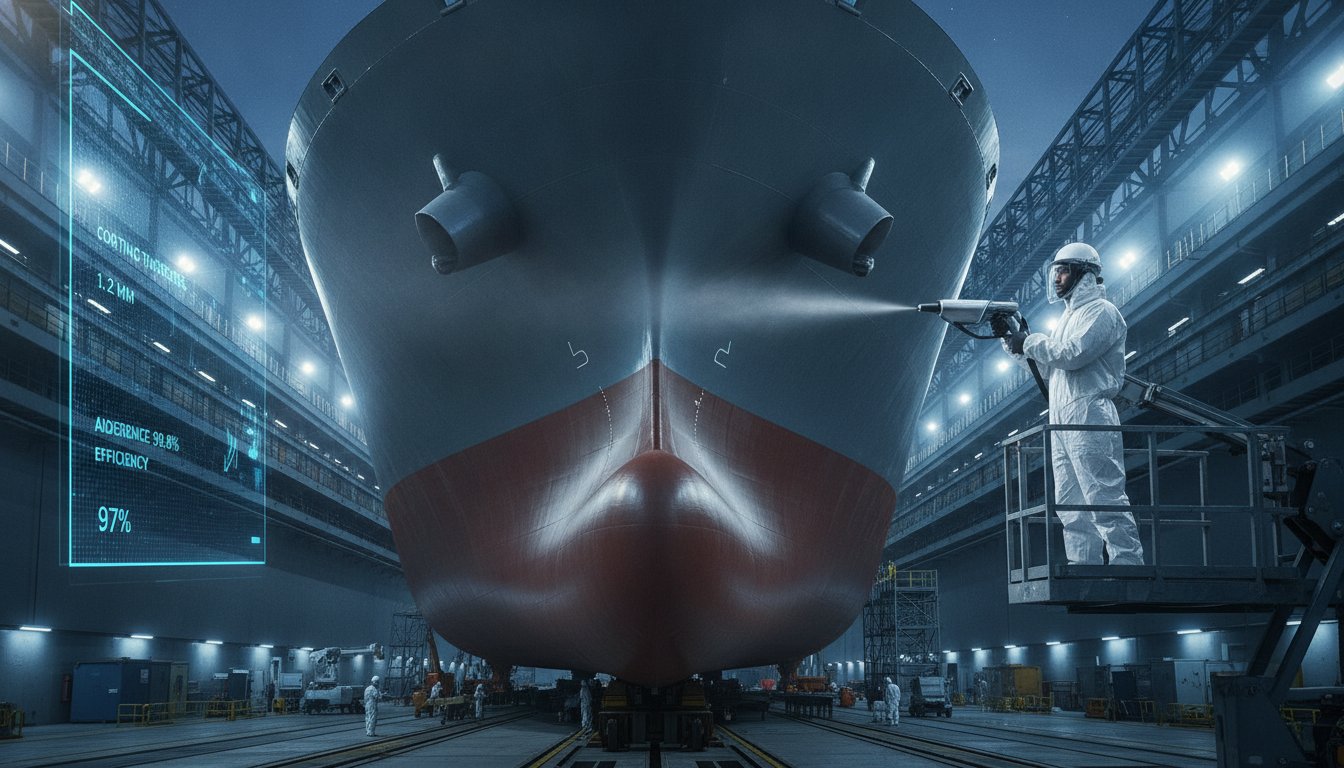
High-performance foul release systems can deliver fuel savings of up to 20% for large vessels, yet these gains are frequently lost due to minor deviations during the dry-docking process. Adhering to the exact technical specifications for foul release coating application is no longer optional. It’s the critical threshold between meeting 2026 CII ratings and facing severe operational penalties. You recognize that the transition to biocide-free systems is driven as much by the bottom line as it is by the 9.5 microgram copper leach rate mandates now enforced by the EPA. This shift requires a move away from traditional painting toward a disciplined, data-driven application process.
This guide provides the definitive engineering protocols required to master anchor profiles, dry film thickness precision, and environmental controls to ensure your vessel achieves its maximum hydrodynamic potential. We’ll examine the mechanical requirements for surface preparation, the chemistry of modern foul release systems, and the rigorous documentation needed to verify long-term fuel savings. You’ll learn how to secure the 10 year dry-dock intervals and verified efficiency gains that define modern maritime stewardship. By treating the hull surface as a strategic asset, you can ensure both regulatory compliance and a superior return on investment.
Key Takeaways
- Understand why viewing hull coatings as high-performance engineered surfaces rather than traditional paint is essential for reducing frictional drag and maximizing hydrodynamic efficiency.
- Master the precise technical specifications for foul release coating application, including mandatory SSPC-SP 10 cleanliness standards and specific Rz anchor profiles required for permanent adhesion.
- Learn to manage critical application parameters, such as maintaining the environmental window and relative humidity limits, to prevent moisture entrapment and coating failure.
- Identify the rigorous quality control protocols, including high-voltage holiday testing and visual drag-reduction assessments, necessary to verify the integrity of the finished surface.
- Discover how the Silane-Siloxane chemistry of Sea-Speed V 10 X Ultra provides a durable hard film that exceeds 2026 VOC standards while eliminating the maintenance issues of soft silicone systems.
The Engineering Shift: Why Technical Specifications for Foul Release Application Matter
The maritime industry has reached a pivotal junction where hull maintenance is no longer a cosmetic or basic protective task. It’s a precise engineering discipline. With the implementation of the IMO’s EEXI and CII regulations in 2026, the hull’s hydrodynamic efficiency is now a critical factor in a vessel’s financial viability. Traditional methods relied on chemical toxicity to repel growth, but modern systems utilize low-surface-energy physics. This transition requires a strict adherence to technical specifications for foul release coating application to ensure the surface performs as an engineered asset rather than just a layer of paint.
Moving away from biocidal leaching toward physical release mechanisms represents a fundamental shift in material science. Instead of poisoning marine organisms, these coatings create a surface so smooth and chemically inert that organisms cannot establish a permanent bond. This approach preserves natural ecosystems while simultaneously reducing the energy required to move a vessel through the water. It’s a synergistic solution that balances operational profit with environmental stewardship.
Frictional Drag and the 10-Micron Rule
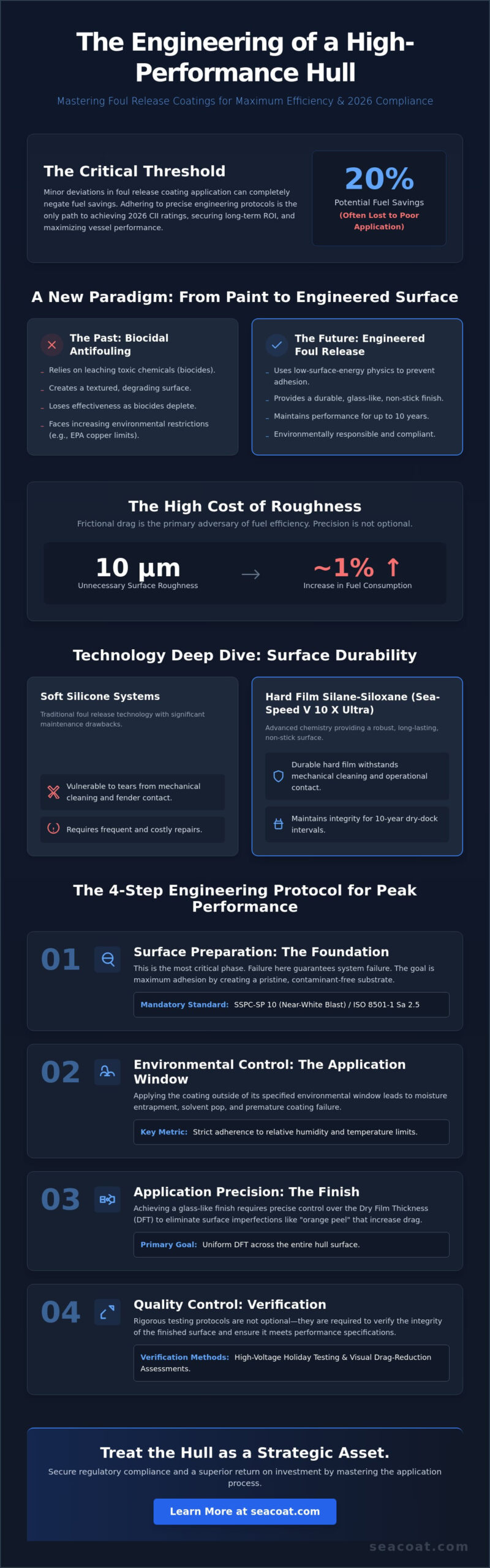
Frictional drag is the primary adversary of fuel efficiency. Research indicates that even minor deviations during the application process can lead to a significant Hull Roughness Penalty. Understanding What is Biofouling? and its mechanical impact on drag is vital for any technical superintendent. Data shows that every 10 microns of unnecessary surface roughness can increase fuel consumption by approximately 1%. While traditional antifouling boat paint often leaves a textured surface that degrades as biocides leach out, foul release systems are designed to provide a glass-like finish. Achieving this level of smoothness depends entirely on the precision of the application technique and the underlying anchor profile.
Silane-Siloxane vs. Traditional Silicone Systems
The industry is currently moving away from soft silicone systems toward advanced Silane-Siloxane technology. These hard-film coatings offer a strategic advantage in both durability and maintenance. Unlike soft silicones that are easily torn during mechanical cleaning or fender contact, Silane-Siloxane films provide a robust, non-stick surface that maintains its integrity for up to 10 years. Integrating these environmental marine coatings into fleet management requires updated technical specifications for foul release coating application. These specifications focus on high-solids delivery and precise dry film thickness (DFT) to eliminate the orange peel effect that plagues less sophisticated applications. By prioritizing technical excellence, operators can secure long-term ROI while meeting the stringent environmental standards of 2026.
Surface Preparation: Mechanical Specifications for Maximum Adhesion
The success of an engineered hull surface is decided long before the first liter of coating is applied. Surface preparation is the most critical phase in the engineering cycle; it dictates the longevity and performance of the entire system. Without a pristine substrate, even the most advanced Silane-Siloxane chemistry will fail prematurely due to delamination. To avoid this, technical specifications for foul release coating application mandate a cleanliness standard of SSPC-SP 10 (Near-White Blast Cleaning) or its international equivalent, ISO 8501-1 Sa 2.5. This level of preparation ensures the removal of all mill scale, rust, and previous coating remnants, leaving only slight streaks or discolorations on the metal surface.
Beyond visual cleanliness, the removal of microscopic contaminants is essential. Soluble salts, if left trapped beneath the film, act as osmotic engines that draw moisture through the coating, leading to catastrophic blistering. Engineering protocols require conductivity testing, typically using the Bresle method, to verify that salt levels are below 50 mg/m². Additionally, inspectors must conduct a thorough review of weld seams and sharp edges. These areas are prone to premature thinning; therefore, grinding sharp edges to a minimum radius of 2mm is necessary to ensure uniform coating continuity across the entire hull geometry.
Cleanliness and Abrasive Blasting Standards
Achieving the correct substrate condition requires specific abrasive grit selection. Operators should utilize sharp, angular grit to produce the necessary mechanical teeth for the primer. It’s non-negotiable to strip away every trace of legacy ablative bottom paint. Because ablative layers are designed to slough off, they lack the structural integrity to support a high-performance foul release system. Once blasting is complete, the surface must be vacuumed or blown down with dry, oil-free air to pass a “white cloth” dust test before the primer window closes. Following rigorous adherence to silicone fouling-release coating specifications ensures that the mechanical bond is as resilient as the chemical one.
Surface Profile and Anchor Patterns
The mechanical bond depends on the Rz (peak-to-valley) anchor pattern. For modern foul release systems, the target profile is generally between 50 and 75 microns. If the profile is too shallow, the coating won’t “lock” to the steel; if it’s too deep, the peaks may protrude through the primer, causing “pinpoint” rusting. Verification is performed using Testex press-o-film tape across multiple hull sections to ensure consistency. For specialized vessels, such as those requiring boat paint for aluminum boats, prep protocols must exclude carbon steel abrasives to prevent galvanic corrosion. Mastering these mechanical details is how you ensure long-term coating stability and operational reliability.
Application Parameters: Environmental and Mechanical Constraints
Precision during the application phase is what separates a standard hull coating from an engineered foul release system. While surface preparation provides the foundation, the actual application phase is where the hydrodynamic performance is finalized. Adhering to the technical specifications for foul release coating application ensures that the low-surface-energy properties are fully realized. Failure to maintain these parameters doesn’t just risk aesthetic issues; it compromises the chemical cross-linking necessary for a 10 year service life. Environmental variables must be monitored constantly, as even a brief excursion outside the specified window can trap moisture at the substrate interface, leading to latent delamination.
Mechanical constraints are equally vital. Airless spray equipment must be calibrated to handle high-solids formulations like Sea-Speed V 10 X Ultra. Standard tip sizes typically range from .019 to .023 inches, with pump pressures maintained between 2,500 and 3,000 psi to ensure proper atomization. Proper atomization prevents the “orange peel” texture that increases frictional drag. If the coating is applied too thickly in a single pass, sags and runs will disrupt the laminar flow across the hull. Conversely, thin spots leave the substrate vulnerable to corrosion and micro-fouling attachment.
The Environmental Specification Table
The following parameters represent the mandatory operational limits for applying modern Silane-Siloxane systems. These must be recorded in the daily log at two-hour intervals during the application process.
| Parameter | Operational Requirement |
|---|---|
| Air Temperature | 5°C to 40°C (41°F to 104°F) |
| Steel Temperature | Minimum 3°C (5°F) above calculated Dew Point |
| Relative Humidity (RH) | Maximum 85% |
| Wind Speed | Maximum 15 knots (to prevent solvent loss and overspray) |
In tropical shipyards, high humidity is the primary challenge, while temperate climates often struggle with the dew point delta. If the steel temperature drops too close to the dew point, microscopic condensation forms instantly. This invisible moisture layer prevents the primer from wetting the surface profile properly, which is a leading cause of coating failure in the maritime sector.
DFT and Layer Management
Managing Dry Film Thickness (DFT) is a multi-stage process that begins with Wet Film Thickness (WFT) monitoring. For a system like Sea-Speed V 10 X Ultra, the primer layer (often Seapoxy 73) must be applied to a specific thickness to fill the anchor profile without burying it. The topcoat is then applied to reach the total system DFT. Applicators must respect the overcoat window; if the topcoat is applied too early, solvent entrapment occurs. If applied too late, the primer may cure too hard for the topcoat to achieve a chemical bond. Maintaining this schedule is critical for ensuring the hard-film durability that modern fleet management demands.
Quality Control and Verification Protocols
Verification is the final pillar of the engineering cycle. Without measurable data, the theoretical benefits of a foul release system remain unproven. Adhering to the technical specifications for foul release coating application requires a rigorous quality control (QC) regimen that begins before blasting and continues until the vessel is waterborne. This process ensures that the hydrodynamic surface meets the precise friction-reduction targets required for EEXI compliance. It’s the difference between a successful long-term asset and an expensive failure.
Visual inspections are the first line of defense, specifically targeting runs, sags, or “orange peel” textures that disrupt laminar flow. However, visual checks alone are insufficient for high-stakes maritime assets. We utilize high-voltage spark testers for holiday testing to identify microscopic pinholes that could lead to localized corrosion. To verify the mechanical bond discussed in the surface preparation phase, ASTM D4541 pull-off adhesion tests are performed on representative areas. Finally, a hull roughness survey using a stylus-type gauge provides the definitive performance baseline. This survey quantifies the Rz values to confirm that the application has successfully minimized the Hull Roughness Penalty.
The 4-Step QC Checklist for Shipyards
To streamline the dry-docking workflow and ensure technical compliance, shipyards should adopt this structured 4-step checklist:
- Step 1: Pre-blast inspection. Verify substrate integrity and conduct Bresle salt contamination tests to ensure levels are below 50 mg/m².
- Step 2: Environmental monitoring. Record air temperature, steel temperature, and humidity every 2 hours to ensure the application window remains open.
- Step 3: DFT spot checks. Use calibrated magnetic gauges to verify thickness across the flat bottom, vertical sides, and high-wear areas like the bow.
- Step 4: Post-cure validation. Perform comprehensive holiday detection and a final roughness survey before the vessel undocks.
Documentation and Record Keeping
A Daily Inspection Report (DIR) is not merely paperwork; it’s a strategic asset for warranty verification and performance tracking. Every technical parameter must be documented with precision. This includes batch numbers, specific mixing ratios, and induction times for multi-component systems like Seapoxy 73. Most importantly, inspectors must verify the pot life of the material. Applying product that has begun its initial cure leads to poor wetting and reduced adhesion, which can compromise the entire system’s integrity. Detailed record-keeping ensures that the vessel’s performance can be audited against its operational data over its 10-year service life. For project managers looking to implement these standards, you can access our full technical documentation and QC templates here to ensure every gallon applied meets our engineering standards.
The Sea-Speed Advantage: Technical Excellence in Foul Release
The 2026 regulatory landscape demands a move away from sacrificial systems toward permanent, high-performance engineered surfaces. Sea-Speed V 10 X Ultra provides this transition through a high-solids, zero-VOC formulation that prioritizes both ecological safety and industrial durability. Adhering to the technical specifications for foul release coating application for this specific chemistry allows fleet managers to bypass the inherent weaknesses of soft silicone elastomers. While soft systems are easily damaged by mechanical contact or aggressive in-water cleaning, the Silane-Siloxane hard film creates a robust, non-stick barrier. It’s a strategic asset. This film maintains its hydrodynamic profile for up to 10 years, ensuring long-term compliance with EEXI and CII standards.
This durability is anchored by the system’s compatibility with high-performance primers like Seapoxy 73. This epoxy foundation ensures that the foul release topcoat is chemically bonded to the substrate, preventing the delamination issues often seen with less sophisticated systems. Precision pays dividends. Because the film is hard and resilient, in-water cleaning protocols are simplified. Divers can utilize standard cleaning equipment without the risk of gouging the coating, which is a frequent failure point for traditional silicone-based products. This mechanical resilience translates directly into extended service intervals and reduced maintenance costs.
Sea-Speed V 10 X Ultra Technical Highlights
- Zero-VOC Profile: Meets and exceeds all 2026 environmental standards, ensuring compliance in any global jurisdiction without sacrificing material strength or longevity.
- High Volume Solids: Maximizes coverage rates and efficiency per gallon, which significantly reduces the total volume of material required for large-scale hull applications.
- Optimized Application Cycles: The simplified two-coat process reduces time in dry-dock, allowing for faster vessel turnaround and lower operational overhead during the maintenance window.
- Mechanical Resistance: The hard-film finish resists abrasion from fenders, ice, and debris, preserving surface smoothness and fuel efficiency throughout the entire service interval.
Next Steps for Fleet Managers
Successful implementation requires precise alignment between the coating chemistry and the vessel’s operational profile. To ensure your application meets the technical specifications for foul release coating application, we provide comprehensive support for technical superintendents and shipyard teams. This includes detailed training requirements for applicators to master the unique flow characteristics and curing windows of Silane-Siloxane technology. You can ensure your fleet achieves its maximum hydrodynamic potential by choosing to Download the Sea-Speed V 10 X Ultra Technical Specifications to begin your vessel-specific engineering review.
Securing Long-Term Hydrodynamic Performance for 2026 and Beyond
Mastering the technical specifications for foul release coating application is the only way to transform hull maintenance from a recurring expense into a strategic performance advantage. We’ve examined how precise anchor profiles, strict environmental monitoring, and rigorous holiday testing work in unison to eliminate the Hull Roughness Penalty. By shifting from sacrificial biocides to engineered Silane-Siloxane physics, you secure an asset that meets the most stringent 2026 EEXI and CII regulations while providing unmatched durability. This isn’t just about protection; it’s about optimizing the entire vessel’s energy profile for up to a decade.
Our proprietary hard-film technology has been in continuous commercial use since 2001. It proves that physical durability and ecological safety are synergistic rather than mutually exclusive. Achieving these results requires a commitment to engineering precision at every stage of the dry-docking cycle. By adhering to these protocols, you ensure that your fleet remains both compliant and competitive in an increasingly regulated global market.
To ensure your next application meets these exacting standards, consult with our technical team for your specific fleet requirements. We’re ready to help you navigate the transition toward a more efficient and sustainable maritime future.
Engineering and Technical FAQs
What is the required surface profile for foul release coating application?
The required surface profile for a successful application is a Near-White Blast Cleaning to SSPC-SP 10 or ISO 8501-1 Sa 2.5 standards. This level of preparation must achieve a specific Rz (peak-to-valley) anchor pattern of 50 to 75 microns. This mechanical tooth is necessary for the primer to bond permanently to the steel substrate. Without this precise profile, the coating risks delamination under the intense hydrodynamic pressures experienced at high service speeds.
Can foul release coatings be applied over old antifouling paint?
No, foul release coatings cannot be applied over old antifouling paint. Traditional ablative coatings are designed to wear away over time; they don’t provide a stable enough foundation for a high-performance engineered system. All legacy layers must be completely removed through abrasive blasting to ensure the new system bonds directly to the prepared substrate. This is a critical step in the technical specifications for foul release coating application to prevent catastrophic coating failure.
What are the humidity and temperature limits for applying Sea-Speed V 10 X Ultra?
For Sea-Speed V 10 X Ultra, the air and steel temperatures should remain between 5°C and 40°C during the application and curing phases. Additionally, the steel temperature must be at least 3°C (5°F) above the calculated dew point to prevent condensation. Relative humidity must stay below 85% to ensure the Silane-Siloxane chemistry cross-links correctly. Monitoring these environmental constraints is vital for achieving the rated hydrodynamic efficiency.
How is Dry Film Thickness (DFT) measured for marine hull coatings?
Dry Film Thickness (DFT) is measured using calibrated non-destructive magnetic or eddy current gauges according to ASTM D7091 standards. Inspectors take multiple readings across the flat bottom and vertical sides of the hull to ensure uniform coverage. During the spraying process, applicators use Wet Film Thickness (WFT) combs to provide real-time feedback. This ensures the final cured film meets the engineering requirements for both protection and surface smoothness.
What equipment is needed for airless spray application of foul release systems?
Airless spray application requires industrial-grade pumps capable of maintaining pressures between 2,500 and 3,000 psi. We recommend using spray tips with an orifice size ranging from .019 to .023 inches to achieve proper atomization of high-solids formulations. Using the correct equipment prevents “orange peel” textures and ensures a laminar flow surface. Proper setup is essential for meeting the technical specifications for foul release coating application and maximizing fuel savings.
What is holiday testing and why is it necessary for hull coatings?
Holiday testing is a high-voltage spark detection method used to locate microscopic pinholes or “holidays” in the cured coating film. These discontinuities are invisible to the naked eye but allow water to reach the steel substrate, leading to localized corrosion and blistering. By identifying and repairing these spots before the vessel undocks, you protect the integrity of the entire hull system. It’s a mandatory quality control step for high-stakes maritime assets.
How long is the curing time before a vessel can be refloated?
The required curing time before a vessel can be refloated depends on the ambient temperature and ventilation conditions at the shipyard. While Sea-Speed V 10 X Ultra is often dry to the touch within hours, a full cure typically takes 12 to 24 hours under standard conditions. You should always consult the specific Technical Data Sheet (TDS) for your project’s temperature profile. Refloating a vessel before the film has achieved its mechanical hardness can lead to premature coating damage.
Are there specific VOC regulations for marine coatings in 2026?
Yes, 2026 marks a significant shift in global environmental compliance for marine coatings. The EPA has restricted copper leach rates to 9.5 micrograms per square centimeter per day, while the IMO has implemented revised hydrolysis kinetics stability tests. These regulations make many traditional biocidal paints obsolete. Utilizing zero-VOC, biocide-free systems like Sea-Speed ensures your fleet remains compliant with both international standards and regional rules like Brazil’s NORMAM-401.