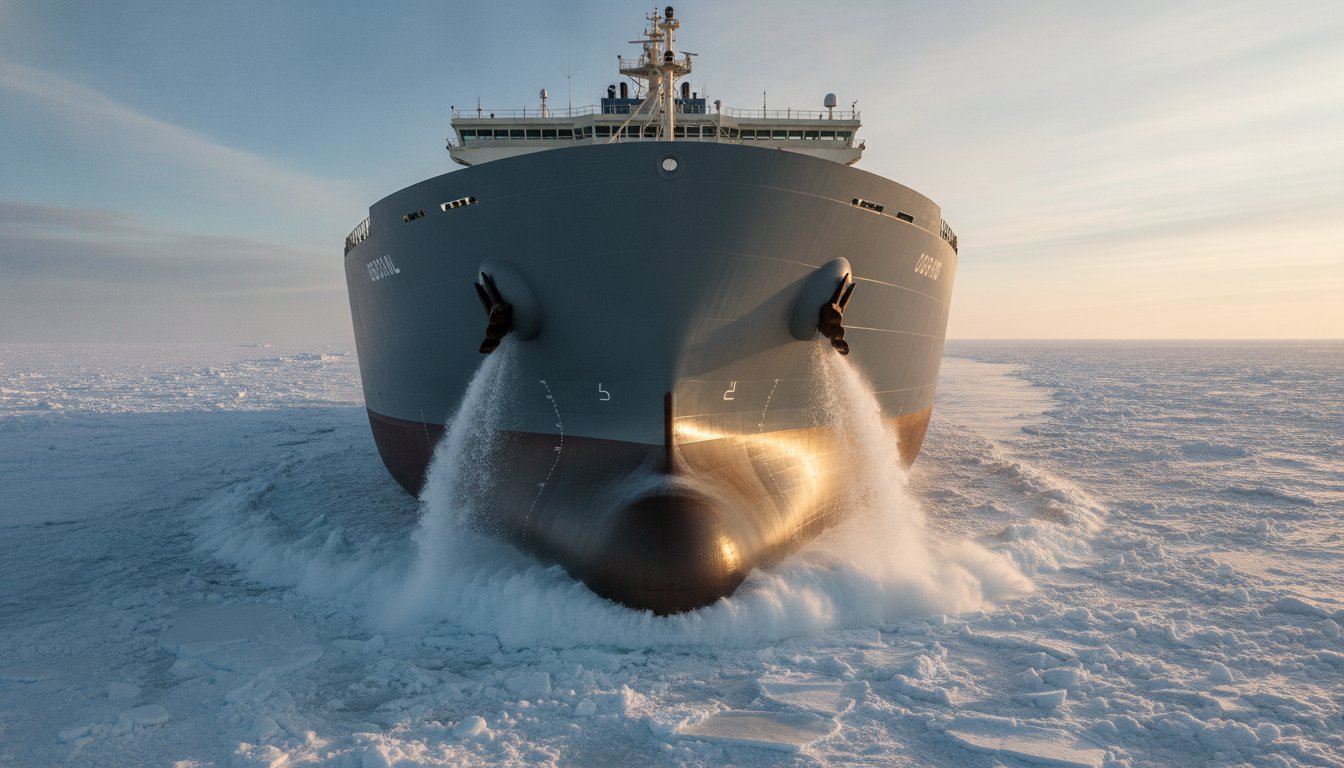
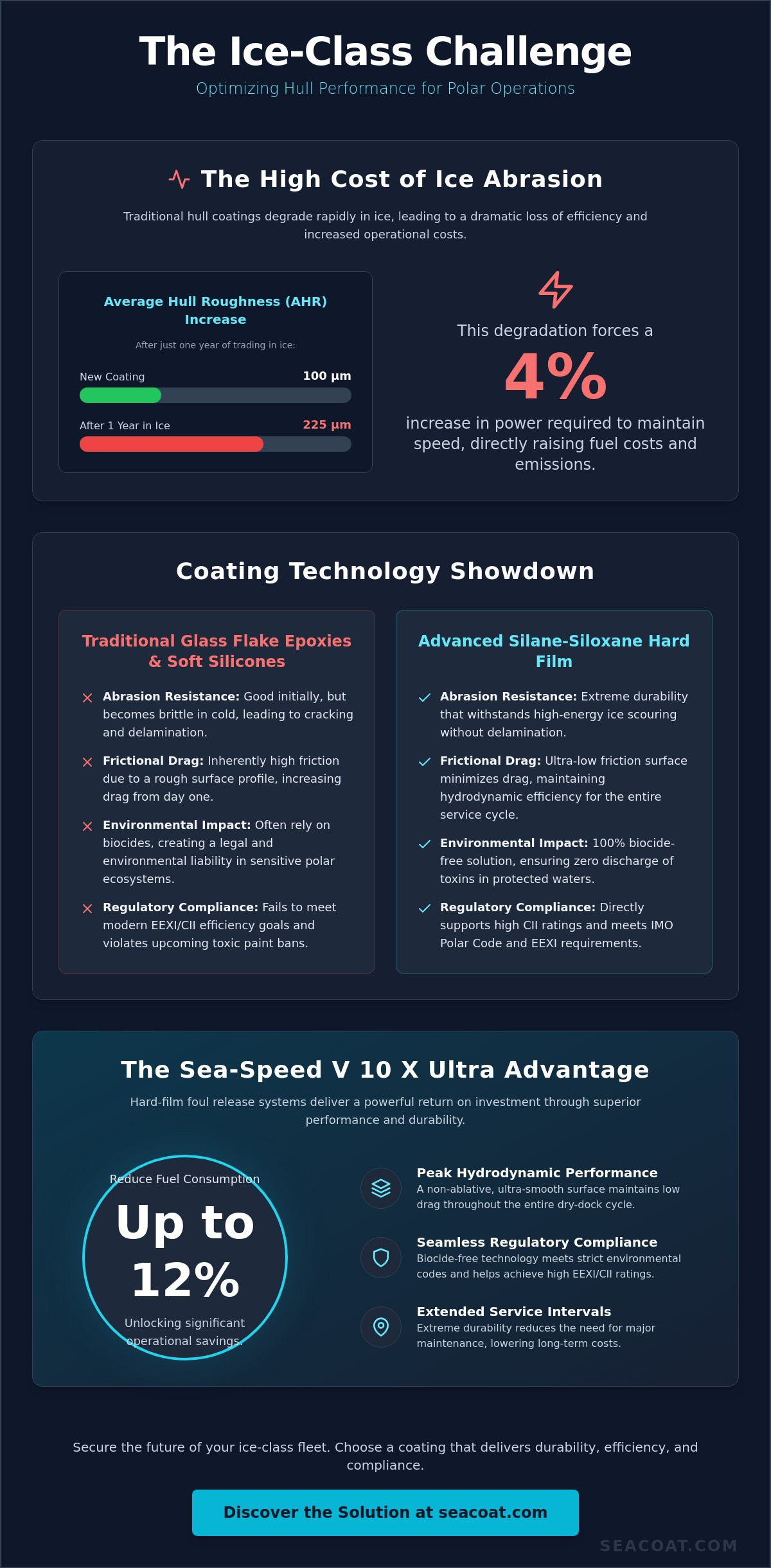
A steel hull equipped with a traditional anticorrosive system can experience an increase in Average Hull Roughness from 100 to 225 microns after just one year of trading in ice. This rapid degradation forces a 4% increase in the power required to maintain vessel speed, directly impacting your bottom line through rising fuel costs and increased emissions. Identifying the best coating for ice class vessels is no longer just about preventing delamination; it’s about maintaining hydrodynamic efficiency in the most unforgiving environments on Earth.
You likely recognize the frustration of seeing standard coatings peel or delaminate under the relentless mechanical stress of ice impact, which leaves your hull vulnerable and inefficient. We’ll show you how advanced hard-film foul release technology, such as Sea-Speed V 10 X Ultra, provides the extreme durability required for ice-going vessels while significantly reducing frictional drag and operational expenses. This article examines how these biocide-free solutions ensure compliance with the IMO Polar Code and EEXI/CII regulations while maintaining a smooth, high-performance surface for the entire dry-dock cycle.
Key Takeaways
- Understand how to mitigate the significant increase in hull roughness typically caused by ice navigation to maintain peak hydrodynamic performance throughout the service cycle.
- Discover why advanced Silane-Siloxane technology is the best coating for ice class vessels, offering a unique combination of extreme abrasion resistance and low frictional drag.
- Analyze the technical limitations of traditional glass flake epoxies and soft silicones when operating in high-stress polar environments where mechanical durability is non-negotiable.
- Gain insights into achieving seamless compliance with the IMO Polar Code and EEXI/CII regulations through the use of high-performance, biocide-free hull solutions.
- Evaluate the strategic ROI of hard-film foul release systems, which can reduce fuel consumption by up to 12% while extending intervals between major maintenance periods.
Requirements for Ice Class Vessel Hull Coatings in 2026
Operating in frozen waters requires more than just structural reinforcement; it demands a specialized protective layer capable of enduring the brutal mechanical reality of ice navigation. An Ice class designation identifies a vessel’s capability to navigate through various ice conditions, from thin first-year ice to multi-year polar pack ice. This classification, governed by the International Association of Classification Societies (IACS), dictates the structural requirements of the ship. However, it also creates a unique set of challenges for the hull coating, which must act as the primary defense against both corrosion and extreme physical abrasion. Historically, the industry relied on heavy-duty glass flake epoxies to manage these loads, but as we enter 2026, the criteria for the best coating for ice class vessels have shifted significantly. Modern operators now require a synergy between extreme mechanical durability and high-level hydrodynamic efficiency.
Mechanical Stress and Ice Abrasion
The physics of ice impact on a vessel’s bow and waterline are unforgiving. As a ship moves through ice, the hull experiences constant high-energy “scouring” events. This process doesn’t just scratch the surface; it exerts immense pressure that can strip away standard coatings, exposing bare steel to the corrosive effects of seawater. This exposure leads to rapid oxidation and a dramatic increase in surface roughness. For a coating to survive, it must possess exceptional mechanical bond strength that remains stable even in sub-zero temperatures. Traditional systems often become brittle in extreme cold, leading to cracking and delamination when the hull flexes under ice pressure. A truly effective ice-class solution must maintain its integrity and adhesion under these specific thermal and mechanical loads.
Environmental and Regulatory Compliance
The regulatory landscape for polar operations is tightening. The toxic antifouling paint ban represents a major pivot for operators working in sensitive ecosystems. Arctic and Antarctic waters are increasingly subject to zero-discharge requirements, making traditional biocidal leachable coatings a significant environmental and legal liability. Furthermore, the 2026 EEXI and CII mandates place a premium on hull efficiency. Because increased hull roughness can force a 4% increase in the power required to maintain speed, selecting the best coating for ice class vessels is now a matter of regulatory compliance. A coating that stays smooth under ice impact directly influences a vessel’s Carbon Intensity Indicator (CII) rating by minimizing fuel burn and emissions. Transitioning to non-toxic, hard-film systems allows operators to meet these stringent environmental standards without sacrificing the mechanical protection necessary for ice-going service.
The Science of Abrasion Resistance vs. Frictional Drag
Traditional ice-class protection has historically prioritized film thickness over surface smoothness. While heavy-duty glass flake epoxies provide the necessary impact resistance, their inherent surface profile is functionally rough. This texture creates a high coefficient of friction that persists even when the coating is new. In contrast, modern high-performance systems focus on minimizing Average Hull Roughness (AHR) to preserve hydrodynamic efficiency. Data shows that a steel hull using a traditional anticorrosive system can see its AHR jump from 100 to 225 microns after just one year of ice service. This degradation forces a 4% increase in the power required to maintain vessel speed; it’s a direct tax on your operational budget. Silane-Siloxane technology is a non-ablative, hard-surface alternative to traditional marine paints. It introduces the “Hard-Film Foul Release” concept, which bridges the gap between the mechanical durability of an epoxy and the extreme slickness of a foul release system.
Hydrodynamic Efficiency in Polar Waters
Ice-class vessels often suffer from 10-15% higher drag than their open-water counterparts because of sacrificial coating cycles and the resulting hull pitting. A non-ablative surface is critical for maintaining speed during the long open-water transits that typically precede polar entry. Silane-siloxane reduces the energy required to move through water by creating a low-energy surface that minimizes molecular interaction with water molecules. This scientific approach ensures that the best coating for ice class vessels doesn’t just protect the steel; it optimizes the vessel’s entire operational profile. By maintaining a smooth surface, operators can achieve significant fuel savings while meeting modern efficiency mandates.
Surface Integrity and Corrosion Protection
Mechanical resistance is the first line of defense in frozen environments. A soft coating, such as a traditional silicone foul release, will simply be “plucked” from the hull by the sheer force of ice movement. A hard-film surface is required to resist this mechanical stripping and keep the protective barrier intact. Ensuring this integrity starts with the substrate. Utilizing a high-performance primer system like Seapoxy 73 creates a tenacious bond between the steel and the topcoat. This prevents the “ice-to-steel” bond that leads to rapid corrosion in fresh ice. When the coating remains intact, the steel remains protected; it’s that simple. For operators seeking to maximize their vessel’s service life, transitioning to Sea-Speed V 10 X Ultra offers a permanent solution to these complex industrial challenges.
Comparing Coating Technologies for Ice Class Service
Selecting the best coating for ice class vessels requires a rigorous evaluation of how different chemistries respond to extreme mechanical loads. While the industry has historically defaulted to glass flake epoxies due to their hardness, the emergence of advanced silane-siloxane systems has redefined what’s possible for polar operations. Soft silicone foul release coatings, though popular in temperate commercial shipping for their drag-reduction properties, are fundamentally unsuitable for ice-going service. The shear forces exerted by ice impact will simply “pluck” soft silicone from the substrate, leading to immediate coating failure and hull exposure. A strategic comparison must look beyond the initial application price and instead focus on the Total Cost of Ownership (TCO), accounting for maintenance cycles and hydrodynamic degradation over time.
Traditional Glass Flake Epoxies
Glass flake epoxies remain a common choice for heavy-duty ice-breaking because of their high impact resistance and lower upfront material costs. These systems rely on a dense matrix of glass particles to provide a sacrificial barrier against abrasion. However, they possess several technical drawbacks:
- Pros: Excellent mechanical protection against large ice chunks; widely available globally.
- Cons: High surface friction that increases with every ice season; prone to “roughing” which necessitates frequent touch-ups and eventual full removal.
- Best for: Low-speed ice-breaking operations where fuel efficiency and hydrodynamic drag are secondary concerns to pure structural shielding.
Advanced Hard-Film Foul Release (Sea-Speed V 10 X Ultra)
For modern fleets, the priority has shifted toward systems that don’t force a choice between durability and speed. Sea-Speed V 10 X Ultra represents a paradigm shift in material science, offering the mechanical bond of an epoxy with the surface energy of a foul release. It’s a permanent, non-toxic solution that doesn’t leach chemicals into sensitive Arctic waters. When considering the foul release coating for ships that must also break ice, this technology stands alone.
- Pros: Ultra-low coefficient of friction; survives repetitive ice impact without delamination; 10+ year service life with minimal maintenance.
- Cons: Higher initial investment in material; requires precise environmental controls during the application process.
- Best for: High-performance fleets and vessels requiring the best coating for ice class vessels to meet EEXI/CII targets while maintaining a 10-year dry-dock window.
The durability gap between these technologies is significant. While a glass flake epoxy might require significant repairs every five years to manage hull roughness, a hard-film silane-siloxane system maintains its surface integrity. This longevity directly translates to higher fleet profitability and a reduced environmental footprint, as the need for frequent recoating and the associated VOC emissions are virtually eliminated.
Calculating ROI: Fuel Savings and Maintenance in 2026
Analyzing the return on investment for hull coatings in polar operations requires a shift from viewing maintenance as an expense to seeing it as a strategic asset management decision. While traditional systems focus on preventing structural damage, the best coating for ice class vessels delivers measurable financial returns through fuel savings of up to 12% compared to rough, degraded surfaces. These gains aren’t temporary; by maintaining a low Average Hull Roughness (AHR) over multiple seasons, operators can stabilize their fuel burn and predict operational costs with greater precision. EEXI compliance can be achieved through strategic hull coating upgrades that significantly reduce total resistance, allowing many operators to avoid the operational constraints and lost capacity associated with Engine Power Limitation (EPL). Identifying the best coating for ice class vessels is therefore a calculation of total lifecycle value rather than initial application price.
Carbon Intensity Indicator (CII) Optimization
A vessel’s yearly CII grade is a direct reflection of its hydrodynamic efficiency. In 2026, the financial penalties for a “D” or “E” rating include mandatory corrective action plans and potential exclusion from certain charters. A premium hard-film coating acts as a performance-enhancing tool that keeps a vessel in the “A” or “B” range by ensuring the engine doesn’t have to work harder to overcome the drag of a rough hull. Selecting a system that prevents the accumulation of ice-induced roughness is a proactive approach to regulatory risk management. It ensures that the ship remains a viable asset in a market that increasingly penalizes carbon intensity.
Maintenance and Repair Cycles
The traditional sacrificial nature of ablative bottom paint is a liability in ice-choked waters. These systems wear away unevenly, creating a turbulent surface that destroys fuel efficiency. Moving to a hard-film system like Sea-Speed V 10 X Ultra allows for an extension of dry-dock intervals from the standard 5 years to a more profitable 10-year cycle. Because these surfaces are non-toxic and incredibly durable, in-water cleaning can be performed in sensitive polar ports without the risk of releasing harmful biocides or heavy metals. This durability also prevents the need for costly mid-season hull cleanings, keeping the vessel in service when it’s most needed. Long-term hull smoothness isn’t just about fuel; it’s a critical predictor of asset resale value.
Evaluate the fuel-saving potential of our ice-class coatings for your next dry-docking.
The Sea-Speed Advantage: Best Coating for Ice Class Vessels
The maritime industry’s transition toward sustainable, high-efficiency operations requires a departure from temporary hull treatments. Sea-Speed V 10 X Ultra represents the pinnacle of this evolution, positioning itself as the best coating for ice class vessels through a unique fusion of material science and fluid dynamics. Unlike traditional epoxies that rely on sacrificial thickness, this silane-siloxane technology provides a permanent, hard-film surface that remains hydraulically smooth even after repeated ice encounters. It’s a “one and done” solution designed to last the entire functional life of the vessel, effectively ending the cycle of costly five-year full removals and recoats. This approach shifts the coating from a recurring maintenance headache to a high-value strategic asset.
Environmental stewardship is woven into the chemical DNA of the system. In 2026, operating in polar regions demands absolute compliance with zero-discharge mandates. Sea-Speed V 10 X Ultra is 100% non-toxic, contains zero biocides, and features zero VOCs, ensuring that your vessel leaves no chemical footprint in the world’s most pristine ecosystems. This commitment to safety doesn’t come at the cost of performance; it enhances it by providing a stable, non-leaching surface that resists fouling and mechanical wear simultaneously. For the expert innovator, it’s the only logical choice that balances the multi-year performance cycle of heavy assets with the global environmental footprint of their operations.
Engineered for Extreme Environments
The mechanical bond strength of Sea-Speed V 10 X Ultra is engineered to withstand the extreme scouring and impact pressures typical of polar transit. Its high-density molecular structure prevents ice from finding purchase on the hull, which significantly reduces ice accretion at the waterline. This non-stick property is a critical safety and efficiency factor, especially for vessels operating in sub-zero temperatures for extended periods. This technology has been successfully deployed in both commercial and military ice-class applications, proving its reliability where standard marine coatings fail. It provides the durability required for ice-going vessels while maintaining the high-performance profile needed for modern efficiency standards.
Implementation and Next Steps
Transitioning your fleet from legacy epoxy systems to a high-performance silane-siloxane system is a methodical process that begins with proper surface preparation and technical oversight. Modernizing your boat hull paint strategy is a cornerstone of any comprehensive decarbonization plan. By reducing total hull resistance, you’re not just saving fuel; you’re future-proofing your assets against tightening carbon regulations. To understand how this technology integrates with your specific operational profile, a detailed technical evaluation is essential. This ensures that the application meets the rigorous standards required for long-term service in ice-choked waters.
Contact Seacoat SCT, LLC for a technical consultation and ROI analysis to determine how our solutions can optimize your ice-class operations and ensure your fleet meets the challenges of the 2026 regulatory environment.
Future-Proofing Your Polar Fleet Operations
The evolution of maritime regulations and the harsh reality of ice navigation have fundamentally redefined the criteria for the best coating for ice class vessels. It’s no longer sufficient to merely protect the steel; modern operators must prioritize surface integrity to ensure long-term hydrodynamic efficiency and regulatory compliance. By transitioning to advanced Silane-Siloxane technology, you’re investing in a strategic asset that’s been proven in commercial applications since 2001. This system eliminates the trade-off between mechanical durability and ecological safety, offering a 100% non-toxic, biocide-free solution that supports the preservation of sensitive polar ecosystems.
A high-performance hull is the most direct path to achieving up to 12% reduction in fuel consumption and extending dry-dock intervals to 10+ years. This shift significantly enhances fleet profitability while meeting the stringent requirements of the EEXI and CII mandates. Now’s the time to move beyond temporary fixes toward a permanent, evidence-based solution that secures your vessel’s operational future. Optimize your ice class fleet with Sea-Speed V 10 X Ultra and experience the synergy of extreme durability and maximum efficiency.
Frequently Asked Questions
Can foul release coatings actually survive ice impact?
Hard-film foul release systems are specifically engineered to endure the mechanical stress of ice impact, whereas traditional soft silicones are not. These advanced silane-siloxane coatings possess a high-density molecular structure that resists the shear forces exerted during ice-breaking. Unlike soft coatings that peel or “pluck” away from the substrate, hard-film technology maintains its mechanical bond and surface integrity in frozen environments.
Is Sea-Speed V 10 X Ultra compatible with existing ice-class primers?
Sea-Speed V 10 X Ultra delivers the most reliable performance when applied over a high-strength primer like Seapoxy 73 to ensure maximum adhesion. While it can be compatible with certain high-performance epoxy primers, we require a technical assessment of the existing substrate before application. A full-system approach is the most effective way to guarantee the long-term durability required for heavy ice navigation.
How much fuel can an ice class vessel save with a slicker hull coating?
Operators can achieve annual fuel savings between 7% and 10% when transitioning from traditional rough epoxies to a high-performance hard-film system. In some specific operational profiles, these savings can reach up to 12% due to the significant reduction in frictional drag. This efficiency gain is a direct result of maintaining a low Average Hull Roughness (AHR) throughout the entire service window.
Does the IMO Polar Code require specific hull coatings?
The IMO Polar Code doesn’t mandate specific coating products, but it sets rigorous standards for structural integrity and environmental safety that dictate your selection. To meet these requirements, vessels must utilize systems that can withstand extreme abrasion without releasing harmful toxins into sensitive Arctic waters. Choosing the best coating for ice class vessels ensures that your fleet remains compliant with these mandatory safety and ecological benchmarks.
What is the difference between glass flake epoxy and silane-siloxane coatings?
Glass flake epoxies rely on sacrificial thickness to provide abrasion resistance, which inherently results in a rougher surface and higher drag. Silane-siloxane coatings provide a permanent, low-energy surface that combines mechanical hardness with extreme slickness. This technology doesn’t just protect the steel; it acts as a performance-enhancing tool that minimizes the energy required to move through water over many years.
How long does a hard-film foul release coating last in ice conditions?
A properly applied hard-film system is designed to maintain its protective and hydrodynamic properties for a full 10-year dry-dock cycle. Traditional ice-class coatings often require extensive repairs or full replacement every five years due to scouring and delamination. The superior bond strength of modern silane-siloxane technology allows it to survive repetitive ice encounters without the need for frequent, costly maintenance touch-ups.
Are non-toxic coatings as effective as traditional antifouling in polar waters?
Non-toxic hard-film coatings are often more effective in polar regions because their performance isn’t dependent on chemical leaching, which slows down in cold water. Instead of using biocides, they utilize a physical, low-energy surface that prevents organisms from adhering to the hull. This physical mechanism is the best coating for ice class vessels because it remains consistently effective regardless of water temperature or mechanical abrasion.
Can Sea-Speed be applied to aluminum ice-class hulls?
Sea-Speed V 10 X Ultra is fully compatible with aluminum ice-class hulls when used with the appropriate specialized primer systems. Aluminum vessels benefit significantly from the drag reduction and weight savings offered by hard-film technology, which enhances their high-speed capabilities. Additionally, because the system is biocide-free, it eliminates the risk of galvanic corrosion that can occur with traditional copper-based antifouling paints.