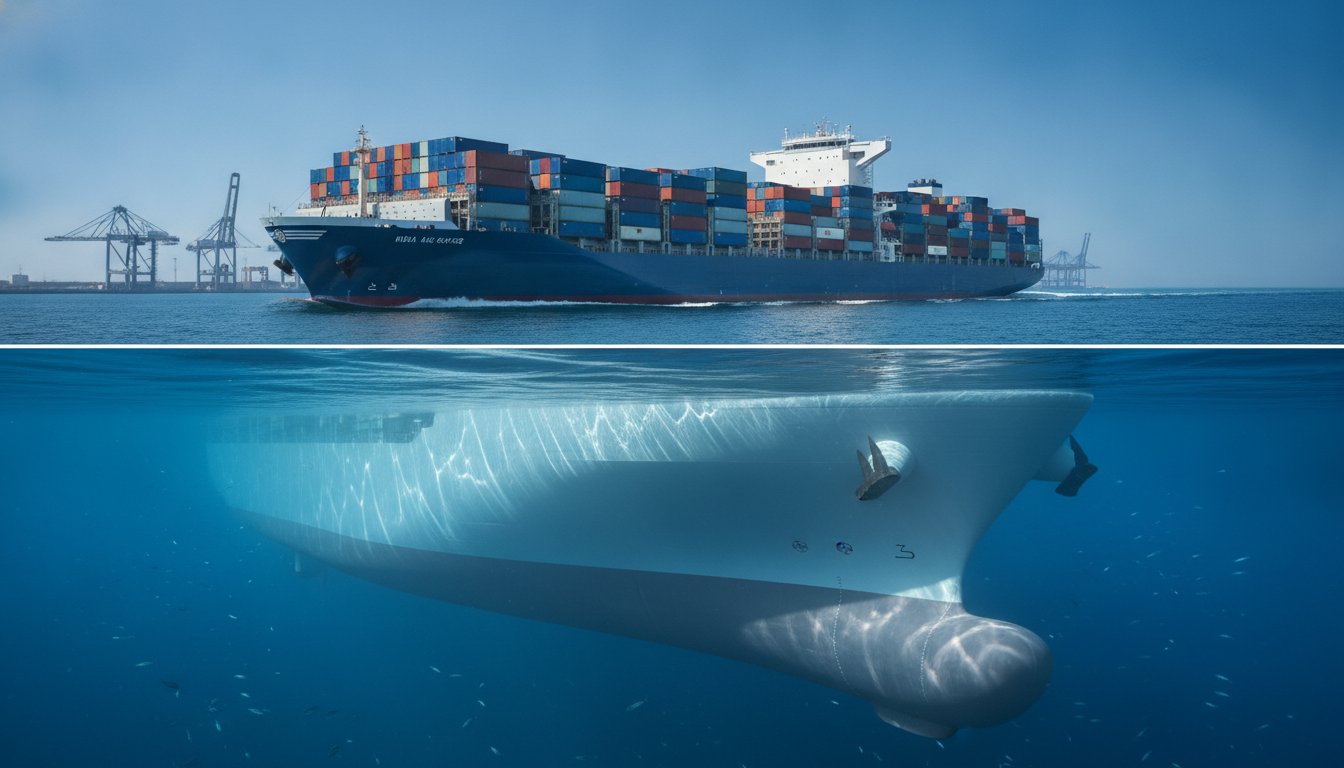
With the EU ETS now requiring shipping companies to surrender allowances for 100% of their verified emissions, the financial burden of hull drag has never been more acute. For operators managing a commercial ship hull coating UK strategy, the traditional reliance on biocidal antifouling paints is becoming a liability rather than a solution. You likely recognize that frequent dry-docking and rising fuel consumption are unsustainable under the 11% carbon intensity reduction factor mandated for 2026. It’s clear that maintaining the status quo is no longer a viable option for fleet profitability or regulatory compliance.
This article demonstrates how transitioning to silane-siloxane technology, such as Sea-Speed V 10 X Ultra, offers a strategic advantage by delivering a documented 12% reduction in fuel consumption. We’ll examine how these hard-film, non-toxic coatings outperform traditional methods to satisfy stringent UK REACH and IMO regulations while extending your inter-docking intervals. You’ll gain a technical understanding of why a shift toward advanced foul release systems is the most effective way to optimize vessel performance and secure long-term return on investment in a decarbonizing market.
Key Takeaways
- Understand how the 2026 IMO updates and UK REACH regulations have shifted the requirements for hull management from simple maintenance to a critical compliance strategy.
- Discover the molecular mechanism of silane-siloxane technology, which utilizes low surface energy to prevent marine organisms from establishing a permanent bond.
- Compare the mechanical resilience of hard-film systems against traditional soft silicone coatings to determine which provides the best protection against physical damage.
- Evaluate the economic impact of a commercial ship hull coating UK strategy that targets a 12% reduction in fuel consumption and significantly longer inter-docking intervals.
- Learn why Sea-Speed V 10 X Ultra serves as a strategic asset for fleet operators aiming to improve CII ratings and meet stringent Net Zero emissions targets.
The Regulatory Landscape for Commercial Ship Hull Coating in the UK
The maritime regulatory environment in the UK has reached a critical inflection point. On May 10, 2024, the Merchant Shipping (Anti-Fouling Systems) Regulations 2024 came into force, effectively prohibiting the application of marine paints containing cybutryne on UK-flagged ships and any vessels operating in UK waters. This legislative shift, alongside the continued prohibition of organotin compounds, forces fleet managers to re-evaluate their choice of commercial ship hull coating UK solutions. It isn’t just about compliance; it’s about the fundamental viability of the vessel in a market where environmental stewardship is increasingly mandated by law.
Major UK logistics hubs like Southampton and Felixstowe are under heightened pressure to manage the introduction of invasive aquatic species (IAS). The problem of biofouling is the primary vector for these species, which can devastate local ecosystems and lead to restrictive port entry requirements. Traditional biocide-based systems are losing their effectiveness as resistance builds and chemical restrictions tighten. Consequently, the industry is transitioning toward foul release systems that rely on surface energy and physical properties rather than chemical toxicity to maintain hull cleanliness.
UK REACH and Environmental Compliance
The UK REACH framework imposes strict limitations on the biocidal active substances that can be manufactured or used within the British maritime sector. As these restrictions tighten, non-toxic coatings have become the strategic standard for North Sea operations, where ecological sensitivity is paramount. By adopting biocide-free technology, operators future-proof their fleets against the inevitable expansion of UK and EU environmental legislation. This proactive approach ensures that vessels remain welcome in all global ports without the risk of non-compliance penalties or the need for costly mid-cycle coating removals.
EEXI and CII: The Performance Imperative
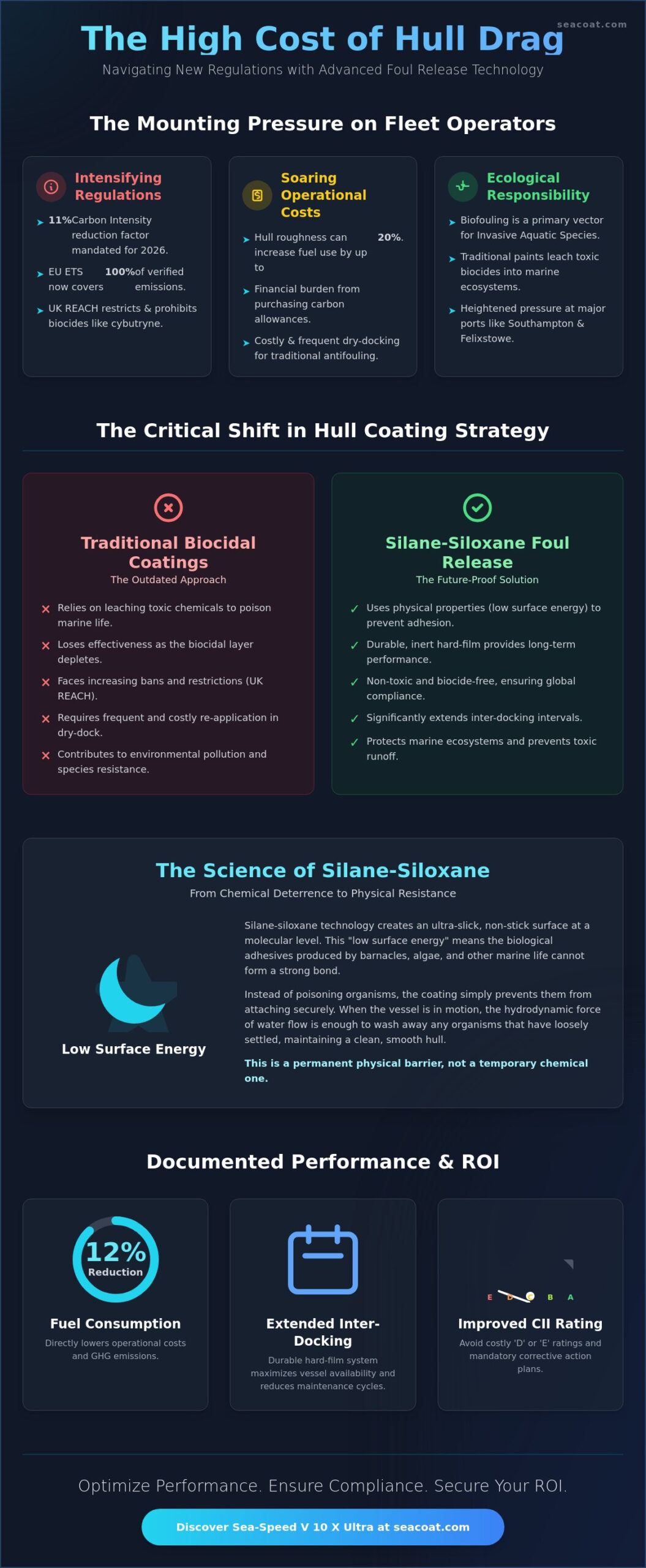
Hull performance is no longer a secondary maintenance concern; it directly influences a vessel’s Energy Efficiency Existing Ship Index (EEXI) and Carbon Intensity Indicator (CII) ratings. For 2026, the annual carbon intensity reduction factor has increased to 11% relative to the 2019 baseline. Because hull roughness can increase fuel consumption by as much as 20% over time, advanced coatings represent the most cost-effective “low-hanging fruit” for compliance. Within the UK maritime decarbonisation programme, maintaining a smooth, efficient hull is recognized as a primary lever for reducing Greenhouse Gas (GHG) emissions. A high-performing commercial ship hull coating UK strategy ensures that vessels avoid the ‘D’ or ‘E’ ratings that now require mandatory Corrective Action Plans as of April 30, 2026.
The Science of Silane-Siloxane: A Hard-Film Foul Release Revolution
The transition toward advanced foul release systems is rooted in a fundamental shift from chemical deterrence to physical resistance. Unlike traditional Self-Polishing Copolymers (SPC) that rely on the controlled leaching of biocides to poison marine organisms, silane-siloxane technology operates at a molecular level to create an inhospitable environment for growth. Choosing a commercial ship hull coating UK fleet managers can trust requires understanding this molecular barrier, which functions as a permanent shield rather than a sacrificial layer. This material science approach ensures that the hull remains protected without the environmental cost of toxic runoff.
The core mechanism behind this technology is low surface energy. At the molecular scale, the silane-siloxane matrix creates a surface so slick that the biological “glue” produced by barnacles, algae, and tubeworms cannot form a secure bond. When the vessel is in motion, the hydrodynamic pressure of the water is often sufficient to shear off any incipient growth. This physical rejection of biofouling aligns perfectly with the latest UK’s anti-fouling regulations, which prioritize the protection of marine ecosystems from harmful chemical additives.
Inert Surface Technology
Silane-siloxane creates a non-reactive, non-leaching barrier that remains stable throughout its service life. Because the chemical matrix is free from heavy metals and toxic biocides, it doesn’t contribute to the accumulation of contaminants in sensitive port sediments. Silane-siloxane is a cross-linked polymer that provides a permanent, non-sacrificial surface. This structural integrity means the coating doesn’t thin over time, maintaining its protective properties for years without the need for the frequent reapplication cycles typical of soft-film or erosive systems.
Hydrodynamic Efficiency and Drag
The relationship between surface roughness, measured as Average Hull Roughness (AHR), and propulsion power is linear and significant. Higher roughness increases frictional drag, forcing engines to work harder and consume more fuel to maintain speed. Sea-Speed V 10 X Ultra achieves sub-100 micron hull roughness, often reaching levels as low as 20 microns when applied correctly. This ultra-smooth profile moves beyond laboratory theoreticals to deliver real-world fuel savings. By reducing the energy required to overcome drag, this commercial ship hull coating UK technology provides a direct path to lower operational costs. Operators looking to maximize these benefits often specify Sea-Speed V 10 X Ultra for its proven performance in variable maritime conditions.
Hard-Film vs. Soft-Film: Choosing Durability for Commercial Fleets
While many industry classifications group all foul release systems together, the physical performance of a hard-film silane-siloxane coating differs fundamentally from that of soft silicone alternatives. For a commercial ship hull coating UK application, durability isn’t a luxury; it’s a prerequisite for operational continuity. Soft silicone coatings, while effective at reducing drag when pristine, are notoriously susceptible to mechanical damage. Even minor contact with fenders or tugs can lead to tearing and delamination, exposing the substrate and creating turbulence that negates the coating’s hydrodynamic benefits. Hard-film technology eliminates this vulnerability by creating a cross-linked polymer matrix that is as resilient as it is smooth.
Mechanical Resistance in Commercial Service
Commercial vessels operating in high-traffic UK coastal routes face constant physical stressors. Tug contact, quay-side operations, and even ice-thinning in northern waters can strip away soft-film coatings, leading to premature failure and localized fouling. Hard-film systems provide superior resistance to abrasion; they don’t tear or peel under mechanical stress. This resilience allows for aggressive in-water cleaning, which is vital for maintaining peak performance between scheduled dry-dockings. Unlike soft silicones that can be damaged by mechanical brushes, a silane-siloxane surface is entirely scrubbable. This ensures that any “slime” layer can be removed without compromising the integrity of the coating or violating UK anti-fouling regulations regarding the release of harmful materials.
Total Cost of Ownership (TCO) Analysis
A strategic evaluation of hull coatings must look beyond the initial application cost to the amortised cost over the vessel’s lifecycle. While traditional antifouling or soft-film products might require reapplication every 3 to 5 years, Sea-Speed V 10 X Ultra is engineered for a 10-year service life. This longevity significantly reduces the Total Cost of Ownership by extending inter-docking intervals and reducing the volume of material required over the vessel’s lifespan. For a detailed breakdown of these economic factors, fleet managers should consult The Definitive Guide to Boat Hull Paint: Performance, Science, and ROI. By investing in a permanent, non-sacrificial surface, operators eliminate the recurring costs associated with surface preparation and re-coating. The result is a strategic asset that delivers consistent fuel savings and regulatory compliance for a decade, rather than a temporary fix that degrades with every nautical mile.
Operational Benefits: Fuel Savings and Extended Inter-Docking
The economic viability of a fleet is tethered to its fuel efficiency. In the context of a commercial ship hull coating UK strategy, the direct correlation between hull cleanliness and bunker fuel expenditure represents the most significant opportunity for cost control. Biofouling creates frictional resistance that forces propulsion systems to consume more energy to maintain service speeds. For vessels operating in the North Sea or across the Atlantic, this “fuel penalty” can escalate rapidly as biofouling matures from a light slime to hard calcareous growth. By utilizing a hard-film foul release coating, operators can maintain a smooth surface that delivers a documented 12% reduction in fuel consumption compared to traditional antifouling methods.
This efficiency is essential for meeting UK Net Zero targets and managing the financial impact of the EU Emissions Trading System (EU ETS). From 2026, the expanded scope of the EU ETS includes carbon dioxide, methane, and nitrous oxide. Every tonne of fuel saved directly reduces the number of allowances a shipping company must surrender. This transition facilitates “Condition Based Maintenance” (CBM), where hull performance is monitored and optimized based on real-time data rather than arbitrary calendar dates. This data-driven approach allows for precise interventions, ensuring the vessel operates at peak hydrodynamic efficiency throughout its service life.
Bunker Cost Mitigation
Calculating the return on investment for a high-performance coating requires looking at current fuel price volatility and the cost of carbon. With EU Allowance (EUA) prices fluctuating between €70 and €100 per tonne, the value of saving fuel is compounded by the avoided cost of emissions. A 12% reduction in fuel consumption isn’t just a marginal gain; it’s a strategic buffer against market fluctuations. This performance-enhancing tool transforms the hull from a maintenance burden into a driver of operational profitability. By reducing the energy required to overcome drag, fleet managers can significantly lower their total bunker expenditure while simultaneously improving their CII ratings.
Extending the Dry-Dock Cycle
Traditional coatings often dictate a 60-month dry-docking schedule to replenish biocidal layers or repair soft silicone damage. Sea-Speed V 10 X Ultra allows fleet managers to move toward a 120-month coating expectation, doubling the interval between major applications. Reducing off-hire time is a critical value proposition for commercial vessels, as every day in dock represents lost revenue. For a comprehensive look at how these systems integrate with broader fleet management, refer to our Marine Coatings: The Definitive Guide for Vessel Protection & Performance. Minimizing the frequency of dry-docking reduces total lifecycle costs and aligns with the long-term stewardship goals of modern maritime industry. To optimize your fleet’s operational window, explore our high-durability foul release systems.
Implementing Sea-Speed V 10 X Ultra for UK Fleet Operations
Transitioning to a high-performance commercial ship hull coating UK system requires a fundamental shift from sacrificial, chemical-based materials to permanent surface technology. Sea-Speed V 10 X Ultra stands as the premier choice for this transition because it resolves the historic tension between industrial durability and environmental safety. It’s a biocide-free, zero-VOC silane-siloxane system that carries verified environmental certifications, ensuring it meets the most stringent UK REACH and international standards. Unlike traditional Self-Polishing Copolymers (SPC) that leach heavy metals and toxic active substances, this system provides a stable, non-reactive film that remains effective for up to ten years. This longevity is backed by a 10-year warranty, providing a level of asset security that temporary coatings cannot match.
Moving away from toxic SPCs involves a strategic cleaning and priming process. Because silane-siloxane is a non-sacrificial, cross-linked polymer, it doesn’t thin or erode over time. This means that once the initial application is complete, the hull maintains its ultra-smooth profile without the need for the repetitive, high-build re-coating cycles that characterize traditional maintenance. The result is a permanent, strategic asset that simplifies regulatory compliance and stabilizes operational costs for the long term.
The Sea-Speed Advantage
The hard-film properties of the Sea-Speed V 10 X Ultra system offer a distinct advantage over soft-film silicone alternatives. It’s engineered for compatibility with multiple substrates, including carbon steel and specialized aluminium hulls. For fleet managers overseeing diverse assets, this versatility simplifies procurement and ensures a uniform standard of protection. If you’re managing lighter vessels or specialized ferry services, you can find specific insights in our guide on the Best Boat Paint for Aluminum Boats. This technology provides a consistent hydrodynamic profile across a commercial fleet, ensuring peak performance regardless of the vessel’s specific construction material.
Application and Technical Support
Successful implementation depends on rigorous technical standards and precise surface preparation. The process begins with the complete removal of existing toxic layers, followed by the application of a high-performance primer like Seapoxy 73 to ensure maximum adhesion. During UK-based dry-docking, adherence to specified film thickness and curing requirements is vital to achieving the intended sub-100 micron surface roughness. As of 2026, quality control must be overseen by qualified coating inspectors holding AMPP Senior Certified Coatings Inspector or FROSIO Level III credentials. This oversight ensures that the final surface meets the exacting standards required for a documented 12% fuel reduction. To begin the transition toward a more efficient fleet, you can Contact Seacoat SCT, LLC for a fleet performance audit to determine the precise ROI for your specific commercial ship hull coating UK requirements.
Optimising Fleet Performance in a Decarbonising Market
The shift toward decarbonisation requires more than just incremental changes; it demands a fundamental re-engineering of hull maintenance strategies. By adopting a hard-film silane-siloxane matrix, fleet operators can achieve a proven sub-100 micron surface roughness that remains stable for a decade. This technology has been in commercial use since 2001, offering a non-toxic and zero-VOC solution that aligns perfectly with the current commercial ship hull coating UK regulatory environment. You’re not just applying paint; you’re investing in a strategic asset that reduces frictional drag and ensures long-term compliance with EEXI and CII standards.
Balancing operational efficiency with environmental stewardship is the hallmark of the modern maritime industry. Transitioning to Sea-Speed V 10 X Ultra allows you to mitigate rising fuel costs while significantly extending your inter-docking intervals. It’s a reliable path toward a more sustainable and profitable future for your fleet. Request a Technical Consultation for Your Fleet today to see how this advanced technology can transform your operational baseline. We look forward to helping you achieve a cleaner, more efficient voyage.
Frequently Asked Questions
Is Sea-Speed V 10 X Ultra compliant with current UK REACH regulations?
Sea-Speed V 10 X Ultra is fully compliant with UK REACH regulations because it’s a non-toxic, biocide-free silane-siloxane system. It contains zero VOCs and no heavy metals, ensuring it meets the latest environmental standards implemented in May 2024. This makes it a sustainable choice for vessels operating in protected UK waters and North Sea routes where chemical restrictions are increasingly stringent.
How does a hard-film foul release coating differ from traditional antifouling?
Traditional antifouling relies on the controlled leaching of biocides to poison marine growth, whereas hard-film foul release uses low surface energy to prevent organisms from bonding. Unlike sacrificial coatings that thin over time, a commercial ship hull coating UK based on silane-siloxane provides a permanent, non-reactive surface. This physical barrier remains stable throughout its service life without releasing harmful chemicals into the marine ecosystem.
What is the expected lifespan of a silane-siloxane hull coating in commercial service?
Sea-Speed V 10 X Ultra is engineered for a 10-year service life in commercial environments. This significantly exceeds the typical 3 to 5-year cycle of conventional antifouling paints. Because the coating is non-sacrificial and doesn’t erode, it maintains its hydrodynamic properties for a decade. This longevity is supported by a 10-year warranty, provided the system is applied according to technical specifications.
Can Sea-Speed coatings be applied over existing hull paint systems?
Sea-Speed coatings shouldn’t be applied directly over existing antifouling paint systems. To ensure maximum adhesion and performance, the hull must be cleaned to the original substrate or a stable epoxy base. A high-performance primer, such as Seapoxy 73, is then used to create a secure bond before the silane-siloxane topcoat is applied in a controlled dry-dock environment to ensure quality control.
What fuel savings can a commercial vessel expect after switching to Sea-Speed?
Commercial vessels can expect a documented 12% reduction in fuel consumption after switching to Sea-Speed V 10 X Ultra. This efficiency is achieved through a proven sub-100 micron surface roughness that minimizes frictional drag. By maintaining a slicker hull, propulsion systems require less energy to overcome resistance. This provides a direct financial buffer against volatile bunker prices and rising emissions costs.
Are hard-film coatings suitable for vessels operating in ice-prone or high-abrasion areas?
Hard-film silane-siloxane coatings are specifically suited for high-abrasion environments, including ice-prone routes. Unlike soft silicone coatings that tear or delaminate upon physical contact, the cross-linked polymer matrix of Sea-Speed is highly resilient. It resists damage from fenders, tug contact, and light ice. This ensures the hydrodynamic profile remains intact even in challenging commercial ship hull coating UK service conditions.
How does the use of non-toxic coatings impact CII and EEXI ratings?
Switching to a non-toxic, low-drag coating directly improves a vessel’s CII and EEXI ratings by reducing carbon intensity per nautical mile. For 2026, the annual carbon intensity reduction factor has increased to 11% relative to 2019. Maintaining a smooth, efficient hull is the most cost-effective way to avoid the ‘D’ or ‘E’ ratings that now require mandatory Corrective Action Plans under current IMO regulations.
Is in-water cleaning safe for silane-siloxane foul release coatings?
In-water cleaning is entirely safe and recommended for silane-siloxane foul release coatings. Because the film is hard and non-sacrificial, it can be scrubbed using mechanical brushes without losing coating thickness or releasing toxins into the water. This allows operators to maintain peak efficiency between dry-dockings and remove slime layers that would otherwise increase drag and fuel consumption during long idle periods.