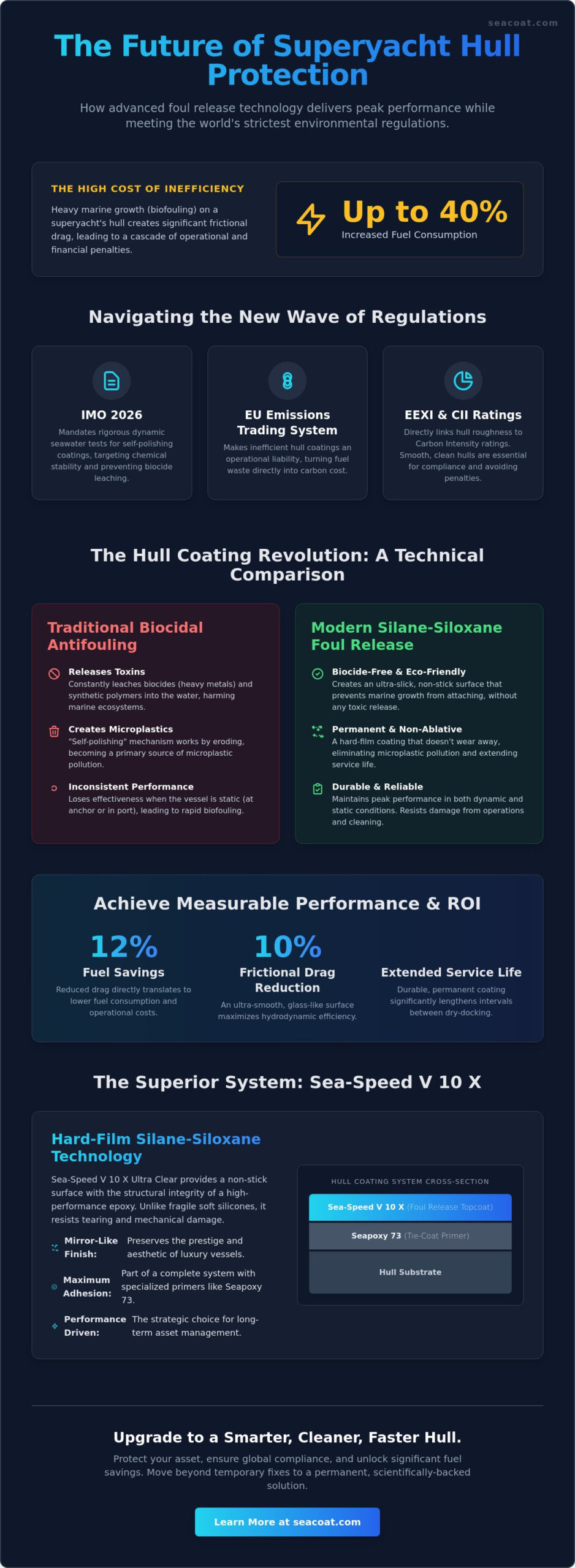
Did you know that heavy marine growth on a superyacht hull can increase fuel consumption by up to 40%? For many owners and operators, the transition to eco-friendly antifouling for superyachts has often felt like a compromise between environmental stewardship and vessel performance. You likely recognize the mounting pressure from the IMO 2026 dynamic seawater circulation tests and the expansion of the EU Emissions Trading System. These regulations make inefficient hull coatings an operational liability rather than just a maintenance choice.
This guide demonstrates how advanced non-toxic foul release technology optimizes superyacht hydrodynamic efficiency while meeting the strictest global environmental regulations. We’ll explore how shifting from traditional biocides to high-performance silane-siloxane systems like Sea-Speed V 10 X Ultra Clear provides a strategic asset for asset management. You will learn how to achieve measurable fuel savings of up to 12%, ensure compliance with EEXI and CII standards, and significantly extend your service life between dry-docking intervals. We’re moving beyond temporary fixes toward permanent, scientifically-backed solutions for the modern maritime era.
Key Takeaways
- Understand how the latest IMO 2026 regulations and EU ETS expansion are mandating a shift toward eco-friendly antifouling for superyachts to ensure global compliance.
- Discover the chemical advantages of silane-siloxane technology, which creates a durable, hard-film foul release surface superior to traditional soft silicone coatings.
- Learn how to reduce frictional drag by up to 10% and achieve measurable fuel savings through enhanced hull hydrodynamic efficiency.
- Explore how high-performance coatings like Sea-Speed V 10 X Ultra Clear provide a mirror-like finish that preserves the prestige and aesthetic standards of luxury vessels.
- Identify the essential components of a long-term hull protection strategy, including the role of specialized primers like Seapoxy 73 in ensuring maximum coating adhesion.
The Regulatory Shift in Superyacht Hull Protection
The maritime industry is undergoing a fundamental transformation in how it approaches hull maintenance. For decades, the standard was toxic, self-polishing copolymers that relied on the continuous release of biocides. Today, eco-friendly antifouling for superyachts is defined by biocide-free, non-ablative systems that provide a permanent, low-energy surface. This shift isn’t merely a trend; it’s a response to increasingly stringent global mandates. As of June 12, 2026, the International Maritime Organization (IMO) requires self-polishing coatings to pass rigorous 72-hour dynamic seawater circulation tests to maintain type approval. These updates address The Problem of Biofouling by focusing on the chemical stability of the coating itself.
For superyacht owners, traditional ablative paints are becoming a significant operational liability. These coatings are designed to wear away, which means they constantly shed heavy metals and synthetic polymers into the water column. In sensitive charter destinations like the Mediterranean or the Maldives, these contaminants are increasingly restricted. Choosing a non-toxic alternative ensures that your vessel remains compliant in every port of call while protecting the marine biodiversity that makes yachting possible. It’s a strategic move from temporary, damaging methods to permanent, sophisticated solutions.
Understanding EEXI and CII for Superyachts
The relationship between hull condition and energy efficiency is now a matter of regulatory record. For vessels over 400 GT, the Energy Efficiency Existing Ship Index (EEXI) and the Carbon Intensity Indicator (CII) have turned hull roughness into a measurable performance metric. Frictional drag reduction through advanced coatings is the most direct path to EEXI compliance without requiring expensive mechanical retrofits. Because hull smoothness directly impacts Carbon Intensity Indicator (CII) ratings, maintaining a clean, glass-like surface is essential for avoiding operational restrictions in EU waters. Using banned biocides in international waters now carries a long-term risk of heavy fines and restricted entry to key marine regions.
The Environmental Impact of Ablative Microplastics
Traditional “self-polishing” paints function by eroding over time, a process that releases microplastics and heavy metals directly into the sea. This mechanical degradation is a primary source of marine pollution in high-traffic yachting hubs. The industry’s transition toward environmental marine coatings represents a standard practice for owners who prioritize long-term asset value and ecological stewardship. By adopting non-ablative technology, you eliminate the discharge of harmful additives, effectively protecting marine biodiversity in fragile ecosystems. This approach treats the hull coating as a performance-enhancing tool rather than just a maintenance requirement.
Silane-Siloxane vs. Traditional Antifouling: A Technical Comparison
The technical evolution of eco-friendly antifouling for superyachts is centered on a move from chemical toxicity to mechanical resistance. Traditional self-polishing copolymers function by leaching biocides into the surrounding water. This mechanism requires the vessel to be in motion to refresh the active surface layer. For superyachts that spend extended periods at anchor or in port, this leaching process often becomes inconsistent, leading to rapid colonization by marine organisms. In contrast, silane-siloxane technology creates a non-stick, low-energy surface that does not rely on chemical release. It adheres to International Maritime Organization (IMO) regulations by eliminating toxins entirely while maintaining superior performance in static conditions.
The primary technical distinction lies between hard-film foul release systems and soft silicone coatings. While soft silicones offer low surface tension, they are notoriously fragile. They often suffer from tearing, “fender rub,” and mechanical damage during routine operations or diver cleaning. A hard-film silane-siloxane coating provides the same slickness with the structural integrity of a high-performance epoxy. This durability is why many operators are transitioning to silane coating systems to ensure long-term hull protection without the risk of delamination. Maintenance is simplified; instead of scrubbing away layers of ablative paint, crew can simply wipe the hard-film surface to remove light slime.
The Science of Surface Energy
Organisms cannot easily adhere to the molecular structure of a silane-siloxane system because the surface energy is too low to support biological bonding. While standard epoxy paints have high surface energy that invites the formation of an initial biofilm, Sea-Speed V 10 X Ultra creates a glass-like finish. This “slickness” is measurable. It prevents the microscopic “anchors” used by barnacles and tubeworms from gaining a foothold. By stopping the biofilm at the molecular level, the coating maintains a smooth profile that directly supports hydrodynamic efficiency. This approach ensures that eco-friendly antifouling for superyachts delivers performance that traditional paints cannot match.
Durability and Longevity in Superyacht Applications
Longevity is a critical metric for large-scale asset management. Traditional ablative cycles require a full haul-out and repainting every 24 months. Hard-film systems are engineered for a 10+ year service life. They resist dockside abrasions and the physical stresses of high-speed transit. This “permanent” nature reduces the frequency of full strip-downs, which are both costly and environmentally taxing. If you are looking to optimize your maintenance cycle, exploring the performance metrics of Sea-Speed V 10 X Ultra reveals significant long-term ROI. These systems represent a strategic shift toward sustainable, high-performance yacht management.
Maximizing Hydrodynamic Efficiency and ROI
Efficiency in the superyacht sector is traditionally viewed through the lens of engine performance and fuel optimization. However, the interface between the hull and the water is where the most significant gains are achieved or lost. Frictional resistance represents approximately 80% of the total resistance on a displacement hull at cruising speeds. By applying eco-friendly antifouling for superyachts, operators can transform the hull from a high-drag surface into a precision-engineered hydrodynamic asset. Systems like Sea-Speed V 10 X Ultra are designed to minimize this resistance by creating an exceptionally smooth, glass-like profile that traditional ablative paints cannot replicate.
The economic impact of hull roughness is quantifiable and severe. Every 20 microns of increased average hull roughness can lead to a 2% to 3% increase in fuel consumption. Because Sea-Speed V 10 X Ultra reduces frictional drag by up to 10%, the resulting fuel savings are substantial, particularly during long-range transits. Data from the 2026 maritime research landscape indicates that heavy marine growth can spike fuel usage by 40%, whereas advanced foul-release systems provide fuel savings of up to 12%. These metrics demonstrate that the coating is not just a protective layer; it’s a performance-enhancing tool that directly lowers engine load and carbon emissions.
Frictional Drag and Fuel Economy
The physics of fluid dynamics dictates that a smoother hull surface maintains a laminar flow within the boundary layer for a longer duration. When the surface is rough, the water flow becomes turbulent, significantly increasing the energy required to move the vessel through the water. A 20-micron reduction in surface roughness can improve fuel efficiency by approximately 2%, a margin that becomes critical when managing the operational costs of 50m+ vessels. Real-world applications on large-scale hulls have shown that transitioning to eco-friendly antifouling for superyachts results in higher top speeds and reduced vibration, contributing to a more stable and efficient passage.
Extended Service Life and Maintenance ROI
Investing in a premium non-toxic marine hull coating shifts the maintenance paradigm from reactive scrubbing to proactive management. Hard-film systems eliminate the need for aggressive in-water cleaning, which often damages the hull and releases contaminants. This is particularly relevant when operating under the EPA’s Vessel General Permit (VGP), which strictly regulates discharges from vessel hulls in U.S. waters. Because these coatings are engineered for a 10-year service life, they minimize the downtime and high costs associated with the frequent two-year haul-out cycles required by traditional paints. The long-term ROI is realized through reduced fuel spend, lower dry-docking fees, and the preservation of the hull’s structural integrity.
Superyacht Aesthetics: Achieving a Mirror-Like Hull Finish
The aesthetic profile of a superyacht is an extension of its owner’s brand and the vessel’s prestige. While performance and regulatory compliance are paramount, the visual condition of the hull below the waterline often dictates the perceived quality of the entire asset. Traditional eco-friendly antifouling for superyachts has historically struggled to match the high-gloss standards of the topsides, often resulting in a matte or chalky finish that degrades the yacht’s silhouette. Advanced silane-siloxane systems solve this challenge by providing a mirror-like finish that maintains its integrity over years of service. Unlike traditional copper-based or ablative paints, these coatings do not oxidize or fade, ensuring that the hull remains a reflection of the yacht’s engineering excellence.
Maintaining color integrity is a significant challenge in marine environments where UV exposure and chemical interactions are constant. Silane-siloxane technology offers exceptional molecular stability. It does not chalk or lose its pigment, making it perfectly compatible with sophisticated metallic finishes and custom hull colors. This capability allows designers to maintain a cohesive aesthetic from the masthead to the keel. For owners who demand perfection, transitioning to a high-performance system is a logical step in luxury yacht management. You can explore the technical specifications of Sea-Speed V 10 X Ultra to understand how it supports the visual standards of world-class vessels.
The Advantage of Clear Foul Release
Sea-Speed V 10 X Ultra Clear represents a breakthrough for vessels with intricate paint schemes or racing pedigrees. By utilizing a clear foul release layer, operators can protect the existing substrate without altering the intended color or texture. This clear-coat technology functions similarly to professional automotive finishes, providing a high-gloss barrier that resists environmental staining. Because the coating is transparent, it allows for easier visual inspection of the hull’s condition during routine maintenance. This transparency ensures that any structural issues or substrate anomalies are identified early, adding a layer of safety to the aesthetic benefit.
Underwater Lighting and Hull Clarity
Modern superyacht design frequently incorporates complex underwater LED systems to create a distinctive nighttime presence. A clean, reflective hull significantly enhances the impact of these lights by maximizing the distribution of the beam across the water. Traditional, dark, or rough antifouling surfaces absorb light, diminishing the visual effect. In contrast, the glass-like surface of a silane-siloxane coating provides the necessary reflectivity to make underwater lighting truly stand out. Utilizing the right antifouling boat paint also prevents “ghosting” or staining around thrusters and sea chests, preserving the “new build” look for years. This attention to detail ensures that the vessel’s prestige is maintained in every operational scenario.
Selecting the Right System: Sea-Speed V 10 X Ultra
Sea-Speed V 10 X Ultra has emerged as the definitive standard for eco-friendly antifouling for superyachts due to its unique silane-siloxane chemistry. While some industry players promote electronic systems as a standalone solution, this coating provides a comprehensive physical barrier that prevents colonization before it begins. The success of any high-performance foul release system depends heavily on the integrity of the bond between the substrate and the topcoat. This is why utilizing Seapoxy 73 as the dedicated primer system is essential. It ensures maximum adhesion and provides an additional layer of corrosion protection, which is vital for the multi-year performance cycle of large-scale assets. Global refit yards now provide specialized support for these applications, ensuring that owners have access to expert innovators regardless of their location.
The Application Process for Superyacht Refits
Achieving a 10-year service life requires meticulous attention to surface preparation during the refit cycle. The process typically begins with grit blasting to remove old, depleted coatings and establish a clean profile for the Seapoxy 73 base. Professional application is essential because the specified dry film thickness must be uniform to maintain the coating’s low-energy properties. Inconsistent thickness can lead to premature wear or reduced hydrodynamic efficiency. During the refit, environmental considerations such as humidity and ambient temperature must be strictly monitored to ensure optimal curing times. This methodical approach is the only way to guarantee the long-term ROI and structural integrity that stakeholders expect from modern vessel management.
Armor-Sil R/G: Protection for Running Gear
A comprehensive strategy for eco-friendly antifouling for superyachts must extend beyond the hull to include the running gear. Propellers, shafts, and rudders are high-turbulence areas where traditional paints fail almost immediately. Armor-Sil R/G is specifically engineered to withstand these extreme mechanical stresses and the high flow rates associated with modern propulsion. By creating a slick, durable surface on the running gear, it helps prevent cavitation damage and improves overall propulsion efficiency. This ensures the vessel maintains a completely biocide-free underwater profile while optimizing thrust and reducing vibration. It’s a sophisticated solution that treats every underwater component as a strategic asset rather than a maintenance requirement.
Advancing Toward Permanent Maritime Sustainability
The transition to eco-friendly antifouling for superyachts represents a strategic pivot from reactive maintenance to proactive performance management. By integrating proprietary Silane-Siloxane technology, which has been refined since 2001, owners can achieve a dual objective: meeting the stringent IMO 2026 environmental mandates while simultaneously optimizing vessel efficiency. This non-toxic, zero VOC formulation eliminates the release of harmful contaminants, ensuring that your vessel remains a steward of the marine ecosystems it traverses. It’s a move toward a permanent, sophisticated solution that prioritizes both ecological safety and physical durability.
Beyond compliance, the transition yields a significant reduction in frictional drag and fuel consumption, providing a measurable return on investment through extended service windows and lower engine loads. The glass-like finish of Sea-Speed V 10 X Ultra ensures that your yacht’s aesthetic prestige is matched by its technical superiority. It’s time to move beyond temporary fixes and adopt a performance-enhancing tool that protects your asset for the long term. Request a Technical Consultation for Your Superyacht Refit to discover how our evidence-based coatings can enhance your operational longevity. We look forward to supporting your next refit with precision-engineered results.
Frequently Asked Questions
Is eco-friendly antifouling as effective as traditional copper paint?
Yes, silane-siloxane systems are highly effective, though they function through mechanical rather than chemical means. While traditional paints rely on heavy metals to kill organisms, this non-toxic technology creates a low-energy surface that prevents adhesion. It’s particularly superior for yachts at anchor, where the lack of water flow often causes biocidal paints to fail prematurely. This approach provides a permanent solution rather than a temporary chemical release.
Can I apply Sea-Speed V 10 X Ultra over my existing bottom paint?
No, Sea-Speed V 10 X Ultra cannot be applied directly over existing antifouling paint. For the system to function as designed, the hull must be grit-blasted to a clean substrate to ensure a proper mechanical bond. We then utilize Seapoxy 73 as a specialized primer to provide maximum adhesion and a smooth foundation for the final topcoat. This methodical preparation is essential for long-term coating integrity.
How much fuel can a superyacht save by switching to a foul release coating?
A superyacht can save up to 12% in fuel costs by transitioning to a high-performance foul release system. By reducing frictional drag and maintaining a smooth boundary layer, the engine load is significantly decreased during long-range transits. This efficiency is a core benefit of adopting eco-friendly antifouling for superyachts in a high-cost fuel environment. These savings help offset the initial investment while reducing the vessel’s carbon footprint.
Does a non-toxic coating require more frequent in-water cleaning?
No, non-toxic hard-film coatings typically require less aggressive cleaning than ablative paints. Because the surface is glass-like and non-stick, light slime can often be removed by the vessel’s movement through the water or a simple wipe-down by a diver. You won’t need the abrasive scrubbing that often damages traditional hull coatings. This reduces maintenance time and prevents the release of paint particulates into the water column.
What happens if the hard-film coating gets scratched or damaged?
If a hard-film coating is scratched, the damage remains localized and is easily repairable. Unlike soft silicone coatings that can peel or tear in large sections, silane-siloxane technology is mechanically durable and adheres firmly to the primer. Minor abrasions can be touched up during a scheduled maintenance stop without requiring a full hull recoat. This durability makes it a strategic asset for vessels operating in busy ports or high-traffic areas.
Is Sea-Speed V 10 X Ultra compliant with IMO biofouling regulations?
Yes, Sea-Speed V 10 X Ultra is fully compliant with the latest International Maritime Organization (IMO) biofouling regulations, including the 2026 updates. Because it’s biocide-free and contains zero VOCs, it meets the strictest global environmental standards. It’s a reliable choice for vessels operating in sensitive marine regions or protected charter zones where traditional toxic paints are increasingly restricted or prohibited.
Can eco-friendly coatings be used on aluminum superyacht hulls?
Yes, these coatings are ideal for aluminum hulls because they are chemically inert and non-conductive. Unlike copper-based paints, which can trigger galvanic corrosion on aluminum substrates, silane-siloxane technology provides a safe and effective barrier. It’s the preferred choice for high-performance aluminum superyachts where structural integrity and weight reduction are primary concerns. It provides protection without the risk of metal degradation.
How long does a silane-siloxane coating typically last before needing a recoat?
A silane-siloxane coating typically provides a service life of 10 years or more before a full recoat is necessary. This longevity far exceeds the standard two-year cycle of traditional ablative paints. By choosing eco-friendly antifouling for superyachts, you significantly reduce the frequency of dry-docking and the associated operational costs. This extended lifecycle is a key component of a sustainable and cost-effective hull management strategy.