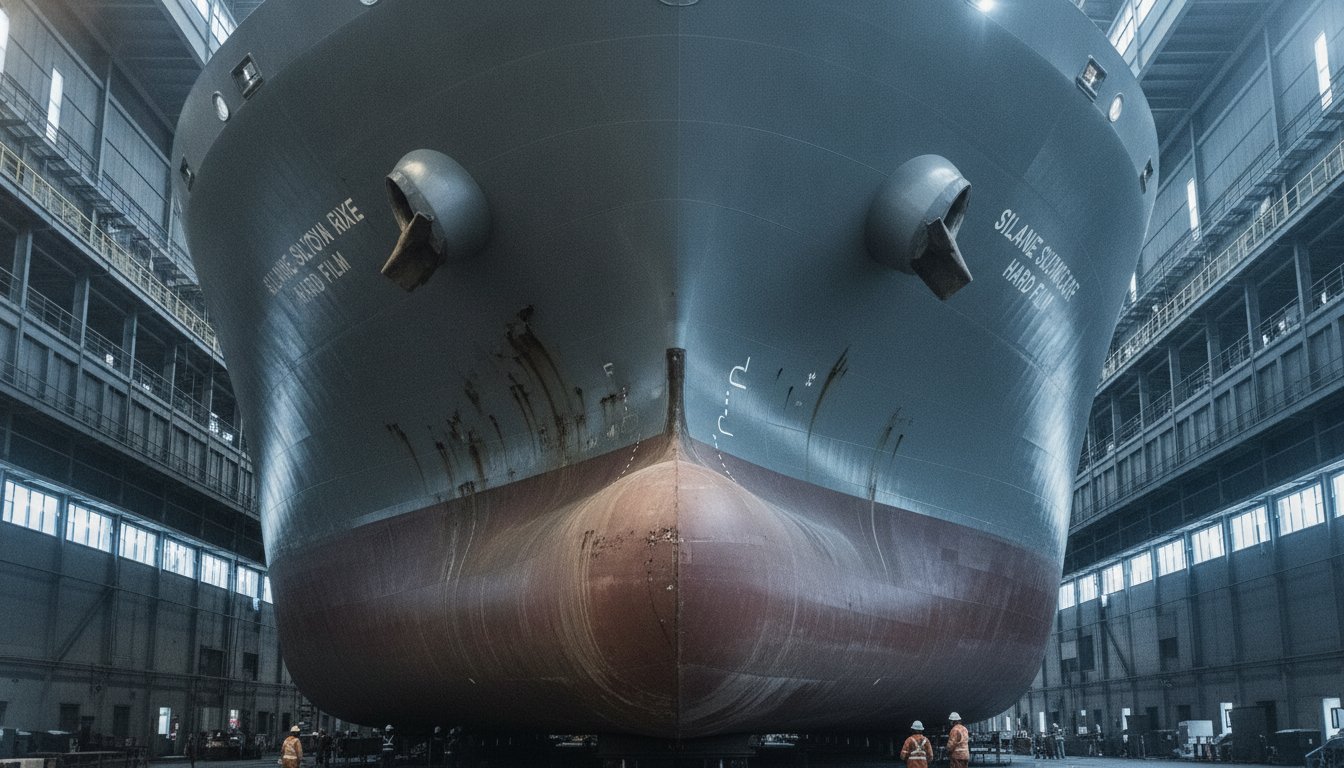
If your vessel is still relying on traditional biocidal paints, you aren’t just managing a maintenance schedule; you’re carrying a compounding financial liability on your balance sheet. While fuel efficiency remains the cornerstone of profitability, the true financial risk of outdated hull coatings often remains hidden beneath the waterline until it manifests as a regulatory fine or a failed Carbon Intensity Indicator (CII) audit. With the 2026 enforcement of Brazil’s NORMAM-401 regime and the looming copper-based paint bans in Washington State, legacy systems have transitioned from simple protective layers into active operational hazards.
It’s understandable to view hull maintenance as a recurring cost of doing business, but the modern maritime environment requires a shift toward strategic asset management. This analysis promises to uncover the hidden operational costs, regulatory penalties, and asset depreciation risks associated with legacy coatings while demonstrating how to mitigate them through advanced material science. We’ll explore the return on investment for biocide-free, silane-siloxane hard-film technologies and how maintaining a surface roughness profile below 5 microns ensures compliance with 2026 EEXI standards. You’ll gain a clear roadmap for extending vessel service life and securing a performance-driven return on investment that prioritizes both ecological safety and the bottom line.
Key Takeaways
- Quantify the impact of surface roughness on your balance sheet by understanding how marginal increases in hull drag lead to exponential fuel expenditures.
- Assess the immediate financial risk of outdated hull coatings in the context of 2026 regulatory shifts, including IMO CII ratings and regional biocide bans.
- Evaluate the long-term ROI of silane-siloxane technology against the hidden maintenance debt of traditional ablative paints and the mechanical vulnerability of soft silicones.
- Implement a strategic hull asset management framework using speed-vs-RPM analysis to identify and mitigate performance degradation before it triggers operational restrictions.
- Discover how advanced hard-film solutions like Sea-Speed V 10 X Ultra provide a biocide-free, low-friction surface that future-proofs assets against evolving environmental standards.
The Hidden Balance Sheet: Quantifying the Drag of Outdated Coatings
The traditional view of hull maintenance as a periodic sunk cost is a management fallacy that obscures the true financial risk of outdated hull coatings. In modern fleet operations, every micron of surface irregularity represents a measurable tax on performance. This isn’t just about the price of paint; it’s about the accumulation of maintenance debt. This term describes the long-term financial burden incurred when legacy coatings fail to provide a stable, low-friction interface, forcing operators to compensate with increased fuel spend and more frequent dry-docking cycles. When a coating system begins to fail, the resulting drag isn’t just a technical issue; it’s a line item that erodes profitability every hour the vessel is at sea.
Frictional Drag and the Exponential Fuel Penalty
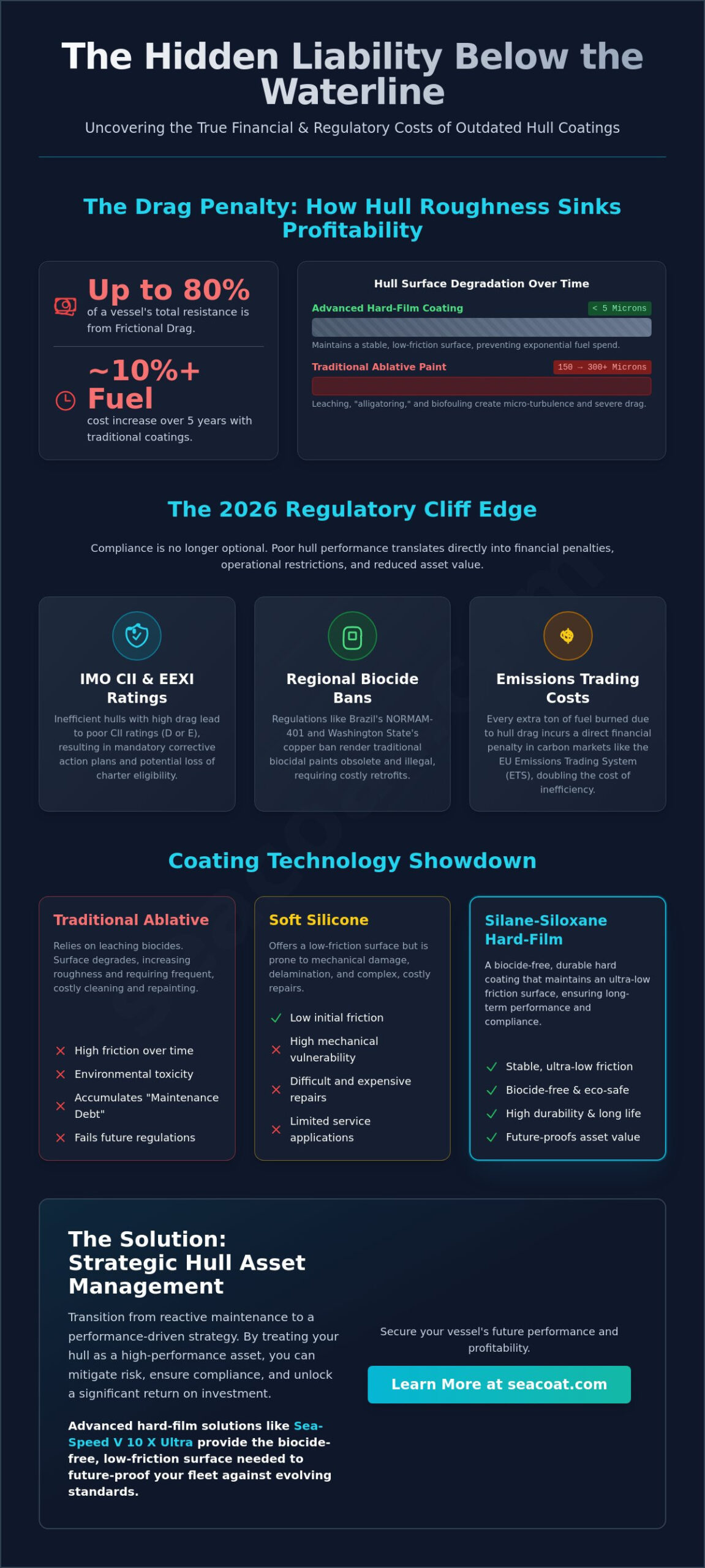
Ships don’t simply move through water; they fight against hydrodynamic resistance. Frictional drag accounts for up to 80% of the total resistance encountered by a vessel, and this resistance is dictated by the texture of the hull. Industry data suggests that even a marginal 10-micron increase in average hull roughness can lead to a 1% increase in fuel consumption. Over a typical five-year service window, a vessel that begins with a 150-micron profile but degrades to 300 microns due to the leaching and depletion of traditional ablative coatings can see fuel costs climb by 10% or more. While traditional paints suffer from viscous resistance as the surface becomes increasingly turbulent, advanced hard-film coatings maintain their finish, preventing the exponential climb in fuel spend that characterizes legacy systems.
The Concept of Maintenance Debt in Hull Management
Maintenance debt manifests most clearly when operators choose the perceived economy of layering fresh paint over old, brittle layers. This practice often leads to alligatoring, a condition where deep cracks and ridges create micro-turbulence that disrupts laminar flow. Beyond the physical drag, the biological reality of Biofouling adds another layer of complexity. Frequent in-water cleaning, while necessary for traditional coatings, often strips the surface integrity and accelerates the depletion of the coating material. This cycle creates a debt that eventually requires a full, costly blast-to-substrate intervention to rectify.
Transitioning from a reactive mindset to strategic asset management requires quantifying these hidden costs. The financial impact extends beyond fuel to include increased engine strain and reduced service windows. For a detailed breakdown of how to transition toward a performance-driven model, refer to The Definitive Guide to Boat Hull Paint, which outlines the specific metrics for evaluating long-term ROI. By treating the hull as a high-performance asset rather than a maintenance requirement, stakeholders can mitigate the regulatory and operational risks that outdated coatings inevitably invite.
Regulatory Compliance and the Cost of Non-Conformity in 2026
By 2026, the maritime industry has moved beyond the grace period for carbon intensity mandates. The financial risk of outdated hull coatings now extends into the legal and commercial viability of the vessel itself. Compliance with International Maritime Organization regulations is no longer a matter of administrative filing; it’s a critical factor in determining a vessel’s Carbon Intensity Indicator (CII) rating. Inefficient hulls generate excessive emissions, which directly inflates the cost of compliance within the EU Emissions Trading System (ETS) and similar regional carbon markets. Every ton of additional fuel burned due to hull drag carries a secondary cost in carbon credits, making legacy coatings a double-edged financial liability.
EEXI and CII: Financial Implications of Poor Ratings
The CII rating system creates a transparent performance metric that charterers and financial institutions use to assess asset risk. Vessels that receive a “D” rating for three consecutive years, or an “E” rating in a single year, are now required to submit a mandatory corrective action plan. This isn’t merely a bureaucratic hurdle. It’s a commercial signal that often leads to lower daily hire rates or total exclusion from certain chartering pools. Because advanced coatings can reduce fuel consumption by up to 20%, they represent the most accessible way to improve a vessel’s rating. Failing to address hull efficiency increases the risk of “stranded assets” that cannot meet 2026 mandates without expensive engine power limitations or structural modifications.
The Inevitable Ban on Toxic Biocides and Legacy Liability
The global regulatory trend is moving decisively toward biocide-free systems. As of January 1, 2026, Washington State’s conditional ban on most copper-based antifouling paints has fundamentally altered the compliance landscape for regional transit. Similarly, the enforcement of Brazil’s NORMAM-401 regime on February 1, 2026, and the copper discharge deadlines in Marina del Rey on March 26, 2026, highlight the shrinking operational space for toxic coatings. If your fleet is still utilizing biocidal systems, you face the financial risk of mid-cycle remediation costs and potential fines for non-compliance in restricted waters.
Transitioning to non-toxic, high-performance alternatives is now a prerequisite for sustainable operations. To align your fleet with these evolving standards, it’s vital to stay informed on the latest Environmental Marine Coatings that offer both durability and compliance. Adopting biocide-free hard-film solutions ensures that your assets remain compliant with global mandates while avoiding the remediation liabilities inherent in legacy paint systems.
Comparing Coating Lifecycles: Ablative vs. Silicone vs. Silane-Siloxane
Selecting a hull coating is a multi-year financial commitment that dictates a vessel’s operational overhead for a decade or more. While procurement departments often focus on the initial cost per liter, this narrow metric ignores the lifecycle performance and the inherent financial risk of outdated hull coatings. To truly understand the ROI of a coating system, stakeholders must evaluate the durability of the film, the frequency of dry-docking, and the labor required to maintain the surface. In many cases, the least expensive upfront option generates the highest long-term liability through performance decay and mechanical failure.
The Hidden Costs of the Ablative Scraping Cycle
Traditional ablative paints operate on a sacrificial principle, where layers of biocidal material slough off to reveal fresh toxins. This process is inherently inefficient. As the paint wears unevenly, it creates a surface that is hydrodynamically turbulent, leading to the “performance decay” discussed in previous sections. Over a 10-year horizon, the “Ablative Trap” becomes evident; the accumulated layers of old, brittle paint eventually require a full, labor-intensive strip to the substrate. The costs associated with this stripping cycle, combined with the lost time in dry-dock, often far exceed the savings of the initial application. For a deeper analysis of these trade-offs, see Ablative Bottom Paint vs. Modern Alternatives.
The economic reality of these systems is stark. Research by the United States Naval Academy on Quantifying the Economic Impact of Hull Fouling demonstrates that the total cost of maintaining a fouled hull extends well beyond fuel. It includes the repetitive costs of coating application and cleaning that legacy systems fail to mitigate effectively.
Durability Risks: Why Soft Silicone Systems Can Fail
Soft silicone foul release systems were once considered the high-tier alternative to ablatives, but they introduce a unique set of financial risks. Silicone is mechanically fragile. A single grounding incident, a rough fender interaction, or even aggressive in-water cleaning can result in a tear. Once the silicone film is breached, its foul-release properties are compromised, leading to rapid colonization by marine organisms. Repairing these tears is technically difficult and often requires specialized application conditions that aren’t always available during routine maintenance.
In contrast, Silane-Siloxane technology represents the Expert Innovator’s approach to hull management. These hard-film systems provide the foul-release benefits of silicone without the mechanical vulnerability. Because the film is durable and non-porous, it supports extended dry-docking intervals and resists the damage that typically plagues softer coatings. By choosing a resilient, hard-film surface, operators don’t just protect the hull; they secure a predictable, high-performance asset that remains efficient through 2026 and beyond.
Strategic Risk Mitigation: A Framework for Hull Asset Management
Mitigating the financial risk of outdated hull coatings requires a transition from intuition-based maintenance to a data-driven risk management framework. In an era where fuel costs and regulatory penalties are volatile, treating the hull as a static maintenance requirement is no longer viable. Instead, fleet managers must adopt a structured audit process that quantifies performance loss and projects future liabilities. By identifying the intersection of mechanical degradation and regulatory compliance, operators can move toward a model of strategic asset preservation.
- Step 1: Conduct a Hull Performance Audit. Utilize high-frequency data to perform a Speed-vs-RPM analysis, identifying deviations from baseline sea trial performance that indicate hull fouling or surface degradation.
- Step 2: Quantify Fuel Consumption Increases. Map current fuel spend against historical data to isolate the “drag tax” caused by increased surface roughness.
- Step 3: Evaluate Maintenance Debt. Assess the physical state of the coating system, specifically looking for alligatoring or layer buildup that signals an imminent need for a full blast-to-substrate intervention.
- Step 4: Assess Regulatory Vulnerability. Project the vessel’s CII rating for the next three years to identify when efficiency losses will trigger mandatory corrective actions or operational restrictions.
- Step 5: Calculate the Net Present Value (NPV). Compare the total cost of ownership for legacy systems against the NPV of a high-performance upgrade, accounting for fuel savings, carbon credit reductions, and extended service windows.
Predicting Long-Term ROI Through Extended Service Windows
The transition to advanced silane-siloxane systems fundamentally alters the dry-docking cycle. While traditional coatings often require significant touch-ups or full re-applications every 36 to 60 months, 10-year hard-film systems can effectively eliminate two entire dry-docking cycles over a decade. The financial value of vessel availability cannot be overstated; every day a ship remains in service rather than in a yard represents direct revenue retention. In the context of hull surface engineering, ROI is the net gain realized through the sustained suppression of frictional resistance and the elimination of redundant dry-docking events over the asset’s operational life.
The Documentation Package: Validating Asset Value
A vessel’s hull condition is a primary determinant of its market value. Maintaining a comprehensive documentation package, including application logs and continuous performance data, allows owners to validate the efficiency of their assets to surveyors and prospective buyers. This transparency is essential for maximizing resale value in a market that increasingly prioritizes energy efficiency. For a detailed look at how to leverage your coating choice during a sale, refer to our Vessel Resale Value Guide. To begin your transition toward a more profitable fleet, explore the high-performance hull coatings offered by Seacoat SCT, LLC, designed to meet 2026 standards.
Future-Proofing with Sea-Speed V 10 X Ultra
Mitigating the financial risk of outdated hull coatings requires a transition from sacrificial, toxic materials to a permanent, high-performance interface. Sea-Speed V 10 X Ultra represents the technical culmination of silane-siloxane research, offering a solution that addresses the systemic drag and regulatory vulnerabilities discussed throughout this analysis. By establishing a stable, biocide-free surface, this technology allows fleet owners to decouple their operating margins from the rising costs of fuel and carbon credits. This is a move toward a sophisticated operational model where the hull is no longer a maintenance burden but a predictable capital asset.
The Economic Advantage of Silane-Siloxane Technology
The core of the Sea-Speed V 10 X Ultra value proposition is its hard-film foul release mechanism. Unlike soft silicones that are prone to mechanical tearing or ablative paints that suffer from uneven depletion, this silane-siloxane composition creates an exceptionally durable, non-porous barrier. This durability facilitates a 10-year lifecycle, which effectively eliminates the redundant labor and material costs of frequent re-applications. Because the film is physically resilient and chemically stable, it supports the rigorous in-water cleaning protocols necessary to maintain peak hydrodynamic efficiency without compromising the coating’s integrity. This stability ensures that the initial gains in fuel economy are preserved throughout the entire service window.
- Optimized Fluid Dynamics: Provides a ultra-smooth surface that minimizes viscous resistance and energy loss.
- Operational Longevity: A verified 10-year service life reduces the frequency of dry-docking and capital-intensive hull stripping.
- Biocide-Free Compliance: Ensures unrestricted access to global ports with stringent copper and discharge regulations.
- Mechanical Resilience: Resists the abrasions and impacts that typically trigger performance failure in delicate foul-release systems.
Turning Maintenance into a Performance Asset
The maritime economy of 2026 rewards operators who prioritize technical precision and long-term asset value. Transitioning to Sea-Speed V 10 X Ultra allows you to move beyond temporary fixes and adopt a solution that actively contributes to a superior CII rating. By investing in a permanent, biocide-free hard-film, you secure a performance profile that protects your profitability against the inevitable tightening of environmental standards. The era of sacrificial coatings is ending; the future belongs to those who view hull efficiency as a strategic priority. Consult with Seacoat SCT, LLC to reduce your operational risks and integrate our advanced material science into your fleet management strategy.
Securing Operational Viability in the 2026 Maritime Economy
The maritime landscape of 2026 leaves no room for the inefficiencies of legacy paint systems. As discussed, the financial risk of outdated hull coatings manifests through both silent fuel drag and the very real threat of regulatory exclusion. Transitioning from a reactive maintenance cycle to a strategic asset management framework isn’t just an environmental choice; it’s a prerequisite for commercial survival. By quantifying maintenance debt and prioritizing surface roughness profiles below 5 microns, fleet managers can transform their hulls from compounding liabilities into high-performance assets.
Sea-Speed V 10 X Ultra provides the evidence-based solution required for this transition. With over 20 years of commercial use, this non-toxic and biocide-free silane-siloxane technology delivers documented fuel savings of up to 15%. It’s a permanent, hard-film system that aligns with both global emission mandates and long-term return on investment goals. Protect your assets and reduce fuel costs with Sea-Speed V 10 X Ultra. Embracing these advanced material solutions ensures your fleet remains competitive, compliant, and ready for the challenges of a decarbonizing industry.
Frequently Asked Questions
What is the primary financial risk of using outdated antifouling paint?
The primary financial risk of outdated hull coatings is the exponential increase in fuel consumption caused by frictional drag. As legacy coatings degrade or leach away, they create a turbulent surface that forces the propulsion system to work harder to maintain cruising speed. This inefficiency doesn’t just inflate daily operational costs; it also invites secondary financial penalties through carbon taxes and increased engine wear over the asset’s lifecycle.
How do hull coatings impact CII and EEXI regulatory compliance?
Hull coatings are a critical lever for meeting Energy Efficiency Existing Ship Index (EEXI) and Carbon Intensity Indicator (CII) requirements. A smooth, low-friction hull directly reduces the CO2 emissions per nautical mile, which is the core metric for CII ratings. Vessels with poor ratings face commercial restrictions or mandatory corrective plans, making high-performance coatings a strategic necessity for 2026 compliance and beyond.
Why are soft silicone coatings considered a financial risk for some vessels?
Soft silicone coatings pose a financial risk due to their mechanical vulnerability and the high cost of repair. These films are easily torn by fenders, debris, or aggressive cleaning, which immediately destroys their foul-release properties. Unlike hard-film systems, damaged silicone often requires specialized, expensive repairs that can extend dry-docking windows and disrupt vessel availability, leading to significant revenue loss.
How does “Maintenance Debt” affect the resale value of a ship?
Maintenance debt refers to the accumulated cost of layering legacy paints, which eventually requires a total blast-to-substrate intervention. For a prospective buyer, this represents a significant future liability that is often deducted from the ship’s valuation. Conversely, a documented history of using high-performance, long-life coatings validates the vessel’s efficiency and preserves its market equity by proving the asset is free from hidden remediation costs.
Can a premium hull coating really pay for itself in fuel savings?
Yes, a premium coating can pay for itself by reducing fuel consumption by up to 15% to 20% compared to fouled or rough surfaces. When you factor in the elimination of multiple dry-docking cycles and the reduction in carbon credit requirements, the initial capital expenditure for a system like Sea-Speed V 10 X Ultra is typically recovered within the first few years of operation through direct fuel savings.
What is the expected lifespan of a Silane-Siloxane coating like Sea-Speed V 10 X Ultra?
Sea-Speed V 10 X Ultra is engineered for a 10-year service life, providing a stable and durable surface that far outlasts traditional sacrificial paints. This longevity is achieved through its silane-siloxane chemical structure, which doesn’t leach or deplete over time. This extended lifecycle allows operators to skip entire re-application cycles, significantly lowering the total cost of ownership and improving the long-term return on investment.
Are non-toxic coatings as effective at preventing biofouling as traditional paints?
Non-toxic foul release coatings are highly effective, but they operate on a mechanical rather than chemical principle. Instead of using biocides to kill organisms, they create a low-surface-energy environment that prevents biofouling from adhering strongly. This allows organisms to be easily removed by the vessel’s movement through water or through non-abrasive in-water cleaning, maintaining a clean hull without the legal risks of environmental contamination.
How does hull roughness correlate to increased operational costs?
Hull roughness correlates directly to operational costs because every 10-micron increase in surface irregularity can raise fuel consumption by approximately 1%. A rough hull increases the viscous resistance against the ship’s movement, requiring more power and fuel to maintain the same speed. Maintaining a surface profile below 5 microns is essential for minimizing these hidden costs and staying within the efficiency mandates enforced in 2026.