With VLSFO prices reaching $1,211 per metric ton in hubs like Fujairah, the traditional 36-month dry-dock cycle is no longer just an operational hurdle. It’s a financial liability that erodes your bottom line. You recognize that maintaining a Tier 1 CII rating is critical for regulatory compliance and market competitiveness. You also know that volatile fuel surcharges, currently sitting at 37.8 percent for June 2026, make every percentage point of hull efficiency vital for your fleet’s survival.
This guide provides a rigorous life cycle cost analysis of marine coatings, offering the technical and economic framework you need to quantify the 10-year ROI of advanced foul release systems over traditional biocidal paints. We’ll master the variables that define long-term performance in an era of tightening environmental mandates. You’ll learn how transitioning to high-performance silane-siloxane technology, such as Sea-Speed V 10 X Ultra, can reduce surface roughness to less than 5 microns. This technical shift can improve fuel efficiency by 12 to 20 percent. We will detail the specific metrics required to justify the upfront investment by eliminating multiple recoating cycles and securing your operational future.
Key Takeaways
- Understand how 2026 IMO regulations transform hull performance from a routine maintenance task into a critical driver of your vessel’s Carbon Intensity Indicator (CII) rating.
- Execute a precise life cycle cost analysis of marine coatings by quantifying the interplay between bunker fuel volatility, daily consumption, and the critical Maintenance Interval Cost (MIC) multiplier.
- Compare the Total Cost of Ownership (TCO) between traditional systems and hard-film silane-siloxane technologies to identify the financial impact of Surface Roughness (MSR) degradation over time.
- Follow a step-by-step framework to calculate the ROI of premium foul release systems, allowing you to mathematically justify the initial application premium to board-level stakeholders.
- Discover how advanced solutions like Sea-Speed V 10 X Ultra serve as strategic assets that can eliminate multiple dry-dock recoating cycles over a ten-year operational window.
The 2026 Marine Coating ROI Landscape: Beyond Fuel Savings
In the current maritime economy, a Life-cycle cost analysis (LCCA) represents the only reliable methodology for evaluating hull performance. It is no longer sufficient to compare the initial price per liter of paint. A true life cycle cost analysis of marine coatings must aggregate the total cost of application, cumulative fuel efficiency, maintenance avoidance, and the preservation of regulatory standing over a ten-year horizon. As bunker fuel prices for VLSFO reach $1,211 per metric ton in hubs like Fujairah, the financial weight of hull drag has shifted from a manageable variable to a primary driver of insolvency for inefficient fleets.
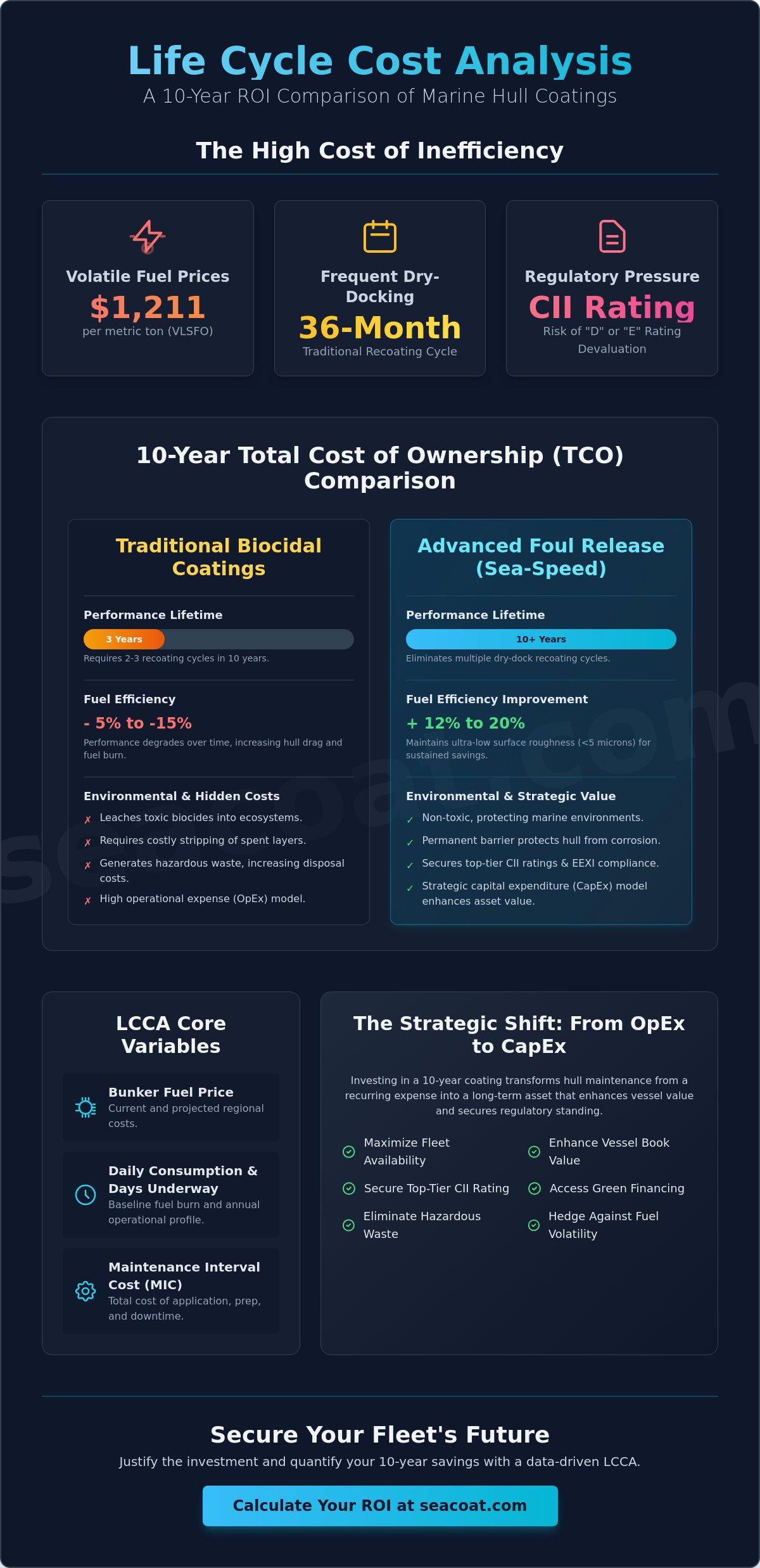
Traditional biocidal coatings often hide significant liabilities behind a lower upfront price. These hidden costs include the leaching of toxic additives into sensitive ecosystems and the recurring necessity of stripping spent layers during frequent 36-month dry-dock cycles. The disposal of hazardous waste generated during these sessions adds thousands to maintenance budgets. In contrast, advanced foul release systems focus on vessel life extension by providing a permanent, non-permeable barrier that protects the substrate from corrosion and osmotic blistering. This shift ensures the structural integrity of the hull is maintained for decades, not just until the next survey.
Regulatory ROI: Avoiding the Cost of Non-Compliance
The 2026 regulatory environment has transformed hull efficiency into a mandatory financial metric. Vessels carrying “D” or “E” Carbon Intensity Indicator (CII) ratings face immediate devaluation in the charter market. Many major cargo owners now refuse to fix vessels that cannot demonstrate top-tier efficiency ratings. This loss of marketability represents a far greater financial risk than the cost of a premium coating application. Furthermore, hydrodynamic efficiency is now the most cost-effective path to EEXI compliance. By maintaining a smooth, low-friction surface, operators can meet carbon reduction targets without the need for expensive engine power limitations or mechanical energy-saving devices. Non-toxic coatings also provide a gateway to emerging green financing and carbon credit markets, where verified emissions reductions are traded as tangible assets.
The Strategic Shift from OpEx to CapEx in Hull Maintenance
A fundamental change in the life cycle cost analysis of marine coatings is the transition from viewing hull protection as a recurring operational expense (OpEx) to a strategic capital expenditure (CapEx). When a coating is engineered to last ten years without reapplication, it becomes a fixed asset that enhances the vessel’s book value. This longevity significantly increases fleet availability by extending service windows and reducing time spent in dry-dock. Environmental Marine Coatings provide a technical framework where superior durability and ecological safety are synergistic, allowing for a 10-year ROI that traditional paints cannot match. By investing in the hull as a performance-enhancing tool, owners secure their margins against fuel volatility and regulatory shifts for the next decade.
The LCCA Formula: Quantifying Fuel, Maintenance, and Compliance
To construct a mathematically sound life cycle cost analysis of marine coatings, fleet managers must transition from simple price comparisons to a multi-variable performance model. The formula isn’t static. It requires the integration of real-world operational data to project the true cost of the hull over a ten-year horizon. When you calculate the impact of bunker fuel prices, which have reached $1,211 per metric ton for VLSFO in hubs like Fujairah, the weight of frictional drag becomes the dominant factor in your financial projection. A comprehensive LCCA must include these core variables:
- Bunker Price: Current and projected fuel costs based on regional availability.
- Daily Consumption: The baseline fuel burn at standard operating speeds.
- Days Underway: Annual operational profile and steaming time.
- Drag Reduction Percentage: The efficiency gain provided by the coating’s surface profile.
Beyond these, you must incorporate Maintenance Interval Costs (MIC) as a critical multiplier. This includes not just the cost of paint and labor, but the Downtime Opportunity Cost (DOC). Every day a vessel spends in dry-dock is a day of lost charter revenue. For a commercial fleet, the delta between a 36-month and a 120-month maintenance window can represent millions in preserved earnings. Additionally, Hull Cleaning Efficiency (HCE) must be factored into the life cycle cost analysis of marine coatings. Hard-film systems allow for more aggressive and efficient in-water cleaning compared to soft-silicone alternatives, which are easily damaged by mechanical grooming.
Calculating Fuel Savings from Frictional Drag Reduction
Hydrodynamic efficiency is the most direct path to reducing operational expenses. Data shows that a 6% reduction in frictional drag can translate into 10% to 15% fuel savings, depending on the vessel’s hull form and service speed. While many coatings claim high “out of the box” performance, the real-world LCCA depends on how that surface holds up over 60 months of service. Theoretical models often ignore the degradation of micro-smoothness caused by biofouling and mechanical wear. To benchmark your fleet’s potential gains, you can refer to the Definitive Guide to Boat Hull Paint for detailed hydrodynamic performance science. Research such as the Life Cycle Assessment of Marine Coatings from Dalhousie University confirms that the choice of coating has a profound impact on both environmental footprint and long-term economic viability.
Maintenance Avoidance: The 10-Year Advantage
The traditional reliance on ablative bottom paint forces a recurring 36-month sacrificial cycle. This process involves the costly removal of spent layers and the disposal of hazardous, copper-laden waste. By switching to a hard-film foul release system like Sea-Speed V 10 X Ultra, operators can extend the service window to a 120-month cycle. This eliminates two full dry-docking events over a decade. The savings from avoiding hull stripping and hazardous waste fees alone often offset the initial application premium. Because these hard-film silanes don’t leach toxins, they remain durable and easy to clean, ensuring that your maintenance strategy supports both your balance sheet and your environmental stewardship goals.
Durability vs. Drag: Comparing Total Cost of Ownership (TCO)
Evaluating the true value of a hull system requires a deep dive into the Total Cost of Ownership (TCO), a metric that extends far beyond the initial application invoice. In a rigorous life cycle cost analysis of marine coatings, we must weigh hydrodynamic efficiency against physical durability. Traditional ablative antifouling paints are designed to erode. This process inherently increases surface friction as the coating wears unevenly over time. Soft silicone systems provide exceptional initial drag reduction, but their low mechanical strength makes them susceptible to tearing and detachment during standard operations or harbor maneuvers. These physical failures lead to localized fouling and significant repair costs. In contrast, hard-film silane-siloxane technology, specifically Sea-Speed V 10 X Ultra, provides a permanent surface that resists impact while maintaining an ultra-low friction profile.
Surface Roughness (MSR) degradation is a primary driver of long-term speed loss and increased fuel consumption. As biocides leach out of traditional paints, they leave behind a porous, honeycombed structure that significantly increases drag. This degradation often negates any initial fuel savings within the first 24 months of service. Research presented in the Life Cycle Assessment of Marine Coatings by the World Maritime University highlights that a coating’s performance over its entire life is more critical than its day one metrics. Hard-film coatings don’t rely on leaching mechanisms. They remain chemically stable and physically smooth for ten years or more, ensuring that the ROI projected at the start of the cycle is actually realized.
Surface Roughness and Long-Term Speed Loss
The mechanism of biocidal leaching creates a self-defeating cycle for vessel operators. As the active ingredients depart the film, the resulting increase in MSR forces the engine to work harder to maintain speed. This process transforms a supposedly efficient hull into a financial liability. Sea-Speed V 10 X Ultra utilizes a silane-siloxane matrix to create a slick surface that minimizes biofouling adhesion through surface energy rather than toxicity. Because the film is non-ablative, it maintains a consistent MSR throughout its service life. This stability is essential for maintaining a favorable CII rating and avoiding the fuel penalties associated with surface aging.
In-Water Cleaning: Risk vs. ROI
Maintenance strategies often overlook the operational costs of hull grooming. Soft silicone coatings require specialized, gentle cleaning equipment to avoid damaging the delicate film, which increases the price per cleaning event. If the silicone is breached, the repair often requires a full dry-docking. Hard-film coatings allow for more aggressive, lower-cost cleaning protocols. They can withstand mechanical brushes and high-pressure grooming without losing thickness or smoothness. Integrating in-water hull cleaning best practices into your life cycle cost analysis of marine coatings reveals that the durability of the film is just as important as its drag coefficient. A robust surface ensures that maintenance remains a minor operational task rather than a major financial risk.
Step-by-Step ROI Calculation for Commercial and Military Fleets
Moving from technical theory to financial practice requires a transparent calculation model. Unlike black-box digital tools that offer little visibility into their underlying assumptions, a manual life cycle cost analysis of marine coatings allows stakeholders to stress-test every variable. This process ensures that the resulting ROI is grounded in actual operational realities rather than generic marketing projections. To build a robust 10-year framework, follow these five essential steps.
- Step 1: Establish your baseline. Audit the last five years of fuel consumption and maintenance expenditures. This data should include the costs of previous paint applications, hull cleaning, and the revenue lost during dry-docking intervals.
- Step 2: Calculate the Application Premium. Determine the upfront cost delta between a standard biocidal system and a premium foul release system. This figure must include the cost of stripping the hull to the bare substrate, which is a one-time requirement for hard-film silanes.
- Step 3: Project fuel savings. Apply a conservative 10% drag reduction factor to your baseline fuel consumption. Given the current volatility of bunker prices, this efficiency gain often represents the largest single contributor to the ROI.
- Step 4: Subtract skipped maintenance costs. The primary advantage of a 10-year system is the elimination of the mid-term dry-dock recoating cycle. Subtract the total cost of a full 5-year maintenance event, including labor, materials, and vessel downtime.
- Step 5: Factor in regulatory standing. Assign a value to the preservation of your CII rating. Maintaining a Tier 1 or Tier 2 standing prevents the financial penalties and restricted chartering opportunities associated with poor carbon efficiency.
Special Considerations for Aluminum and Military Hulls
For aluminum vessels, the ROI calculation must prioritize the prevention of galvanic corrosion. Traditional copper-based paints can lead to catastrophic structural failure if the barrier coat is breached. Utilizing non-metallic, hard-film systems eliminates this risk entirely, extending the asset’s service life and reducing emergency repair costs. In military contexts, ROI is often measured by mission readiness and maximized time-on-station. A coating that resists fouling without toxic leaching ensures that specialized hulls remain operational in sensitive environments for longer periods. For specific data on substrate protection, consult the guide on the best boat paint for aluminum boats.
Sensitivity Analysis: Fuel Price Volatility
A rigorous life cycle cost analysis of marine coatings must account for the unpredictable nature of global energy markets. Whether your fleet is transitioning to Ammonia, Methanol, or continuing with VLSFO, high-efficiency coatings act as a financial hedge against price spikes. Conservative fuel price forecasting remains the cornerstone of any resilient maritime life cycle cost analysis. By stress-testing your model against a 20% increase in fuel costs, you can demonstrate how premium coatings protect margins during periods of geopolitical instability. Quantify your fleet’s potential by evaluating the Sea-Speed V 10 X Ultra performance specifications.
Maximizing Lifetime Asset Value with Sea-Speed V 10 X Ultra
Adopting Sea-Speed V 10 X Ultra represents a departure from the reactive maintenance cycles that have historically burdened fleet operations. It’s a move toward viewing the hull coating as a strategic capital asset rather than a recurring operational expense. When you finalize a 10-year life cycle cost analysis of marine coatings, the data consistently favors high-performance silane-siloxane systems. This technical framework yields a triple-tier ROI: substantial fuel savings derived from sustained hydrodynamic efficiency, the total elimination of mid-term re-application costs, and the seamless maintenance of high CII ratings. By investing in a permanent surface, you insulate your fleet from the labor and material inflation that typically plagues 36-month dry-docking intervals.
The environmental ROI is equally quantifiable. Because Sea-Speed V 10 X Ultra contains zero biocides and leaches no toxic contaminants, it protects the ecological health of the ports and waterways where your vessels operate. This non-toxic profile, combined with a 12% to 20% reduction in fuel consumption, results in a massive decrease in greenhouse gas emissions. Technical consultation and precision ROI modeling allow fleet managers to map these benefits directly to their corporate sustainability targets, turning regulatory compliance into a competitive advantage in the green chartering market.
The Science of Permanent Substrate Protection
The core of this technology lies in its molecular structure. Silane-siloxane coatings create a non-porous, permanent bond with the hull substrate, providing a level of durability that traditional paints cannot match. There’s a critical financial distinction between “foul release” and “antifouling” in 10-year projections. Antifouling relies on the controlled depletion of toxins, a process that inherently degrades the film’s smoothness and physical integrity. Foul release systems, however, utilize low surface energy to prevent adhesion. You can explore these differences in detail by reviewing the Definitive Guide to Antifouling and Foul Release. This shift ensures the hull remains a high-performance tool for the entire decade, rather than a surface in a constant state of decay.
Future-Proofing Your Fleet for 2030 and Beyond
As the industry transitions toward expensive alternative fuels like ammonia and methanol, the value of drag reduction will only increase. Every watt of energy saved through surface efficiency becomes more valuable as fuel costs per megajoule rise. Modern coating choices also impact a vessel’s resale value; a hull that has been protected by a permanent, non-corrosive system for ten years is a far more attractive asset than one subjected to repeated abrasive blasting and toxic buildup. This Expert Innovator’s approach to strategic hull management ensures that your life cycle cost analysis of marine coatings supports long-term terminal life expectancy. By choosing intelligence over temporary fixes, you secure the operational efficiency and financial resilience of your fleet for the next decade of maritime commerce.
Securing Decadal Efficiency in a Volatile Maritime Economy
The integration of 2026 regulatory standards and bunker fuel volatility necessitates a transition from reactive maintenance to strategic fleet management. By applying a rigorous life cycle cost analysis of marine coatings, operators can move beyond the limitations of traditional biocidal paints that require frequent, costly dry-dock cycles. This methodical approach identifies the true value of maintaining hydrodynamic smoothness over a decade, rather than just surviving the next survey window. It transforms the hull from a maintenance burden into a performance-enhancing asset that actively defends your margins.
Advanced foul release technology offers a documented 10-year service life and up to a 15% reduction in fuel consumption, ensuring your assets remain IMO, EEXI, and CII compliant. This performance isn’t just a maintenance preference; it’s a financial hedge against the rising costs of alternative fuels and carbon penalties. Investing in a permanent, non-toxic solution aligns your operational goals with global environmental stewardship while protecting your long-term margins. Ready to quantify these benefits for your specific operations? Request a Technical ROI Analysis for Your Fleet to discover how permanent substrate protection transforms your bottom line. Your path to a more resilient and sustainable operational future starts with evidence-based decision-making.
Frequently Asked Questions
How much fuel can I realistically save by switching to a foul release coating?
Vessel operators can realistically expect fuel efficiency improvements of 12% to 20% when transitioning to a high-performance foul release system. This gain is achieved by reducing surface roughness to less than 5 microns, which significantly lowers frictional drag compared to traditional paints. These savings are verified through operational data and remain consistent as long as the hull’s micro-smoothness is maintained through proper grooming.
Is the ROI on a premium coating still positive if bunker fuel prices drop?
Yes, the ROI remains positive because a comprehensive life cycle cost analysis of marine coatings accounts for variables beyond fuel consumption. Even in lower fuel price environments, the elimination of two full dry-docking and recoating cycles over ten years provides massive savings. Avoiding hull stripping labor and hazardous waste disposal fees ensures the financial baseline stays strong regardless of energy market fluctuations.
How does a 10-year coating cycle affect my mandatory dry-docking schedule?
A 10-year cycle doesn’t eliminate mandatory class surveys, but it removes recoating from the critical path of those surveys. Instead of stripping and painting every 36 months, you simply perform a high-pressure wash and minor touch-ups if mechanical damage has occurred. This significantly reduces the time spent in dry-dock, allowing the vessel to return to service and generate revenue much faster than ships using traditional systems.
What is the financial impact of a poor CII rating under 2026 regulations?
A poor Carbon Intensity Indicator (CII) rating of “D” or “E” leads to immediate financial devaluation and restricted chartering opportunities. Major cargo owners and logistics hubs increasingly prioritize vessels with superior efficiency ratings to meet their own ESG targets. Ships that fail to maintain high ratings face higher port fees, restricted access to certain regions, and a significant reduction in their daily charter rates.
Can I calculate ROI for smaller recreational vessels or only for large commercial fleets?
You can calculate ROI for any hull size, as the economic principles of fuel savings and maintenance avoidance are universal. While the scale of the numbers differs, the percentage-based gains in efficiency and the cost-benefit of skipping annual haul-outs remain consistent. For smaller vessels, the life cycle cost analysis of marine coatings often highlights the value of preserving the hull’s gelcoat and reducing long-term engine wear.
Does the LCCA include the cost of in-water hull cleaning during the 10-year period?
Yes, a rigorous analysis must include the frequency and cost of in-water grooming sessions. Hard-film coatings like Sea-Speed V 10 X Ultra actually lower these costs because their durable surfaces allow for more aggressive and efficient cleaning protocols. Unlike soft silicones that require specialized, expensive equipment to avoid tearing, hard-film systems can be maintained using standard mechanical brushes without damaging the coating’s integrity.
How do non-toxic coatings affect carbon credit eligibility for shipping companies?
Non-toxic coatings enhance carbon credit eligibility by providing a verifiable mechanism for reducing greenhouse gas emissions. Because these systems are biocide-free and improve hydrodynamic efficiency, they qualify as “green technology” under many international maritime financing frameworks. This status can provide access to lower interest rates and participation in carbon trading markets where verified fuel savings are converted into tradable financial assets.
What is the typical payback period for a Sea-Speed V 10 X Ultra application?
The payback period for a Sea-Speed V 10 X Ultra application typically falls between 18 and 24 months for high-utilization commercial vessels. This rapid return is driven by the combination of immediate fuel savings and the avoidance of the first major recoating event at the three-year mark. For military or specialized vessels with different operational profiles, the payback is often measured by increased mission readiness and extended asset service life.