
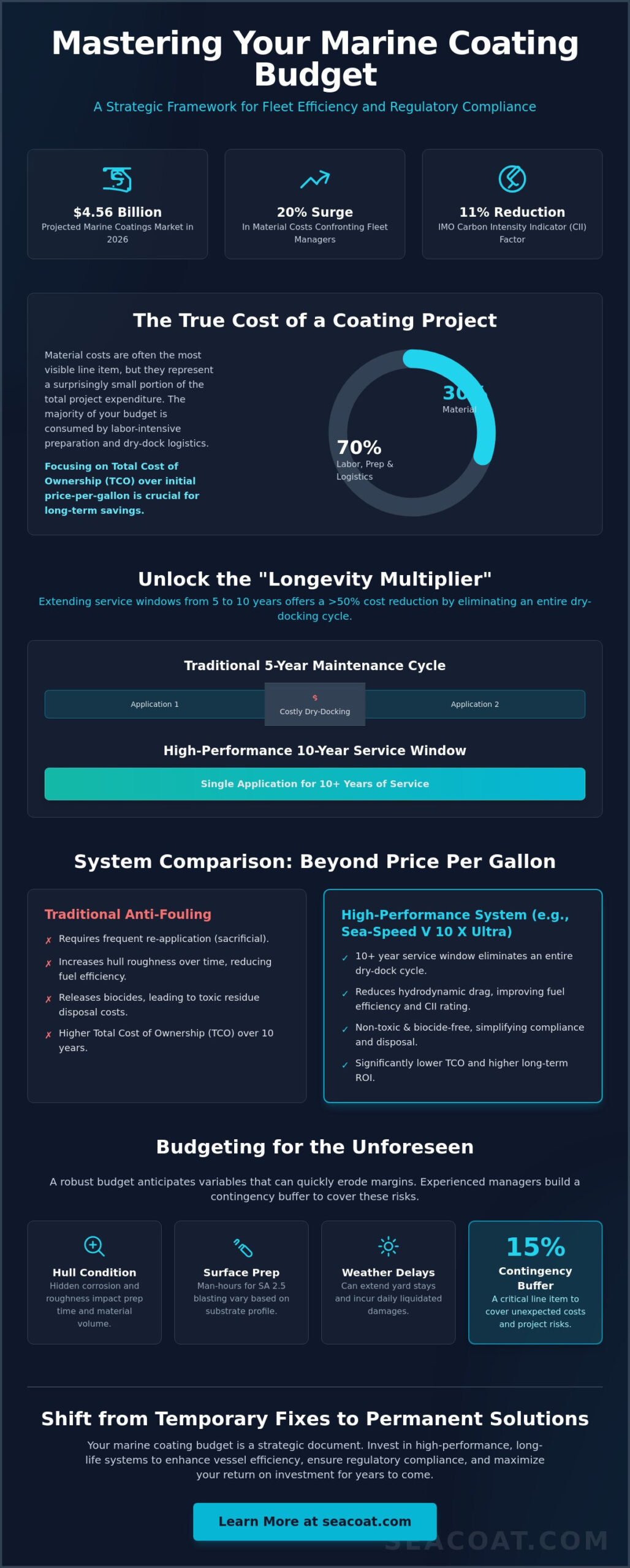
With the global marine coatings market projected to reach $4.56 billion in 2026, fleet managers are confronting a 20% surge in material costs alongside an 11% IMO Carbon Intensity Indicator reduction factor. You likely recognize that a dry-docking budget is often a moving target; unforeseen surface preparation labor and inaccurate volume estimates can quickly erode your operational margins. Relying on a standardized marine coating project budget template is no longer just a clerical task. It’s a strategic necessity for maintaining vessel efficiency and regulatory compliance in a high-stakes environment.
This guide provides a comprehensive framework to master maintenance planning by accounting for material performance variables and long-term fuel ROI. You’ll learn how to quantify the value of transitioning to high-performance, non-toxic systems like Sea-Speed V 10 X Ultra. We examine how to balance immediate application expenses against a decade of operational savings, ensuring your fleet remains competitive as labor rates rise and environmental mandates tighten. This approach shifts the focus from temporary fixes to permanent, evidence-based solutions for your maritime assets.
Key Takeaways
- Understand the “Longevity Multiplier” and why extending service windows to 10 years offers a 50% cost reduction over traditional maintenance cycles.
- Utilize a comprehensive marine coating project budget template to align technical specifications with 2026 EEXI performance metrics and environmental regulations.
- Master material estimation by accounting for hull roughness and the critical differences between theoretical and actual coverage rates.
- Quantify operational gains by calculating the fuel savings and payback period associated with high-performance solutions like Sea-Speed V 10 X Ultra.
- Identify hidden labor variables in surface preparation, including the specific man-hour requirements for various abrasive and hydro-blasting standards.
Core Components of a Marine Coating Project Budget
Constructing a robust fiscal plan for vessel maintenance requires moving beyond simple price-per-gallon calculations. In the current maritime economy, a marine coating project budget template must function as a strategic performance document that balances immediate expenditures against a multi-year operational cycle. The framework rests on three primary pillars: surface preparation, material procurement, and application logistics. While material costs are often the most visible line item, they frequently represent less than 30% of the total project expenditure. The remaining 70% is consumed by labor-intensive preparation and the logistical complexities of dry-docking.
A sophisticated budget accounts for the Total Cost of Ownership (TCO) rather than just the initial application cost. For instance, while traditional anti-fouling paint might offer a lower entry price, its sacrificial nature requires frequent re-application and results in increasing hull roughness over time. In contrast, investing in high-performance, biocide-free systems like Sea-Speed V 10 X Ultra may involve higher initial material costs but yields significant dividends through extended service windows and reduced “off-hire” opportunity costs. When a vessel remains in the water longer between dry-docking events, the realized ROI far outweighs the upfront premium.
Fixed vs. Variable Project Costs
Budgeting accuracy depends on distinguishing between static and fluid expenses. Fixed costs include dry-docking duration fees, basic equipment rentals, and standard docking/undocking charges. These are predictable based on the vessel’s displacement and the facility’s rate sheet. Variable costs are more elusive. They include the actual volume of grit required for SA 2.5 blasting, which fluctuates based on the severity of existing corrosion and the substrate’s profile. Weather-related delays can also stall application schedules, leading to daily liquidated damages or extended yard stays. To mitigate these risks, experienced fleet managers build a 15% contingency buffer into their marine coating project budget template to cover “hidden” hull damage discovered only after the vessel is out of the water.
Regulatory and Environmental Line Items
As of 2026, environmental compliance is no longer a peripheral concern but a central budgetary driver. New regulations require precise accounting for the disposal of toxic residues and hazardous waste generated during the removal of old coatings. Furthermore, the financial impact of Greenhouse Gas (GHG) emissions ratings, such as the Carbon Intensity Indicator (CII), directly influences vessel valuation and chartering potential. High-performance coatings contribute to better CII ratings by reducing hydrodynamic drag, which lowers fuel consumption. You can explore more about the shifts toward sustainable hull performance to understand how these metrics integrate into long-term financial planning. Failing to budget for these performance-linked variables can lead to unexpected penalties and reduced asset liquidity in an increasingly regulated market.
Material Estimation: Beyond Price Per Gallon
Accurate estimation within a marine coating project budget template requires a shift away from the reductive “price per gallon” metric. True fiscal value is found in the cost per square meter of service life. While high-performance materials often carry a higher initial purchase price, they unlock the “Longevity Multiplier.” A 10-year coating system is effectively 50% cheaper than two separate 5-year applications. This is because it eliminates an entire dry-docking cycle, including the massive overhead of yard fees and labor. You’re not just buying paint; you’re purchasing an extended operational window for your asset.
Adhesion serves as the foundation of this durability. Budgeting for a high-performance primer like Seapoxy 73 ensures the coating system remains intact under extreme hydrodynamic stress. Inferior primers often lead to premature delamination, which necessitates expensive spot repairs or total recoating during mid-cycle inspections. Additionally, you must account for the hidden costs of “soft” silicone coatings. These systems often require recurring underwater cleaning and frequent touch-ups to remain effective. These maintenance fees can quickly outpace the savings of a cheaper initial bid, making them a liability in a long-term financial model.
Volume Solids and Spread Rates
High-solids coatings like Sea-Speed V 10 X Ultra optimize material usage by minimizing evaporative loss during the curing process. Calculating the ratio between Wet Film Thickness (WFT) and Dry Film Thickness (DFT) is essential for determining actual volume requirements. Higher volume solids mean less material is needed to achieve the specified protective barrier. Maximizing volume solids ensures that a higher percentage of the applied product remains on the hull as a protective film, effectively reducing waste and volatile emissions. This efficiency directly reduces the total volume of product purchased and the associated environmental footprint of the project.
Foul Release vs. Ablative Material Cycles
Traditional ablative paints rely on a sacrificial mechanism that wears away over time. This process increases hull roughness and fuel consumption as the coating degrades. You can learn more about understanding the sacrificial cycle vs. modern alternatives to see how stable hard-film technology differs. Hard-film foul release systems maintain a consistent surface profile for years, preventing the “Hull Friction Tax” associated with aged ablative surfaces. For specialized applications, budgeting for Sea-Speed V 10 X Ultra Clear provides the same hydraulic efficiency while preserving the substrate’s aesthetic. Transitioning to these systems begins with evaluating hard-film foul release options for your fleet’s specific 2026 requirements.
Labor and Surface Preparation: The Variable Math
Labor represents the most volatile variable in any shipyard project. While material costs are quantifiable, man-hours fluctuate based on the vessel’s physical condition and the yard’s operational efficiency. A professional marine coating project budget template must distinguish between standardized abrasive blasting and specialized hydro-blasting. SA 2.5 grit blasting remains the industry benchmark for achieving a near-white metal finish, yet it generates significant waste volume that requires expensive disposal. Hydro-blasting offers a cleaner alternative but often requires longer drying times before the first primer coat, such as Seapoxy 73, can be applied to the substrate.
Application complexity further dictates the final invoice. Traditional multi-coat systems extend the dry-docking schedule because each layer necessitates specific inter-coat drying intervals. If ambient humidity exceeds 85% or temperatures drop below the dew point, these intervals can double, leading to costly yard extensions. Transitioning to advanced systems that require fewer coats, such as Sea-Speed V 10 X Ultra, directly minimizes these risks. Reducing the number of application cycles significantly lowers the total man-hours billed, turning a technical material choice into a major logistical advantage.
Surface Preparation Standards
Effective budgeting requires a granular understanding of SSPC and NACE standards. Achieving a high-quality profile is non-negotiable for the adhesion of long-life coatings. However, the removal of legacy TBT or copper-based paints introduces significant regulatory expenses. These toxic residues demand specialized containment and hazardous waste management fees that standard “spot repair” budgets often overlook. Relying on spot repairs frequently fails to address deep-seated substrate degradation, leading to localized failures that compromise the entire hull’s performance within 18 months.
Application Logistics and Equipment
The shift toward sophisticated silane-siloxane technology, such as Armor-Sil R/G, necessitates specific application infrastructure. High-performance coatings often require specialized spray equipment to ensure correct mixing ratios and proper atomization. Your marine coating project budget template should also account for scaffolding and full-containment shrouding, particularly when working in environmentally sensitive regions or near residential areas. Finally, factor in “overspray” loss. In high-wind shipyard environments, material loss can reach 15% to 25% depending on the application method and the vessel’s geometry. Planning for these logistical realities prevents mid-project capital shortfalls.
Modeling ROI: Fuel Savings and Operational Gains
The most significant oversight in a standard marine coating project budget template is the failure to quantify the “Hull Friction Tax.” Scientific research indicates that biofouling can increase fuel consumption by as much as 40%, creating a persistent drain on operational capital that far exceeds the initial cost of any coating system. When you transition from viewing a hull coating as a maintenance expense to a strategic asset, the financial modeling shifts. By calculating the payback period for high-performance systems like Sea-Speed V 10 X Ultra, fleet managers can demonstrate how superior fluid dynamics directly protect the bottom line against volatile fuel price forecasts.
Operational gains also manifest through significantly extended service windows. Traditional coatings often require a 24-month dry-docking cycle to maintain effectiveness, but hard-film, biocide-free technology allows for intervals of 60 months or longer. This extension eliminates the massive overhead associated with mid-cycle yard stays and keeps the vessel in a revenue-generating state. You can find more detailed data in the definitive guide to hull paint performance and ROI, which explores the scientific link between surface roughness and long-term financial outcomes.
Fuel Consumption Reduction Analysis
Low-friction surfaces provide a measurable reduction in hydrodynamic drag, typically yielding between 3% and 12% in fuel savings depending on the vessel type and operational profile. A 5% reduction in fuel consumption over a 5-year period can effectively offset the entire cost of a premium coating application while significantly improving the vessel’s net present value. Beyond direct fuel spend, a smooth hull reduces the mechanical load on the engine and propulsion systems. This decrease in torque requirement leads to lower exhaust gas temperatures and reduced wear on internal components, further lowering the long-term maintenance burden across the fleet.
EEXI and CII Compliance Savings
As of 2026, the IMO Carbon Intensity Indicator (CII) reduction factor has increased to 11% relative to the 2019 baseline. Vessels with poor ratings face the prospect of forced “slow steaming” or mandatory corrective action plans, both of which carry heavy financial penalties. Advanced coatings function as a critical tool for maintaining high CII ratings without sacrificing operational speed. By integrating these performance metrics into your marine coating project budget template, you can account for the value of carbon credits and regulatory compliance. Investing in hull efficiency is the most direct path to securing a vessel’s future in an increasingly decarbonized market. To begin optimizing your fleet’s performance profile, evaluate our hard-film foul release solutions for your next dry-docking cycle.
Finalizing Your Marine Coating Project Budget
Finalizing your marine coating project budget template requires a meticulous review of the technical specification against the financial reality of the shipyard environment. This is the stage where theoretical coverage rates meet the practical constraints of application logistics and regulatory oversight. A successful budget isn’t merely a list of expenses; it’s a verification tool that ensures every dollar spent contributes to a measurable increase in vessel efficiency. By the time you reach this final phase, your spreadsheet should reflect the shift from viewing hull maintenance as a recurring drain to seeing it as a performance-enhancing investment.
When presenting the final budget to stakeholders, the emphasis must remain on the 10-year operational cycle. Traditional procurement models often prioritize the lowest initial bid, yet as we’ve explored, this frequently leads to higher total costs through increased fuel burn and shorter dry-docking intervals. You’re providing a roadmap for asset longevity. Highlighting the absence of volatile environmental contaminants and the durability of hard-film systems like Sea-Speed V 10 X Ultra frames the budget as a tool for both fiscal and environmental stewardship. It’s a proactive stance that aligns with the industry’s move toward permanent, sophisticated solutions rather than temporary fixes.
The Budget Checklist
Before finalizing your figures, ensure your marine coating project budget template includes these critical line items to prevent mid-project capital shortfalls:
- Environmental Compliance: Have you accounted for the specialized waste disposal fees associated with removing old, toxic residues?
- Application Timelines: Is the labor estimate aligned with the specific drying schedule of your chosen system, accounting for local humidity and temperature forecasts?
- Hull Roughness Metrics: Did you include the cost for pre- and post-application roughness measurements to verify the projected fuel savings?
- Logistical Buffers: Is there a contingency for equipment rentals or scaffolding extensions if weather delays occur during the application window?
The SCT Advantage
Seacoat Technology provides the scientific expertise necessary to refine your project estimates and ensure your fleet maintenance strategy is grounded in data. Our non-toxic, silane-siloxane technology represents a fundamental departure from traditional methods, offering a synergistic balance of physical durability and ecological safety. Solutions like Armor-Sil R/G and Sea-Speed V 10 X Ultra Clear are engineered for maximum surface efficiency, helping you mitigate the negative effects of biofouling while extending your vessel’s service life. We don’t just sell products; we provide the technical support required to transform your maintenance cycle into a strategic asset management plan. To move beyond generic estimates toward a precise performance model, contact Seacoat SCT for a customized project evaluation.
Optimizing Your Fleet for a High-Performance Future
Mastering vessel maintenance in 2026 requires a departure from traditional, short-term fiscal models. By integrating a marine coating project budget template into your planning, you transition from managing simple expenses to overseeing strategic assets. This approach ensures you account for the critical variables of surface preparation labor, regulatory compliance fees, and the long-term ROI of superior fluid dynamics. The evidence is clear; prioritizing hull efficiency and extended service windows is the most effective way to protect your margins against rising fuel costs and tightening environmental mandates.
Seacoat Technology has pioneered biocide-free, Silane-Siloxane technology since 2001, providing a proven alternative to sacrificial coatings. Our non-toxic, zero-VOC formulations like Sea-Speed V 10 X Ultra deliver documented fuel savings of up to 12%, directly supporting your CII ratings and operational bottom line. It’s time to move beyond temporary fixes toward permanent, scientifically backed solutions that value both durability and ecological safety. Download our Technical Data Sheets to refine your budget and secure a competitive advantage for your fleet. Your commitment to smarter maintenance today ensures a more efficient and sustainable maritime operation for years to come.
Frequently Asked Questions
What is the typical cost per square foot for a professional marine coating project?
Total project costs depend on vessel displacement and the complexity of the surface profile. As of May 2026, professional labor rates for bottom painting range from $12 to $22 per foot for standard applications. You must also account for global price increases from major manufacturers, which saw hikes of up to 20% in early 2026. Regional labor rates vary significantly, with some marinas listing professional services at $90.00 per hour.
How do I calculate the amount of paint needed for my vessel’s hull?
Calculate the required volume by dividing the total submerged surface area by the product’s practical coverage rate, then multiply by the number of intended coats. High-solids systems like Sea-Speed V 10 X Ultra provide a superior spread rate because less material is lost to evaporation during the curing process. Always include a loss factor for overspray, which can reach 25% in high-wind shipyard environments.
What are the hidden costs in a dry-docking coating project?
Overlooked expenses often include hazardous waste disposal fees for toxic residues and mandatory environmental compliance permits. A marine coating project budget template should also factor in “off-hire” opportunity costs and the daily fees for scaffolding or specialized spray equipment. We recommend a 15% contingency buffer to address substrate degradation or corrosion discovered only after the initial blasting is complete.
How does foul-release coating affect my vessel’s fuel budget?
Hard-film foul-release technology reduces hydrodynamic drag by maintaining a smooth surface profile over multiple years. This efficiency can yield fuel savings between 3% and 12%, directly offsetting the initial investment. Unlike traditional sacrificial paints that increase in roughness as they age, these systems prevent the “Hull Friction Tax,” leading to lower engine load and reduced fuel expenditure across the entire service life.
Can I use a standard budget template for both aluminum and steel hulls?
The core budgeting framework remains consistent, but the technical material specifications must differ to prevent galvanic corrosion. Steel hulls require high-build epoxy primers like Seapoxy 73 to establish a durable dielectric barrier. Aluminum hulls necessitate biocide-free systems to avoid the severe pitting caused by copper-based compounds. While the spreadsheet structure is the same, the material cost line items must reflect these distinct chemical requirements.
What environmental regulations should I budget for in 2026?
You must budget for the EU Emissions Trading System (EU ETS) and the IMO’s Carbon Intensity Indicator (CII) requirements. In 2026, shipping companies are required to surrender allowances for 70% of their verified CO2 emissions. Additionally, the CII reduction factor has increased to 11% relative to the 2019 baseline. Failing to meet these standards can lead to mandatory corrective action plans and significant financial penalties that impact vessel valuation.
How do I justify the higher cost of non-toxic coatings to my CFO?
Focus the justification on the “Longevity Multiplier” and the reduction in dry-docking frequency. Non-toxic, silane-siloxane systems like Sea-Speed V 10 X Ultra extend service windows from 24 months to 60 months or more. This extension eliminates the massive overhead and lost revenue of a mid-cycle yard stay. When combined with documented fuel savings, the total cost of ownership is significantly lower than traditional toxic alternatives.
What is the difference between theoretical and practical coverage in budgeting?
Theoretical coverage is the mathematical yield on a perfectly smooth surface with zero waste, while practical coverage accounts for the realities of the shipyard. Your marine coating project budget template must use practical coverage to account for surface profile roughness and application loss. High-solids formulations improve this ratio by ensuring a higher percentage of the applied product remains on the hull as a protective dry film.