With VLSFO prices reaching $962.55 per metric ton as of May 2026, a single percentage point of hull drag can now represent a six-figure operational penalty. You’re likely facing the combined pressure of 70% CO2 allowance surrenders under the EU ETS and the new NORMAM-401 biofouling mandates, making hull efficiency a critical pillar of your financial strategy. Utilizing a precise ROI calculator for vessel coatings is essential for moving beyond the initial application cost to evaluate the total cost of ownership over a 10-year cycle. While traditional biocidal coatings require frequent intervention, non-toxic foul release systems can yield a 40% reduction in maintenance expenditure over a decade.
This guide will help you master the complex financial metrics of hull performance and quantify the long-term savings of advanced silane-siloxane technologies. You’ll learn how to build a clear framework for comparing coating durability, focusing on the operational benefits of hard-film solutions like Sea-Speed V 10 X Ultra Clear. We’ll examine how these systems facilitate compliance with EEXI and CII mandates while significantly reducing your annual fuel spend through superior surface smoothness and reduced fluid resistance.
Key Takeaways
- Shift from a narrow focus on initial application costs to a strategic operational expense model that prioritizes multi-year hull performance and asset longevity.
- Understand how silane-siloxane chemistry creates a non-porous, hydrophobic surface that significantly reduces hydrodynamic drag and annual fuel consumption.
- Learn the technical steps to build an accurate ROI calculator for vessel coatings by factoring in fuel prices, maintenance intervals, and regulatory compliance surcharges.
- Evaluate the hidden financial penalties of traditional ablative paints, including frequent repainting cycles and the mechanical damage caused by aggressive hull cleaning.
- Future-proof your fleet against tightening environmental mandates like EEXI and CII by adopting zero-toxicity, high-durability solutions such as Sea-Speed V 10 X Ultra.
Understanding the Economic Impact of Marine Hull Coatings
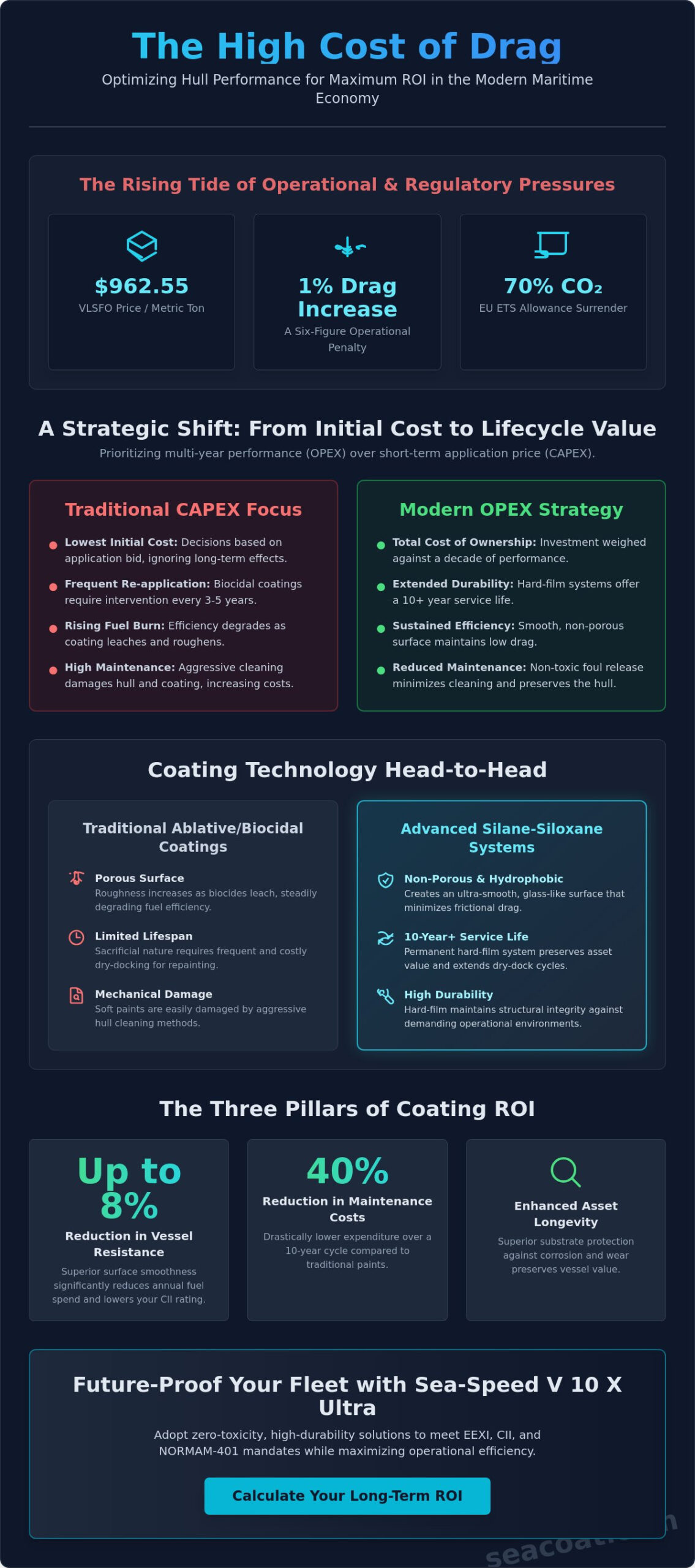
Traditionally, hull coatings were managed as a recurring Capital Expenditure (CAPEX) item, often selected based on the lowest bid for application. This short-term view is no longer viable in a high-stakes maritime economy where VLSFO prices sit near $962.55 per metric ton. Modern fleet management requires a shift toward Operational Expenditure (OPEX) optimization, where the initial investment is weighed against a decade of performance. The industry is moving away from sacrificial, biocidal coatings toward permanent, hard-film systems that offer a superior return on investment. Using a sophisticated boat hull paint strategy transforms the hull from a maintenance liability into a performance-enhancing asset.
The “Three Pillars” of coating ROI define this new financial landscape. First, fuel efficiency remains the dominant factor, as high-performance coatings can reduce a vessel’s resistance by up to 8%. Second, maintenance costs are drastically lowered; non-toxic foul release systems can yield a 40% reduction in expenditure over ten years compared to traditional paints. Third, asset longevity is preserved through superior substrate protection. These factors combined demonstrate that the cheapest coating at the dock is often the most expensive over the lifecycle of the ship.
The Cost of Biofouling: More Than Just Drag
Biofouling is a complex biological process that starts the moment a hull enters the water. Understanding The Science of Frictional Drag reveals that even a thin layer of slime can increase fuel consumption by significant margins. Beyond fuel, heavy fouling creates immense strain on the propulsion system, leading to accelerated mechanical wear and premature engine failure. There’s also a growing legal risk; as of February 1, 2026, Brazil’s NORMAM-401 regulations require strict biofouling management for ships over 24 meters. Failure to comply can result in port exclusions and heavy fines, making hull cleanliness a matter of global market access.
Regulatory ROI: EEXI and CII Compliance
Environmental mandates are now the primary catalysts for technological adoption. Under the EU Emissions Trading System (ETS), shipping companies must surrender allowances for 70% of their verified CO2 emissions as of January 1, 2026. This creates a direct financial link between hull smoothness and carbon taxes. An accurate ROI calculator for vessel coatings must account for these regulatory surcharges, which can dwarf the cost of the coating itself. By maintaining a favorable Carbon Intensity Indicator (CII) rating through passive efficiency technologies like Sea-Speed V 10 X Ultra, operators protect their charter rates and avoid the operational restrictions that plague lower-rated vessels. This proactive approach ensures that compliance costs are mitigated while operational flexibility is maximized.
The Science of Frictional Drag and Fuel Consumption ROI
Fluid dynamics dictate that a vessel’s speed-fuel curve is primarily determined by frictional resistance, a factor that must be central to any ROI calculator for vessel coatings. This resistance is a direct function of Average Hull Roughness (AHR). When a hull surface is microscopically uneven, it creates turbulence within the boundary layer, forcing the propulsion system to work harder to maintain speed. Silane-Siloxane technology addresses this at the molecular level, creating a non-porous, hydrophobic interface that remains exceptionally smooth over time. Unlike soft silicone coatings that are prone to mechanical damage and “ghosting,” hard-film systems like Sea-Speed V 10 X Ultra maintain their structural integrity and low-friction profile even in demanding operational environments.
Surface Roughness vs. Material Science
The transition from traditional biocidal paints to advanced material science hinges on the ability to control the boundary layer. Traditional coatings often feature a porous surface that increases in roughness as the biocides leach out, leading to a steady decline in efficiency. In contrast, low friction coatings reduce the energy required for propulsion by maintaining a consistent, glass-like finish that minimizes skin friction. This permanent slickness is achieved through a cross-linked polymer matrix that resists the attachment of marine organisms without the use of depleting toxins. The result is a hull that stays cleaner for longer, ensuring that the ship’s hydrodynamic profile doesn’t degrade between dry-docking intervals.
Fuel Savings: The Primary ROI Driver
Fuel remains the largest variable expense for any maritime operator. With VLSFO prices at $962.55 per metric ton as of May 2026, the financial impact of a 6% to 12% reduction in fuel consumption is substantial. An accurate ROI calculator for vessel coatings must account for these savings by projecting the shift in the speed-fuel curve over the entire service life of the coating. Real-world applications show that vessels can achieve significant speed gains at constant power settings, or conversely, maintain service speeds at lower RPMs. This shift directly translates into a shorter payback period for the initial coating investment. Operators looking to optimize their fleet’s performance should evaluate the long-term durability of Sea-Speed systems to ensure these efficiency gains are sustained for a decade or more.
Comparing Life-Cycle Costs: Traditional Antifouling vs. Hard Foul Release
Evaluating the true efficiency of a vessel requires looking beyond the next voyage. While fuel savings provide immediate relief, the structural integrity and maintenance cadence of the hull determine the long-term profitability of the asset. A comprehensive ROI calculator for vessel coatings must integrate these lifecycle variables to provide a realistic projection of Total Cost of Ownership (TCO). Many operators fall into the trap of selecting coatings based on the lowest initial application price, failing to account for the compounding expenses of frequent dry-docking and the mechanical degradation of the substrate over time.
The distinction between a sacrificial system and a permanent solution is fundamental to maritime financial planning. Traditional biocidal coatings operate on a principle of depletion, where the material itself is designed to wear away. This creates a performance curve that begins to decline the moment the ship leaves the dock. In contrast, hard foul release systems like Sea-Speed V 10 X Ultra provide a stable, non-depleting surface. This stability ensures that the hydrodynamic benefits calculated at the start of the cycle remain consistent throughout a decade of service.
Ablative Paints: The Sacrificial Cycle Cost
The financial burden of ablative bottom paint extends far beyond the cost per gallon. These systems typically require a full refresh every 24 to 36 months, involving significant labor for surface preparation and re-application. A major “hidden cost” is the management of toxic wash water; as environmental regulations tighten, the expense of disposing of copper-laden effluent during hull cleaning has risen sharply. Furthermore, as the paint leaches and roughens, the resulting increase in skin friction forces the engine to consume more fuel to maintain service speeds. Over a ten-year period, the cumulative cost of three to four re-painting cycles, combined with lost operational days, often makes the “cheaper” upfront option three times more expensive than a premium hard-film alternative.
Sea-Speed: The Permanent Solution ROI
Transitioning to a silane-siloxane hard film like Sea-Speed V 10 X Ultra Clear fundamentally alters the maintenance budget. Because these coatings are non-toxic and exceptionally durable, they don’t require full re-blasts at every dry-docking. The surface is hard enough to withstand mechanical scrubbing without losing film thickness or performance. This durability allows for more flexible hull cleaning schedules, as the coating isn’t damaged by brush or water-jet systems. By eliminating the need for frequent full-system applications and reducing the frequency of professional cleanings, operators can realize a 40% reduction in maintenance expenditure. Integrating these long-term savings into an ROI calculator for vessel coatings reveals that the higher initial CAPEX of a permanent system is recovered through drastically lower OPEX within the first few years of operation.
How to Build an Accurate ROI Model for Your Fleet
Constructing a robust financial model requires moving beyond superficial estimates. An effective ROI calculator for vessel coatings must synthesize hard technical data with variable market conditions to produce a defensible Net Present Value (NPV). This process begins with five essential steps. First, gather baseline data, specifically your annual fuel spend based on the current VLSFO price of $962.55 per metric ton and your historical dry-dock frequency. Second, calculate the Total Applied Cost, which includes surface preparation, material volume, labor, and the critical cost of vessel downtime. Third, estimate performance gains; high-performance coatings typically yield fuel savings between 6% and 12%. Fourth, factor in maintenance savings, including a projected 40% reduction in long-term cleaning costs. Finally, apply a Discounted Cash Flow (DCF) analysis to account for the time value of money over a 10-year service life.
Variables That Most Calculators Miss
Standard models often overlook the significant impact of vessel “Off-Hire” costs. Every day a ship sits in dry-dock for re-painting is a day of lost revenue, making coating longevity a primary driver of profitability. Beyond fuel, the regulatory landscape has introduced new cash-flow variables. With the EU ETS requiring the surrender of allowances for 70% of verified CO2 emissions as of January 1, 2026, every ton of fuel saved represents a double financial win. Efficiency gains now reduce both bunker invoices and carbon tax liabilities. A well-preserved hull also enhances the vessel’s resale value, as a permanent silane-siloxane system indicates a high standard of asset stewardship and protection against future environmental bans.
Calculating the Payback Period
The “break-even” point is the moment when cumulative operational savings equal the initial investment premium. While high-performance coatings require a higher upfront CAPEX, they typically pay for themselves within 12 to 18 months of operation. This rapid payback is accelerated by fuel price volatility; as bunker costs rise, the ROI window shortens. Performing a sensitivity analysis allows fleet managers to see how their investment holds up under different fuel price scenarios, ensuring the strategy remains sound even if market conditions shift. To begin optimizing your fleet’s financial performance, evaluate the technical specifications of Sea-Speed V 10 X Ultra for your next dry-dock cycle. This data-driven approach ensures that your coating choice is a strategic asset rather than a mere maintenance requirement.
Maximizing Long-Term Asset Value with Sea-Speed V 10 X Ultra
The adoption of Sea-Speed V 10 X Ultra represents a transition from reactive maintenance to proactive asset stewardship. In an era where the IMO’s Pollution Prevention and Response Sub-Committee has recommended a legally binding instrument for biofouling control as of February 2026, the financial risk of relying on legacy biocidal systems is mounting. A precise ROI calculator for vessel coatings demonstrates that the value of a hard-film system isn’t just found in fuel savings. It’s found in the total elimination of toxic leachates that face increasing port restrictions. By choosing a zero-toxicity silane-siloxane coating, you’re future-proofing your fleet against the inevitable phase-out of copper-based products and the rising costs of hazardous waste disposal.
This strategic shift ensures that your vessels remain compliant with the 70% CO2 emission allowance surrenders required by the EU ETS as of January 2026. The longevity of the Sea-Speed system, backed by a 10-year warranty, provides a stable baseline for financial forecasting. It removes the volatility of frequent repainting cycles and allows for a more predictable OPEX model. It’s a strategic asset for large-scale management.
A Technical Advantage for Every Vessel Type
The return on investment varies by operational profile, but the benefits remain consistent across the maritime sector. For high-speed craft, the ROI is driven by maximizing speed and minimizing hydrodynamic drag, allowing for shorter transit times and lower fuel burn. For slow-steaming tankers or bulk carriers, the priority shifts to preventing heavy fouling during extended idle periods. Sea-Speed’s low surface energy prevents marine organisms from forming a permanent bond, even when the vessel is stationary. This makes it the preferred antifouling boat paint alternative for 2026, as it does not require a minimum service speed to remain effective. Whether managing a commercial fleet or military assets, the ability to maintain a clean hull without sacrificial chemical depletion is a critical competitive advantage.
Seacoat SCT: Your Partner in Efficiency
Seacoat SCT has led the transition toward non-toxic, silane-siloxane innovation since 2001. We provide bulk industrial supply for fleet-wide implementation, supporting both commercial and military partners in achieving their decarbonization goals. Our technical team assists in the development of a comprehensive ROI calculator for vessel coatings tailored to your specific fleet data, including fuel spend, dry-docking intervals, and regulatory exposure. We don’t just provide a product; we provide a verifiable path to operational efficiency and environmental responsibility. To move beyond temporary fixes and secure the multi-year performance of your assets, contact Seacoat for a custom ROI projection for your vessel. A detailed performance audit will help you quantify the exact impact of advanced foul release technology on your bottom line.
Securing Decades of Operational Efficiency
Transitioning to a high-performance hull strategy is a decision that impacts every facet of vessel management, from bunker invoices to environmental certification. A comprehensive ROI calculator for vessel coatings reveals the hidden penalties of traditional ablative systems, including the high cost of toxic waste management and the performance decay inherent in sacrificial materials. By prioritizing a non-porous, hydrophobic interface, you ensure that your fleet remains compliant with tightening global mandates while maintaining peak hydrodynamic efficiency. It’s no longer just about protection; it’s about active performance enhancement.
Seacoat’s technology has been in continuous commercial use since 2001, offering a 100% non-toxic and VOC-free solution that supports both the health of our oceans and the stability of your balance sheet. With a proven 10+ year service life across various vessel types, our silane-siloxane systems provide a permanent strategic asset. You’re invited to request a custom ROI analysis for your fleet from the Seacoat experts to see how these metrics apply to your specific operational profile. Investing in scientifically validated technology is the surest way to manage the complexities of the modern maritime economy with confidence.
Frequently Asked Questions
How much fuel can a high-performance hull coating actually save?
Commercial vessel operators typically realize fuel savings ranging from 6% to 12% annually when switching to low-friction hull coatings. These reductions are a direct result of minimizing hydrodynamic drag and maintaining a smooth surface profile throughout the entire service interval. By reducing skin friction, the propulsion system requires less energy to maintain service speeds, which directly lowers bunker consumption.
What is the typical payback period for a premium foul release coating?
The typical payback period for a premium foul release system falls between 12 and 18 months of operation. This rapid recovery of the initial investment is driven by immediate fuel savings and the mitigation of carbon tax liabilities under regulations like the EU ETS. Over a 10-year cycle, the savings continue to accumulate through reduced maintenance and extended dry-docking intervals.
Do hard coatings like Sea-Speed require more cleaning than traditional paint?
Hard coatings actually reduce the frequency and intensity of hull cleanings because they utilize a mechanical foul release mechanism rather than chemical depletion. Organisms find it difficult to form a permanent bond with the non-porous silane-siloxane surface. Most light fouling is removed by the water’s shear force at service speeds, and any remaining debris is easily cleared with light mechanical scrubbing.
How does a hull coating impact my vessel’s CII rating for 2026 compliance?
Hull efficiency is a critical factor in determining a vessel’s Carbon Intensity Indicator (CII) rating because it directly influences the amount of fuel burned per mile. By maintaining a low Average Hull Roughness (AHR), high-performance coatings ensure the ship operates at peak hydrodynamic efficiency. This helps operators stay within favorable rating bands, protecting charter rates and avoiding the operational restrictions that target lower-rated vessels.
Can I apply a hard foul release coating over existing antifouling paint?
Advanced hard-film coatings require a clean, properly prepared substrate to ensure maximum adhesion and long-term performance. We don’t recommend applying these materials over existing, depleting antifouling paints. Because traditional paints are designed to slough off or leach chemicals, they create an unstable foundation that would eventually cause the new, permanent system to fail or delaminate.
What are the main factors to include in a vessel coating ROI calculator?
An effective ROI calculator for vessel coatings must integrate annual fuel spend, dry-docking frequency, and the total cost of vessel downtime. It’s also vital to account for maintenance savings, such as reduced cleaning costs, and the avoidance of environmental surcharges. Factoring in the extended 10-year service life of systems like Sea-Speed V 10 X Ultra provides a more accurate Net Present Value (NPV) than looking at application costs alone.
How does the longevity of silane-siloxane coatings compare to silicone?
Silane-siloxane coatings offer significantly greater durability than soft silicone systems because they create a hard, impact-resistant film. Soft silicones are notoriously prone to tearing, “ghosting,” and mechanical damage during port operations or hull cleanings. Hard-film technology maintains its structural integrity and low-friction properties for a decade or more, eliminating the need for frequent touch-ups or premature replacement.
Are non-toxic coatings more expensive to apply than traditional copper paints?
Initial material costs for non-toxic coatings may be higher, but the total lifecycle cost is considerably lower than traditional copper-based paints. These systems eliminate the expensive disposal of toxic wash water and the need for full re-blasts at every dry-docking. When you consider the 40% reduction in maintenance expenditure over ten years, the non-toxic option emerges as the more economical strategic choice.