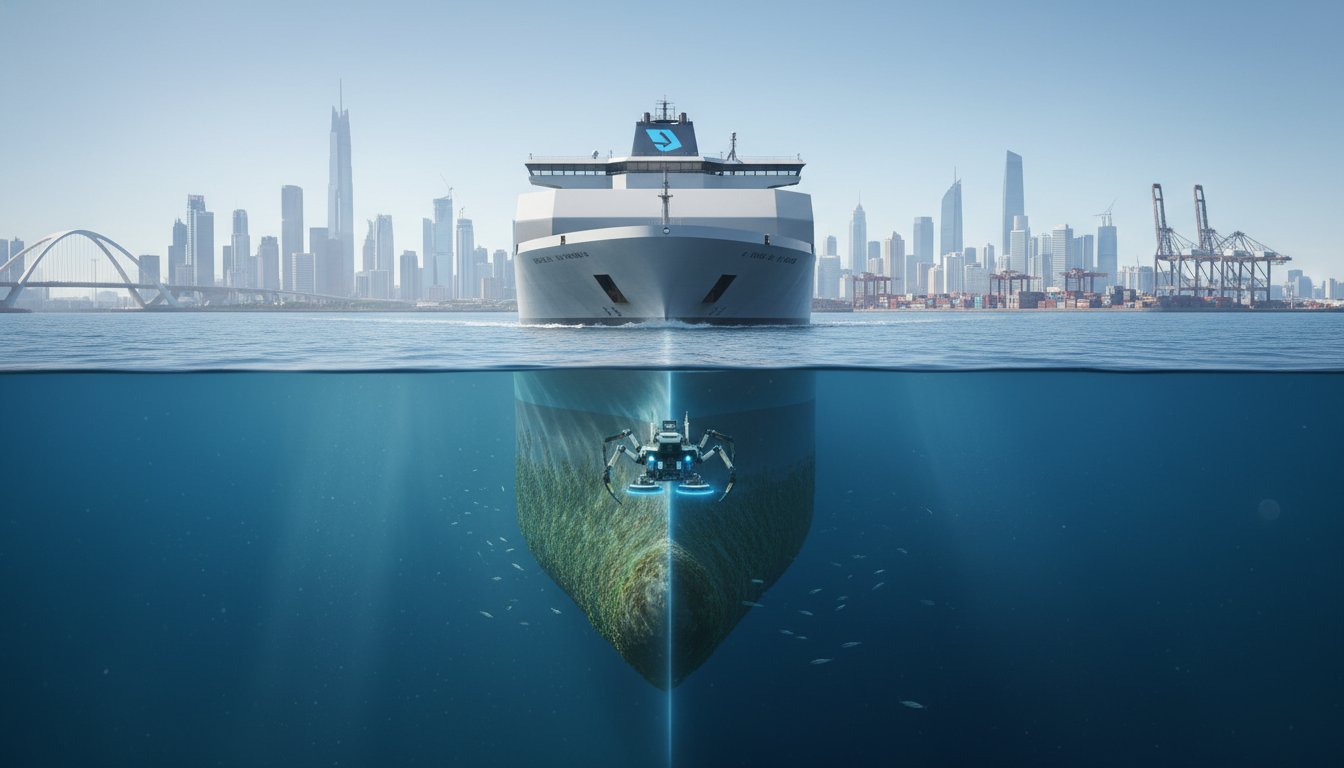
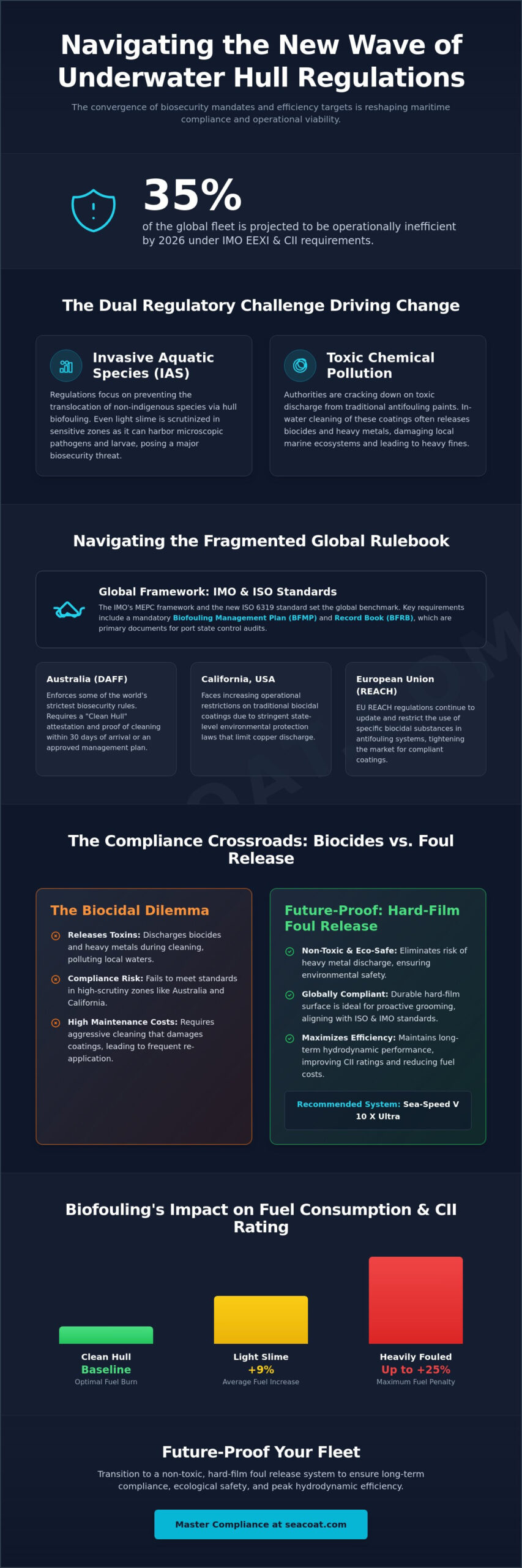
By 2026, approximately 35% of the global fleet is projected to be operationally inefficient under IMO EEXI and CII requirements unless they adopt advanced technical solutions. This challenge is intensified by a tightening web of underwater hull cleaning regulations that have shifted the burden of compliance from routine maintenance to high-stakes legal strategy. You’re likely dealing with the stress of inconsistent port rules and the fear of massive fines for accidental biocide discharge. It’s a difficult balance to maintain vessel speed while adhering to the strict biosecurity standards seen in Australia or the new NORMAM-401 requirements in Brazil.
This guide provides the technical clarity you need to master international and regional laws while maximizing your operational efficiency. We’ll analyze the implications of the new ISO 6319 standard published in March 2026, break down the EU REACH updates regarding biocidal substances, and explain how selecting a durable, hard-film foul release coating can future-proof your fleet. By moving beyond temporary fixes, you can significantly reduce cleaning-related downtime and eliminate the environmental risks associated with traditional antifouling systems.
Key Takeaways
- Identify the dual regulatory focus on invasive species and chemical pollution to ensure your maintenance protocols align with the latest ISO 6319 global standards.
- Master the specific documentation hurdles in high-scrutiny zones like Australia and California, where traditional biocidal coatings face increasing operational restrictions.
- Implement a strategic framework for obtaining in-water cleaning permits by maintaining accurate Biofouling Management Plans and comprehensive Record Books.
- Discover how transitioning to non-toxic, hard-film foul release systems like Sea-Speed V 10 X Ultra eliminates the risk of heavy metal discharge during routine grooming.
- Future-proof your fleet against evolving underwater hull cleaning regulations by selecting surface technologies that prioritize both ecological safety and long-term hydrodynamic efficiency.
The Evolution of Global Underwater Hull Cleaning Regulations
The landscape of maritime operations is undergoing a fundamental shift as underwater hull cleaning regulations transition from voluntary guidelines to rigorous enforcement frameworks. At their core, these regulations manage the removal of biological growth to achieve two critical objectives: the prevention of Invasive Aquatic Species (IAS) translocation and the mitigation of toxic chemical discharge into local ecosystems. Understanding what biofouling is—the accumulation of microorganisms, plants, algae, or small animals on wetted surfaces—is essential for grasping why authorities are tightening their grip on vessel maintenance. This is no longer just about hull integrity; it’s a matter of global biosecurity and environmental stewardship.
By 2026, the intersection of these rules with the IMO’s Energy Efficiency Existing Ship Index (EEXI) and Carbon Intensity Indicator (CII) targets has become undeniable. Research indicates that biofouling increases a vessel’s fuel consumption by an average of 9%, while a heavily fouled hull can see increases of up to 25%. Ships failing to manage their hull performance risk falling into inferior CII ratings, which can lead to operational restrictions or mandatory corrective actions. Maintaining a clean hull isn’t just a biosecurity requirement; it’s a financial and regulatory necessity for fleet survival.
The IMO MEPC Framework and 2026 Standards
The MEPC.1/Circ.918 guidance provides the technical architecture for modern in-water maintenance. Central to this framework is the Biofouling Management Plan (BFMP), which has become a primary document for port state control audits. Authorities now look for evidence of proactive management rather than reactive cleaning. This shift has led to the rise of “grooming,” a term that describes the frequent, gentle removal of early-stage biofilms. Unlike traditional cleaning, which often involves aggressive mechanical force that can damage coatings, grooming aims to maintain a smooth surface without releasing sequestered biocides into the water column.
Invasive Species: The Biosecurity Mandate
The GloFouling Partnerships have significantly influenced international enforcement by highlighting the ecological devastation caused by non-indigenous species. Even light slime layers are now under scrutiny in sensitive marine zones because they can harbor microscopic pathogens or larvae. These organisms don’t always stay attached; changes in vessel speed or water temperature can trigger detachment, leading to the establishment of invasive populations. Consequently, underwater hull cleaning regulations in 2026 demand that operators account for the entire lifecycle of their hull’s surface condition, ensuring that the ship doesn’t become a vector for ecological disruption through accidental detachment.
Regional Enforcement: Key Restrictions in Australia, California, and the EU
While the IMO provides a foundational framework, regional enforcement is where the operational complexity of underwater hull cleaning regulations becomes most acute. Fleet managers don’t just face a single set of rules; they must negotiate a fragmented landscape of local mandates that can vary significantly between adjacent ports. This inconsistency creates a substantial risk of non-compliance, particularly for vessels utilizing traditional biocidal coatings that are increasingly restricted in sensitive ecological zones. Relying on outdated maintenance schedules can result in heavy fines or even the refusal of entry into key global hubs.
Navigating Australian Biosecurity Laws
Australia’s Department of Agriculture, Fisheries and Forestry (DAFF) enforces some of the world’s most stringent biosecurity protocols. As of 2024, the 18-month educational phase for the Biosecurity Amendment Regulations has ended, and requirements are in full force. All vessels entering Australian waters must provide a “Clean Hull” attestation and maintain a comprehensive Biofouling Record Book (BFRB). If a vessel cannot prove it was cleaned within 30 days of arrival or managed under an approved plan, it faces significant delays. Documentation is now as critical as the physical state of the hull; without evidence-based reporting, even a clean hull may be deemed a biosecurity risk.
North American Standards: From California to the Great Lakes
The Vessel Incidental Discharge Act (VIDA) is moving into its 2026 implementation phase, harmonizing federal standards while allowing for state-level stringency. The California State Lands Commission (SLC) remains a primary driver of change, enforcing strict limits on biocide leaching during in-water maintenance. In many “impaired” water bodies across California, cleaning biocidal coatings is effectively prohibited to prevent heavy metal accumulation. This creates a strategic advantage for operators who have transitioned to non-toxic foul release systems, as these coatings bypass the leaching restrictions that stall traditional maintenance in US ports.
In the European Union, the May 14, 2026 update to the REACH Regulation has further restricted active substances like Irgarol 1051 and Diuron. From June 1, 2026, any coating product exported to the EU must carry an Active Substance Authorisation (ASA) certificate from the ECHA. This regulatory pressure aligns with the 2023 international biofouling guidelines, pushing ports like Singapore and Vancouver toward “no-cleaning” zones for traditional paints. In these hubs, only specialized capture-and-filter cleaning or non-ablative surfaces are permitted, making the choice of hull coating a decisive factor in global port accessibility and compliance with underwater hull cleaning regulations.
The Biocide Dilemma: Why Traditional Antifouling Fails Modern Compliance
The maritime industry currently faces a paradoxical challenge known as the biocide dilemma. To maintain the hydrodynamic efficiency required by 2026 carbon intensity targets, hulls must remain free of biofouling. However, the act of cleaning traditional biocidal coatings releases concentrated plumes of heavy metals, such as copper and zinc, directly into the harbor. This conflict places ship owners at the center of increasingly restrictive underwater hull cleaning regulations that prioritize local water quality over vessel performance. It’s a “Catch-22” where the maintenance required for efficiency is the very act prohibited by environmental law.
Traditional coatings rely on a controlled release of toxins to prevent growth. When mechanical brushes or water jets are applied during in-water maintenance, this leaching rate accelerates exponentially. Port authorities have responded by mandating “Capture and Collect” systems to mitigate this discharge. While these systems are effective at preventing pollution, they impose significant operational costs and extend service windows. For high-frequency fleets, these requirements often make routine grooming economically unviable, leading to higher fuel consumption and regulatory friction.
Leaching Rates and Water Quality Standards
Port authorities increasingly utilize the Total Maximum Daily Load (TMDL) metric to set strict limits on the mass of pollutants allowed in a water body. Mechanical agitation during hull cleaning can cause local toxicity levels to exceed these thresholds in minutes. For fleet owners, the invisible cost of compliance involves more than just specialized equipment fees. It includes the administrative burden of proving that no prohibited discharge occurred during the operation, a task that’s nearly impossible with eroding biocidal surfaces.
Ablative vs. Hard-Film Systems in Regulatory Audits
The regulatory audit process is significantly simplified when a vessel utilizes an inert, non-leaching surface. Traditional ablative bottom paint is designed to wear away, which inherently conflicts with zero-discharge mandates in modern ports. In contrast, hard-film foul release systems, such as those based on silane-siloxane chemistry, provide a permanent, non-biocidal barrier. These surfaces allow for unrestricted cleaning permits because they don’t rely on a sacrificial cycle to function. Transitioning to these performance-based systems ensures that underwater hull cleaning regulations become a manageable routine rather than a legal bottleneck for your global operations.
Operational Strategy: Navigating In-Water Cleaning Audits and Permits
Securing a permit for in-water maintenance in 2026 requires more than a simple request; it demands a data-driven demonstration of environmental safety. Port authorities now evaluate applications based on the risk of biosecurity breaches and chemical contamination. Navigating the complexities of underwater hull cleaning regulations requires a proactive administrative framework that begins long before a vessel reaches the harbor. To simplify this administrative burden, consider upgrading to a non-toxic, hard-film coating that meets the most stringent discharge standards.
A standardized framework for obtaining permits involves four critical steps. First, operators must submit a Biofouling Management Plan (BFMP) that aligns with MEPC.1/Circ.918 standards. Second, the Biofouling Record Book (BFRB) must be updated to reflect the vessel’s recent cleaning history and current fouling state. Third, technical data sheets (TDS) for the hull coating must be provided to prove the surface is non-ablative and biocide-free. Finally, the selection of a cleaning contractor must be verified through evidence of “Best Practice” adherence, often requiring the use of Remotely Operated Vehicles (ROVs) to provide pre-cleaning and post-cleaning video logs. These logs serve as the primary verification tool for regulatory compliance, ensuring that no macrofouling was released into the local environment.
Maintaining the Biofouling Record Book
The BFRB is no longer a secondary log; it’s a mandatory legal document under regulations like Brazil’s NORMAM-401, where non-compliance can result in fines up to BRL 2 million. Operators must record cleaning dates, precise GPS locations, and the specific mechanical methods employed. Integrating hull performance metrics, such as speed-loss data, into these reports provides a scientific basis for the necessity of the cleaning. By 2026, digital record-keeping has become the primary method for reducing audit friction, as it allows for the instantaneous sharing of high-resolution ROV data with port state control officers.
Selecting Compliant Cleaning Technologies
The choice between brush-based systems and high-pressure water jets depends heavily on the coating’s mechanical properties. While aggressive brushes might be necessary for heavy growth on traditional paints, they often damage the surface and accelerate biocide leaching. Preserving the surface energy and smoothness of boat hull paint is essential for long-term ROI. In high-risk biosecurity zones, authorities increasingly mandate “Closed-Circuit” or “Capture-and-Filter” systems. These technologies ensure that 100% of the removed material is filtered to a specific micron level, preventing the spread of invasive species and ensuring adherence to underwater hull cleaning regulations in even the most restrictive global ports.
Future-Proofing with Non-Toxic, Hard-Film Foul Release Systems
The maritime industry’s transition toward 2026 sustainability targets requires a fundamental reassessment of hull coating technology. As established in previous sections, the conflict between operational efficiency and underwater hull cleaning regulations has rendered traditional biocidal systems a liability. To navigate this landscape, forward-thinking operators are moving away from sacrificial, toxic chemistries in favor of inert, hard-film foul release systems. Silane-Siloxane technology has emerged as the gold standard for this new era, offering a surface that is both hydrodynamically superior and ecologically benign. By utilizing a non-leaching barrier, vessels can bypass the permit bottlenecks that currently plague ships with copper-based or ablative paints.
The regulatory ROI of this shift is measurable and immediate. Vessels equipped with non-toxic coatings experience significantly faster permit approvals in restrictive ports like Vancouver and Singapore, where “capture and collect” mandates are most stringent. Because these coatings don’t release prohibited toxins during mechanical grooming, the administrative and equipment costs associated with cleaning are drastically reduced. This transition also extends the service life of the asset. Unlike traditional paints that require frequent re-application and intensive dry-docking, hard-film systems provide multi-year durability, transforming the hull coating from a recurring maintenance expense into a strategic performance asset.
Sea-Speed: Compliance Without Compromise
Sea-Speed V 10 X Ultra represents the pinnacle of this technological shift. It’s a 100% non-toxic, zero-VOC hard-film system that provides a smooth, low-energy surface that organisms find difficult to adhere to. Because Seacoat’s technology is entirely biocide-free, it’s exempt from the cleaning bans currently affecting traditional antifouling products in “impaired” water bodies. This allows for proactive grooming to maintain peak efficiency without the risk of legal penalties. In practice, operators utilizing these environmental marine coatings have successfully reduced frictional drag while meeting the highest international standards for biosecurity and chemical discharge.
Long-Term Strategic Asset Management
Adopting advanced foul release technology is a commitment to long-term stewardship and operational intelligence. In an industry where reliability and regulatory compliance are the primary concerns, the ability to maintain a clean hull without environmental compromise is a significant competitive advantage. This strategy aligns perfectly with the IMO’s focus on longevity and the reduction of the global maritime footprint. Rather than reacting to each new restriction, fleet managers can future-proof their operations by choosing materials that are inherently compliant. We invite you to contact Seacoat SCT, LLC today to evaluate your fleet’s compliance strategy and discover how our silane-siloxane solutions can simplify your adherence to underwater hull cleaning regulations while maximizing your return on investment.
Securing Operational Longevity in a Regulated Era
The trajectory of global maritime policy indicates that the historical reliance on sacrificial, toxic antifouling systems is no longer a viable strategy for fleet operators. Successfully navigating the tightening framework of underwater hull cleaning regulations requires a move toward inert surface technologies that decouple hull maintenance from environmental contamination. The administrative burden of Biofouling Management Plans and port-specific discharge audits becomes significantly more manageable when the hull surface is inherently non-toxic and non-leaching.
Our proprietary Silane-Siloxane technology provides a permanent, high-performance barrier that eliminates the biocide dilemma, facilitating faster permit approvals in even the most restricted harbors. This transition doesn’t just simplify regulatory compliance; it delivers a proven reduction in fuel consumption and greenhouse gas emissions by maintaining peak hydrodynamic efficiency over extended service windows. It’s time to transition from reactive maintenance to a proactive, performance-driven strategy that protects both your bottom line and the marine ecosystems your vessels traverse.
Upgrade your fleet to a regulation-ready foul release system to ensure your assets are prepared for the 2026 regulatory landscape and beyond. You can lead the transition toward a cleaner, more efficient maritime future with confidence.
Frequently Asked Questions
Are underwater hull cleaning regulations mandatory globally?
Mandatory enforcement of underwater hull cleaning regulations is currently managed through a patchwork of regional laws rather than a single global mandate. While the IMO provides a foundational framework via the MEPC.1/Circ.918 guidelines, individual nations like Australia and Brazil have moved to make these requirements compulsory. The publication of the ISO 6319 standard in March 2026 further accelerates this trend by providing ports with a harmonized protocol for conducting and documenting environmentally sound in-water maintenance.
Can I clean my boat’s hull in a California marina in 2026?
In-water cleaning in California is subject to strict oversight by the State Lands Commission and local harbor authorities. If your vessel utilizes a biocidal coating, cleaning is often prohibited in “impaired” water bodies to prevent heavy metal accumulation that exceeds Total Maximum Daily Load limits. Operators must typically verify that their cleaning method utilizes capture-and-collect technology or that their hull surface is non-toxic and non-leaching before receiving a maintenance permit.
What is a Biofouling Management Plan (BFMP) and do I need one?
A BFMP is a vessel-specific document that outlines the strategy for biofouling control, including the choice of coating and the schedule for inspections. You need one if you operate a commercial vessel over 24 meters entering high-scrutiny regions like Australia or Brazil, where it’s a mandatory requirement for port entry. This plan must be accompanied by a Biofouling Record Book to provide a verifiable history of all hull maintenance activities and biological grooming.
Why is cleaning traditional antifouling paint restricted in many ports?
Restrictions on traditional antifouling paints exist because mechanical cleaning triggers a spike in the leaching of heavy metals like copper and zinc. These biocides are designed to be released slowly; however, the agitation from brushes or water jets causes a concentrated plume of toxins to enter the water column. Port authorities restrict these activities to protect local marine life and prevent the long-term contamination of harbor sediments with industrial chemicals.
How do non-toxic foul release coatings simplify cleaning permits?
Non-toxic foul release coatings, such as Sea-Speed V 10 X Ultra, simplify the permit process by removing the primary cause for regulatory concern: chemical discharge. Since these coatings are inert and biocide-free, they don’t release prohibited toxins during grooming. Port authorities often grant cleaning approvals more efficiently for these systems because they don’t require the complex capture-and-filter equipment mandated for vessels with traditional ablative or biocidal paints.
What happens if my vessel is found with invasive species in Australia?
If a vessel is found with macrofouling or invasive aquatic species in Australian waters, it faces severe operational consequences. Authorities may issue a direction for the vessel to leave Australian territory or undergo specialized cleaning at a designated facility at the owner’s expense. Under the Biosecurity Amendment Regulations 2021, failure to manage biofouling risks can lead to significant delays and potential legal action against the ship operator.
Do I need a special permit for ROV-based hull cleaning?
Yes, most major global ports require a specific permit for any in-water cleaning operation, regardless of whether it is performed by divers or Remotely Operated Vehicles (ROVs). The permit application typically requires proof that the ROV system is compatible with your specific hull coating and can meet local water quality standards. Authorities often favor ROV operations because they can provide high-resolution video logs as evidence of compliance with underwater hull cleaning regulations.
How does hull cleaning affect my vessel’s CII rating?
Hull cleaning is a primary lever for maintaining a favorable Carbon Intensity Indicator (CII) rating by ensuring the hull remains hydrodynamically efficient. Because biofouling is estimated to increase a ship’s fuel consumption by an average of 9%, even light slime layers can lead to excessive greenhouse gas emissions. Regular grooming reduces frictional drag, allowing the vessel to operate within its targeted carbon intensity category and avoid the operational penalties associated with poor CII performance.