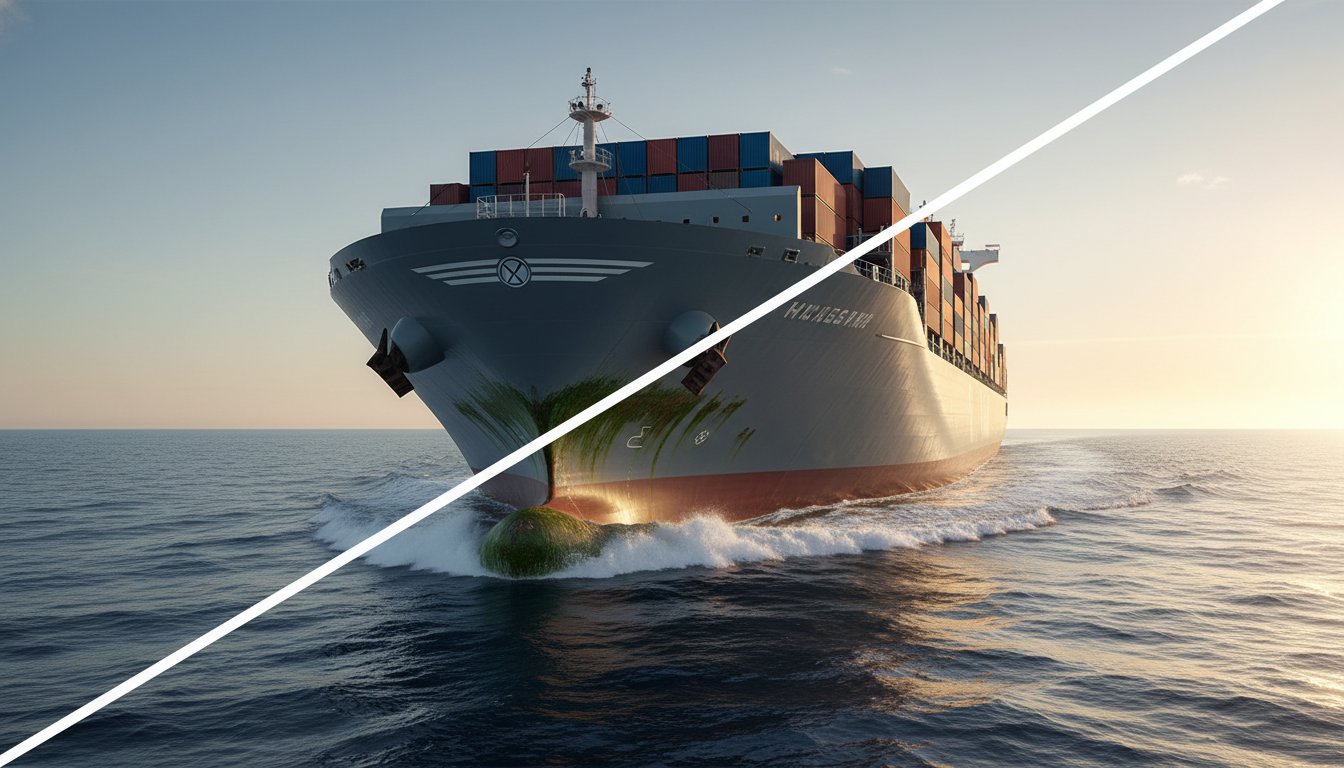
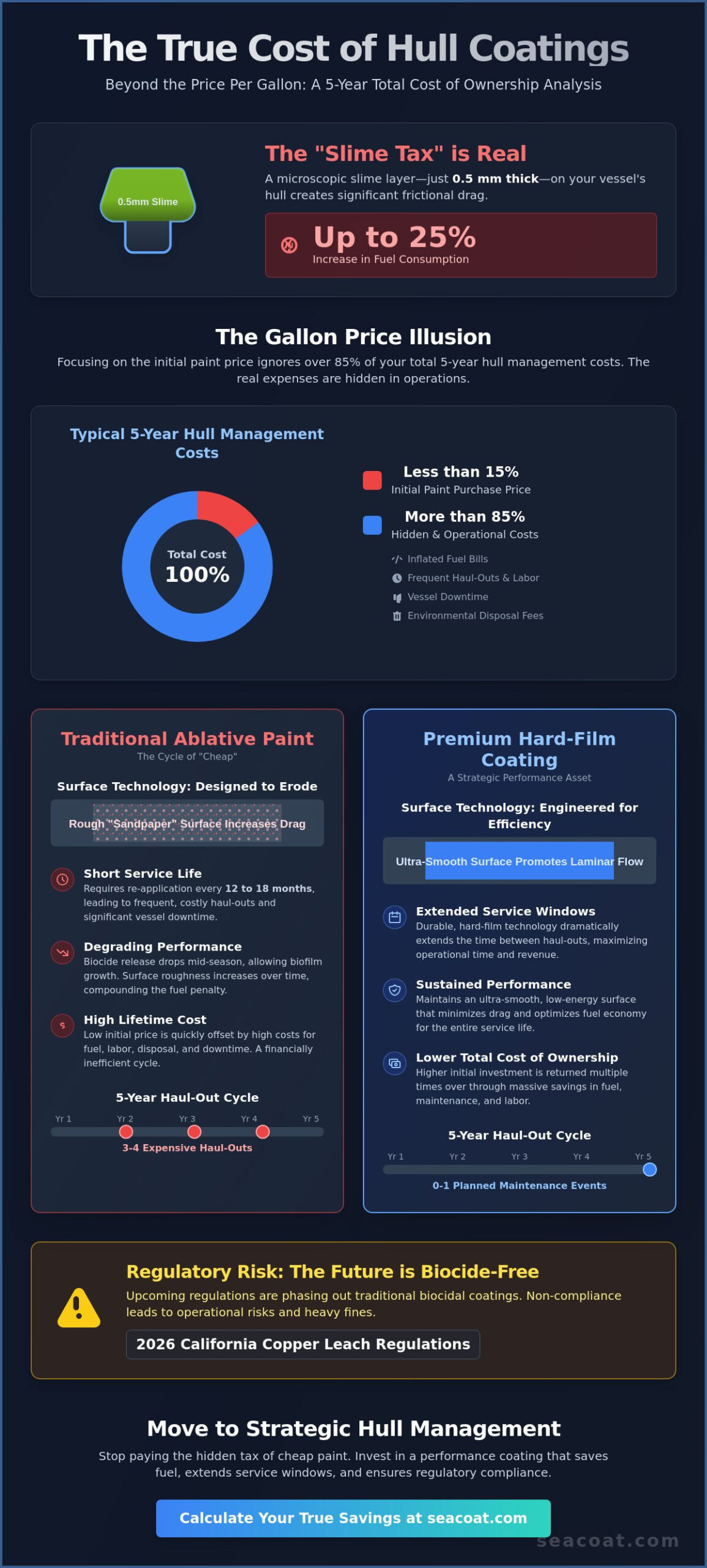
A slime layer measuring just 0.5 mm on your vessel’s hull can increase fuel consumption by as much as 25%. While the sticker shock of premium coatings often leads owners toward budget-friendly alternatives, the hidden costs of cheap bottom paint manifest quickly through inflated fuel bills and shortened haul-out cycles. It’s easy to view the initial purchase price as the primary expense, but in a high-stakes maritime environment, that figure usually accounts for less than 15% of your total hull management costs over a five-year period.
We understand that balancing immediate operational budgets with long-term asset protection is a constant challenge, especially as fuel prices remain volatile. This analysis will show you how to move beyond the surface-level price tag to calculate the true total cost of ownership for your coating system. You’ll learn how to mitigate the frictional drag tax, ensure compliance with 2026 California copper leach regulations, and transition to hard, biocide-free technologies that extend your service windows while improving vessel speed.
Key Takeaways
- Quantify the hidden costs of cheap bottom paint by shifting your focus from the initial price per gallon to a comprehensive five-year total cost of ownership model.
- Identify how microscopic surface roughness in traditional ablative systems creates a drag tax that can increase fuel consumption by as much as 25% as the coating wears.
- Evaluate the financial impact of the 2026 copper leach regulations to avoid the operational risks and fines associated with non-compliant biocidal coatings.
- Discover why hard-film foul release technology functions as a strategic performance asset that extends service windows and maximizes fuel economy.
Why Cheap Bottom Paint is a Financial Illusion
Vessel owners often fall into the trap of evaluating hull coatings based on the immediate invoice rather than the multi-year operational cycle. In the maritime sector, “cheap” typically refers to traditional biocidal ablative paints. These systems rely on the controlled erosion of a resin matrix to release toxins, such as copper or zinc, to repel marine growth. While the entry-level price per gallon is lower than advanced alternatives, this approach ignores the hidden costs of cheap bottom paint that accumulate via increased hydrodynamic drag and frequent maintenance intervals. It’s a fundamental misunderstanding of the difference between simple protection and performance enhancement.
The psychology of the “gallon price” trap remains a persistent hurdle in fleet management. Procurement officers may prioritize a lower upfront expenditure, yet these initial savings are often neutralized within the first six months of operation. Traditional Antifouling paint technology provides basic protection against barnacles, but it fails to optimize the hull surface for efficiency. High-performance systems like Sea-Speed V 10 X Ultra treat the hull as a strategic asset. They focus on surface energy and mechanical smoothness rather than relying solely on chemical toxicity to manage biofouling.
The Lifecycle of a Low-Cost Coating
Low-cost coatings utilize inferior resins that degrade rapidly under the stresses of fluid dynamics. During the initial application, these paints may appear smooth, but they lack the mechanical durability to maintain that profile. By mid-season, the biocide release rate often drops below the threshold required to prevent biofilm attachment. This leads to the “slime tax,” where even a thin 0.5 mm layer of growth can spike fuel consumption by 25%. By the end of the season, the vessel often requires aggressive mechanical cleaning. This process further depletes the remaining coating and necessitates an early return to dry-dock, creating a cycle of constant repair rather than steady operation.
Labor vs. Material: The Real Cost Ratio
When you analyze a typical haul-out invoice, the paint itself often represents a small fraction of the total expenditure. The bulk of the cost is consumed by labor, pressure washing, environmental disposal fees, and the opportunity cost of vessel downtime. Applying a low-grade ablative every 12 to 18 months is mathematically irrational when labor costs are high. These coatings require extensive surface preparation, including the removal of old, flaky layers that have lost their adhesive integrity. Investing in a durable, hard-film system like Sea-Speed V 10 X Ultra reduces the frequency of these expensive labor events. This shift significantly lowers the hidden costs of cheap bottom paint over a five-year cycle by extending the time between haul-outs.
The Frictional Drag Tax: How Surface Roughness Inflates Fuel Bills
Hydrodynamic efficiency is dictated by the interaction between the vessel’s wetted surface and the surrounding water column. When owners opt for traditional ablative paints, they often overlook the microscopic topography of the coating. These paints are designed to erode, which inherently creates an uneven surface profile. Over time, this erosion transforms the hull into a texture resembling fine-grit sandpaper. This increased roughness disrupts the boundary layer of water, leading to a phenomenon known as the “drag tax.” This is one of the most significant hidden costs of cheap bottom paint, as it forces the propulsion system to work harder to maintain cruising speeds.
The fuel penalty associated with surface degradation is quantifiable and severe. Research indicates that even a thin slime layer of just 0.5 mm can increase fuel consumption by as much as 25%. If the fouling progresses to heavy growth, the required shaft power can spike by 86%, resulting in massive fuel penalties. These inefficiencies are compounded by the environmental impact of ship hull paint, as traditional biocidal systems contribute to heavy metal accumulation in marine ecosystems while simultaneously draining the owner’s operating budget. Transitioning to a non-toxic, hard-film coating addresses both the economic and ecological liabilities of modern vessel management.
Fluid Dynamics and Hull Efficiency
Laminar flow is the ideal state where water moves in smooth, parallel layers over the hull. Hard-film silane-siloxane surfaces, such as Sea-Speed V 10 X Ultra, facilitate this by providing an ultra-smooth finish with low surface energy. This low surface energy reduces the “grip” that water has on the hull, allowing the vessel to slip through the medium with minimal resistance. In technical terms, frictional resistance is the component of total hull drag caused by the shear stress of water moving across the wetted surface area of the vessel. By minimizing this stress, you directly reduce the energy required for transit. You can evaluate your vessel’s efficiency potential by considering the transition to a high-performance foul-release system.
Case Study: Fuel Savings Over 1,000 Nautical Miles
When comparing a standard ablative surface to a Sea-Speed V 10 X Ultra surface over a 1,000-nautical-mile transit, the disparity in performance becomes clear. A commercial vessel operating with a rough, fouled hull will consume significantly more metric tons of fuel to cover the same distance as a vessel with a smooth, hard-film coating. For recreational owners, this translates to hundreds of dollars in unnecessary fuel stops. Beyond the immediate fuel burn, the increased drag places immense strain on the engine and drivetrain. This accelerated mechanical wear leads to premature component failure and higher long-term maintenance expenses, further inflating the hidden costs of cheap bottom paint.
Maintenance Math: Comparing 5-Year Operational Cycles
Evaluating a hull coating based on its purchase price is a short-sighted strategy that ignores the compounding nature of maritime expenses. Most traditional systems operate on a 12 to 18-month cycle, requiring frequent returns to the yard for re-application. In contrast, advanced hard-film coatings like Sea-Speed V 10 X Ultra are engineered for a 10-year service life. When you calculate the Total Cost of Ownership (TCO), the hidden costs of cheap bottom paint become undeniable. You aren’t just buying paint; you’re subscribing to a recurring schedule of haul-outs, labor, and downtime that premium systems effectively eliminate.
One of the primary advantages of a hard-film system is its compatibility with proactive hull management. Unlike soft coatings that slough off during cleaning, hard surfaces allow for regular in-water maintenance without releasing biocides into the ecosystem. This capability maintains the hull’s hydrodynamic profile between major service intervals. It’s a shift from a reactive model to a strategic management approach where the coating remains a permanent asset rather than a sacrificial layer that requires constant replenishment.
Dry-Docking and Opportunity Costs
The financial impact of vessel downtime is often the largest line item in a maintenance budget. For commercial operators, every day spent in dry-dock represents lost revenue. Even for recreational owners, the recurring expense of haul-out fees adds up quickly. In regions like California, professional application services that include haul-out and pressure washing can range from $71.00 to $106.00 per foot. Because traditional ablative bottom paint relies on a sacrificial cycle, it forces these expenses upon the owner nearly every season. These aren’t just maintenance tasks; they’re structural inefficiencies that drain capital and reduce the operational availability of the vessel.
The 5-Year ROI Framework
To understand the true value of a coating, you must look at a five-year horizon. A budget-friendly paint may seem attractive at the point of sale, but it eventually necessitates a full strip-and-sand process to remove built-up, inactive layers. This stripping process is labor-intensive and expensive, often exceeding the cost of the original application. When you factor in five years of haul-outs, annual material costs, and the labor for prep work, the hidden costs of cheap bottom paint far exceed the investment of a premium system. The break-even point typically occurs within the second or third year, after which the premium coating provides pure operational savings through reduced maintenance and optimized fuel efficiency.
Regulatory Risk and Environmental Liabilities in 2026
Vessel owners operating in 2026 face a regulatory environment that has moved decisively against traditional biocidal chemistry. As of January 1, 2026, California law prohibits the application of antifouling paints to recreational vessels if the copper leach rate exceeds 9.5 micrograms per square centimeter per day. This shift renders many legacy products obsolete and introduces a new tier of hidden costs of cheap bottom paint. Beyond the physical degradation of the hull, non-compliant coatings now invite administrative fines and potential exclusion from sensitive waterways. The legal landscape has evolved to reward surface efficiency and ecological stewardship while penalizing the use of leaching toxins.
International mandates like the IMO’s Carbon Intensity Indicator (CII) have further linked hull performance to legal compliance. Because a fouled hull dramatically increases fuel consumption, it directly impacts a vessel’s carbon rating. A poor CII rating can lead to mandatory corrective actions or operational restrictions; this effectively turns a budget paint job into a high-stakes financial risk. By selecting advanced coatings like Sea-Speed V 10 X Ultra, operators ensure their assets remain compliant with both local biocide regulations and global efficiency standards.
The Global Shift Toward Non-Toxic Solutions
The maritime industry is witnessing a transition where environmental marine coatings are no longer optional for commercial fleets. Institutional investors and port authorities increasingly prioritize Environmental, Social, and Governance (ESG) metrics, making “Clean Hull” certifications a valuable strategic asset. Transitioning away from toxic biocides mitigates the risk of future litigation and prepares the vessel for increasingly stringent water quality standards. This proactive approach converts maintenance into a PR advantage, demonstrating a commitment to the preservation of marine ecosystems while maintaining peak operational speed.
Future-Proofing Your Vessel
Investing in silane-siloxane technology allows owners to bypass the costly cycle of mid-cycle stripping and remediation. When regulations tighten further, owners with legacy coatings will face the massive expense of total paint removal and hazardous waste disposal. Non-toxic, hard-film coatings are the only long-term compliance strategy that survives shifting legislative goalposts and protects against future biocide bans. By adopting a permanent solution today, you eliminate the hidden costs of cheap bottom paint associated with regulatory obsolescence. You can explore compliant coating solutions to secure your vessel’s operational future.
Moving Toward Strategic Hull Management with Sea-Speed
Transitioning from a cycle of repetitive maintenance to a strategy of asset management requires a fundamental shift in perspective. Most vessel owners “paint” their hulls as a defensive measure against biofouling, treating the process as a recurring chore. Strategic operators “coat” their hulls to optimize hydrodynamic performance and secure long-term value. This distinction is central to eliminating the hidden costs of cheap bottom paint. By prioritizing a hard-film foul release system, you move away from a sacrificial model toward a performance-based investment that pays dividends in fuel efficiency and asset longevity.
Evaluating a coating based on ROI rather than upfront cost is the hallmark of sophisticated fleet management. When you account for the reduction in fuel waste, the elimination of annual haul-outs, and the mitigation of regulatory risks, the choice becomes clear. The hidden costs of cheap bottom paint are simply too high for modern operations to absorb. Transitioning your vessel or fleet begins with a data-driven assessment of your current operational profile and a commitment to long-term efficiency.
The Sea-Speed Advantage: Silane-Siloxane Technology
Silane-siloxane technology represents the pinnacle of modern material science in the maritime sector. Unlike soft silicones that are prone to tearing or traditional ablatives that erode, Sea-Speed V 10 X Ultra creates a glass-like finish. This surface minimizes the mechanical bond of biofouling; it allows organisms to be easily displaced by the shear forces of water during transit. It’s a permanent solution that remains effective for up to 10 years, providing a level of durability that traditional systems cannot match. For a deeper dive into technical specifications and the physics of surface energy, you can consult the definitive guide to boat hull paint.
Implementation and ROI Consultation
Requesting a custom ROI analysis allows you to see the specific financial impact of a high-performance coating on your unique bottom line. This process considers your vessel type, typical transit speeds, and historical fuel consumption to project real-world savings. Certified applicators ensure that the silane-siloxane system is applied with the technical precision required to achieve maximum surface efficiency. Taking this step moves your vessel beyond basic protection toward a future of optimized performance and environmental compliance. You can calculate your potential fuel savings with Sea-Speed V 10 X Ultra to begin the transition to a more efficient maritime operation.
Secure Your Vessel’s Performance and Compliance
The shift toward advanced foul-release systems is no longer an environmental preference; it’s a financial necessity for modern vessel operations. By evaluating the total cost of ownership over a multi-year cycle, it’s clear that the hidden costs of cheap bottom paint manifest through excessive fuel consumption and the recurring burden of annual dry-docking. Our proprietary Silane-Siloxane technology provides a non-toxic, 100% biocide-free solution that resists biofouling through mechanical smoothness rather than chemical leaching. This innovative approach allows you to achieve documented fuel savings of up to 12% while maintaining a surface that remains effective for a decade. You can successfully mitigate the drag tax and ensure full compliance with 2026 biocide regulations without sacrificing speed or durability. Stop wasting fuel and start saving with Sea-Speed V 10 X Ultra. Investing in high-performance hull coatings transforms a maintenance requirement into a strategic asset that protects both your bottom line and the marine ecosystems we share. It’s time to move beyond temporary fixes and adopt a permanent solution for your fleet.
Frequently Asked Questions
Is expensive bottom paint really better than the cheap stuff?
Yes, premium coatings are superior because they prioritize surface energy and hydrodynamic efficiency over simple chemical toxicity. While budget paints focus on temporary biocide release, high-performance options provide a durable, hard finish that maintains its integrity for years. This technical superiority reduces the frequency of maintenance and optimizes the vessel’s overall performance profile. It’s the difference between a sacrificial layer and a permanent performance asset.
How much fuel can a high-performance hull coating actually save?
High-performance coatings can reduce fuel consumption by as much as 12% compared to standard antifouling paints. This efficiency is achieved by maintaining a smooth, low-friction surface that prevents the attachment of biofilms. Since even a thin slime layer can increase fuel burn by 25%, the ability to keep a hull clean through simple water movement provides a massive operational advantage for commercial and recreational operators alike.
What are the specific hidden costs of using ablative paint?
The primary hidden costs of cheap bottom paint in an ablative system include the cumulative expense of annual haul-outs, high labor costs for surface preparation, and the “drag tax” caused by uneven wearing. Ablatives are designed to erode, which creates a rough surface that increases resistance. Over time, the cost of extra fuel and the need for frequent re-application far exceed the initial savings of the paint itself.
Do non-toxic bottom paints work as well as copper-based paints?
Modern non-toxic coatings often outperform copper-based paints by utilizing foul-release mechanisms rather than biocidal leaching. Instead of poisoning marine life, these silane-siloxane systems create a surface so smooth that organisms can’t maintain a mechanical bond. This results in a cleaner hull over a longer period, especially for vessels that operate at higher speeds or maintain regular transit schedules where the water flow assists the release.
How long does a premium foul release coating like Sea-Speed last?
A premium foul-release coating like Sea-Speed V 10 X Ultra is designed to last up to 10 years when properly applied. This is a permanent hard-film solution that doesn’t require the annual sacrificial re-coating common with traditional paints. This extended lifespan allows owners to move away from the expensive 12-month maintenance cycle toward a long-term strategic asset management model that maximizes vessel availability and reduces total expenditure.
What is the ‘Drag Tax’ and how do I calculate it for my boat?
The “Drag Tax” is the increase in fuel expenditure caused by hull roughness and biofouling. You can estimate it by comparing your vessel’s fuel burn at a specific cruising speed when the hull is freshly cleaned versus after six months of operation. If you see a 10% increase in fuel consumption for the same speed, that difference represents the financial impact of surface resistance and fouling attachment.
Will I save money on haul-outs by switching to a hard-film coating?
You’ll save significant capital on haul-outs because hard-film coatings eliminate the need for annual dry-docking to re-apply paint. Since these coatings are durable and non-leaching, they can be maintained via in-water cleaning without damaging the surface or violating environmental laws. This shift extends the time between major service intervals, significantly reducing yard fees, labor costs, and the opportunity cost of vessel downtime.
Are there new regulations in 2026 regarding traditional bottom paint?
Yes, as of January 1, 2026, California has implemented strict regulations prohibiting the application of antifouling paints with a copper leach rate exceeding 9.5 micrograms per square centimeter per day on recreational vessels. This mandate reflects a broader global shift toward biocide-free alternatives. Staying ahead of these legal requirements is essential for maintaining port access and avoiding the hidden costs of cheap bottom paint related to administrative fines.