
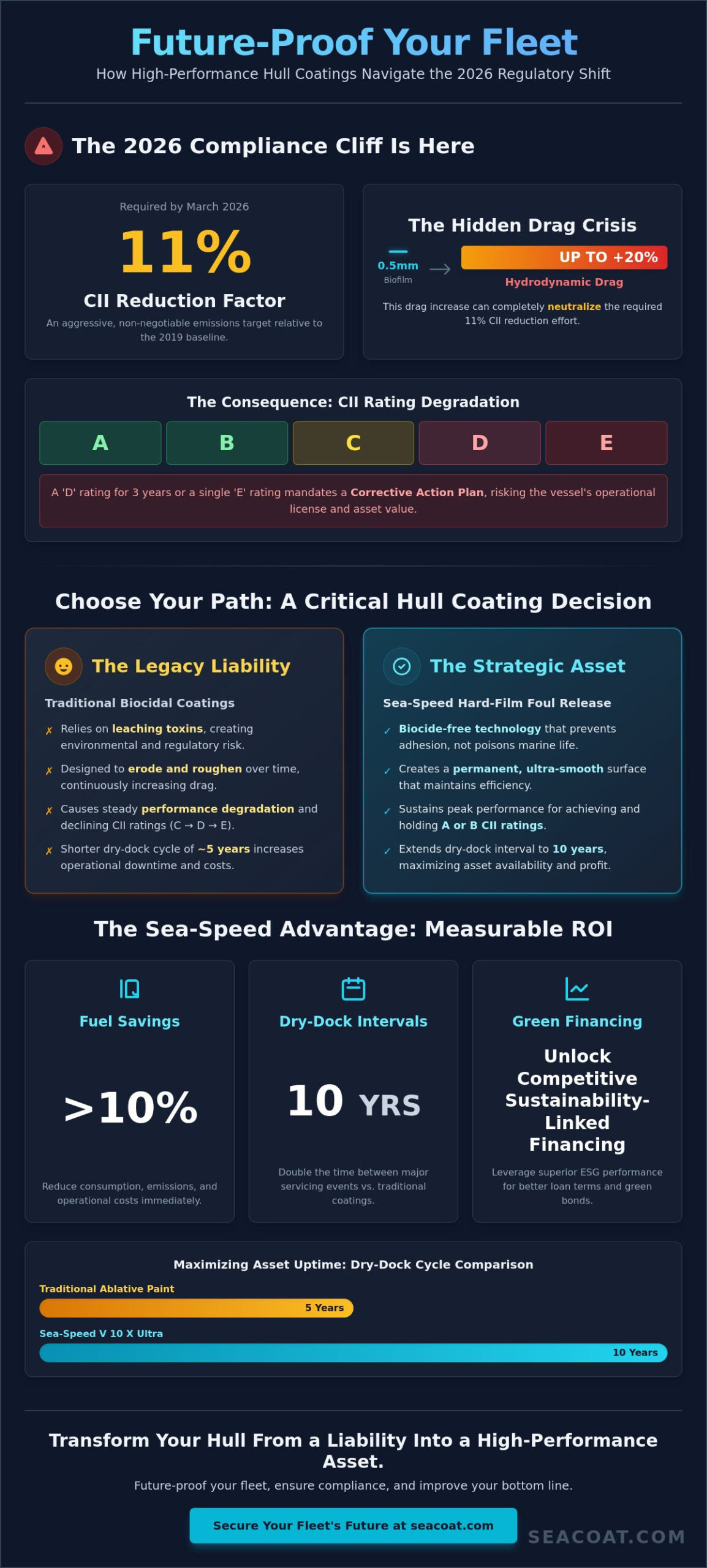
A biofilm layer as thin as 0.5 millimeters can increase your vessel’s hydrodynamic drag by up to 20%, effectively neutralizing your efforts to meet the 11% CII reduction factor required as of March 2026. You’re likely feeling the mounting pressure of the EU ETS expansion and the threat of mandatory corrective action plans if your fleet’s carbon intensity doesn’t align with Phase 2 targets. Implementing the right green shipping compliance hull coating solutions is no longer a simple maintenance choice; it’s a strategic move to protect your asset value and operational license.
You’ll learn how to leverage advanced foul release technology, such as our Sea-Speed V 10 X Ultra, to achieve A or B CII ratings while reducing fuel consumption by more than 10%. We’ll explore how shifting to biocide-free, hard-film siloxane systems allows you to extend dry-dock intervals to 10 years and unlock competitive green financing. This guide provides the technical data and regulatory context needed to transform your hull from a liability into a high-performance engine for fleet modernization.
Key Takeaways
- Analyze why the 2026 CII reduction factor of 11% makes traditional biocidal coatings a primary risk for fleet rating degradation and regulatory penalties.
- Master the science of biocide-free silane-siloxane technology to achieve a permanent foul release surface that maintains hydrodynamic efficiency over a 10-year life cycle.
- Identify the specific documentation and performance audits required to leverage green shipping compliance hull coating solutions for securing sustainability-linked financing and green bonds.
- Evaluate the economic shift of transforming hull maintenance into a strategic asset that delivers fuel savings exceeding 10% while doubling the interval between major dry-docking events.
The 2026 Regulatory Landscape: Why Traditional Hull Coatings Risk Non-Compliance
The maritime industry has entered a period of intensified oversight as the IMO 2030 decarbonization targets move from distant goals to immediate operational requirements. By March 12, 2026, the required annual carbon intensity reduction factor, known as the Z factor, increased to 11% relative to the 2019 baseline. This shift marks the start of a more aggressive enforcement phase for the Carbon Intensity Indicator (CII). Shipowners now face a landscape where the margin for error in vessel efficiency has effectively vanished. Many operators find themselves trapped by the limitations of legacy technologies. Traditional biocidal coatings, which rely on the steady depletion of toxic agents to prevent growth, are fundamentally incompatible with these stricter standards. As these coatings age, their surface roughness increases. This leads to a steady degradation in hydrodynamic performance. Choosing the right green shipping compliance hull coating solutions is now the primary lever for bridging the gap between current performance and mandatory emissions targets.
This “Compliance Gap” is a technical reality where a vessel that begins a dry-dock cycle with a ‘C’ rating can quickly slide into ‘D’ or ‘E’ territory because hull friction has increased. Under 2026 regulations, a vessel rated ‘D’ for three consecutive years or ‘E’ in a single year must submit a formal corrective action plan as part of its Ship Energy Efficiency Management Plan (SEEMP). Failing to address hull efficiency doesn’t just increase fuel costs; it risks a vessel’s operational license and marketability in a sector that now prioritizes transparent ESG performance.
Understanding CII and EEXI Interdependence
The Energy Efficiency Existing Ship Index (EEXI) serves as a one-time technical measure of a ship’s design efficiency, while the CII is an ongoing operational measure of how a ship actually performs. While many owners turned to Engine Power Limitation (EPL) to satisfy EEXI requirements, these passive measures are often insufficient to maintain a viable CII rating under the 2026 11% reduction mandate. Hull drag is the single largest variable ship owners can control. By optimizing the hull surface, operators can improve their CII rating without sacrificing speed or cargo capacity. For a deeper look at this transition, explore our analysis of Environmental Marine Coatings and their role in sustainable performance.
The Hidden Cost of ‘Cheap’ Antifouling
The financial logic of low-cost ablative paints fails when held against 2026 fuel prices and emissions penalties. Data indicates that a biofilm layer as thin as 0.5 millimeters can increase hydrodynamic drag by up to 20%. Understanding The Science of Anti-Fouling reveals why traditional methods struggle; they are designed to fail over time as the active ingredients leach away. Furthermore, global regulations are tightening around these toxins. As of February 1, 2026, Brazil began full enforcement of its NORMAM-401 regulations, requiring strict biofouling management plans. Vessels using traditional leaching paints face higher scrutiny and potential port entry delays compared to those utilizing permanent, non-toxic foul release systems.
The Science of Hard-Film Silane-Siloxane: A Solution for Long-Term Compliance
Silane-siloxane chemistry represents a fundamental departure from the reactive, biocidal methods that have dominated marine engineering for decades. While traditional coatings rely on the controlled release of toxic heavy metals to poison settling organisms, silane-siloxane technology creates a low-energy, hydrophobic surface that prevents permanent biological adhesion. This is the core distinction between “antifouling” and “foul release.” In the context of International Maritime Organization regulations, specifically the AFS Convention, this biocide-free approach ensures that vessels remain compliant without the risk of future chemical bans or restricted port access.
Many shipowners are familiar with soft silicone foul release systems, but these materials often lack the mechanical integrity required for rigorous commercial service. Hard-film silane-siloxane, such as Sea-Speed V 10 X Ultra, offers a robust alternative that bridges the gap between protection and performance. Unlike soft silicones that tear under the pressure of tug fenders or during routine underwater cleanings, hard-film systems provide a durable, glass-like finish that resists abrasion. This physical strength is paired with an impeccable environmental profile; these solutions contain zero VOCs and result in zero heavy metal leaching into sensitive marine ecosystems. It’s a permanent solution that treats the hull as a performance-enhancing tool rather than a sacrificial layer.
Hydrodynamic Efficiency and Surface Roughness
The true value of green shipping compliance hull coating solutions lies in their ability to maintain ultra-low surface roughness (Rt) over multiple years of operation. A coating’s initial “as-applied” smoothness is a critical starting point, but its long-term resistance to degradation determines its impact on your bottom line. Silane-siloxane maintains a consistently low coefficient of friction for 10 years or longer, effectively preventing the gradual increase in drag that typically erodes a vessel’s CII rating mid-cycle. For a deeper technical analysis of how surface chemistry influences propulsion energy requirements, consult The Definitive Guide to Boat Hull Paint.
Mechanical Resistance in Commercial Operations
Commercial vessels face constant mechanical stress from tug operations, fender contact, and even ice navigation in northern routes. Soft silicone coatings frequently fail in these high-friction scenarios, leading to exposed hull patches where aggressive fouling can take hold. A hard-film system acts as a strategic asset, providing the mechanical durability necessary to keep the hull clean and hydrodynamically efficient throughout the entire dry-dock cycle. If you’re looking to optimize your fleet’s long-term performance, exploring advanced siloxane systems is the logical next step for modern vessel management.
Measuring ROI: How Hull Smoothness Impacts the Bottom Line
Quantifying the return on investment for hull coatings requires a shift from viewing paint as a recurring maintenance expense to treating it as a strategic financial asset. In the 2026 fiscal environment, where fuel costs remain volatile and carbon emissions carry a direct price tag, the hydrodynamic efficiency of a vessel is the primary determinant of its profitability. Advanced green shipping compliance hull coating solutions deliver a measurable reduction in propulsion energy requirements, often ranging between 10% and 20% compared to traditional ablative systems. This efficiency gain isn’t merely theoretical; it manifests as a direct reduction in daily bunker consumption, providing a buffer against price spikes and improving the vessel’s competitive standing in the charter market.
The financial impact extends into the realm of carbon tax mitigation. As of 2026, the EU Emissions Trading System (ETS) fully covers 100% of emissions from intra-EU voyages and 50% from international voyages entering or leaving EU ports. By maintaining an ultra-smooth hull, operators significantly lower their CO2 output, thereby reducing the number of European Union Allowances (EUAs) they must purchase. This creates a dual-stream ROI: lower fuel expenditures and reduced regulatory costs. Additionally, a slicker hull provides the operational flexibility to engage in slow steaming without compromising schedule integrity, as the reduced drag allows the vessel to maintain necessary speeds at lower engine loads.
The 10-Year Life Cycle Analysis
Evaluating the Total Cost of Ownership (TCO) for Sea-Speed V 10 X Ultra reveals significant long-term advantages over the standard five-year dry-docking model. Traditional antifouling paints require complete removal and reapplication every 60 months due to depletion and coating failure. Our “one and done” application philosophy changes this trajectory. By investing in a hard-film silane-siloxane system, shipowners can extend the service life of the coating to 10 years or more. This effectively eliminates one entire dry-docking cycle’s worth of material and labor costs, while ensuring the hull remains at peak performance throughout its lifespan.
Hull Cleaning and Performance Monitoring
Maintaining peak efficiency requires adherence to the latest IMO Biofouling Guidelines, which emphasize proactive management to prevent the accumulation of even minor biofilms. Hard-film coatings offer a distinct advantage here because they don’t rely on a soft, sacrificial layer. This mechanical durability allows for more frequent and aggressive in-water cleanings without the risk of coating loss or environmental contamination. Unlike soft silicones that can be easily damaged by cleaning brushes, silane-siloxane surfaces withstand rigorous maintenance, ensuring that the hull’s coefficient of friction remains optimized for the duration of the voyage.
Step-by-Step: Leveraging Advanced Coatings to Secure Green Financing
Access to capital in the maritime sector is undergoing a fundamental transformation. As of 2026, major financial institutions have fully integrated climate alignment into their lending criteria, making it increasingly difficult to secure traditional financing for vessels that don’t demonstrate a clear path toward decarbonization. By integrating advanced green shipping compliance hull coating solutions into your fleet modernization strategy, you can unlock preferential interest rates and green bonds that were previously inaccessible. This process moves beyond simple maintenance; it requires a data-driven approach to prove that your hull optimization will directly impact your vessel’s environmental, social, and governance (ESG) performance.
The first step involves conducting a comprehensive baseline hull performance audit. You must analyze your current fuel consumption against the 2026 CII reduction targets to identify the exact “compliance gap” your fleet faces. From there, you can quantify the projected rating improvement associated with a silane-siloxane upgrade. Presenting a roadmap that shows a vessel moving from a ‘C’ or ‘D’ rating to a stable ‘A’ or ‘B’ provides lenders with the assurance they need to classify the project as a low-risk, sustainable investment. This technical evidence is the cornerstone of any successful modernization proposal.
The Poseidon Principles and ESG Reporting
Financial institutions participating in the Poseidon Principles now use CII data to assess the carbon intensity of their shipping portfolios. A vessel with high hydrodynamic drag is increasingly viewed as a stranded asset risk. To mitigate this, you should incorporate coating life-cycle data into your ESG reporting framework. Highlighting the 10-year service life and zero VOC profile of technologies like Sea-Speed V 10 X Ultra demonstrates a commitment to long-term stewardship. It’s a clear signal to underwriters that you’re prioritizing both operational efficiency and ecosystem preservation.
Drafting the Modernization Proposal
Your proposal to lenders must lead with hard metrics. You should include predicted drag reduction percentages, calculated CO2 abatement figures, and the total elimination of biocidal leaching. For a comprehensive framework on how to structure these technical arguments, refer to Marine Coatings: The Definitive Guide. By framing a hull upgrade as a performance-enhancing tool rather than a repair cost, you position your fleet as a primary candidate for sustainability-linked loans. If you’re ready to begin this transition, you can consult with our technical team to develop a fleet-wide compliance roadmap.
The Sea-Speed Advantage: Future-Proofing Your Fleet for 2030 and Beyond
As the maritime industry accelerates toward its 2030 decarbonization milestones, the selection of a hull coating system has evolved into a high-stakes decision for fleet managers. Sea-Speed V 10 X Ultra has emerged as the industry standard for hard-film foul release technology, offering a permanent solution that bypasses the inherent failures of depleting biocidal paints. By utilizing a sophisticated silane-siloxane matrix, this technology creates a non-stick surface that maintains its hydrodynamic integrity for 10 years or more. It’s a strategic shift that aligns green shipping compliance hull coating solutions with the long-term financial health of the vessel, ensuring that performance doesn’t degrade as the dry-dock cycle progresses.
The real-world efficacy of the Sea-Speed system is evidenced by its extensive track record in both commercial and military applications. In high-stakes environments where reliability is non-negotiable, our coatings have demonstrated the ability to maintain ultra-low surface roughness even under extreme operational stress. This synergy of performance and stewardship allows operators to protect marine ecosystems from heavy metal leaching while simultaneously protecting their bottom line. Seacoat SCT, LLC provides the technical expertise and worldwide availability necessary to support global fleet managers in this transition, offering a level of scientific precision that temporary fixes simply cannot match.
A Strategic Asset for Commercial Shipping
For high-utilization assets like container ships, tankers, and cruise liners, every hour of downtime and every ton of excess fuel represents a significant loss. Sea-Speed V 10 X Ultra is the logical choice for these vessels because it eliminates the need for the frequent, aggressive hull scrubbing required by traditional coatings. The hard-film finish provides superior resistance to mechanical damage, ensuring that the vessel remains in its peak ‘as-applied’ condition for the duration of its service life. This longevity is critical for maintaining the A and B CII ratings required to stay competitive in a market that now penalizes inefficiency with both taxes and restricted chartering opportunities.
Ready to Modernize Your Fleet?
The transition to a sustainable, high-performance fleet requires more than just a product; it requires a comprehensive technical roadmap. We invite you to move beyond the limitations of traditional antifouling and explore how our biocide-free technology can transform your operational profile. Our team is prepared to provide detailed technical assessments, performance audits, and a full review of our testing and certifications data. You don’t have to choose between environmental responsibility and ROI. Contact Seacoat SCT, LLC today to begin your fleet modernization and secure your compliance status for 2030 and beyond.
Securing Fleet Viability in the Decarbonization Era
The 11% CII reduction factor established in March 2026 has transformed hull performance from a maintenance line item into a critical determinant of commercial survival. By shifting to biocide-free, silane-siloxane technology, you eliminate the performance decay inherent in traditional leaching paints. These green shipping compliance hull coating solutions provide the hydrodynamic stability needed to maintain ‘A’ or ‘B’ ratings while significantly reducing your exposure to EU ETS carbon costs. You’re no longer just protecting a hull; you’re protecting your vessel’s operational license in a tightening regulatory market.
Since 2001, our technology has delivered 10-year life cycle performance with zero VOCs and zero heavy metal leaching. This proven track record ensures your fleet modernization is backed by two decades of scientific data rather than recent industry speculation. Implementing Sea-Speed V 10 X Ultra allows you to bridge the compliance gap and present a robust ESG framework to green financing lenders. It’s a strategic move that balances environmental stewardship with long-term profitability.
Contact SeaCoat SCT today for a technical consultation on your fleet’s compliance strategy. We’re ready to help you optimize your assets for a more efficient and profitable future on the water.
Frequently Asked Questions
How do hull coatings directly affect a vessel’s CII rating?
Hull coatings dictate the level of hydrodynamic drag, which is the primary variable in a vessel’s operational fuel consumption. By maintaining an ultra-smooth surface, green shipping compliance hull coating solutions reduce the engine power required to maintain speed, directly lowering CO2 emissions per cargo ton-mile. This efficiency is essential for meeting the 11% carbon intensity reduction factor mandated for 2026.
Can advanced hull coatings help secure lower interest rates for green shipping loans?
Yes, financial institutions following the Poseidon Principles use CII ratings to assess the climate alignment of their maritime portfolios. A vessel that achieves an A or B rating through hull optimization is viewed as a lower-risk asset. This performance data allows shipowners to access sustainability-linked loans and green bonds that often feature preferential interest rates compared to traditional financing.
What is the difference between foul release and traditional antifouling paint?
Traditional antifouling relies on the steady leaching of biocides to kill marine organisms upon contact. Foul release technology, like our silane-siloxane systems, creates a low-energy, hydrophobic surface that prevents biological adhesion without using toxins. This approach is more sustainable and avoids the performance degradation that occurs as traditional biocidal layers deplete over time.
How long does a hard-film silane-siloxane coating like Sea-Speed last?
Sea-Speed V 10 X Ultra is engineered for a 10-year service life, which is double the industry standard for traditional coatings. Because it is a hard-film system, it doesn’t wear away or require reapplication every 60 months. This longevity provides consistent hydrodynamic performance across multiple dry-docking cycles, significantly reducing the total cost of ownership for fleet managers.
Are non-toxic hull coatings as effective as traditional biocidal paints?
Non-toxic coatings are actually more effective at maintaining long-term efficiency because they don’t rely on chemical depletion. While traditional paints become increasingly rough as biocides leach out, silane-siloxane remains smooth. Research indicates that advanced foul release systems can facilitate measurable fuel savings of 6% to 10% by maintaining ultra-low surface roughness throughout their life cycle.
What are the EEXI requirements for existing ships in 2026?
As of early 2026, the IMO has completed its review of the Energy Efficiency Existing Ship Index (EEXI), reinforcing the technical design standards for the global fleet. Vessels must demonstrate they meet a specific CO2 emissions limit based on their ship type and capacity. While many use Engine Power Limitation for compliance, hull optimization provides the necessary efficiency boost to maintain operational speeds.
How does hull surface roughness impact fuel consumption?
Surface roughness creates friction that forces the engine to work harder to overcome drag. Data from 2026 shows that a biofilm layer as thin as 0.5 millimeters can increase hydrodynamic drag by up to 20%. By utilizing a hard-film coating that resists fouling and withstands cleaning, operators can prevent this drag and avoid the associated spike in bunker costs.
Is Sea-Speed V 10 X Ultra compatible with aluminum or composite hulls?
Sea-Speed V 10 X Ultra is fully compatible with aluminum, fiberglass, and composite substrates. Since it’s biocide-free and non-conductive, it eliminates the risk of galvanic corrosion that often plagues aluminum hulls when using copper-based paints. This makes it an ideal solution for high-speed ferries, patrol boats, and other specialized vessels requiring durable, lightweight performance.