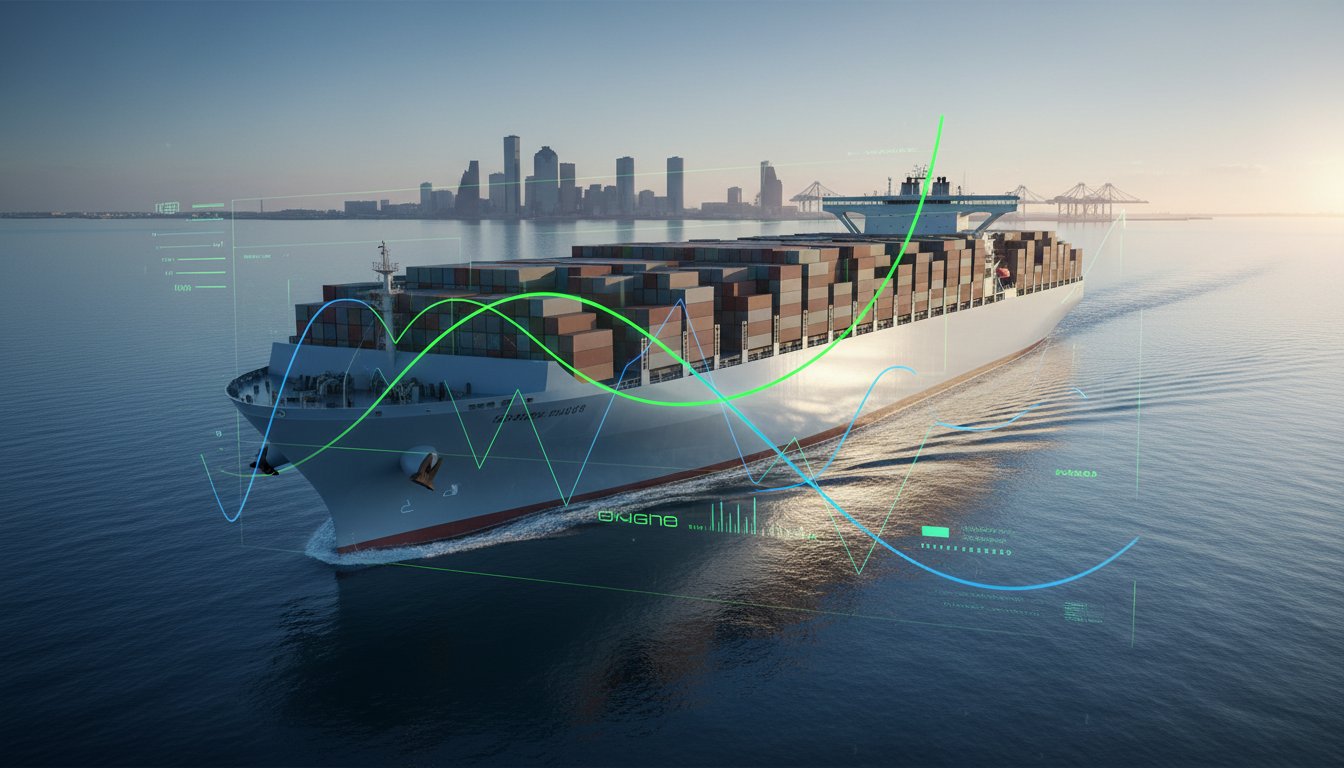
Did you know that high-performance, biocide-free foul release coatings can reduce a vessel’s fuel consumption by up to 11.7% while improving speed by 3.7%? Some next-generation silane-siloxane systems even reach fuel savings of 20% compared to traditional biocidal paints. You likely realize that the initial price-per-gallon is a misleading metric in a market where premium coatings can exceed $400 per gallon. With the EPA’s January 1, 2026, copper leach rate mandate limiting emissions to 9.5 micrograms per square centimeter, the “cheap” choice is often a legal and financial liability.
This guide demonstrates how calculating total cost of ownership for marine paint moves your strategy beyond material costs toward long-term operational profitability. We’ll provide a defensible data model to justify premium investments like Sea-Speed V 10 X Ultra to your stakeholders. You’ll learn how to leverage hydrodynamic efficiency to reduce your Carbon Intensity Indicator (CII) by up to 22% and extend dry-docking intervals to a full 10-year lifecycle. We’ll break down the variables of drag reduction and maintenance mitigation to transform your hull coating from a simple maintenance expense into a high-yield strategic asset.
Key Takeaways
- Learn to distinguish between deceptive acquisition costs and the actual operational expenses that dictate long-term vessel profitability.
- Master a rigorous framework for calculating total cost of ownership for marine paint by evaluating the five pillars of lifecycle expense, from surface preparation to hydrodynamic drag.
- Quantify the “roughness penalty” associated with traditional ablative coatings to understand how surface turbulence impacts your fuel budget over time.
- Discover how hard-film silane-siloxane systems like Sea-Speed V 10 X Ultra optimize ROI by eliminating the sacrificial cycle of frequent re-application.
- Align your fleet with tightening environmental regulations while simultaneously improving your Carbon Intensity Indicator (CII) through advanced hull performance.
Defining Total Cost of Ownership (TCO) for Marine Coatings
Industry stakeholders are moving away from the narrow focus of the procurement desk to embrace a more holistic financial perspective. As we move through 2026, the maritime sector recognizes that the lowest invoice price for a drum of paint rarely equates to the lowest cost of running a vessel. Mastering the variables involved in calculating total cost of ownership for marine paint requires a shift from transactional procurement to strategic asset management.
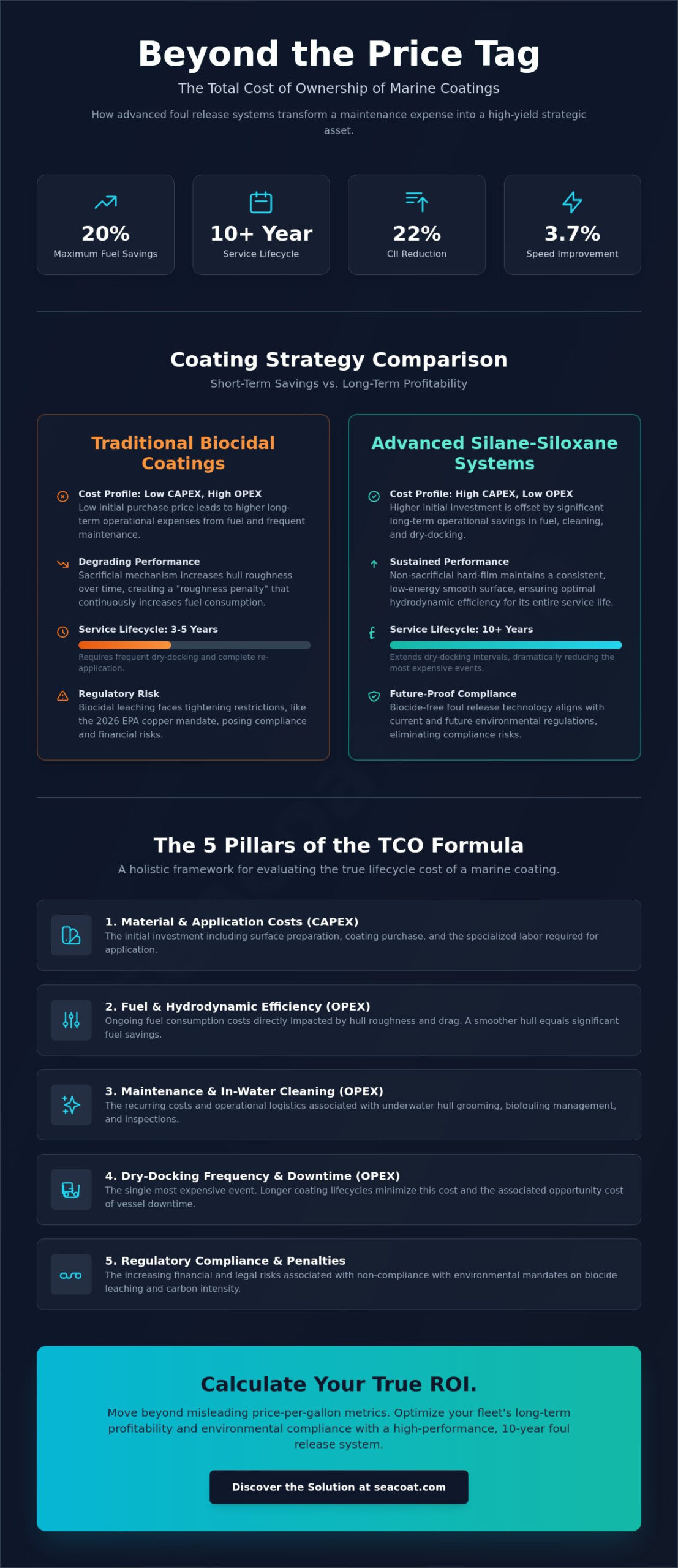
Strictly defined, Total Cost of Ownership (TCO) is the comprehensive estimation of every expense related to a coating system over its entire functional service life. It accounts for the immediate acquisition of materials and the subsequent operational impacts on fuel burn, hull cleaning frequency, and dry-dock intervals. By calculating total cost of ownership for marine paint through a 120-month lens, fleet managers can justify the higher upfront costs of advanced silane-siloxane systems like Sea-Speed V 10 X Ultra.
Acquisition vs. Operational Expenditure
The financial profile of a marine coating is divided into Capital Expenditure (CAPEX) and Operational Expenditure (OPEX). CAPEX includes the initial purchase price of the coating, surface preparation costs, and the labor required for application. While these figures are visible on day one, they represent only a fraction of the lifecycle cost. OPEX encompasses the ongoing fuel consumption penalties caused by hull roughness and the recurring costs of underwater hull grooming. A “cheap” coating often leads to the highest OPEX.
Application complexity also plays a significant role in initial labor costs. Traditional multi-coat systems might seem familiar, but they often require longer dry-dock stays and more man-hours for surface preparation. Conversely, high-solids, hard-film coatings may demand more precise application conditions, yet they mitigate long-term costs by providing a more durable, hydrodynamic surface that resists mechanical damage and biofouling attachment.
The 10-Year Service Life Benchmark
The 10-year window has become the critical benchmark for commercial and military ROI in 2026. This decade-long cycle allows operators to see the true degradation rates of different technologies. Traditional ablative paints rely on a sacrificial mechanism; they wear away to reveal fresh biocide. This process inherently increases surface roughness over time, which degrades hydrodynamic efficiency and necessitates more frequent repainting.
Hard-film systems do not rely on this sacrificial cycle. They maintain a consistent, low-energy surface that facilitates foul release without losing film thickness. Longevity fundamentally reduces the “Cost per Year” metric by spreading the initial application expense over a decade rather than the typical 36 to 60 months. This extended service life minimizes the frequency of dry-docking, which is often the single most expensive event in a vessel’s operational calendar.
The 5 Pillars of the Marine Paint TCO Formula
To arrive at a precise figure when calculating total cost of ownership for marine paint, one must look beyond the bucket price and evaluate the entire operational ecosystem. We categorize these variables into five distinct pillars. Pillar 1 covers initial material and application costs, which include surface preparation and specialized labor. Pillar 2 focuses on fuel consumption and hydrodynamic efficiency. Pillar 3 addresses maintenance and in-water cleaning intervals. Pillar 4 accounts for dry-docking frequency and the associated opportunity costs of vessel downtime. Finally, Pillar 5 considers regulatory compliance and environmental penalties, which have become increasingly punitive as of 2026.
A rigorous 20-year life cycle cost analysis provides the data necessary to justify high-performance investments. It reveals that the cumulative impact of these pillars determines the true financial footprint of a vessel. By quantifying each element when calculating total cost of ownership for marine paint, fleet managers can move from reactive maintenance to a proactive strategy that favors long-term profitability over short-term savings.
Hydrodynamic Drag and Fuel Optimization
There’s a direct, measurable correlation between hull roughness and fuel burn. Traditional biocidal paints rely on a leaching mechanism that naturally creates a “roughness penalty” as the film degrades, often increasing surface texture by hundreds of microns. In contrast, foul release systems maintain a slick, low-energy surface. This hydrodynamic advantage can yield fuel savings between 5% and 12% depending on vessel speed and operating profile. Advanced silane-siloxane coatings ensure this efficiency doesn’t diminish after the first season, providing consistent performance throughout the 10-year cycle.
Dry-Docking and Maintenance Intervals
Vessel downtime is an immense hidden cost. Unscheduled maintenance or frequent dry-docking for repainting disrupts charter schedules and drains capital. Hard-film durability allows for extended 5-year or even 10-year dry-dock cycles because the coating doesn’t require the “sacrificial” re-application typical of ablative paints. This longevity also reduces the need for aggressive hull scrubbing, which often damages softer coatings and accelerates the fouling cycle. For those seeking to optimize these intervals, a high-durability solution like Sea-Speed V 10 X Ultra offers a significant strategic advantage.
Regulatory Costs and EEXI Compliance
The financial impact of Carbon Intensity Indicator (CII) ratings is a primary concern in 2026. Vessels with poor hydrodynamic performance face higher operational taxes and restricted access to certain ports. Non-toxic coatings help operators avoid biocide leaching fines while simultaneously improving their EEXI ratings through drag reduction. Investing in environmental marine coatings is no longer just an ethical choice; it’s a financial necessity for future-proofing assets against evolving global standards.
Quantifying the Hidden Costs of Traditional Toxic Antifouling
Traditional procurement often treats antifouling as a recurring commodity expense. This narrow perspective overlooks the cumulative financial erosion caused by the “Sacrificial Cycle.” When calculating total cost of ownership for marine paint, one must account for the fact that ablative systems are designed to fail by design. These coatings erode to release biocides, a process that inherently increases hull roughness and hydrodynamic turbulence over time. This mechanical degradation is a hidden tax on every nautical mile traveled.
The Failure of the Ablative Model
The long-term financial drain of ablative bottom paint becomes evident after several dry-dock cycles. As layers are added over years of maintenance, paint “build-up” occurs, creating an uneven surface that triggers a significant “Roughness Penalty.” This turbulence forces the propulsion system to work harder, increasing fuel consumption and carbon emissions. Eventually, the accumulated layers reach a critical thickness where they begin to flake or detach, necessitating total hull stripping. This stripping process is a massive hidden TCO factor that can cost tens of thousands of dollars in labor and equipment, yet it’s rarely factored into the initial price-per-gallon comparison.
Soft silicone coatings present a different set of hidden costs. While they offer initial foul-release properties, they often lack the mechanical durability required for high-abrasion environments. In high-stress areas like the bow, rudder, or splash zone, soft films can tear or detach easily. This mechanical fragility results in unscheduled maintenance and premature dry-docking, which completely negates any perceived savings from the coating’s initial performance. Choosing a hard-film system avoids these early failure costs by providing a surface that resists physical impact and abrasion.
Environmental and Liability Risks
Regulatory compliance in 2026 introduces new financial risks for vessels using outdated technologies. The U.S. EPA mandate, effective January 1, 2026, limits copper leach rates to 9.5 micrograms per square centimeter per day. Vessels exceeding these limits face potential fines and restricted port access in sensitive regions. Additionally, the disposal of toxic blast media, which is the hazardous waste generated during the removal of biocidal paints, carries high environmental surcharges that do not apply to biocide-free systems.
Poorly protected hulls also risk transporting invasive species, leading to severe penalties in international waters. From a strategic perspective, these toxic systems impact a vessel’s Carbon Intensity Indicator (CII) rating. As the industry moves toward decarbonization, the “Roughness Penalty” of traditional paint becomes a direct liability, potentially lowering the vessel’s commercial value and operational eligibility. By calculating total cost of ownership for marine paint with these regulatory and environmental variables included, the shift toward hard-film, biocide-free technology becomes a clear economic imperative.
Step-by-Step Guide to Calculating Your Vessel’s Paint TCO
Moving from a simple procurement mindset to a lifecycle strategy requires a structured analytical approach. A logical framework for calculating total cost of ownership for marine paint starts with raw data and ends with a defensible financial model. By following these five steps, fleet managers can quantify the performance gap between traditional biocidal systems and advanced silane-siloxane technology. This process transforms hull coatings from a line-item expense into a strategic asset for vessel management.
Step 1 & 2: Setting the Financial Baseline
You can’t manage what you don’t measure. The first step involves gathering historical data on your vessel’s current performance. This baseline must include precise figures for annual fuel expenditures, current hull cleaning frequencies, and the exact daily hire rate (DHR) of the vessel. The DHR is a critical variable; it represents the revenue lost every day the ship is out of service. If a dry-docking period extends by three days due to complex application or multi-coat curing times, that cost must be added to the acquisition total.
The acquisition phase includes the cost of materials, specialized labor, and the equipment required for surface preparation. When modeling the initial build, ensure you include the cost of high-performance primers like Seapoxy 73. These specialized undercoats are essential for ensuring the long-term adhesion of the topcoat. While the initial material cost for premium systems is higher, these figures are the only ones most competitors consider. To get the full picture, you must move into operational forecasting.
Step 3 & 4: Modeling Long-Term Performance
Once the baseline is set, you must forecast the operational impact of your coating choice. Use a conservative 5% fuel saving estimate to model your return on investment. While some silane-siloxane systems reach up to 20% savings, a 5% baseline provides a defensible floor for stakeholder presentations. This stage also requires adjusting for the “Hard Film” advantage. Unlike ablative paints that require re-application every 24 to 36 months, a hard-film system like Sea-Speed V 10 X Ultra is designed for a 10-year service life with zero re-application.
The final analytical step in calculating total cost of ownership for marine paint is the Net Present Value (NPV) calculation. You must compare the “Cost of Avoided Maintenance” over the second five-year cycle. Traditional coatings will require at least two additional dry-docking events for repainting within a decade. By amortizing the premium initial cost over 120 months and subtracting the avoided costs of labor, materials, and vessel downtime, the premium choice often reveals itself as the most economical path. For a tailored analysis of your fleet’s potential savings, you can request a technical consultation with our engineering team.
Strategic Investment: The 10-Year ROI of Silane-Siloxane Systems
Adopting a silane-siloxane system is a transition from reactive maintenance to strategic asset management. While traditional coatings focus on short-term prevention, Sea-Speed V 10 X Ultra is engineered to function as a permanent hull asset. When calculating total cost of ownership for marine paint, the distinction between a sacrificial coating and a durable hard film becomes the primary driver of fleet profitability. This technology doesn’t just protect the hull; it optimizes the entire hydrodynamic profile of the vessel for a full decade.
The Sea-Speed Performance Advantage
The “Hard Film” foul release mechanism is the scientific foundation of this ROI. Unlike soft silicone coatings that are easily damaged during transit or cleaning, this system creates a robust, non-stick surface that resists mechanical abrasion. The chemistry of silane-siloxane marine paint ensures that biofouling cannot form a strong bond, allowing for effortless removal through simple water pressure or vessel movement. For high-performance racing applications where weight and surface tension are critical, Sea-Speed V 10 X Ultra Clear provides an even more specialized solution for TCO optimization by maximizing speed while maintaining extreme durability.
Consider a standard freighter hull over a 10-year period. In a traditional model, that vessel would require at least two full repainting cycles, including extensive surface preparation and multiple coats of biocidal paint. A silane-siloxane system eliminates these mid-cycle dry-dock requirements. The hard-film surface remains intact, maintaining its low-energy properties without the need for re-application. This longevity directly translates into hundreds of thousands of dollars in avoided labor and material costs, alongside the preservation of the vessel’s revenue-generating days.
Final ROI Synthesis
The “Zero VOC” advantage adds another layer of financial benefit. By eliminating volatile organic compounds, operators ensure easier regulatory compliance and improved worker safety during application. This reduces the risk of project delays due to environmental restrictions in sensitive port areas. When you present a TCO-based proposal to corporate or military stakeholders, the narrative shifts from “how much does it cost” to “how much does it save.” You’re presenting a model that accounts for a 5% to 12% reduction in fuel burn and the total elimination of sacrificial paint cycles.
The synthesis of these variables proves that the “expensive” premium coating is often the most profitable choice for any long-term maritime operation. By calculating total cost of ownership for marine paint through this 120-month lens, the economic superiority of hard-film technology is undeniable. To see how these metrics apply to your specific vessels, consult with SeaCoat for a custom TCO analysis of your fleet and start treating your hull as a high-yield asset.
Optimizing Vessel Assets for Long-Term Profitability
Transitioning from a transactional procurement mindset to a lifecycle strategy is the only way to ensure commercial viability as environmental standards tighten. By calculating total cost of ownership for marine paint, you’ve seen how the initial material price is dwarfed by the cumulative impact of fuel burn, dry-dock downtime, and regulatory penalties. Hard-film solutions like Sea-Speed V 10 X Ultra provide a proven 10-year lifecycle that eliminates the constant cycle of sacrificial re-application while achieving up to a 12% reduction in fuel consumption through superior hydrodynamic optimization.
Modern fleet management requires a data-driven approach to hull performance. Our biocide-free, zero VOC systems ensure total regulatory compliance while protecting both your bottom line and the marine ecosystems where you operate. It’s time to move beyond temporary fixes and invest in a permanent hull asset that delivers measurable ROI year after year. Download our 10-Year Marine TCO Calculation Framework to begin your transition toward a more efficient and profitable fleet. We’re ready to help you navigate these complex variables with technical precision and scientific confidence.
Frequently Asked Questions
Is a premium foul release coating always cheaper in the long run?
Yes, for any vessel operating beyond a 36 month window, premium systems offer superior value. While the initial acquisition cost is higher, these coatings amortize that expense over a 120 month service life. Traditional ablative paints require repainting every 24 to 60 months, which forces the owner to pay for material and labor multiple times within a single decade. Choosing a 10 year system eliminates at least one full dry dock cycle, saving significant capital.
How much can a high-performance coating actually save on fuel costs?
Verified data shows that high performance foul release coatings reduce fuel consumption by up to 11.7% compared to traditional biocidal paints. Some advanced silane siloxane systems reach fuel savings of 20% by maintaining a low energy, hydrodynamic surface. These savings are a direct result of drag reduction. Since fuel typically accounts for 50% to 60% of total ship operating costs, even a 5% reduction drastically improves your bottom line.
What are the primary factors that inflate marine paint TCO?
Hydrodynamic drag and dry dock downtime are the most significant cost drivers. Traditional ablative coatings increase hull roughness by hundreds of microns over time, creating a “roughness penalty” that forces engines to burn more fuel. Additionally, the Daily Hire Rate (DHR) lost during maintenance is a massive hidden expense. If a vessel is out of service for 10 days for repainting, the lost revenue often exceeds the cost of the paint itself.
Can I calculate TCO for a single recreational vessel or is it only for fleets?
TCO modeling is essential for individual owners, especially with the January 1, 2026, EPA mandate. This regulation limits copper leach rates to 9.5 micrograms per square centimeter, making many traditional paints illegal or subject to future fines. Calculating total cost of ownership for marine paint allows a recreational owner to see that a biocide free system like Sea-Speed V 10 X Ultra pays for itself through reduced cleaning fees and better fuel economy over five years.
How do 2026 EEXI regulations affect the TCO of my current hull paint?
Regulatory compliance is now a core pillar of calculating total cost of ownership for marine paint. Vessels with poor hydrodynamic performance face lower Carbon Intensity Indicator (CII) ratings, which can lead to operational taxes or restricted port access. High performance coatings can improve a vessel’s CII rating by 20% to 22%. This improvement future proofs the asset and prevents the financial penalties associated with non compliance in the 2026 regulatory environment.
Does the type of hull material (aluminum vs. steel) change the TCO calculation?
Yes, the material dictates the preparation and primer requirements. Aluminum hulls are particularly sensitive to galvanic corrosion and require biocide free systems to avoid structural damage. Steel hulls need a robust, high solids primer like Seapoxy 73 to ensure the topcoat lasts for the full 10 year cycle. Failure to use the correct primer leads to coating detachment, which causes an immediate and expensive spike in TCO due to unscheduled repairs.
What is the “opportunity cost” of choosing a traditional antifouling paint?
The opportunity cost is the revenue you lose while the vessel sits in dry dock for recurring maintenance. Every day spent stripping and reapplying sacrificial paint is a day the vessel isn’t generating income. Traditional paints require these visits twice as often as hard film systems. When you factor in the fuel wasted on a rougher hull, the “cheaper” paint choice becomes an expensive barrier to maximizing your vessel’s annual earning potential.
How does in-water cleaning affect the TCO of hard-film vs. soft-silicone coatings?
Hard film coatings allow for frequent, aggressive grooming without damaging the surface, which keeps TCO low. Soft silicone coatings are fragile and often tear during mechanical cleaning. A single tear can lead to widespread coating failure and premature dry docking. By choosing a durable hard film, you reduce the risk of accidental damage and ensure the coating maintains its hydrodynamic properties for the entire 10 year lifecycle.