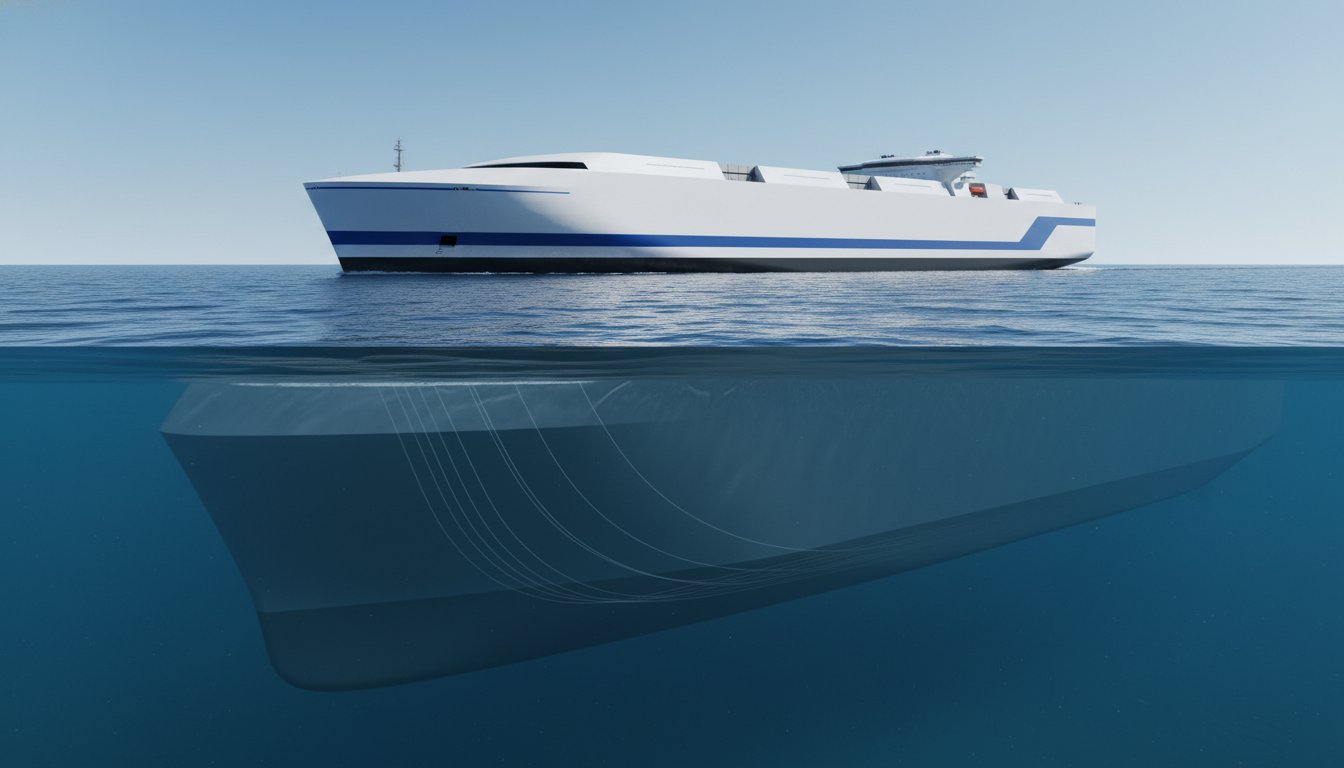
A mere 0.5 mm layer of slime on a vessel hull can increase fuel consumption and carbon emissions by up to 25 percent according to recent maritime efficiency studies. You’ve likely felt the pressure of rising fuel expenditures and the logistical burden of frequent dry-docking to re-apply traditional ablative paints. As environmental regulations tighten and biocide bans become the global standard, the reliance on temporary fixes is no longer a viable strategy for fleet management. It’s clear that the maritime industry requires a shift toward permanent, performance-driven assets rather than recurring maintenance expenses.
In this 2026 ROI analysis, we provide a technical breakdown of the total cost of foul release coating system adoption compared to long-term operational savings. You’ll discover how investing in advanced siloxane technology facilitates hydrodynamic optimization and extends dry-docking intervals to a 10-year cycle. We’ll examine the data behind biocide-free compliance and how reducing surface roughness directly impacts your bottom line. This guide previews the transition from high-maintenance coatings to a strategic hull management approach that prioritizes both ecological stewardship and measurable profitability.
Key Takeaways
- Analyze the multi-layered financial structure of marine coatings, moving beyond initial unit prices to evaluate material volume, labor, and long-term operational savings.
- Identify how vessel geometry and hull condition dictate the total cost of foul release coating system implementation, including the mitigation of hidden expenses from legacy paint removal.
- Compare the 10-year lifecycle advantage of permanent siloxane systems against the repetitive sacrificial re-application cycles required by traditional ablative antifouling paints.
- Discover how the “Hard Film” durability of Sea-Speed V 10 X Ultra optimizes maintenance by allowing aggressive in-water grooming without the coating loss associated with softer alternatives.
- Learn to leverage biocide-free, zero-VOC technology as a strategic asset to maximize hydrodynamic efficiency and ensure regulatory compliance for the entire ownership cycle.
What Defines the Total Cost of Foul Release Coating Systems?
Understanding the cost of foul release coating system technology requires a shift from traditional maintenance accounting to a model of total asset optimization. Unlike conventional antifouling paints that rely on the leaching of biocides to poison marine organisms, foul release systems utilize low-surface-energy chemistry to prevent attachment. This distinction is critical for vessel operators facing stricter IMO regulations in 2026. A comprehensive Biofouling overview demonstrates how biological accumulation increases drag, yet the solution lies in the physics of the surface rather than chemical toxicity. Modern Silane-Siloxane technology has emerged as the premier hard-film solution, offering a durable alternative to soft silicones while providing a significant Hydrodynamic ROI. This metric measures the intersection of reduced fuel consumption and extended service life, moving the conversation beyond the initial dry-dock invoice.
Material Costs vs. Application Labor
Material costs for these premium systems often exceed those of traditional ablative coatings. This isn’t due to marketing premiums but reflects the complex molecular engineering required to achieve Zero VOC status and high durability. Application labor is another significant variable. These systems require precise surface preparation and specific environmental controls during the curing process. The integration of high-performance primers, such as Seapoxy 73, is essential to ensure the foul release topcoat adheres correctly to the substrate. While the labor quote might be higher than standard applications, it secures a ten-year life cycle that eliminates the need for frequent recoating.
The Premium for Non-Toxic Technology
The shift toward non-toxic technology is driven by both environmental stewardship and economic risk mitigation. Regulatory bodies are increasingly penalizing toxic leaching, making the engineering of biocide-free coatings a necessity for global fleet compliance. Investing in Zero VOC systems removes the threat of future fines and restricted port access. This transition is explored in depth within our environmental marine coatings guide. By prioritizing a cost of foul release coating system that aligns with 2026 sustainability standards, owners protect their assets against both biological drag and legislative volatility. The following factors influence the total investment:
- Surface Roughness: Lower initial roughness reduces skin friction drag immediately upon deployment.
- Durability: Hard-film Silane-Siloxane prevents the tearing and peeling common in older silicone generations.
- Regulatory Compliance: Avoidance of hull cleaning restrictions in sensitive ecological zones.
- Fuel Optimization: Direct reduction in bunker consumption through maintained hydrodynamic efficiency.
The decision to implement a foul release system is a strategic one. It’s an investment in a permanent surface modification rather than a temporary chemical barrier. By focusing on the ten-year performance cycle, the initial capital expenditure is mitigated by the dramatic reduction in operational overhead.
Key Variables Influencing Your Marine Coating Investment
Calculating the total cost of foul release coating system requires a rigorous analysis of technical specifications rather than a simple comparison of retail pricing. Every hull presents a unique hydrodynamic challenge based on its geometry, intended service life, and the biological pressure of its primary trade routes. For a fleet manager, the investment isn’t merely the price of the paint; it’s the cost of the entire application process and the resulting performance gains over a ten-year cycle.
Vessel geometry dictates the initial volume requirements. Large commercial vessels with high block coefficients require significantly more material than streamlined recreational hulls. However, the most volatile variable is the existing substrate condition. Stripping layers of accumulated, failing biocidal paint often accounts for 30% to 50% of the initial labor budget. Research into the environmental and economic impacts of a biocide-free antifouling coating indicates that while initial application costs may be higher due to prep requirements, the elimination of toxic leaching justifies the investment through reduced regulatory fees and extended dry-dock intervals.
Operational profiles also dictate material thickness. High-speed ferries operating at 30+ knots utilize different hydrodynamic shear forces than slow-steaming bulk carriers. This speed determines the required film thickness to ensure the coating remains intact against cavitation and abrasion. Geographic factors, such as the high biofouling pressure found in tropical waters like the Caribbean or the Singapore Strait, may necessitate more robust systems compared to vessels operating in colder, less nutrient-rich environments.
Surface Preparation and Priming Costs
Achieving a “near-white” metal blast, defined by SSPC-SP 10 or NACE No. 2 standards, is non-negotiable for long-term adhesion. Skipping this precision step to save 15% on upfront labor costs often results in catastrophic delamination within 24 months, effectively doubling the lifetime cost of foul release coating system. A high-build, durable primer creates a permanent barrier that mitigates future substrate corrosion and reduces the need for spot repairs during subsequent inspections.
Volume and Coverage Rates
Material expenditure is a direct function of Dry Film Thickness (DFT). While traditional silicone-based systems often require thick, multi-coat applications to achieve durability, the advanced chemistry of Sea-Speed V 10 X Ultra allows for optimized coverage with a harder, thinner film. For commercial hulls, square footage is calculated by multiplying the length between perpendiculars by the sum of the breadth and twice the draft, then applying a block coefficient. Efficient systems like SeaCoat’s minimize the volume required to reach the target DFT, providing a more favorable long-term economic profile for the asset owner.
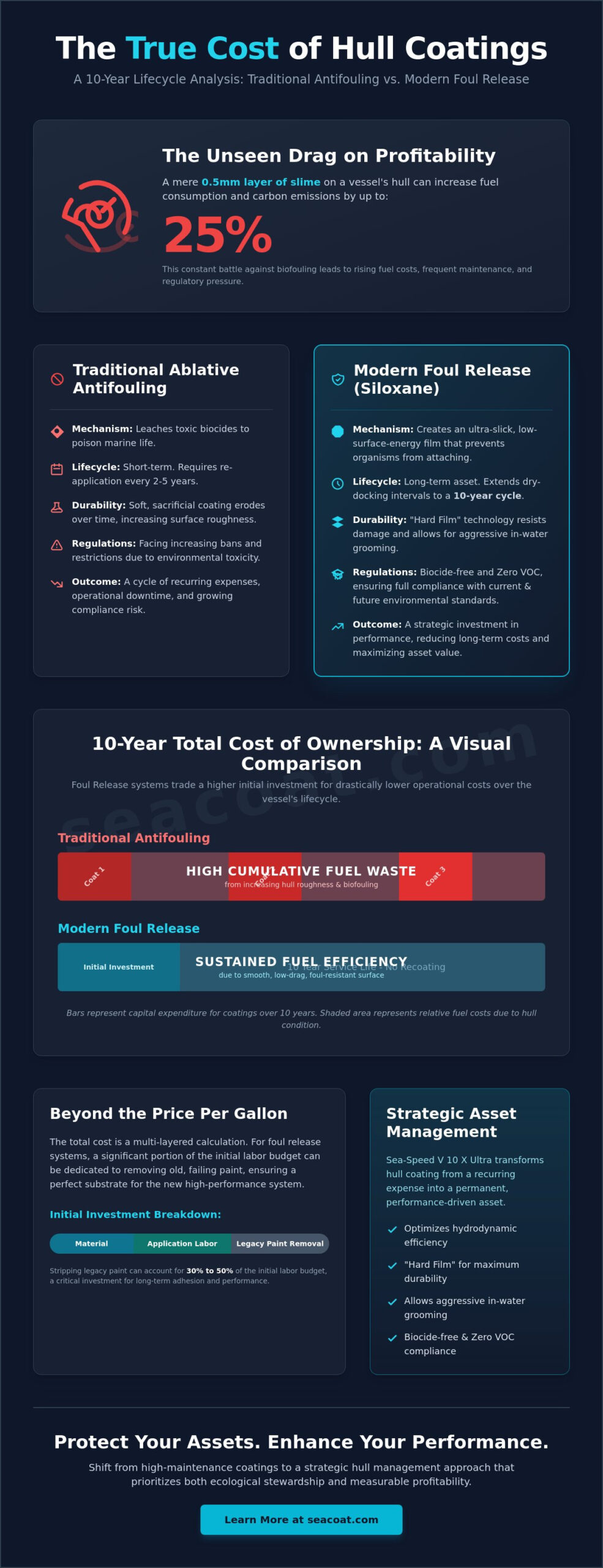
Antifouling vs. Foul Release: A 10-Year Lifecycle Comparison
Strategic asset management in the maritime sector requires a 10-year evaluation window to accurately quantify return on investment. Traditional ablative bottom paint operates on a sacrificial cycle, where biocide-laden layers erode to expose fresh toxins. This mechanism necessitates haul-outs every 18 to 24 months for re-application. Over a decade, a vessel using this method will undergo five full maintenance cycles. These recurring events introduce significant hidden expenses, including escalating dry-docking fees, lost charter revenue, and the high cost of disposing of toxic waste generated during hull preparation.
The Sea-Speed V 10 X Ultra system replaces this cycle with a permanent film model. As a hard-film, siloxane-based coating, it provides a stable surface that doesn’t deplete over time. When analyzing the total cost of foul release coating system, the single-application profile eliminates four major maintenance windows. This shift from reactive maintenance to a long-term technical solution preserves the structural integrity of the hull while ensuring consistent operational availability.
The 2-Year vs. 10-Year Maintenance Arc
Cumulative labor costs for five antifouling applications often exceed the initial capital expenditure of a premium foul release system by 300% or more. Beyond labor, the roughness penalty of aged ablative paint significantly degrades performance. Each successive layer of traditional paint increases hull micro-roughness, which elevates drag and forces engines to work harder. By contrast, a single application of Sea-Speed maintains a smooth, hydrodynamic profile for the entire 120-month period, preventing the compounding fuel penalties associated with paint buildup.
Operational Savings: The Fuel Factor
The ultra-smooth surface of a high-performance foul release coating directly correlates to measurable efficiency gains. Data indicates that vessels transitioning from traditional biocide paints to siloxane systems achieve fuel savings between 4% and 12%. These efficiencies stem from the coating’s ability to minimize the energy required to overcome drag. Frictional resistance is the force acting opposite to a vessel’s motion caused by the shear stress of water against the wetted surface area of the hull. By reducing this resistance, operators can maintain cruising speeds at lower RPMs, which directly optimizes the annual bunkering budget and extends engine service life. The cost of foul release coating system is essentially subsidized by these fuel savings within the first three years of operation.
Estimating Maintenance and In-Water Cleaning Costs
The operational budget of a commercial vessel often hinges on the frequency and intensity of hull maintenance. Traditional biocidal paints rely on controlled depletion, while first generation foul release systems often utilize soft silicone elastomers. These soft coatings are notoriously fragile; they’re prone to tearing during standard port operations or contact with floating debris. The true cost of foul release coating system management is often hidden in these recurring repairs. In contrast, Sea-Speed utilizes a hard film silane-siloxane chemistry that provides a durable, non-stick surface capable of withstanding rigorous mechanical cleaning without coating loss.
In-water grooming serves as a cost-effective alternative to premature dry-docking. Because Sea-Speed V 10 X Ultra is a hard film system, divers can use specialized brushes to remove stubborn macro-fouling without compromising the film’s thickness. This scrubbability ensures that the hull remains hydrodynamically efficient between scheduled dockings. Additionally, the coating’s low surface energy promotes a self-cleaning effect; vessels operating at speeds above 10 knots often shed accumulated slime through simple transit, reducing the reliance on manual intervention. This durability directly impacts the frequency of required hull inspections, as the integrity of the coating remains stable over much longer periods than traditional options.
Soft Silicone vs. Hard Silane-Siloxane Maintenance
Soft silicone coatings are vulnerable to spotting where small tears lead to delamination, requiring expensive underwater repairs or early docking. Sea-Speed V 10 X Ultra offers superior impact resistance, making it ideal for high-traffic waterways where debris is common. By choosing a scrubbable surface, operators mitigate the long-term expenses associated with biofouling management. This durability ensures the cost of foul release coating system ownership remains predictable over a ten-year cycle, avoiding the budget volatility of fragile alternatives.
Reduced Dry-Dock Intervals
Extending dry-dock intervals from the standard 24 or 36 months to a 60 or 120-month cycle fundamentally alters fleet profitability. Every day a ship spends in dock represents lost revenue and high labor costs. By maintaining a smooth, intact hull surface for a decade, Sea-Speed maximizes vessel availability. Operators can find detailed performance metrics and ROI frameworks in The Definitive Guide to Boat Hull Paint. This transition from short-term fixes to a permanent coating solution optimizes both technical performance and the bottom line.
Analyze how a permanent coating solution can stabilize your operational budget. Calculate your fleet’s potential maintenance savings today.
Strategic Asset Management with Sea-Speed V 10 X Ultra
Sea-Speed V 10 X Ultra represents a paradigm shift in hull maintenance and long-term asset preservation. For most vessel owners, this silane-siloxane technology functions as a one-time application for the entire ownership cycle. While traditional ablative paints require re-application every 24 to 36 months, Sea-Speed provides a durable, hard-film surface designed for a 10-year lifecycle. This longevity fundamentally alters the cost of foul release coating system calculations by eliminating multiple dry-docking cycles and repeated product purchases.
The “Triple Bottom Line” of Sea-Speed delivers measurable advantages across three critical pillars:
- Economic: Significant hull roughness reduction leads to fuel consumption decreases of 6% to 12% depending on the vessel type.
- Environmental: The formula is 100% biocide-free and contains zero VOCs, ensuring compliance with the most stringent global standards.
- Operational: Minimized skin friction allows for increased top speeds and optimized engine load profiles, reducing wear on propulsion systems.
Adopting this technology is a strategic move toward future-proofing your assets. As IMO Carbon Intensity Indicator (CII) ratings become more aggressive and local jurisdictions move to ban copper-based biocides, Sea-Speed ensures your fleet remains compliant without expensive mid-cycle retrofits. It’s an investment in regulatory resilience.
Why Sea-Speed is the Expert Choice
Sea-Speed isn’t a new experiment; it carries a 20-year commercial track record of performance in diverse maritime environments. The proprietary Silane-Siloxane chemistry creates a non-stick surface that prevents organisms from forming permanent bonds. For performance-critical applications or racing hulls, the “Clear” option provides a distinct advantage by allowing visual inspection of the substrate while maintaining peak hydrodynamics. From our technical base in Tomball to our regional hubs in Singapore, our global support network provides expert oversight for every project, ensuring consistency across international fleets.
Taking the Next Step in Vessel Optimization
Securing an accurate cost of foul release coating system quote requires a detailed specification sheet. You’ll need to provide the vessel’s wetted surface area, current coating history, and typical operating speeds. It’s vital to choose certified applicators for the installation process. These professionals are trained to manage the specific temperature and humidity requirements needed to achieve a glass-smooth finish, which is essential for maintaining the 10-year performance warranty and maximizing hydrodynamic efficiency.
Ready to optimize your fleet’s performance? Contact Seacoat SCT for a technical consultation and fleet ROI analysis.
Securing Decadal Efficiency in Modern Fleet Management
Transitioning from traditional biocidal antifouling to a high-performance siloxane solution isn’t just a maintenance choice; it’s a strategic capital investment. When you evaluate the total cost of foul release coating system technology, the data favors longevity over low-entry price points. Sea-Speed V 10 X Ultra delivers a documented 10-year lifecycle performance, which eliminates the frequent dry-docking cycles typically required by ablative paints. This system maintains a smooth, hydrodynamic profile that generates proven fuel savings for commercial and military fleets, directly lowering operational overhead through reduced drag. Beyond the balance sheet, our non-toxic formulation contains zero VOCs, ensuring your vessel meets strict environmental regulations without sacrificing film durability. You’re choosing a permanent hard-film surface that resists mechanical damage while actively preserving marine ecosystems. By prioritizing a 10-year performance window, you’re transforming a recurring expense into a long-term asset. It’s time to optimize your vessel’s hydrodynamic efficiency and environmental profile for the next decade of maritime operations.
Request a Professional Quote for Sea-Speed V 10 X Ultra to begin your transition to a cleaner, more efficient fleet.
Frequently Asked Questions
How much more does a foul release system cost compared to traditional antifouling paint?
The initial cost of foul release coating system technology typically ranges from 1.5 to 2.5 times the price of traditional ablative antifouling paints per gallon. This upfront investment covers advanced silane-siloxane chemistry that eliminates the need for biocide replenishment. While the 2024 industry average for premium copper-based paint is lower, those systems require reapplication every 24 months. A hard-film foul release system provides a 10 year lifecycle, which offsets the initial price gap within the first two haul-out cycles.
Can Sea-Speed V 10 X Ultra be applied over existing bottom paint to save on costs?
No, you can’t apply Sea-Speed V 10 X Ultra directly over existing antifouling paint because the bond requires a clean, stable substrate. Proper application necessitates removing all old, depleted coatings down to the original gelcoat or primer to ensure the siloxane bond achieves its maximum 10 year durability. Skipping this step leads to delamination. While surface preparation accounts for approximately 40% of the total application labor, it ensures the hydrodynamic efficiency remains at peak levels for a decade.
What is the expected lifespan of a hard-film foul release coating?
A high-performance hard-film foul release coating is engineered to last 10 years or more with proper maintenance. Unlike traditional paints that leach toxins and thin out over time, these biocide-free systems maintain a constant film thickness and surface smoothness. Data from long-term maritime deployments shows that the non-depleting nature of silane-siloxane technology prevents the build-up cycle. This longevity reduces the frequency of major bottom jobs by 80% over a 10 year period.
Do I need special equipment to apply a foul release system?
Yes, applying these systems requires professional-grade airless spray equipment capable of maintaining specific pressure ratios for high-solids coatings. Standard rollers or DIY brushes don’t achieve the ultra-smooth, low-drag finish necessary for optimal hydrodynamic performance. Applicators must use moisture-traps and specific tip sizes, often 0.017 to 0.021 inches, to ensure a uniform 10 mil dry film thickness. This precision application is critical for achieving the zero VOC and high-durability standards required in modern maritime operations.
How does the cost of in-water cleaning change with a foul release coating?
In-water cleaning costs decrease because the hard-film surface allows for the use of soft brushes or high-volume, low-pressure water tools. Traditional toxic paints require aggressive scrubbing that removes the coating itself, but foul release systems rely on a low-energy surface that prevents permanent attachment. Diver labor hours typically drop by 50% per session. Because the coating is biocide-free, cleaning doesn’t release heavy metals into the marine ecosystem, ensuring compliance with 2026 environmental regulations.
Is there a significant price difference between soft silicone and silane-siloxane coatings?
While the initial purchase price of soft silicone and silane-siloxane coatings is often comparable, the total cost of foul release coating system ownership is lower for silane-siloxane due to its durability. Soft silicones are susceptible to tearing and mechanical damage from fender rub or debris, often requiring repairs within 3 years. Silane-siloxane systems like Sea-Speed V 10 X Ultra provide a hard-film finish that resists abrasion. This physical toughness eliminates the frequent touch-up costs associated with delicate silicone alternatives.
What are the hidden costs of using traditional toxic antifouling paints?
The primary hidden costs include increased fuel consumption due to hull roughness and the rising expense of hazardous waste disposal. Traditional paints develop a sandpaper texture as biocides leach out, which can increase drag by 10% or more. 2023 IMO regulations and local port authorities are also increasingly taxing the removal of copper-laden wash water. These environmental compliance fees and the 24 month reapplication cycle make traditional coatings more expensive than foul release systems over a 5 year window.
How quickly does the fuel savings ROI typically cover the initial coating cost?
Most vessel operators see a full return on investment through fuel savings within 12 to 18 months of operation. By reducing hull friction and maintaining a smooth surface, foul release technology can improve fuel efficiency by 6% to 12% compared to fouled or rough traditional paints. For a vessel consuming 5,000 gallons of fuel annually, a 10% efficiency gain saves 500 gallons per year. These operational savings, combined with reduced haul-out frequency, ensure the system pays for itself long before the 10 year lifecycle ends.