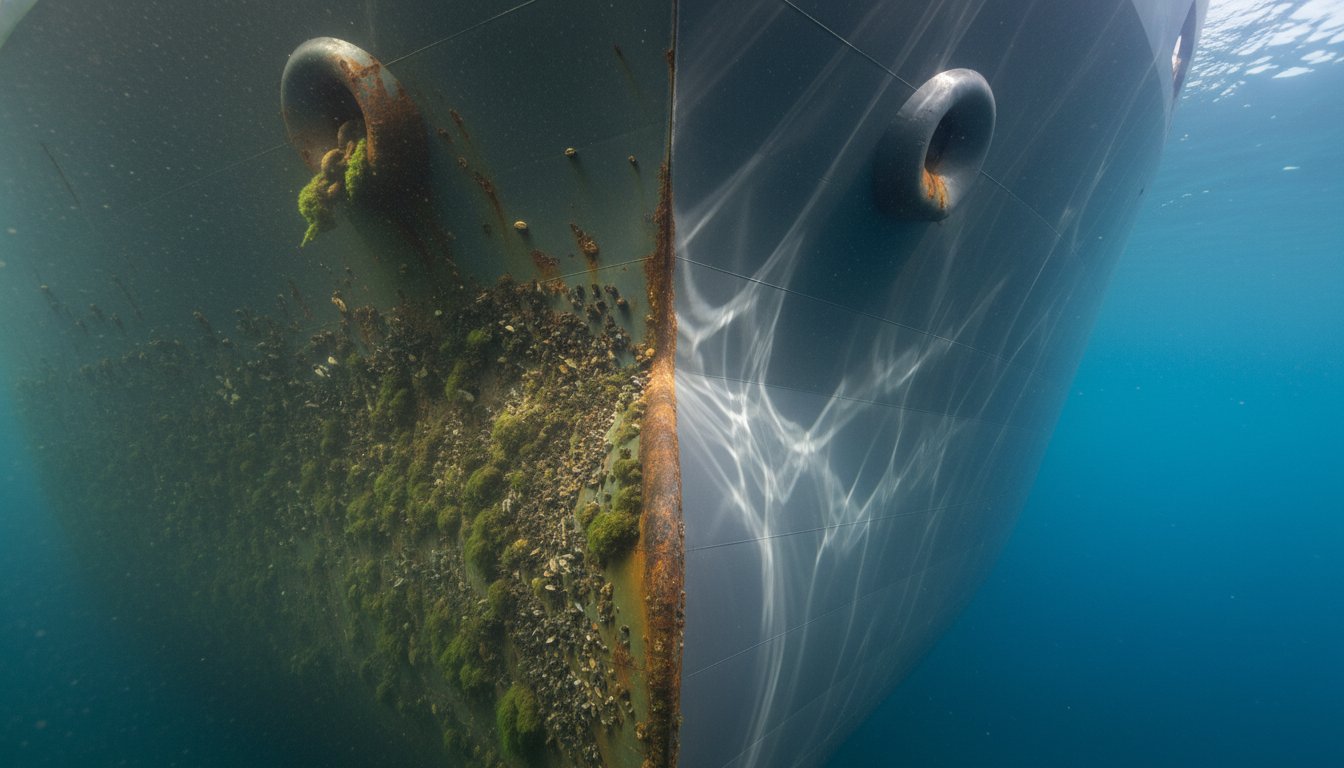
By January 1, 2026, the cost of maintaining a traditional ablative hull coating will shift from a standard maintenance expense to a primary liability for vessel owners. As global maritime authorities enforce the marine paint regulations 2026, the focus on biocide discharge and EEXI carbon targets means the margin for operational inefficiency has vanished. Most fleet managers already recognize that leaching toxins and surface roughness are no longer just environmental concerns; they’re direct threats to the bottom line. You’re likely facing the pressure of avoiding substantial fines while struggling with the 4% to 6% fuel penalty caused by hull fouling and surface degradation.
This guide details how to align your fleet with these stringent requirements while simultaneously securing a 10 year hull protection lifecycle. We’ll explore how transitioning to advanced, biocide-free siloxane coatings provides the hydrodynamic optimization necessary to meet 2026 environmental benchmarks. You’ll discover the specific chemical properties that allow for zero VOC emissions and how these permanent hard film solutions eliminate the high costs of frequent dry docking. We’ll conclude with a strategic roadmap for achieving full regulatory compliance across all global jurisdictions and a significant reduction in long term operational expenditure.
Key Takeaways
- Understand the critical shift toward holistic lifecycle management as the marine paint regulations 2026 transition from discharge-based rules to comprehensive environmental protection standards.
- Prepare for the accelerated phase-out of traditional biocides like Zinc Pyrithione by identifying high-performance, non-toxic alternatives that meet US EPA and IMO requirements.
- Navigate stringent new biofouling limits in Australian and Brazilian waters while mastering the mandatory “containment and capture” protocols for in-water cleaning.
- Discover the direct correlation between hull surface roughness and your Carbon Intensity Indicator (CII) rating to optimize vessel fuel efficiency and operational ROI.
- Evaluate how advanced silane-siloxane technology offers a future-proof, biocide-free solution that ensures long-term hydrodynamic performance and regulatory compliance.
Understanding the 2026 Marine Paint Regulatory Landscape
The International Maritime Organization (IMO) 2026 roadmap signals a transition from discharge-based oversight to a model of holistic lifecycle hull management. This shift means the industry can no longer view Anti-fouling paint as a standalone maintenance item. Instead, it’s a critical component of a vessel’s Carbon Intensity Indicator (CII) rating. The year 2026 represents a definitive turning point where international enforcement by the IMO aligns with aggressive regional mandates from the EPA and European maritime authorities. Compliance now requires a strategic approach to hydrodynamic optimization rather than a simple application of traditional coatings.
Governing bodies are moving beyond the chemical composition of the wet paint to analyze how the coating performs over its entire service life. The EPA’s Vessel General Permit (VGP) and the upcoming 2026 revisions focus heavily on the cumulative impact of leaching biocides and the incidental release of microplastics during in-water cleaning. For fleet managers, this means the selection of a coating system is no longer just about preventing growth; it’s about mitigating long-term environmental liabilities and ensuring the operational efficiency of the maritime industry through reduced surface roughness.
IMO Biofouling Guidelines and Mandatory Controls
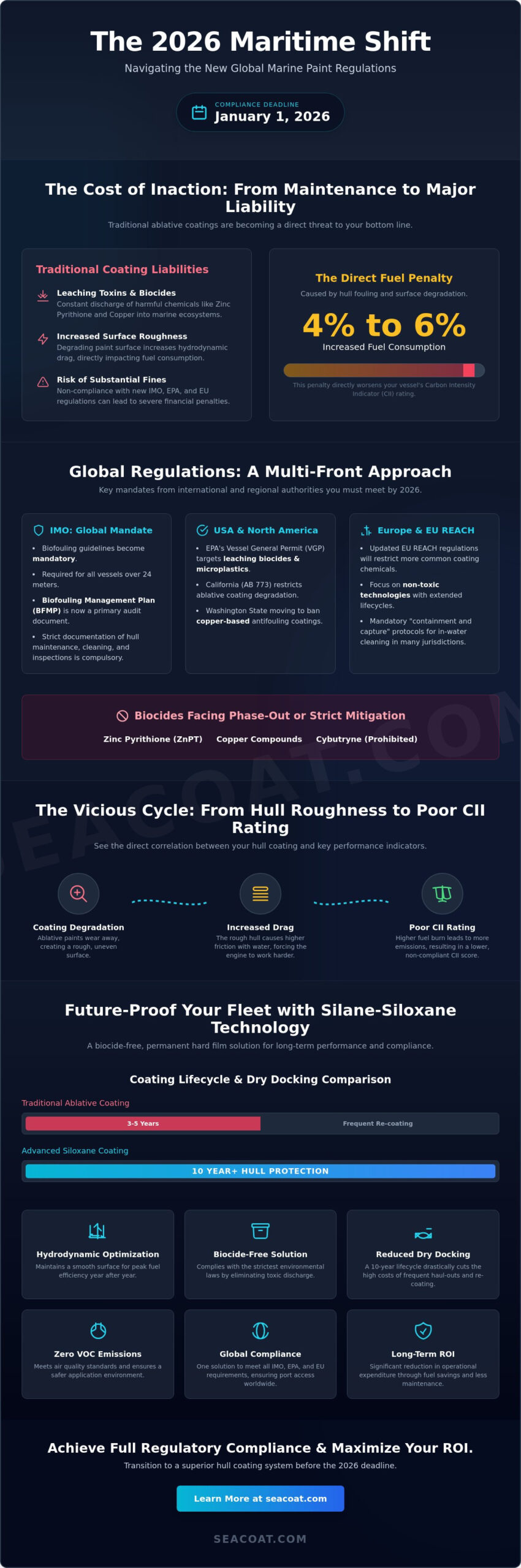
By January 1, 2026, the IMO’s previously voluntary biofouling guidelines become mandatory for all vessels over 24 meters in length. This regulatory evolution centers on the Biofouling Management Plan (BFMP), which serves as a primary audit document during port state control inspections. Owners must provide comprehensive documentation of hull maintenance logs that detail every cleaning event and inspection. These logs aren’t just paperwork; they’re evidence of a vessel’s commitment to preventing the transfer of invasive aquatic species. Precise record-keeping of coating applications and niche area treatments is now a baseline requirement for port entry in high-sensitivity regions.
Regional Tightening: North American and European Mandates
Regional jurisdictions are setting even tighter benchmarks that challenge traditional maritime practices. California’s AB 773 introduces new restrictions on microplastics and leaching biocides, specifically targeting the degradation of ablative coatings that release material into the water column. In the Pacific Northwest, Washington State is finalizing its stance on copper-based antifouling ingredients, accelerating the push for biocide-free alternatives. These localized marine paint regulations 2026 create a complex compliance environment for global fleets.
In Europe, EU REACH updates for 2026 will impact marine coating chemical inventories by restricting several common stabilizers and active substances. These mandates necessitate a move toward siloxane-based, non-toxic technologies that offer a ten-year life cycle. By adopting marine paint regulations 2026 compliant systems now, operators can avoid the costs of mid-cycle re-coating and ensure their assets remain welcome in every major global port. This transition isn’t just about avoiding fines; it’s about securing the long-term ROI of the vessel through superior hydrodynamic performance and environmental stewardship.
Biocide Restrictions: The 2026 Phase-Out of Copper and Zinc Pyrithione
The US EPA’s Registration Review for common marine biocides has reached a critical inflection point, with 2026 serving as the primary implementation deadline for revised risk mitigation measures. Zinc Pyrithione (ZnPT), a staple co-biocide used to control soft fouling, is facing increased mitigation measures because of its high toxicity to non-target aquatic invertebrates and fish. The 2026 regulatory shift reflects updated environmental risk assessments that demonstrate these chemicals don’t remain localized on the hull; they migrate into the surrounding ecosystem and persist in marine sediment.
This evolution follows the global prohibition of Cybutryne, which vessels must have removed or sealed by 2026 if they haven’t already under the AFS Convention. The legacy of organotin variants like TBT serves as a historical warning for the industry. Modern marine paint regulations 2026 focus on preventing the cumulative ecological damage caused by chemical leaching. Regulators are now prioritizing the protection of biodiversity over the convenience of traditional toxic anti-foulants.
The Science of Toxic Leaching vs. Foul Release
Traditional biocidal paints rely on a controlled “leaching rate” to maintain efficacy. This process continuously releases toxic ions into the water column to kill larvae and spores before they can attach to the hull. In high-traffic ports like Rotterdam or the Port of Long Beach, copper accumulation has reached levels that exceed safe environmental thresholds. By 2026, new toxicity data will likely redefine “safe” biocide levels downward, making traditional copper-based systems less viable for international trade. This is why the IMO Biofouling Guidelines emphasize the need for more sustainable management practices to prevent the spread of invasive species without relying on heavy metal discharge.
Future-Proofing Against Chemical Bans
Applying a coating that faces a ban mid-lifecycle is a significant financial risk for ship owners. A standard five-year dry-docking cycle means a coating applied in 2024 must remain compliant through 2029. Transitioning to biocide-free systems eliminates the risk of regulatory obsolescence while maintaining high hydrodynamic efficiency. Biocide-free foul release is the 2026 industry gold standard for achieving long-term compliance and peak hull performance.
Current marine paint regulations 2026 indicate that the industry is moving toward a zero-discharge future. Selecting biocide-free foul release technology
Biofouling Management Standards and In-Water Cleaning Rules
The maritime landscape is shifting from voluntary guidelines to strict enforcement as marine paint regulations 2026 take full effect. Regulatory bodies now recognize that hull condition directly dictates carbon intensity and ecosystem health. Central to this shift is the management of invasive aquatic species (IAS), which move across oceans via hull colonization. By 2026, the International Maritime Organization (IMO) expects 100% of vessels to maintain a Biofouling Management Plan that aligns with revised MEPC.378(80) standards. Beyond biosecurity, new Underwater-Radiated Noise (URN) regulations emphasize hull smoothness. A fouled hull increases hydrodynamic drag by up to 40%, forcing engines to work harder and generating excessive low-frequency noise that disrupts marine mammal communication. Maintaining a “near-zero” fouling state is no longer optional for operational efficiency; it’s a regulatory mandate.
Brazilian Hull Fouling Limits: A Case Study in Enforcement
Brazil’s Directorate of Ports and Coasts (DPC) has established some of the world’s most stringent entry requirements. For 2026, vessels must demonstrate that macro-fouling occupies less than 5% of the submerged surface area. Port authorities utilize Remotely Operated Vehicles (ROVs) to conduct random inspections before berthing. If a vessel exceeds the threshold for calcareous growth or heavy slime, it faces immediate refusal of entry. Non-compliant ships are often ordered to international waters for cleaning, a process that can cost operators upwards of $30,000 in fuel and lost time, excluding the cleaning fees themselves. These protocols mirror Australia’s Biosecurity Act, which requires evidence of proactive hull management within 30 days of arrival.
In-Water Cleaning: Hard Film vs. Soft Silicone
The 2026 regulatory framework mandates “containment and capture” for all in-water cleaning activities to prevent the release of biocides and invasive larvae into local ecosystems. This requirement exposes a critical weakness in traditional soft silicone “foul release” coatings. These materials are delicate; aggressive mechanical brushes or high-pressure water jets used in capture systems often tear the silicone matrix. Once the surface is compromised, hydrodynamic performance plummets and the vessel becomes more susceptible to colonization.
In contrast, hard-film silane-siloxane systems provide the structural integrity required for frequent grooming. These environmental marine coatings are engineered to withstand 1,500 psi of water pressure without losing film thickness. This durability allows for proactive cleaning, where slime is removed before it transitions into macro-fouling. Choosing a coating that survives modern capture technology is essential for meeting marine paint regulations 2026 while extending the dry-dock cycle to 10 years. Key benefits of these systems include:
- Mechanical Resilience: Ability to withstand repeated ROV-based cleaning without surface degradation.
- Hydrodynamic Stability: Maintaining a surface roughness below 100 microns over long-term deployments.
- Regulatory Safety: Biocide-free compositions that simplify the permitting process for in-port cleaning.
Vessel managers must prioritize coating hardness to ensure their fleet remains compliant with both port entry standards and the evolving URN limits. A durable surface is the only way to facilitate the frequent grooming required to eliminate the drag that fuels both noise and emissions.
Optimizing Vessel Efficiency for EEXI and CII Compliance
The Energy Efficiency Existing Ship Index (EEXI) and the Carbon Intensity Indicator (CII) have fundamentally changed how fleet managers view hull maintenance. Under the upcoming marine paint regulations 2026, maintaining a vessel’s hydrodynamic profile isn’t just about speed; it’s a critical regulatory requirement. Hull surface roughness accounts for up to 80% of a ship’s total resistance. When a hull’s profile exceeds a 100-micron roughness threshold, fuel consumption can spike by 6% to 10%. Advanced coatings act as a primary ‘Category A’ technical measure for EEXI improvement, offering a non-mechanical route to achieving compliance without reducing engine power or installing expensive hardware.
Reducing Frictional Drag to Lower GHG Emissions
CII ratings are dynamic, meaning a ship that is currently rated ‘C’ could slip into ‘D’ or ‘E’ by 2026 as annual thresholds tighten. Hydrodynamic analysis demonstrates that a slick hull reduces the power required for propulsion by minimizing the turbulent boundary layer. High-performance silane-siloxane coatings create a low-energy surface that discourages biofouling attachment. In verified case studies, vessels utilizing these advanced foul-release systems reported fuel savings of 8.5% compared to traditional biocidal paints. This efficiency is vital because every ton of fuel saved directly prevents 3.11 tons of CO2 from entering the atmosphere. As coatings degrade, their frictional resistance increases. A standard SPC (Self-Polishing Copolymer) paint may see a roughness increase of 20 to 30 microns per year, whereas a high-durability siloxane system maintains its profile for over 60 months.
The 10-Year Life Cycle: Sustainability through Longevity
Sustainability in the maritime sector requires a move away from the three-year dry-docking cycle. Frequent re-painting generates significant waste and high VOC emissions, which conflict with modern ESG goals. Implementing a long-term boat hull paint strategy reduces the environmental footprint of maintenance by extending the interval between full applications to a decade. Total Ownership Cost is defined as the aggregate of initial application expenses, cumulative fuel savings over ten years, and the avoided costs of mid-cycle hull cleanings and regulatory non-compliance penalties. Investing in a 10-year system provides a predictable ROI by mitigating the financial impact of carbon taxes, such as the EU Emissions Trading System (EU ETS), which began its phase-in for shipping in 2024. These financial pressures make surface optimization a strategic priority for any forward-looking fleet operator.
Maximize your fleet’s compliance strategy by exploring our technical data on hull performance today.
Future-Proofing with Seacoat Silane-Siloxane Technology
As the maritime industry nears the implementation of marine paint regulations 2026, the focus shifts from temporary mitigation to permanent hull optimization. Sea-Speed V 10 X Ultra represents a paradigm shift in marine chemistry. Unlike traditional epoxy coatings that often fail due to brittleness or silicone systems that are prone to tearing, silane-siloxane technology provides a robust, non-migratory solution. This chemical structure creates a high-density molecular bond with the substrate, resulting in a surface that’s both physically hard and chemically inert.
Operational data from military and commercial deployments confirms that Sea-Speed delivers a ten-year service life. It contains zero VOCs and is entirely biocide-free. This ensures that vessels don’t just comply with 2026 standards but exceed them. By removing heavy metals like copper or zinc from the equation, operators eliminate the risk of environmental fines and regulatory scrutiny. The coating’s durability allows for mechanical cleaning without damaging the film, a feat that silicone-based alternatives can’t replicate. Military vessels and commercial tankers using this technology have reported sustained hydrodynamic efficiency even in high-fouling tropical waters.
Sea-Speed V 10 X Ultra: Technical Specifications
The primary advantage of Sea-Speed lies in its hard-film durability paired with ultra-low surface energy. While conventional antifouling boat paint relies on the controlled release of toxins, Sea-Speed uses physics to prevent adhesion. Its surface roughness is measured at less than 10 microns, which significantly reduces hydrodynamic drag. This smooth profile is resistant to standard in-water cleaning tools; it doesn’t scrub off or deplete over time. It’s a permanent foul-release system that maintains its integrity through multiple cleaning cycles, ensuring the hull remains at peak performance for years.
Implementation Strategy for Fleet Managers
Transitioning a fleet to Sea-Speed requires a methodical approach to surface preparation. When moving away from old ablative systems, the hull must be blasted to a near-white metal finish to ensure the silane-siloxane bond is absolute. Once applied, fleet managers can transition to data-driven hull management. Monitoring performance through ISO 19030 standards allows for precise tracking of fuel efficiency gains and long-term ROI. For a detailed regulatory roadmap and a comprehensive fleet assessment, contact Seacoat SCT, LLC to align your operations with marine paint regulations 2026 and secure the longevity of your maritime assets.
Securing Your Fleet’s Future in a Biocide-Free Era
The implementation of marine paint regulations 2026 represents more than a simple compliance hurdle; it marks a necessary evolution in maritime engineering and environmental stewardship. By phasing out harmful substances like copper and zinc pyrithione, the industry is moving toward a standard where hydrodynamic performance and ecological safety are inseparable. SeaCoat has pioneered this transition. Our silane-siloxane technology has been in continuous commercial use since 2001, providing a robust alternative to traditional toxic coatings. These systems are entirely biocide-free and contain zero VOCs, addressing both atmospheric and aquatic environmental concerns simultaneously.
With a proven 10-year service life, our coatings don’t just meet biofouling management standards; they provide a durable foundation for optimizing EEXI and CII ratings through sustained drag reduction. It’s essential to adopt a strategy that views hull coatings as a long-term strategic asset rather than a recurring maintenance expense. We’re committed to providing the technical precision and data-backed reliability your operations require to thrive under these new global mandates. Request a Technical Consultation for Your Fleet’s 2026 Compliance Strategy. We’re ready to help you navigate this transition with confidence and scientific clarity.
Frequently Asked Questions
What are the specific IMO biofouling requirements taking effect in 2026?
The 2026 IMO guidelines mandate a transition from voluntary to mandatory Biofouling Management Plans (BFMP) for all vessels over 400 gross tonnage. Operators must maintain a Biofouling Record Book that documents every cleaning and inspection event. Under the MEPC.378(80) resolution, port states will require verified proof of hull maintenance to prevent invasive species transfer. This regulatory shift targets a 50% reduction in ship-borne aquatic invasive species by 2030.
Is copper-based antifouling paint being banned globally in 2026?
No global ban on copper-based antifouling exists for 2026, though regional restrictions are tightening in jurisdictions like California and the European Union. While the IMO hasn’t issued a total prohibition, the 2023 IMO Biofouling Guidelines encourage the adoption of non-toxic alternatives. In the Mediterranean, specific ports are beginning to restrict copper leaching rates to below 5 micrograms per square centimeter per day to protect local biodiversity.
How do marine coatings help with EEXI and CII compliance?
High-performance marine coatings facilitate EEXI and CII compliance by reducing hydrodynamic drag by up to 10%. Since the Carbon Intensity Indicator (CII) measures grams of CO2 emitted per cargo-carrying capacity, reducing friction directly lowers fuel consumption. A smooth siloxane-based coating prevents the 1% to 2% daily efficiency loss caused by slime buildup. This technical optimization ensures vessels maintain an ‘A’ or ‘B’ rating under 2026 marine paint regulations 2026 standards.
Can I clean my hull in-water under 2026 regulations?
You can clean your hull in-water under 2026 regulations provided the process includes 100% capture of all removed biological material and coating debris. The BIMCO industry standard for in-water cleaning requires specialized equipment to prevent the release of invasive species into local waters. Traditional scrubbing that releases plumes is now prohibited in 35% of major global ports. Compliance relies on using closed-circuit systems that filter effluent down to 10 microns.
What is the difference between foul release and traditional antifouling?
Foul release coatings utilize a low-surface-energy silicone matrix to prevent attachment, whereas traditional antifouling relies on the controlled release of biocides. Traditional ablative paints wear away to expose fresh toxins, often losing effectiveness after 36 months. In contrast, foul release systems like SeaCoat’s siloxane technology provide a non-stick surface. This allows organisms to detach naturally once the vessel reaches speeds above 8 knots, maintaining a smooth hydrodynamic profile without chemical leaching.
Are there specific 2026 regulations for aluminum-hulled vessels?
Specific 2026 regulations for aluminum-hulled vessels focus on the total elimination of cybutryne and the restriction of copper to prevent galvanic corrosion. The IMO AFS Convention already bans organotin compounds, but 2026 standards emphasize non-conductive barrier coats. Aluminum hulls require biocide-free, epoxy-based systems to avoid the sacrificial pitting that occurs when copper-based paints contact the metal. These regulations ensure structural integrity while meeting new 2026 environmental discharge limits.
How long does a modern biocide-free coating last compared to ablative paint?
A modern biocide-free coating typically lasts 10 years, which is double the 60-month maximum lifespan of high-quality ablative paints. Because biocide-free systems don’t rely on a depleting chemical reserve, they don’t require the frequent recoating cycles common in the industry. Data shows that these hard-film coatings maintain their 20-micron surface roughness profile over a decade. This longevity reduces dry-docking frequency by 50%, providing a superior return on investment for fleet managers.
Do 2026 regulations apply to recreational pleasure craft or just commercial ships?
The 2026 marine paint regulations 2026 apply primarily to commercial vessels over 400 gross tonnage, but recreational craft must still comply with regional biocide restrictions. While the IMO Biofouling Management Plan is mandatory for large ships, pleasure craft are subject to the AFS Convention’s ban on harmful substances like cybutryne. In regions like the Baltic Sea, recreational vessels face 100% biocide bans in specific coastal zones. Owners should adopt non-toxic coatings to ensure access to all international marinas.