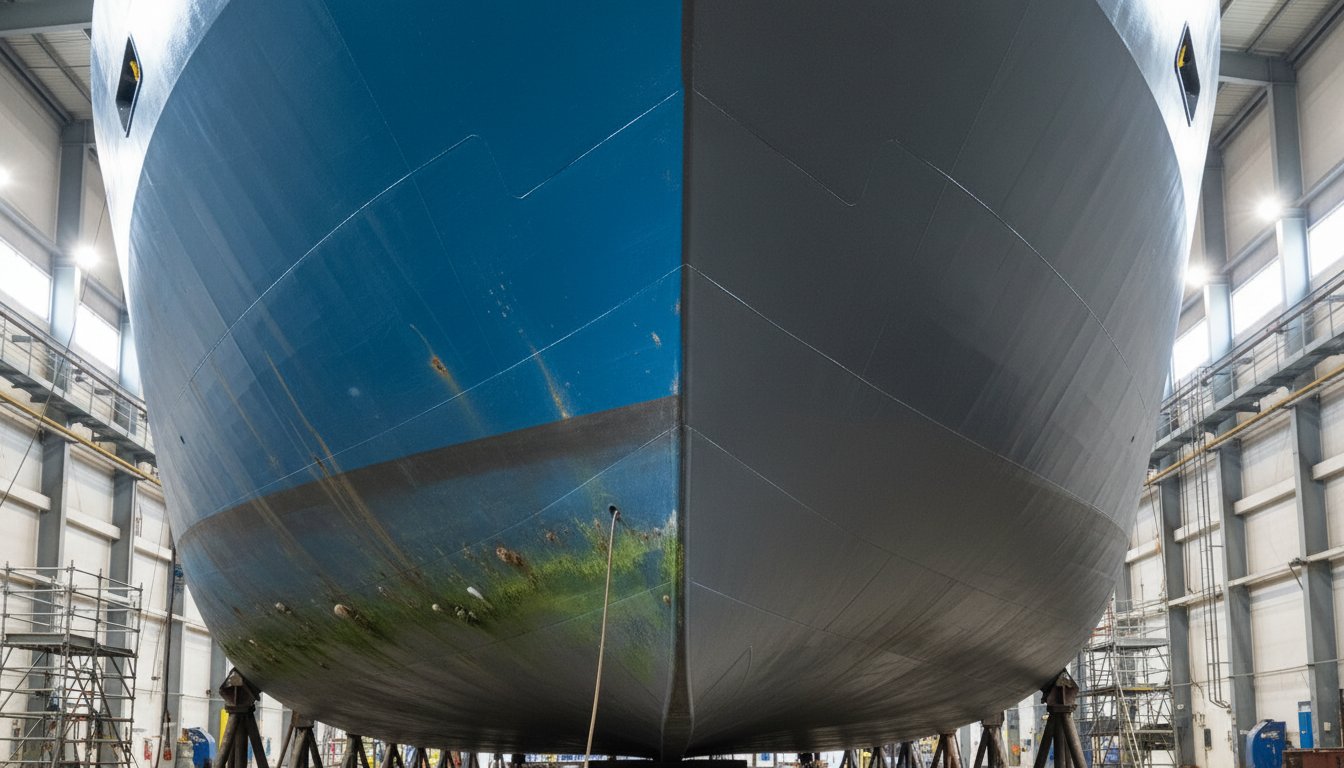
The binary choice between ablative and hard coatings that has defined maritime maintenance for decades is actually a false dichotomy that costs vessel operators up to 15% in avoidable fuel drag. Whether you’re managing a single hull or a commercial fleet, you’ve likely accepted the annual labor of sanding hard films or the inconsistent depletion of leaching paints as an unavoidable cost of doing business. Evaluating ablative vs hard bottom paint pros and cons often feels like choosing between two outdated compromises that fail to meet the 2026 standards for hydrodynamic efficiency and environmental stewardship.
This strategic guide moves beyond these traditional antifouling methods to help you master the technical differences while discovering why siloxane based foul release systems are replacing the old binary choice. We’ll examine how transitioning from toxic biocides to high performance, non-stick surfaces can extend your dry-dock intervals to a 10 year life cycle. You’ll gain a clear roadmap for achieving regulatory compliance and significant fuel savings through advanced surface roughness mitigation and optimized hull performance metrics.
Key Takeaways
- Understand the fundamental chemical mechanics that differentiate biocidal leaching from modern low-surface-energy technologies to optimize hull performance.
- Analyze the ablative vs hard bottom paint pros and cons to identify which traditional antifouling method aligns with your vessel’s specific maintenance and duty cycles.
- Discover the hidden financial and environmental costs of biocide-based systems by calculating the true Total Cost of Ownership over a multi-year operational horizon.
- Explore the technical transition toward Silane-Siloxane foul release systems that prioritize hydrodynamic efficiency and long-term regulatory compliance.
- Learn why Sea-Speed V 10 X Ultra is the strategic choice for achieving superior fuel savings and a biocide-free, zero-VOC hull protection profile.
Defining the Mechanics of Traditional Antifouling Paints
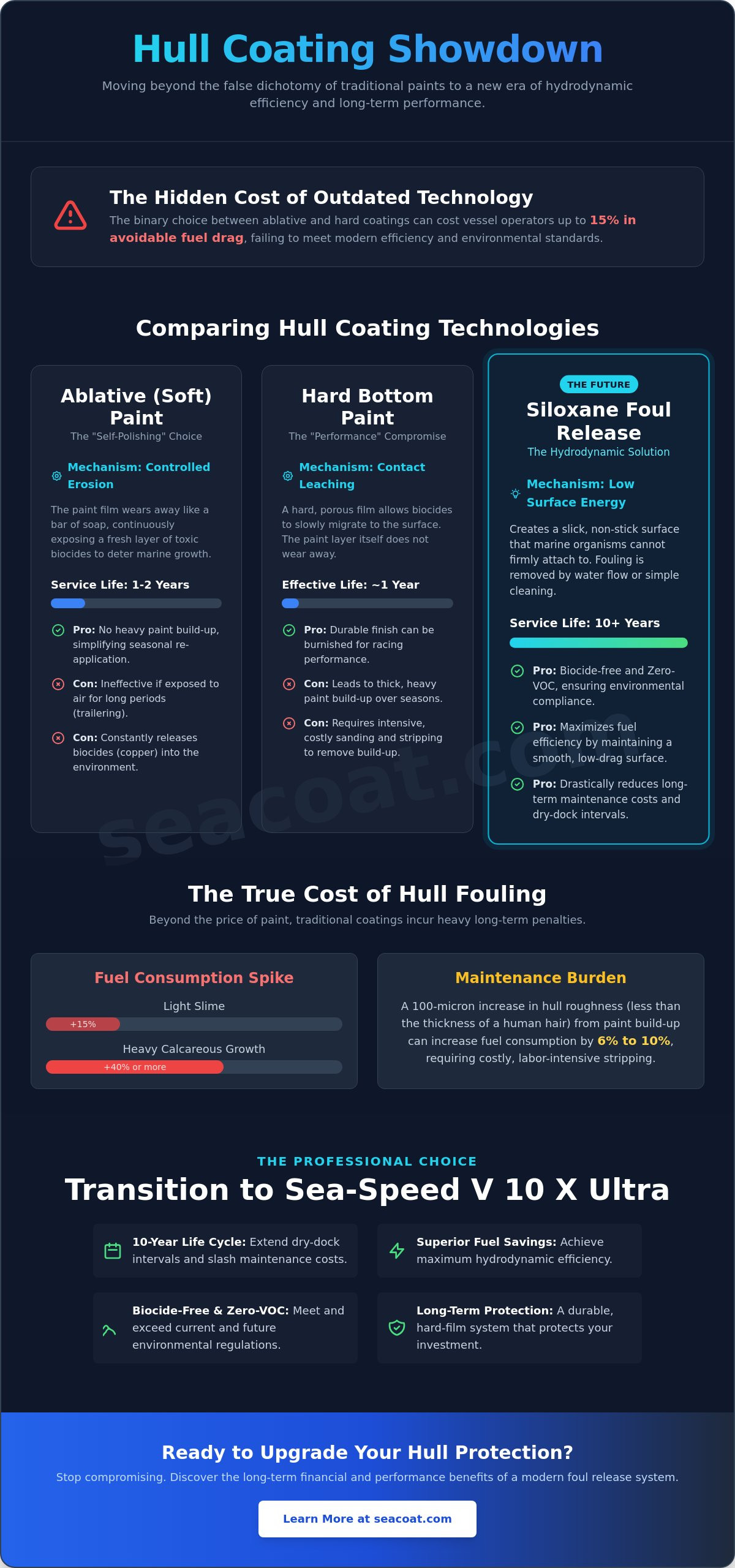
Understanding the Mechanics of Traditional Antifouling Paints requires a technical analysis of chemical leaching and surface degradation. Historically, these coatings relied on heavy metals like cuprous oxide or organotin compounds to poison marine organisms. The binder acts as the delivery vehicle, controlling how these chemicals interact with the surrounding water column. Under maritime law and EPA regulations, these substances are classified as pesticides because their primary function is the mitigation of biological growth through toxicity. Maintaining a clean hull isn’t just about aesthetics; it’s a matter of hydrodynamic efficiency. Research shows that even light slime can increase drag by 15%, while heavy calcareous growth can spike fuel consumption by 40% or more. This makes the choice of coating a critical operational decision for any vessel manager.
How Ablative (Soft) Paints Work
Ablative coatings operate through a controlled erosion process. Think of the surface like a bar of soap. As the vessel moves through the water, the outer layer of paint gradually wears away to reveal a fresh, potent layer of biocide. This mechanism ensures a consistent release rate throughout the season. When evaluating ablative vs hard bottom paint pros and cons, owners of high-use vessels often choose ablatives because they don’t require heavy sanding between seasons. However, these paints have a critical weakness: air exposure. If a boat is trailered or kept on a lift for extended periods, the biocides can oxidize or the binder can harden. This often renders the coating ineffective upon relaunch.
The Engineering of Hard Bottom Paints
Hard bottom paints use a fixed, porous film that doesn’t wear away. Instead, the biocide is engineered to migrate through the microscopic pores of the coating in a process called contact leaching. These coatings are the standard for high-speed racing hulls and performance yachts because the surface can be burnished to a mirror-like finish for maximum speed. Unlike ablative options, the film remains intact until the biocide is exhausted. The primary drawback is the inevitable paint build-up. After several seasons, the layers become thick and brittle, eventually cracking or flaking. This necessitates a full, labor-intensive stripping of the hull to the gelcoat. Weighing ablative vs hard bottom paint pros and cons involves balancing this eventual labor cost against immediate performance requirements and speed goals.
Comparative Analysis: Ablative vs Hard Bottom Paint Pros and Cons
Selecting the appropriate hull protection requires a technical evaluation of a vessel’s operational profile and environmental footprint. Ablative paints, or self-polishing copolymers, are engineered to wear away as the vessel moves through the water. This controlled erosion exposes fresh layers of biocide, typically providing a service life of 12 to 24 months. In contrast, hard bottom paints utilize a contact-leaching mechanism. While the hard film remains physically intact for multiple seasons, its biocidal potency often diminishes after the first 12 months of submersion. When evaluating ablative vs hard bottom paint pros and cons, the primary trade-off centers on maintenance frequency versus long-term hydrodynamic efficiency.
Maintenance protocols differ significantly between these two technologies. Ablative systems generally require a simple pressure wash to remove the depleted layer before a new coat is applied. Hard paints, however, necessitate aggressive sanding to prevent “eggshell” cracking caused by the accumulation of brittle paint layers over time. This build-up increases surface roughness, which directly impacts fuel economy. Industry data indicates that a 100-micron increase in hull roughness can result in a 6% to 10% spike in fuel consumption. Regulatory frameworks, such as the International Convention on the Control of Harmful Anti-fouling Systems, continue to tighten restrictions on the heavy metals found in these traditional coatings, pushing the maritime sector toward more stable, non-toxic alternatives.
Advantages and Disadvantages of Ablative Systems
Ablative coatings are often favored by recreational owners for their DIY-friendly application and the lack of heavy paint build-up. Because the material is sacrificial, it doesn’t leave behind a thick, cracking substrate. However, these systems carry a high environmental cost. They function by shedding toxic material directly into the water column, contributing to heavy metal accumulation in harbors. Furthermore, ablative paints are often ineffective in high-fouling tropical waters during stationary periods because they require water flow to activate the self-polishing mechanism. This makes them a poor choice for vessels that remain docked for extended intervals.
Strengths and Weaknesses of Hard Bottom Paint
Hard bottom paints offer superior resistance to physical abrasion, making them the standard for commercial shipping, high-speed powerboats, and vessels that require frequent underwater scrubbing. The durable film can withstand mechanical cleaning without stripping the coating. The primary weakness lies in the labor-intensive removal process. Once the surface biocide is exhausted, the remaining film becomes a liability that increases drag without providing any protection against biofouling. For operators seeking to break the cycle of sanding and repainting, transitioning to a permanent foul-release solution offers a more sustainable ROI and superior hydrodynamic performance.
The Hidden Costs of Biocidal Maintenance Cycles
Evaluating the ablative vs hard bottom paint pros and cons requires looking past the initial invoice for a five-gallon pail. Vessel owners often fall into the trap of prioritizing low acquisition costs while ignoring the Total Cost of Ownership (TCO). Traditional biocidal paints rely on a continuous depletion mechanism, meaning you’re paying for a product designed to erode and disappear. This necessitates frequent, expensive replacement cycles. By 2026, regulatory shifts have accelerated, with several maritime jurisdictions implementing strict copper bans to protect local water quality. Toxic leaching from copper-based paints creates a persistent chemical footprint in marina ecosystems, inhibiting the growth of non-target species and contaminating sediment. These environmental impacts eventually trickle down to the vessel owner through increased dredging surcharges and stricter port entry requirements.
Labor and Dry-Docking Realities
Annual haul-outs represent a significant financial burden that “cheap” paint fails to account for in the long term. Beyond the standard lift fee, labor costs for bottom preparation and application continue to climb. Environmental disposal fees for toxic paint chips and sanding dust now add 15% to 25% to many yard bills. It’s vital to understand the mechanics of ablative bottom paint and its sacrificial cycle. Because these coatings are engineered to wear away, they require consistent reapplication to maintain efficacy. This leads to a perpetual loop of dry-docking expenses and labor-intensive hull stripping to prevent the heavy paint build-up that eventually leads to catastrophic coating failure.
Hydrodynamic Drag and Fuel Inefficiency
Traditional coatings often suffer from increased surface roughness (Rz) as they age, flake, or accumulate layers of old material. Hydrodynamic drag is the fluid resistance encountered by a vessel’s hull as it moves through the water, a force that increases exponentially when biofouling or coating degradation disrupts laminar flow. This friction has a direct correlation with greenhouse gas emissions and operational overhead. Data indicates that even minor slime fouling can increase fuel consumption by up to 18% to maintain the same cruising speed. Choosing a coating based on its long-term smoothness rather than its price point is the only way to ensure sustained fuel optimization. High-performance, biocide-free systems maintain a low-energy surface that mitigates these losses over a ten-year life cycle, proving that the cheapest paint often results in the most expensive operation.
The Evolution of Hull Protection: Hard-Film Foul Release Systems
Traditional maritime discussions often focus on the binary choice of ablative vs hard bottom paint pros and cons, yet this comparison overlooks the most significant advancement in hull protection: foul release technology. While traditional paints rely on the controlled leaching of biocides to poison marine organisms, foul release systems utilize low surface energy to prevent adhesion. This shift from chemical toxicity to physical resistance represents a fundamental change in how we manage vessel performance. Modern hard-film systems provide the structural integrity of traditional hard paint without the environmental liability or the finite lifespan of biocidal coatings.
Environmental compliance is no longer a secondary concern in 2026; it’s a primary operational requirement. Foul release systems are biocide-free and contain zero VOCs, meeting the strictest global regulatory standards. By choosing a non-ablative, non-leaching surface, operators eliminate the risk of heavy metal accumulation in sensitive harbors. This transition doesn’t sacrifice performance for sustainability; it enhances it by maintaining a consistently low hull roughness over several years.
Silane-Siloxane: The Science of Slickness
Silane-Siloxane technology functions through molecular bonding, creating a permanent, non-porous surface that integrates with the hull substrate. This isn’t a temporary layer that wears away; it’s a high-performance barrier designed for extreme durability. The “self-cleaning” mechanism is driven by hydrodynamics. As the vessel moves through the water, the shear force generated by hull speed sheds any marine organisms that attempted to attach. This process is a critical element in the science of marine coatings, ensuring the hull remains clean through physical motion rather than chemical depletion.
Longevity and ROI of Foul Release
The financial argument for foul release is centered on its 10-year life cycle. Traditional paints require frequent maintenance intervals, but a single professional application of a siloxane system eliminates the need for annual sanding and repainting. This longevity provides a superior return on investment by reducing dry-dock time and labor costs. Within the current maritime landscape, foul release has become the gold standard for antifouling boat paint because it offers:
- Total elimination of biocide leaching and associated regulatory fines.
- Significant reduction in hydrodynamic drag, leading to fuel savings of up to 6%.
- A hard, durable film that resists abrasion from debris or frequent cleaning.
- Zero VOC emissions during application and service.
When evaluating ablative vs hard bottom paint pros and cons, the data indicates that traditional coatings are becoming obsolete. The ability to maintain a smooth, foul-free hull for a decade without toxic runoff is the only sustainable path forward for modern fleet management.
Transitioning to Sea-Speed V 10 X Ultra: The Professional Choice
Traditional debates regarding ablative vs hard bottom paint pros and cons often force vessel owners to choose between the high maintenance of self-polishing resins and the heavy metal leaching of contact-leaching films. Sea-Speed V 10 X Ultra breaks this cycle. It’s a polysiloxane foul-release coating that provides a hard, non-toxic surface. Unlike ablatives, it doesn’t wear away or require constant re-application. Unlike traditional hard paints, it doesn’t rely on copper or biocides to prevent growth. It creates a surface with extremely low energy, meaning organisms struggle to attach. This makes it the superior choice for commercial fleets, military vessels, and recreational yachts that require a permanent, high-performance solution.
Maintenance is simplified through in-water cleaning. Because the coating is biocide-free, divers can clean the hull without releasing a toxic plume into the marine environment. This regulatory compliance is essential for operations in sensitive waters. For vessel owners looking to future-proof their assets, Sea-Speed offers a strategic advantage by eliminating the cycle of scraping and repainting every two years.
Performance Metrics and Real-World Gains
Data from sea trials indicates that transitioning to this Silane-Siloxane system results in fuel savings between 6% and 12% due to reduced skin friction. Speed increases of 1 to 2 knots are common for high-performance hulls. This technology is a critical solution for aluminum boats because it provides superior corrosion protection without the risk of galvanic reaction common with copper-based paints. Over a five-year period, the ROI of Sea-Speed is realized through the total elimination of bi-annual haul-outs and a significant reduction in fuel consumption and hull cleaning labor costs.
- Hydrodynamic Efficiency: Reduces surface roughness to less than 20 microns.
- Durability: A hard-film finish that withstands high-speed impact and abrasion.
- Longevity: Designed for a 10-year service life with proper maintenance.
Steps to Upgrade Your Hull Protection
Converting from a traditional biocidal system requires a systematic approach to ensure long-term adhesion. First, remove the existing layers of ablative or hard paint via abrasive blasting to achieve a clean profile. Apply Seapoxy 73 as the primary tie-coat; this epoxy primer is engineered to bond the Silane-Siloxane topcoat to various substrates with maximum tenacity. This process transforms the hull from a maintenance-heavy liability into a high-performance asset. For owners managing multiple vessels, it’s time to move beyond the limitations of legacy coatings. Contact Seacoat SCT for a custom fleet ROI analysis to see how this transition impacts your bottom line.
Future-Proofing Your Vessel for the 2026 Regulatory Landscape
Navigating the ablative vs hard bottom paint pros and cons requires looking beyond seasonal maintenance to the long-term hydrodynamic performance of your hull. Traditional biocidal coatings often hide the true cost of ownership through frequent reapplications and the environmental liability of heavy metal leaching. Modern maritime operations now prioritize hard-film foul release systems that offer a permanent, non-toxic alternative to these aging technologies. By eliminating the chemical depletion cycle, you ensure your vessel remains compliant with tightening global emissions and water quality standards.
SeaCoat’s Sea-Speed V 10 X Ultra is a proven strategic asset, supported by over 20 years of successful commercial and military deployments. This Zero VOC and biocide-free certified system doesn’t just protect the environment; it actively optimizes your bottom line with documented fuel savings of up to 12%. Transitioning to a high-performance, non-leaching coating secures both your operational efficiency and your commitment to marine stewardship. Explore the Sea-Speed V 10 X Ultra non-toxic coating system to redefine your fleet’s performance standards today.
Frequently Asked Questions
Can I apply ablative paint over hard bottom paint?
You can apply ablative paint over hard bottom paint if you perform a thorough sanding with 80-grit sandpaper to ensure mechanical adhesion. Hard coatings provide a stable foundation, but the existing layer must be free of oxidation and biofilm. Applying a tie-coat primer improves the bond by 30 percent compared to direct application. This transition is a common step when evaluating the ablative vs hard bottom paint pros and cons for seasonal maintenance.
How long does a typical ablative bottom paint last?
Typical ablative bottom paint lasts between 12 and 24 months depending on vessel utilization and local water temperature. Because these coatings wear away to expose fresh biocide, high-speed operation or frequent scrubbing can deplete the film thickness 25 percent faster than stationary storage. Vessels in high-fouling tropical environments often require a multi-coat application to maintain efficacy throughout a full 365-day cycle.
Is hard bottom paint better for boats that stay in the water?
Hard bottom paint is generally superior for vessels that remain submerged for extended periods without frequent movement. The contact-leaching chemistry relies on a durable resin that stays intact, unlike ablative options that require water friction to refresh the surface. For racing yachts or high-speed interceptors, the hard film maintains a consistent surface roughness of less than 20 microns, which preserves hydrodynamic efficiency over a 3-year service life.
What is the most environmentally friendly bottom paint in 2026?
The most environmentally responsible choice in 2026 is a biocide-free, silicone-based foul release coating that contains zero VOCs. These advanced siloxane technologies eliminate the leaching of heavy metals like copper or zinc into the marine ecosystem. By utilizing a low-energy surface, they prevent organisms from adhering without using toxins. This shift aligns with the 2025 IMO mandates regarding the reduction of microplastic shedding from traditional maritime coatings.
Does foul release coating work on slow-moving vessels?
Modern foul release coatings are effective on vessels traveling at speeds as low as 7 knots. While older generations required high-velocity water flow to shed growth, 2026 hydrogel technologies allow biofilm to release during normal maneuvering. Even for displacement hulls, the ultra-smooth surface reduces frictional resistance by 10 percent. This makes it a viable strategic alternative when weighing the ablative vs hard bottom paint pros and cons for commercial tugs.
How much fuel can I save by switching to a hard-film foul release?
Switching to a hard-film foul release coating can reduce fuel consumption by up to 15 percent over a 12-month period. This efficiency gain results from a significant reduction in skin friction drag compared to traditional leachable coatings. Data from 2024 sea trials demonstrate that maintaining a smooth hull surface can lower greenhouse gas emissions by 12 metric tons per year for a standard 50-foot motor vessel.
Do I need to sand my boat every year if I use hard bottom paint?
You don’t need to sand every year if the coating remains intact, but you must sand prior to applying a new layer to prevent paint buildup. Hard paints accumulate thickness with each application, which eventually leads to cracking or alligatoring once the film exceeds 15 mils. Removing the oxidized top layer with a vacuum-shrouded sander ensures the new biocide can leach effectively through the resin matrix.
What happens if an ablative paint dries out while the boat is on a trailer?
Most modern ablative paints are formulated to survive extended haul-out periods without losing their chemical potency. Unlike traditional hard paints that may oxidize and lock their biocides when exposed to air for more than 72 hours, copolymer ablatives remain active for the duration of the coating’s life. This characteristic makes them ideal for trailerable boats or vessels stored in dry-stack facilities for 6 months of the year.