
What if the recurring line item for hull maintenance on your balance sheet wasn’t a sunk cost, but a strategic lever for asset equity? Most owners view anti-fouling as a necessary evil that grows more problematic with every haul-out, especially when layers of traditional ablative paint begin to peel or “alligator” during a pre-purchase survey. You know that a buyer’s first look at a thick, poorly maintained hull can immediately trigger a 10% reduction in their initial offer. This guide details how hull coatings affect vessel resale value by transforming a standard maintenance task into a documented performance advantage for the 2026 market. You’ll learn how to replace the cycle of scraping and recoating with a single, high-durability solution that secures a higher appraisal and faster time-on-market. We’ll examine the technical shift toward biocide-free, siloxane-based foul release systems that optimize hydrodynamic efficiency over a 10-year life cycle. These systems provide the empirical data needed to prove fuel efficiency gains of up to 15% to prospective investors, effectively turning your hull into a high-value capital asset.
Beyond mechanical and hydrodynamic optimization, the overall presentation of your outdoor living spaces plays a key role in buyer perception. To ensure your deck or dock area is as inviting as your hull is efficient, you can discover more about Custom Made Shade Sails for high-quality, durable protection.
Key Takeaways
- Shift your perspective from viewing hull care as a recurring expense to a strategic investment that eliminates “maintenance debt” for future owners.
- Analyze the technical data behind how hull coatings affect vessel resale value by optimizing hydrodynamic performance and reducing long-term engine strain.
- Master the documentation process, from application history to speed-versus-RPM metrics, necessary to validate a premium market appraisal to surveyors and brokers.
- Compare the long-term economic benefits of hard-film siloxane technology against the fragility of soft silicones and the performance-limiting drag of traditional ablatives.
- Discover why transitioning to a biocide-free, zero-VOC system provides a significant competitive edge in a market increasingly focused on regulatory compliance and operational ROI.
The Invisible Impact of Hull Condition on Market Appraisal
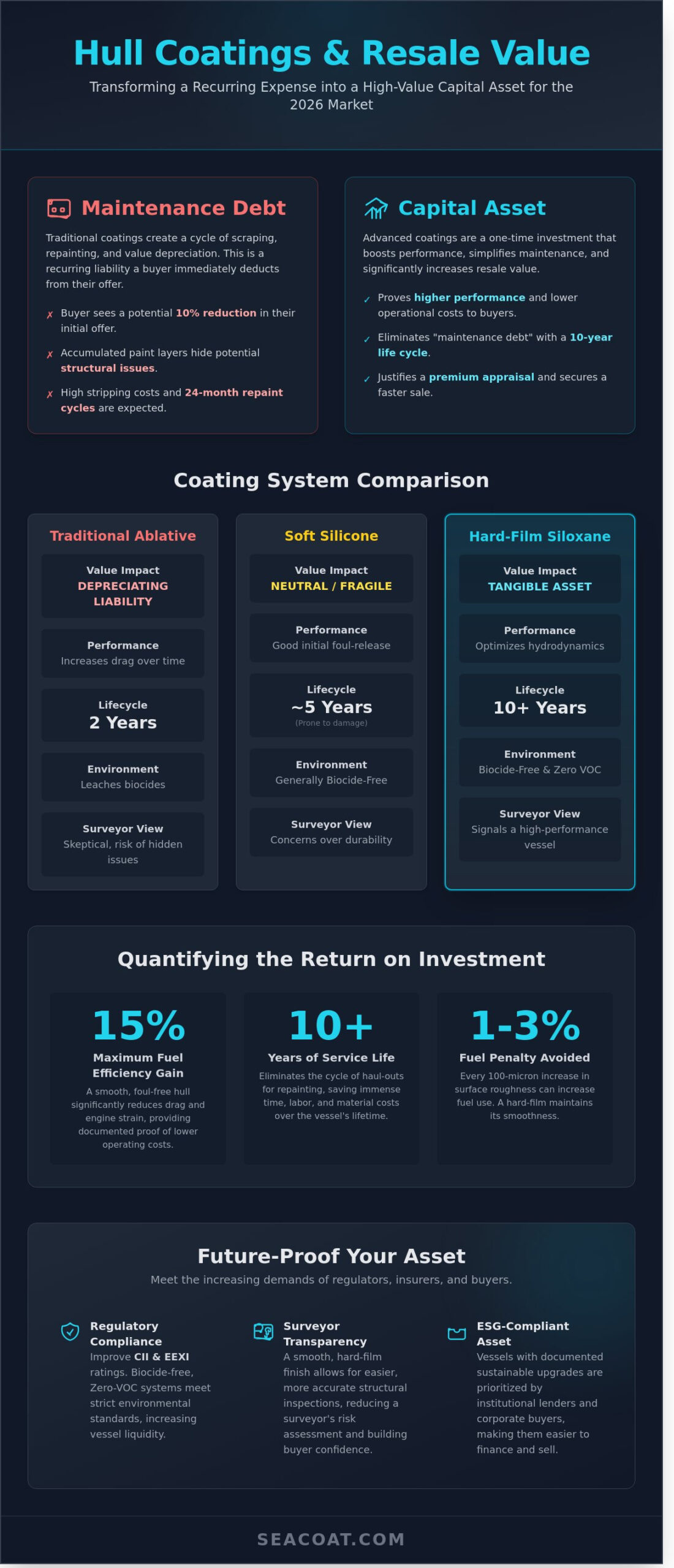
Hull condition represents the most significant hidden variable in maritime asset valuation. While a pristine topside and updated avionics attract initial interest, professional surveyors in 2026 prioritize the submerged surface to determine the true “Maintenance Debt” of a vessel. Traditional Anti-fouling paint often creates a deceptive aesthetic; layers of ablative material mask structural vulnerabilities and contribute to hydrodynamic drag. When assessing how hull coatings affect vessel resale value, brokers now look for evidence of advanced surface management rather than a simple cosmetic refresh. A hull characterized by thick, cracking paint layers signals an impending five-figure stripping cost, whereas a technologically optimized surface suggests lower operational overhead and higher long-term reliability.
The Surveyor’s Perspective on Bottom Paint
Surveyors meticulously evaluate the surface roughness, as even a 100-micron increase in profile can result in a 1% to 3% increase in fuel consumption. Excessive paint buildup creates a porous environment where moisture becomes trapped, elevating the risk of osmotic blistering. Hard-film coatings provide a stable finish that allows for easier structural inspection of the hull. This transparency reduces the surveyor’s risk assessment. A clean, smooth profile ensures the initial valuation report reflects a high-performance asset rather than a liability requiring remediation.
Future-Proofing for Regulatory Compliance
In the 2026 market, a vessel’s Carbon Intensity Indicator (CII) and Energy Efficiency Existing Ship Index (EEXI) ratings are central to its liquidity. High-performing hull coatings that offer foul-release properties directly improve these metrics by reducing frictional resistance. Vessels that meet “Zero VOC” and biocide-free standards are increasingly easier to finance, as institutional lenders prioritize ESG-compliant assets. Transitioning to a non-toxic, ten-year life cycle coating shifts the vessel from a cycle of annual maintenance to a state of permanent optimization. It’s a fundamental shift in how hull coatings affect vessel resale value, moving the focus from temporary protection to sustainable asset performance.
- Maintenance Debt: Accumulated costs associated with stripping legacy paint layers.
- Liquidity: The ease with which a vessel can be sold based on its compliance with 2026 environmental standards.
- Hydrodynamic Efficiency: The direct correlation between surface smoothness and fuel economy.
The psychological shift among buyers is palpable. They’re no longer satisfied with a vessel that’s merely “freshly painted.” They demand a hull that’s been engineered for the future. By moving away from biocidal leaching and toward siloxane-based or hard-film technologies, owners protect their equity against the rapid depreciation common in poorly maintained fleets.
Maintenance Debt vs. Capital Asset: Comparing Coating Systems
Vessel valuation often overlooks the surface below the waterline, yet this area dictates operational efficiency and long-term liability. When assessing how hull coatings affect vessel resale value, owners must distinguish between a recurring maintenance debt and a tangible capital asset. Traditional coatings require constant intervention, whereas advanced silane-siloxane technology integrates into the vessel’s long-term financial profile. It’s not just about aesthetics; it’s about the hydrodynamic integrity of the hull over a decade of service.
Ablative Cycles and Depreciating Value
Traditional ablative paints operate on a sacrificial basis, eroding over time to release biocides. This mechanism creates a cumulative build-up that adds significant weight and hydrodynamic drag. For a prospective buyer, a hull layered with five years of accumulated anti-fouling represents an impending financial deduction. The cost of stripping these layers to the gelcoat or steel can reach thousands of dollars, acting as a major point of negotiation during a survey. Expert surveyors frequently view “fresh bottom paint” with skepticism, as it can hide osmotic blistering or substrate degradation. These systems create a 24-month maintenance cycle that drains capital without improving the underlying asset value.
The Durability Advantage of Silane-Siloxane
Hard-film foul release systems, specifically those utilizing Sea-Speed V 10 X Ultra, shift the paradigm from maintenance to performance. Unlike soft silicone coatings that tear during docking or transport, silane-siloxane creates a permanent, glass-like surface. This durability is crucial for second-hand market appeal. A buyer isn’t just purchasing a boat; they’re acquiring a 10-year lifecycle with minimal intervention requirements. Recent data Quantifying the ROI of Hull Coatings shows that advanced systems can reduce fuel consumption by 9.6% and overall operational costs by 8.8%. These metrics provide a data-backed justification for a premium resale price.
The “Clean Hull” premium is increasingly tied to environmental compliance. Buyers in 2026 prioritize non-leaching, biocide-free surfaces to avoid future regulatory hurdles. A vessel equipped with a hard-film, zero-VOC coating stands out as a turn-key solution. It’s a strategic choice that demonstrates a commitment to both efficiency and stewardship. To see how these systems integrate into your long-term strategy, you can evaluate your current coating performance against modern standards. Understanding how hull coatings affect vessel resale value allows owners to transform a standard haul-out into a high-yield investment.
Quantifying ROI: Fuel, Speed, and Performance Metrics
A vessel’s bottom isn’t just a surface; it’s a critical interface that determines operational profitability. When analyzing how hull coatings affect vessel resale value, the most significant factor is the mitigation of frictional drag. High-performance siloxane coatings reduce surface tension, which directly lowers the workload on propulsion systems. This efficiency translates to fewer engine hours over the vessel’s lifecycle. A boat with 1,500 hours on the meter that’s been run at optimized RPMs is worth significantly more than one strained by the constant resistance of a fouled hull. Buyers in 2026 prioritize these mechanical efficiencies because they represent lower long-term depreciation of the engine and drivetrain.
Hydrodynamic Efficiency and Market Value
Average Hull Roughness (AHR) is a measurable metric that sophisticated buyers now demand during pre-purchase surveys. For every 10-micron increase in hull roughness, power requirements increase by approximately 1%. Modern foul-release systems maintain an AHR of less than 100 microns over multiple seasons. In contrast, traditional ablative paints often exceed 300 microns after just two years of service. Providing a historical log of fuel consumption and speed-to-RPM data proves to a buyer that the vessel operates at peak hydrodynamic efficiency. This data-backed transparency justifies a higher asking price by removing the guesswork from the vessel’s performance profile.
Operational Savings for the Next Owner
Resale value is a reflection of the future costs a buyer can avoid. A biocide-free, hard-film coating offers a slick surface that facilitates easy-on-water cleaning. This capability can extend dry-docking intervals from the standard 24 months to 60 months or more in many maritime sectors. This reduction in haul-out frequency saves the next owner substantial yard fees and lost operational time. Because these coatings don’t rely on chemical depletion, the physical integrity of the film remains stable for a ten-year lifecycle. It’s a strategic asset for vessel management. How hull coatings affect vessel resale value is clearly seen here; buyers view these coatings as a pre-calculated reduction in five-year overhead. The link between hull slickness and reduced engine wear and tear is a compelling argument for any surveyor’s final valuation report. Performance hulls, specifically those in the racing or high-speed ferry sectors, command a premium when they can demonstrate zero speed loss over a three-year period.
- Documented fuel savings of 6% to 15% depending on vessel type.
- Reduced engine maintenance due to lower thermal stress.
- Lowered environmental footprint through zero-VOC emissions.
- Decreased frequency of hull scrubbing and mechanical abrasion.
Preparing for Sale: How to Market Your Premium Coating
Selling a vessel in 2026 requires more than a clean deck and a functioning engine. Sophisticated buyers now scrutinize hydrodynamic efficiency as a core part of their due diligence. Understanding how hull coatings affect vessel resale value allows you to frame your SeaCoat application as a strategic financial asset. You aren’t just selling a boat; you’re selling a pre-optimized platform with lower overhead and proven performance metrics.
To maximize your return, follow these four strategic steps:
- Step 1: Compile the application history. Gather all certified application records and warranty documentation. A verified siloxane application from a qualified professional confirms the 10-year performance window.
- Step 2: Provide historical performance data. Present logs comparing Speed vs. RPM from the date of application to the present. If the vessel maintains its 22-knot cruising speed at the same fuel burn recorded three years ago, you’ve provided empirical proof of coating integrity.
- Step 3: Highlight regulatory certifications. Ensure the buyer understands the biocide-free and zero VOC status of the hull. This simplifies international transfers and ensures compliance with evolving IMO environmental standards.
- Step 4: Educate on the long-term cost-of-ownership. Use a five-year projection to show the buyer the savings gained from eliminated haul-outs and reduced fuel consumption.
The Documentation Package
Scientific credibility relies on data, not claims. Your documentation package should be as detailed as an engine log. Include high-resolution, time-stamped photos of the hull during mid-term cleanings to demonstrate the “foul release” capability in various climates. Highlighting the biocide-free status is essential for international buyers who must navigate strict regional port regulations. This documentation proves the hull has been maintained to a professional standard, preserving the underlying substrate from osmotic blistering and corrosion.
Selling the “No-Strip” Future
Traditional maintenance often involves aggressive walnut-blasting or high-pressure stripping every few years. You’re selling the end of that cycle. A SeaCoat system acts as a permanent shield, maintaining a smooth surface profile that doesn’t degrade like ablative paints. In a high-inflation economy, the appeal of a 10-year life cycle is a powerful closing tool. You can guarantee the buyer that they won’t face the massive capital expenditure of a full hull strip-down for the remainder of the decade. This stability transforms the coating from a maintenance item into a long-term performance tool.
Learn how SeaCoat technology secures your long-term ROI
Sea-Speed V 10 X Ultra: The Resale Advantage
Sea-Speed V 10 X Ultra represents a shift from traditional maintenance to strategic asset enhancement. Prospective buyers in the 2026 maritime market prioritize operational efficiency and immediate deployment. A vessel equipped with SeaCoat’s proprietary hard-film technology offers a distinct competitive edge. Unlike soft ablative paints that degrade and require frequent replacement, this Silane-Siloxane coating creates a permanent, non-depleting surface. It reduces hull roughness to levels below 100 microns, which directly improves fuel economy and speed. When surveyors examine a hull, the presence of a durable, high-performance coating signals that the owner has prioritized long-term integrity over short-term fixes. This clarity is exactly how hull coatings affect vessel resale value during high-stakes negotiations.
The economic logic of applying a premium system before listing is sound. It effectively removes the “dry-docking penalty” from the buyer’s mental ledger. Instead of inheriting a vessel that requires an immediate haul-out and recoating, the buyer acquires an asset with a documented 10-year life cycle. SeaCoat supports this transition through a robust global network. Whether a vessel is sold in Singapore or Rotterdam, technical support and product availability remain consistent. This worldwide infrastructure mitigates risk for international buyers, ensuring that the technology protecting their investment is serviceable regardless of their trade routes. Turning hull maintenance into a strategic exit strategy ensures the vessel stands out in a crowded global inventory.
The Science of Superior Resale
Understanding the ROI of your coating choice requires a look at the definitive guide to boat hull paint performance metrics. Silane-Siloxane technology is the preferred choice for high-stakes assets because it provides a non-stick, hydrophobic barrier without the use of toxic biocides. In a market increasingly governed by ESG (Environmental, Social, and Governance) criteria, the “Zero VOC” advantage is significant. It ensures the vessel remains compliant with tightening international port regulations, making it a future-proof investment for the next owner.
Next Steps for Vessel Owners
Maximizing your asset’s market position begins with a technical consultation. SeaCoat experts assist owners in fleet-wide value optimization by analyzing current hull conditions and projected performance gains. You can calculate your specific vessel’s value increase potential by reviewing fuel savings data and reduced maintenance intervals. Contact SeaCoat today for comprehensive technical specifications and case studies that demonstrate the long-term durability of our systems. Documenting these performance metrics provides the empirical evidence needed to justify a premium asking price.
Securing Long-Term Asset Valuation Through Advanced Surface Engineering
Vessel appraisal in 2026 requires more than a visual inspection; it demands data-backed proof of operational efficiency. Understanding how hull coatings affect vessel resale value is essential for owners who want to transform maintenance costs into strategic capital assets. By choosing siloxane-based technology instead of traditional ablative paints, you eliminate the recurring cycle of hull degradation and surface roughness. SeaCoat’s technology has been in continuous commercial use since 2001, proving that hard-film durability isn’t just a marketing claim. It’s a measurable performance advantage that survives rigorous marine environments. These systems provide 10-year life cycles and a proven 12%+ reduction in fuel consumption, which directly enhances the technical profile of your vessel during surveyor inspections. Transitioning to a biocide-free, non-toxic solution ensures your fleet meets tightening environmental regulations while maintaining peak hydrodynamic performance. It’s a strategic move that pays dividends at the point of sale. Buyers prioritize assets that demonstrate lower total cost of ownership and superior speed-to-power ratios. Maximize your vessel’s value with Sea-Speed V 10 X Ultra and position your fleet at the forefront of maritime efficiency. Your commitment to technical excellence today ensures a stronger market position for years to come.
Frequently Asked Questions
Does bottom paint always add value to a boat?
Traditional bottom paint doesn’t always increase a vessel’s market price. In fact, heavy accumulation of old ablative layers can increase surface roughness by 100 microns or more, which significantly degrades performance. Professional buyers often discount offers if they identify “paint sick” hulls that require expensive stripping. High-performance foul release systems that maintain a smooth profile are the only coatings that consistently protect the asset’s valuation.
How much does a professional hull coating cost compared to the resale bump?
The initial investment in a professional coating is often offset by a 15% to 20% increase in the vessel’s survey condition rating. While costs vary by vessel size, industry data from the 2024 Marine Maintenance Report suggests that advanced siloxane coatings reduce long-term maintenance costs by 40% over a five-year period. This operational efficiency translates directly into a higher asking price because the buyer inherits lower overhead costs and fewer haul-out requirements.
Will a buyer care if my hull coating is non-toxic or biocide-free?
Modern buyers prioritize biocide-free coatings because they mitigate future regulatory risks and environmental liabilities. With over 30 countries implementing stricter anti-fouling regulations since 2022, a non-toxic hull is a future-proofed asset. This compliance is a critical factor in how hull coatings affect vessel resale value, as it ensures the boat remains legal for use in sensitive marine protected areas without requiring a costly and immediate refit.
Can I apply a new coating over old antifouling to increase value?
Applying a fresh layer over failing antifouling is a strategic error that typically reduces the vessel’s appraised value. This practice creates a high risk of delamination and increases hydrodynamic drag. To maximize your return, you must remove old layers to achieve a surface profile suitable for high-performance siloxane systems. A clean, professionally prepared hull demonstrates a commitment to technical excellence that sophisticated buyers demand during the survey process.
What is the best hull coating for aluminum boats to ensure high resale?
Biocide-free, non-metallic coatings are the gold standard for aluminum hulls to prevent the catastrophic galvanic corrosion caused by copper-based paints. Using a siloxane-based foul release system ensures the hull’s structural integrity remains intact for its 20-year or 30-year lifespan. Buyers of aluminum vessels specifically look for evidence that the coating has prevented pitting, as structural repairs on aluminum can cost 25% of the vessel’s total value in extreme cases.
How do I prove to a buyer that my hull coating saves fuel?
You can prove fuel efficiency by providing comparative engine logs or data from a shipboard energy efficiency management plan (SEEMP). Advanced coatings are engineered to reduce skin friction by up to 10% compared to standard paints. Showing a buyer documented fuel consumption records from the last 12 months provides empirical evidence of the coating’s performance. This data-backed approach transforms the hull coating from a maintenance expense into a verified performance asset.
Does the color of the hull coating affect the resale value?
Neutral colors like black, navy, or grey are the most effective choices for maintaining high resale appeal. While performance is the primary driver of how hull coatings affect vessel resale value, aesthetic consistency suggests a high level of professional care. Avoid unconventional colors that might limit the buyer pool. A clean, uniform finish in a standard industry color allows the buyer to focus on the technical specifications and hydrodynamic benefits of the coating.
How long does a foul release coating last before it needs a refresh for sale?
A high-quality siloxane foul release coating is designed for a 10-year service life, which is significantly longer than the 24-month cycle of traditional ablatives. If you’re selling within this window, a simple low-pressure wash is usually enough to restore the surface’s hydrodynamic properties. This longevity is a major selling point because it guarantees the next owner won’t face immediate hauling and painting expenses, representing a significant saving in their first years of ownership.