By 2026, any bulk carrier that maintains a ‘D’ rating for three consecutive years must submit a formal plan for corrective action, yet industry data suggests that nearly 30% of the existing global fleet remains at risk of underperformance. You likely recognize that the transition from simple data reporting under IMO DCS to active carbon intensity management represents a fundamental shift in maritime operations. Mastering the technical nuances of calculating CII rating for bulk carriers is no longer just a regulatory requirement; it’s a strategic necessity for maintaining asset value and long-term operational viability.
This guide provides a comprehensive breakdown of the Carbon Intensity Indicator formula and demonstrates how to leverage technical data to secure a superior ‘A’ or ‘B’ rating. You’ll learn how to transform raw fuel consumption figures into actionable intelligence while discovering how hydrodynamic optimization and hull surface roughness directly influence your carbon footprint. We’ll explore the step-by-step calculation process and the specific operational adjustments required to ensure your fleet remains both compliant and competitive in an increasingly stringent regulatory environment.
Key Takeaways
- Understand the MARPOL Annex VI regulatory framework and how the Carbon Intensity Indicator applies to bulk carrier fleets exceeding 5,000 GT.
- Master the precise technical methodology for calculating CII rating for bulk carriers by aggregating annual fuel consumption and applying IMO-defined carbon conversion factors.
- Identify the critical operational and technical variables, such as weather routing and engine efficiency, that dictate your vessel’s efficiency and regulatory standing.
- Explore actionable strategies like Just-In-Time arrivals and transit speed optimization to effectively mitigate fuel-to-distance ratios and elevate your rating.
- Discover how advanced hard-film coatings like Sea-Speed V 10 X Ultra offer a permanent, low-friction solution for long-term hydrodynamic optimization and compliance.
Understanding the IMO CII Framework for Bulk Carrier Fleets
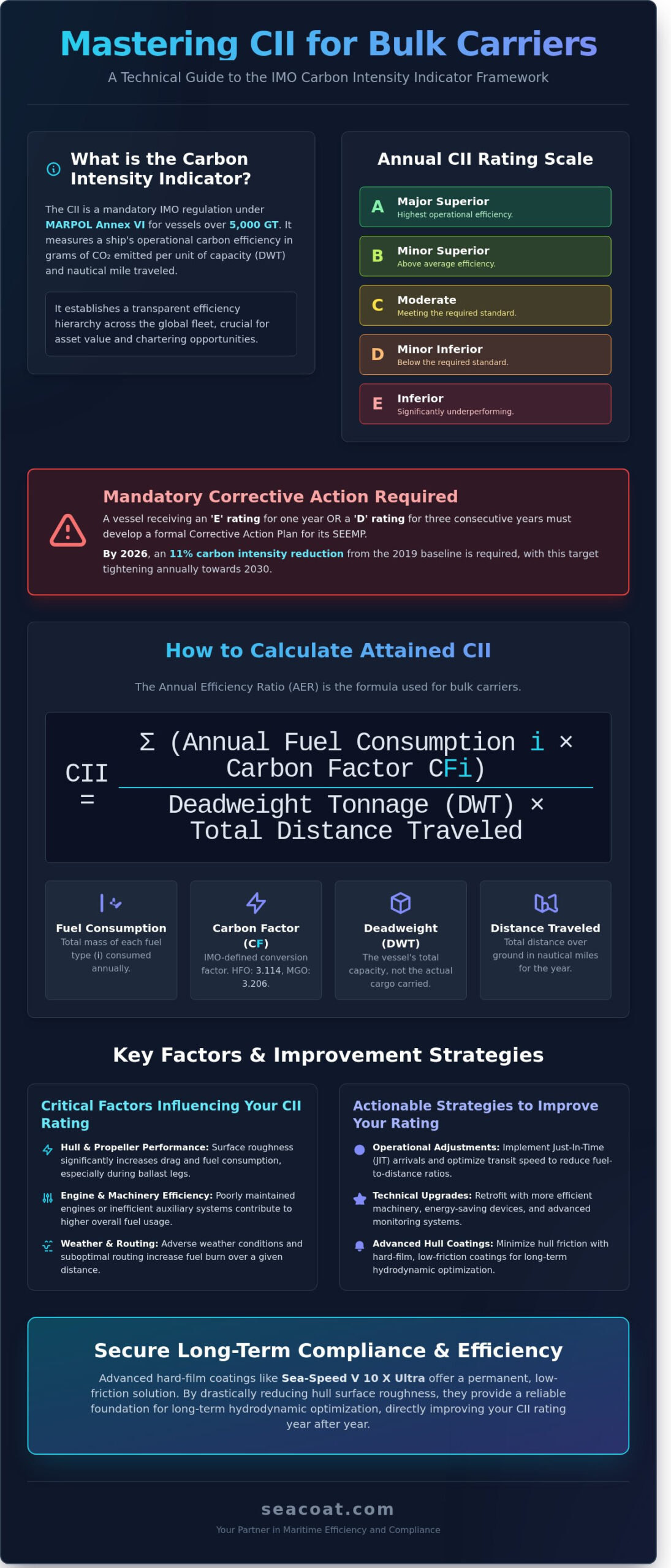
The Carbon Intensity Indicator (CII) represents the IMO’s primary mechanism for regulating the operational efficiency of existing ships. It measures the grams of CO2 emitted per unit of deadweight capacity and nautical mile. For the bulk carrier sector, this isn’t a voluntary benchmark but a mandatory requirement under MARPOL Annex VI. Every bulk carrier above 5,000 gross tonnage (GT) must now document its performance to maintain its license to operate. The system assigns an annual grade ranging from A (major superior) to E (inferior performance), creating a transparent hierarchy of efficiency across the global fleet.
Compliance carries significant operational weight and affects the long-term viability of the asset. A vessel that receives an E rating in a single year, or a D rating for three consecutive years, triggers a mandatory corrective action plan. This plan must be integrated into the Ship Energy Efficiency Management Plan (SEEMP) Part III and approved by the relevant administration or recognized organization. The objective is clear: operators must demonstrate a verified pathway to returning the vessel to a C rating or better. Failing to address these performance gaps doesn’t just impact the environment; it leads to restricted chartering opportunities and diminished asset value in a market that increasingly prioritizes green credentials.
The 2026 Regulatory Landscape
The IMO’s roadmap involves a tightening of reduction factors that leave little room for technical stagnation. By 2026, the required reduction in carbon intensity will reach 11% compared to the 2019 baseline. This trajectory continues toward a 40% reduction target by 2030. Data for these assessments is pulled directly from the IMO Data Collection System (DCS), which tracks fuel oil consumption and distance traveled. Bulk carriers are especially sensitive to these metrics because their duty cycles often involve extended periods of idling or ballast legs, which can degrade the rating if the hull isn’t hydrodynamically optimized to reduce drag.
Key Metrics: AER vs. EEOI
When calculating CII rating for bulk carriers, the industry relies on the Annual Efficiency Ratio (AER). It’s important to distinguish this from the Energy Efficiency Operational Indicator (EEOI). While EEOI calculates efficiency based on the actual cargo transported, AER utilizes the vessel’s total Deadweight Tonnage (DWT). This means the rating is influenced by the ship’s maximum capacity rather than its specific utilization rate on a given voyage. Because calculating CII rating for bulk carriers via AER penalizes vessels for time spent without cargo, maintaining a low-friction hull surface is the most reliable way to offset the carbon costs of ballast voyages and port delays.
Step-by-Step: How to Calculate the Attained CII for a Bulk Carrier
The standardized methodology for calculating CII rating for bulk carriers follows a rigorous framework established by the IMO to ensure transparency across the global fleet. This calculation isn’t a subjective exercise; it’s a technical audit of a vessel’s operational efficiency over a full calendar year. The process requires high-precision data from the engine room and bridge logs to ensure the final value reflects actual performance rather than estimates.
- Step 1: Aggregate total annual fuel consumption by fuel type. This includes all fuel consumed for propulsion and auxiliary power, categorized into grades like Heavy Fuel Oil (HFO), Marine Gas Oil (MGO), or Liquefied Natural Gas (LNG).
- Step 2: Convert fuel mass to CO2 mass. You must use the IMO-defined carbon conversion factors (Cf) found in MEPC.245(66). For example, HFO uses a factor of 3.114, while MGO is calculated at 3.206.
- Step 3: Determine total distance traveled. This figure is the distance over ground in nautical miles, typically verified via GPS data and noon reports.
- Step 4: Identify the vessel’s capacity. For bulk carriers, the IMO mandates using Deadweight Tonnage (DWT) as the capacity metric.
- Step 5: Apply the AER formula. The result is your attained CII value, expressed in grams of CO2 per DWT-mile.
The AER Formula Breakdown
The Annual Efficiency Ratio (AER) serves as the foundation for the CII metric. The mathematical representation is CII = (Fuel Consumption × Cf) / (DWT × Distance). Bulk carriers use DWT as a constant in the denominator, which assumes the vessel is fully loaded at all times. This simplifies global reporting but places a heavy emphasis on hydrodynamic efficiency. Since the DWT and distance are largely fixed by trade routes and vessel design, the primary variable you can control is fuel consumption. A critical step when calculating CII rating for bulk carriers involves precise fuel mass measurements, as even a 1% error in flow meter calibration can shift a vessel from a B rating to a C rating.
Data Integrity and Verification
Reliability in your results depends on the synergy between noon reports and automated monitoring systems. Discrepancies often arise from inaccurate distance calculations, where log speed is used instead of ground speed, potentially skewing results by 3% to 5%. Third-party verification is mandatory for IMO Data Collection System (DCS) submissions. To ensure compliance and optimize your score, it’s vital to address the underlying causes of fuel overconsumption. Implementing advanced foul release technology reduces the frictional resistance that forces engines to work harder. Verified data shows that maintaining a smooth, low-friction hull surface is the most effective way to lower the numerator in the AER equation without reducing operational speed.
Factors Influencing Bulk Carrier CII Ratings
Calculating CII rating for bulk carriers requires a precise understanding of how operational choices and technical specifications intersect. Speed is the most significant operational lever. Because fuel consumption follows a non-linear relationship with velocity, reducing speed by 10% can yield a 20% to 30% reduction in fuel consumption. This directly lowers the numerator in the CII equation. However, long port stays can negatively skew these results. While a vessel is at anchor or berth, it consumes auxiliary fuel for power and climate control without adding to the distance traveled. This stagnant period increases the carbon intensity per mile for the reporting period.
Technical variables provide the foundation for efficiency. Modern bulkers utilize waste heat recovery systems to capture thermal energy from exhaust gases, repurposing it for shipboard heating or electricity. This reduces the load on auxiliary engines. The ballast-to-laden ratio also presents a unique challenge for bulk carriers. These vessels often perform long ballast voyages after discharging cargo. Because the CII formula uses Deadweight Tonnage (DWT) as a proxy for capacity, these empty legs can actually benefit the rating if the vessel maintains a high distance-to-fuel ratio, though they represent lower economic utility. To ensure fairness, the IMO’s G5 guidelines offer correction factors for specific scenarios. These include allowances for ice-class vessels or energy-intensive equipment like self-unloading gear and refrigerated containers.
The Role of Frictional Drag
Hydrodynamic performance is a primary driver of vessel efficiency. Hull fouling increases surface roughness, which directly elevates frictional drag. Data suggests that a 10-micron increase in average hull roughness can result in a 1% increase in fuel consumption. Bulk carriers are especially susceptible to biofouling because they often wait in nutrient-rich coastal waters for berth availability. When a hull’s surface degrades, the engine must work harder to maintain speed, causing CO2 emissions to spike. Utilizing biocide-free, siloxane-based foul release coatings maintains a smooth, low-energy surface. This technology prevents the attachment of marine organisms, ensuring the vessel’s hydrodynamic profile remains optimized throughout its five-year service interval.
Environmental and External Factors
External conditions like sea state and wind significantly impact the attained CII. Heavy weather can increase resistance, forcing a vessel to consume 15% more fuel just to maintain its schedule. Route optimization software helps masters identify paths with favorable currents and minimal wave resistance, protecting the rating from environmental volatility. Vessel managers also focus on emissions at berth. Implementing cold ironing, or shore-to-ship power, allows the vessel to shut down auxiliary engines entirely. This elimination of port-side emissions is a critical strategy when calculating CII rating for bulk carriers, as it prevents the annual carbon total from being inflated by necessary operational delays.
Operational and Technical Strategies to Improve CII Ratings
Compliance is not a static achievement. When calculating CII rating for bulk carriers, operators quickly realize that technical efficiency and operational behavior are inextricably linked. Improving a vessel’s grade requires a dual-track approach that targets both how the ship is sailed and how its submerged surfaces interact with the marine environment. Just-In-Time (JIT) arrivals represent a critical operational shift. By coordinating with port authorities to adjust speed based on berth availability, vessels minimize time spent at anchorage. This reduces idling fuel consumption, which is vital because the CII formula penalizes fuel burned while the vessel isn’t moving.
Slow steaming remains the most effective immediate lever for emission mitigation. Reducing transit speed by 10% can lead to a 20% to 27% reduction in fuel consumption. This optimization of the fuel-to-distance ratio directly improves the annual carbon intensity metric. However, operational changes alone may not be enough for older bulkers to maintain a ‘C’ rating or better as the IMO thresholds tighten annually through 2030.
Hydrodynamic Optimization
Hull condition is the primary variable in hydrodynamic resistance. Traditional ablative paints rely on the controlled erosion of biocides to prevent fouling. This chemical process creates a micro-rough surface that increases drag over the lifespan of the coating. In contrast, permanent foul release systems utilize low-energy siloxane chemistry to create a smooth, hydrophobic barrier. Understanding the science of hull paint reveals that maintaining a low Average Hull Roughness (AHR) can reduce power requirements by 6% to 12% compared to standard anti-fouling. These coatings don’t leach toxins, aligning regulatory compliance with environmental stewardship.
Energy-saving devices (ESDs) provide additional technical gains. Hardware modifications like Mewis ducts or propeller boss fin caps optimize wake flow and reduce turbulence. These devices typically offer a 3% to 8% gain in propulsion efficiency. When integrated with a high-performance coating, the cumulative impact can prevent a vessel from slipping into ‘D’ or ‘E’ categories.
Fleet Management Best Practices
Digital twins provide a virtual model of the vessel to simulate various operational scenarios. This allows shore-side teams to monitor the calculating CII rating for bulk carriers in real-time rather than waiting for end-of-year data aggregates. Crew training is equally essential. Small adjustments in auxiliary engine usage and boiler management can trim daily fuel oil consumption by 2% to 5%. Strategic alignment between EEXI hardware limitations and CII operational profiles ensures that the vessel remains a viable asset throughout its 10-year dry-dock cycle. Decisions made today regarding surface coatings and monitoring systems will dictate the commercial viability of the fleet for the next decade.
Leveraging Sea-Speed V 10 X Ultra for Long-term CII Compliance
Optimizing the hydrodynamic efficiency of a vessel is one of the most effective ways to influence the variables used when calculating CII rating for bulk carriers. Sea-Speed V 10 X Ultra offers a permanent, non-ablative siloxane solution that fundamentally changes hull performance. Unlike traditional self-polishing copolymers (SPC) that rely on the controlled depletion of biocides, this hard-film coating creates an ultra-smooth, low-friction surface. This technical shift minimizes hull roughness, which is a primary driver of parasitic drag and increased fuel consumption.
Sustainability is integrated into the chemical formulation. Sea-Speed V 10 X Ultra is 100% biocide-free and contains zero Volatile Organic Compounds (VOCs). It doesn’t leach heavy metals or toxic chemicals into marine ecosystems, ensuring compliance with tightening global environmental standards. By maintaining a lower coefficient of friction over the life of the vessel, operators can achieve a sustained reduction in the Annual Efficiency Ratio (AER), preventing the gradual rating degradation common with depleting coatings.
Hard Film Durability and Maintenance
The durability of a hard-film coating provides a distinct advantage over soft silicone or ablative alternatives. Sea-Speed V 10 X Ultra is engineered for a 10-year life cycle, which significantly extends the intervals between full hull applications. This longevity reduces dry-docking costs and ensures that the vessel maintains its peak efficiency rating year after year. For more on how these technologies align with the regulatory landscape, see the latest updates on environmental marine coatings.
Maintenance is simplified through high-pressure water cleaning or specialized in-water scrubbing. The coating’s physical hardness allows for frequent cleaning without damaging the film or releasing toxins into the water column. This capability is vital for bulk carriers operating in high-fouling regions, as it allows the crew to maintain a clean hull and a favorable CII score without the need for premature recoating.
The ROI of Premium Coatings
While the initial investment in a premium siloxane coating is higher than standard anti-foulants, the long-term ROI is driven by substantial fuel and carbon savings. When calculating CII rating for bulk carriers, even a 5% reduction in drag can be the difference between a C and a D rating. Real-world applications on large bulkers have demonstrated fuel savings ranging from 6% to 12% depending on the vessel’s operational profile and previous hull condition.
- Reduces fuel consumption through superior hydrodynamic smoothness.
- Eliminates the need for biocide-related regulatory documentation.
- Extends asset life by providing a permanent barrier against corrosion.
- Lowers total cost of ownership by reducing hull maintenance frequency.
SeaCoat provides technical support to help fleet managers quantify these improvements. Contact Seacoat today for a custom CII impact assessment to determine how Sea-Speed V 10 X Ultra can secure your fleet’s regulatory future.
Securing Long-Term Efficiency Through Technical Optimization
Mastering the process of calculating CII rating for bulk carriers is now a core operational requirement for vessel owners facing rigorous IMO mandates. Success depends on a dual approach that combines precise data monitoring with strategic hardware upgrades. By addressing hydrodynamic drag through advanced hull coatings, operators can achieve quantifiable gains in fuel efficiency and carbon intensity metrics. This transition from reactive maintenance to proactive performance management is essential for maintaining a competitive edge in a decarbonizing market.
Sea-Speed V 10 X Ultra utilizes Silane-Siloxane technology that’s been field-proven since 2001 to deliver superior foul release properties. This specialized chemistry is documented to provide up to a 12% reduction in fuel consumption, directly improving your attained CII. Unlike traditional biocidal coatings that require frequent reapplication, this system provides a 10-year life cycle warranty. It’s a strategic asset that transforms hull maintenance into a long-term performance advantage.
Request a technical consultation on how Sea-Speed can improve your fleet’s CII rating to begin optimizing your vessel’s environmental and economic trajectory. We’re ready to help you navigate these regulatory requirements with scientific precision.
Frequently Asked Questions
What is the difference between EEXI and CII for bulk carriers?
EEXI (Energy Efficiency Existing Ship Index) is a one-time technical certification measuring a vessel’s design efficiency, while the Carbon Intensity Indicator (CII) is an annual operational rating based on actual emissions. EEXI focuses on how the ship’s built, but CII evaluates how you operate it. This means a bulk carrier with a high EEXI score can still receive a low CII rating if it’s managed inefficiently. It’s a distinction between hardware and behavior.
Can a bulk carrier improve its CII rating without modifying the engine?
You can improve your rating by optimizing hydrodynamic performance through advanced hull coatings like siloxane-based foul release systems. These non-toxic coatings reduce frictional drag by 10% or more, which directly lowers fuel consumption. When calculating CII rating for bulk carriers, reducing drag is a strategic way to maintain compliance without the capital expenditure of engine derating or installing hardware like Mewis ducts. It’s a reliable method for long-term ROI.
How does port waiting time affect my vessel’s CII rating?
Port waiting time negatively impacts your CII because the vessel continues to emit CO2 while stationary, which reduces the distance traveled in the CII formula. In 2023, data showed that extended idling can degrade a rating from a B to a C within a single month. Because the calculation is based on grams of CO2 per deadweight-ton mile, idle time increases the numerator while the denominator remains stagnant. It’s a logistical challenge for bulk fleets.
What happens if my bulk carrier receives an E rating in 2026?
If your bulk carrier receives an E rating in 2026, you’re required to develop a corrective action plan and include it in your Ship Energy Efficiency Management Plan (SEEMP) Part III. This plan must outline the specific operational or technical measures you’ll implement to achieve a C rating or higher. Failure to demonstrate these improvements can result in the loss of your Statement of Compliance. This restricts your ability to trade in international waters.
Are there any correction factors available for bulk carriers in heavy weather?
The IMO provides specific correction factors for adverse weather conditions under the MEPC.352(78) guidelines to account for increased fuel consumption. These formulas allow owners to subtract specific emissions caused by sea states exceeding Beaufort Scale 6. Utilizing these corrections is essential when calculating CII rating for bulk carriers operating on North Atlantic or North Pacific routes where heavy weather occurs during 30% of annual voyages. It ensures the data reflects true efficiency.
How often is the CII rating recalculated?
The CII rating is recalculated every calendar year based on the previous 12 months of operational data. You must report your fuel oil consumption data to the IMO Data Collection System by March 31 of each following year. This annual cycle creates a continuous performance loop, requiring shipowners to monitor their hydrodynamic efficiency and operational patterns daily. It prevents year-end surprises in your rating and ensures you remain compliant with the 2% annual reduction target.
Does using biofuels improve my CII rating?
Using biofuels improves your CII rating because sustainable fuels have a lower carbon conversion factor (Cf) than traditional heavy fuel oil. For example, a B30 biodiesel blend can reduce the calculated CO2 emissions by approximately 25% compared to standard VLSFO. This reduction directly lowers the numerator in the CII equation. It’s an effective bridge technology for vessels that can’t undergo immediate structural retrofits to reach compliance. It serves as a strategic asset for fleet management.
Is the CII rating public information for charterers?
The IMO doesn’t currently publish individual vessel ratings in a public database, but this information is increasingly accessible through commercial platforms and chartering requirements. Major charterers now include CII performance clauses in 85% of new time-charter agreements to ensure they meet their own Scope 3 emission targets. While the regulatory data is private, market transparency means a poor rating will likely impact your vessel’s commercial viability and freight rates. Transparency is the new industry standard.