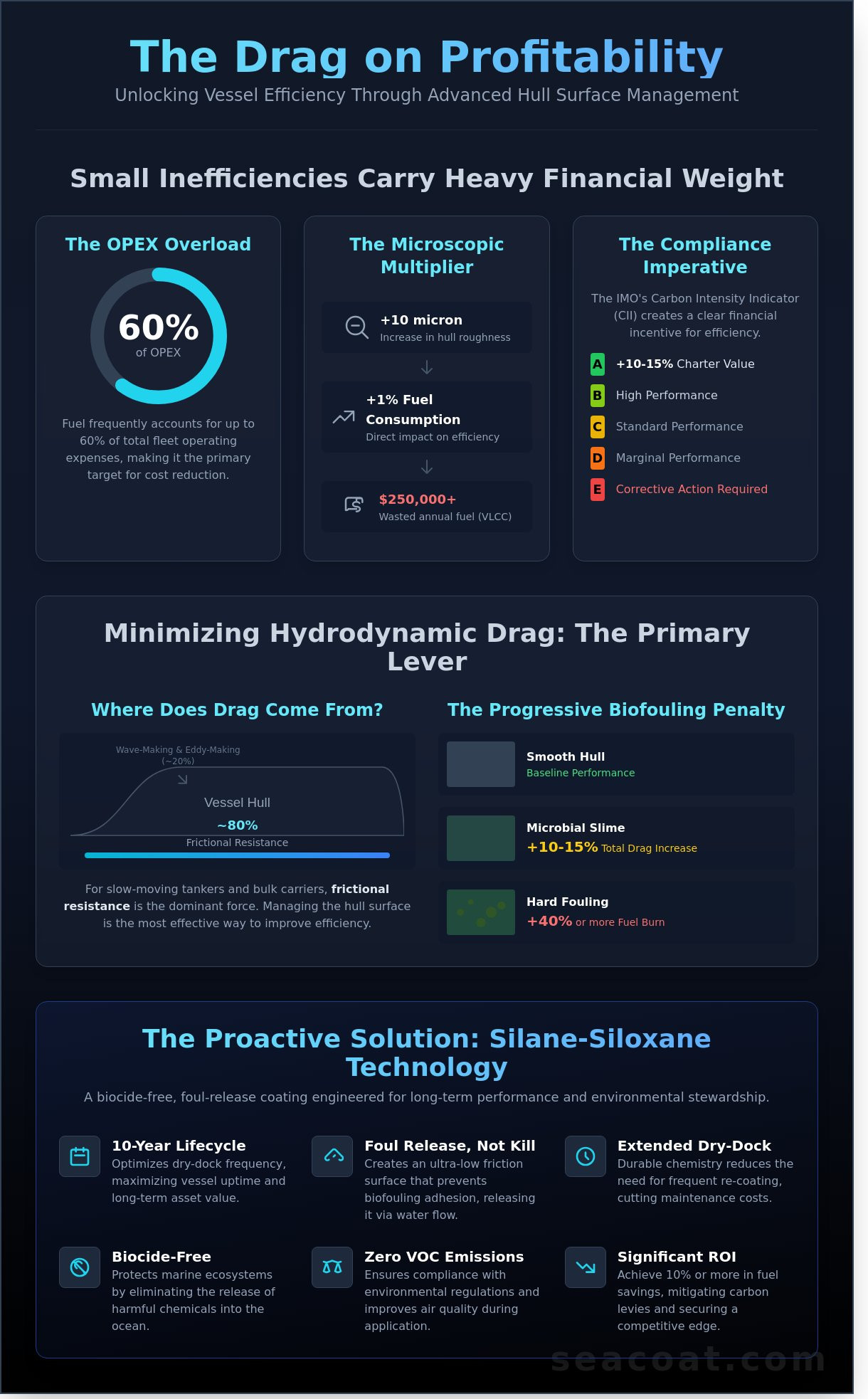
A 10-micron increase in average hull surface roughness can trigger a 1% rise in fuel consumption; for a standard VLCC, this translates to over $250,000 in wasted annual fuel expenditure. You’re likely feeling the pressure of these mounting operational costs alongside the rigid EEXI and CII compliance deadlines. Understanding how to improve vessel efficiency is no longer a matter of routine maintenance; it’s a strategic necessity for fleet survival and long-term asset value.
You’ll discover the technical levers and hydrodynamic strategies required to reduce fuel consumption by 10% or more while ensuring your assets meet international environmental standards. This guide details the transition toward siloxane-based, biocide-free foul release coatings that offer a 10-year lifecycle and zero VOC emissions. We’ll explore the scientific correlation between surface topography and drag reduction, providing a clear roadmap for optimizing long-term vessel performance and extending dry-dock intervals through precise chemical engineering. By shifting from reactive cleaning to proactive surface management, you can mitigate performance degradation and secure a significant return on investment.
Key Takeaways
- Analyze how the IMO’s Carbon Intensity Indicator (CII) is redefining operational profiles and the necessity of aligning energy input with transport work.
- Master the science of hydrodynamic drag to understand how to improve vessel efficiency by targeting frictional resistance as the primary lever for fuel reduction.
- Compare the long-term ROI of mechanical retrofits against advanced foul-release coatings to prioritize high-impact efficiency technologies beyond engine upgrades.
- Implement a rigorous 5-step framework for monitoring performance baselines and quantifying hull roughness through advanced underwater assessment techniques.
- Discover how silane-siloxane technology offers a biocide-free, 10-year solution that optimizes both dry-dock frequency and environmental stewardship.
Understanding the Drivers of Vessel Efficiency in 2026
Vessel efficiency is the fundamental ratio of energy input to transport work performed. In the current maritime climate, this isn’t just a performance metric; it’s the baseline for commercial survival. By 2026, the industry has moved beyond simple fuel monitoring toward integrated systems that analyze hydrodynamic drag, engine thermal efficiency, and specialized hull coatings. Fuel remains the largest variable in maritime operating expenses (OPEX), frequently accounting for 50% to 60% of total fleet costs. Managers seeking how to improve vessel efficiency must look toward holistic strategies that combine technical upgrades with rigorous operational data analysis.
A systematic approach to Marine energy management provides the necessary framework for these improvements. It shifts the focus from reactive maintenance to proactive optimization. This methodology allows operators to identify energy leaks in real-time, whether they stem from mechanical degradation or increased hull roughness. By quantifying every kilowatt of energy used against the cargo miles achieved, companies can secure a measurable return on investment for their efficiency technologies.
The Regulatory Landscape: EEXI and CII Compliance
The IMO’s 2026 requirements demand a 2% annual reduction in carbon intensity. The Energy Efficiency Existing Ship Index (EEXI) mandates technical improvements, such as engine power limitations or the installation of energy-saving devices, to meet a specific baseline. Simultaneously, the Carbon Intensity Indicator (CII) ranks vessels from ‘A’ to ‘E’. An ‘A’ rating can increase a vessel’s charter value by 10% to 15%, while ‘E’ rated ships face mandatory corrective action plans and potential bans from major international ports. These regulations make how to improve vessel efficiency a matter of legal and financial necessity.
Economic Impact of Fuel Inefficiency
Small inefficiencies carry heavy financial weight. For a standard Panamax vessel consuming 30 metric tons of Very Low Sulfur Fuel Oil (VLSFO) per day at a price of $650 per ton, a 1% increase in fuel consumption adds $71,175 to annual operating costs. This waste directly correlates with higher greenhouse gas (GHG) emissions, triggering higher costs under the EU Emissions Trading System (ETS). Implementing Vessel Performance Optimization isn’t just an environmental choice; it’s a strategic move to mitigate carbon levies and maintain a competitive edge in a market that rewards high-performing, low-emission assets.
These costs are ultimately passed down through the supply chain, affecting the price of everything from manufactured goods to imported natural produce. For businesses that rely on daily fresh imports, such as suppliers of sugarcane and coconuts, shipping efficiency is paramount. To see an example of how this impacts the fresh food industry, you can find out more.
How to Minimize Hydrodynamic Drag: The Science of Hull Performance
Vessel performance relies on overcoming three distinct forms of resistance: frictional, wave-making, and eddy-making. While wave-making resistance is largely a function of hull form and speed, frictional resistance accounts for up to 80% of the total drag on slow-moving tankers and bulk carriers. To understand how to improve vessel efficiency, operators must prioritize the reduction of this frictional component. While hull design remains static after construction, the surface condition is a dynamic variable. We view surface chemistry as the primary lever for performance optimization. Technical research regarding Hydrodynamic Drag Reduction confirms that managing the interaction between the hull and the fluid boundary layer is essential for sustained fuel conservation.
Surface Roughness and the Boundary Layer
Micro-roughness disrupts the laminar flow of water, creating turbulence within the boundary layer that increases resistance. Every 25-micron increase in average hull roughness correlates to a 1% increase in fuel consumption. Physical roughness often stems from mechanical damage, corrosion, or poor coating application; biological roughness, however, is a constant environmental pressure. Maintaining a low-energy surface profile isn’t just a maintenance task; it’s a strategic necessity for fluid dynamics.
The Biofouling Penalty
Biological growth presents a progressive threat to operational margins. Even a light layer of microbial slime, which may appear negligible during a cursory inspection, can increase total hydrodynamic drag by 10% to 15%. This biofilm acts as a foundation for hard calcareous fouling, such as barnacles or tubeworms, which can spike fuel burn by over 40% in severe cases. When analyzing how to improve vessel efficiency, the transition from reactive cleaning to proactive prevention is vital. For a deeper look at these biological mechanisms, see our guide on [Marine Biofouling: The Problem and Modern Solutions].
Modern fleet managers are moving away from traditional ablative technologies that degrade over time. Utilizing a biocide-free foul release system ensures the hull maintains its “as-applied” smoothness throughout the entire docking cycle. This approach treats the coating as a performance-enhancing asset rather than a simple sacrificial layer. By stabilizing the surface chemistry, you mitigate the long-term degradation of the boundary layer and ensure predictable, high-level performance for ten-year cycles.
Evaluating Efficiency Technologies: Beyond Engine Retrofits
Many operators focus exclusively on the engine room when considering how to improve vessel efficiency. While mechanical upgrades deliver results, they often require capital expenditures that take 5 to 8 years to recoup. Mechanical retrofits like Mewis ducts or bulbous bow optimizations provide 3% to 8% efficiency gains, but they don’t address the root cause of hydrodynamic resistance. High-performance coatings offer a superior ROI by tackling the 60% of total vessel resistance caused by hull friction. Recent data from the IMO suggests that even minor slime layers increase fuel consumption by 9%, making surface management a primary economic lever for any fleet manager.
Propulsion and Engine Optimization
Waste heat recovery systems and engine de-rating for slow steaming are standard tactics for modern fleets. These systems struggle when hull drag is high. A fouled hull forces engines to operate at 15% to 20% higher load ranges to maintain target speed, pushing the machinery out of its optimal fuel consumption curve. Maintaining a clean hull ensures the propeller works in a uniform wake field. This synergy maximizes the impact of energy-saving devices, ensuring that every kilowatt produced translates into forward momentum rather than overcoming preventable drag. When the hull is smooth, the propulsion system operates within its designed efficiency sweet spot.
The principle of tuning an engine’s operational parameters to match its load is universal, extending from massive marine diesels to high-performance automotive engines. Calibrating a vehicle’s computer, for instance, can unlock significant gains in power and efficiency. To see how these principles are applied in the automotive world, you can visit N2 Speed.
Advanced Hull Coatings as a Strategic Asset
Traditional biocidal antifouling relies on the controlled release of toxins like cuprous oxide. This process eventually depletes the paint film and leaves a rough, pitted surface profile that increases drag. Silane-siloxane foul-release systems represent a paradigm shift in marine chemistry. Choosing a coating is a critical decision in how to improve vessel efficiency over a multi-year dry-dock cycle. Unlike soft silicone alternatives that tear during fender impact or ice transit, hard-film foul-release coatings provide the durability needed for 10-year service intervals. These coatings utilize low surface tension to create a slick, hydrophobic barrier. At speeds above 10 knots, hydrodynamic shear forces naturally detach biofouling organisms.
This “self-cleaning” mechanism provides a permanent performance-enhancing tool with zero VOC emissions. It’s a non-toxic approach that treats the hull as a strategic asset rather than a recurring maintenance liability. By maintaining a surface roughness of less than 100 micrometers over the life of the coating, operators can ensure long-term compliance with evolving environmental regulations while significantly reducing the total cost of ownership.
A 5-Step Framework for Optimizing Vessel Performance
Systematic efficiency isn’t achieved through isolated upgrades. It requires a structured transition from reactive maintenance to predictive, data-led management. For operators analyzing how to improve vessel efficiency, this five-step framework provides a roadmap to measurable fuel savings and reduced emissions through technical precision.
Step 1 & 2: Data-Driven Performance Baselines
Accurate benchmarking begins with high-frequency data collection via onboard sensors. Integrating shaft torque meters and Coriolis fuel flow meters allows technical managers to monitor specific fuel oil consumption (SFOC) with 99% accuracy. Relying on manual noon reports or basic visual hull inspections is a mistake. A hull that appears clean to a diver can still harbor micro-roughness; a 10-micron increase in average hull roughness translates to a 1% rise in required power. Modern audits utilize underwater ROVs equipped with laser scanners to quantify these surface deviations. This objective data is essential for calculating ROI on a premium foul release coating from Seacoat SCT, LLC relative to the actual drag penalty of the current system.
Step 3 & 4: Technology and Tactics
Effective coating selection depends on the vessel’s duty cycle. A container ship maintaining 22 knots requires different hydrodynamic properties than a bulk carrier that spends 25% of its time at anchor. Siloxane-based systems provide a low-energy surface that encourages biofouling to release under hydrodynamic shear. Selecting biocide-free, non-leaching systems is a strategic necessity for future-proofing against tightening IMO environmental regulations and potential bans on copper-based paints. These coatings don’t just protect the steel; they serve as a permanent performance asset.
Operational adjustments like trim and draft optimization further refine performance. By adjusting the longitudinal center of buoyancy, crews can reduce wave-making resistance by 3.5% in specific ballast conditions. These small tactical gains, when paired with a high-performance coating, create a compounding effect on total fuel efficiency. Implementing weather routing software also ensures the vessel avoids unnecessary hull stress and resistance from adverse sea states, protecting the integrity of the coating film.
The final step involves shifting to proactive maintenance planning. Instead of waiting for heavy growth to appear, scheduled in-water grooming of hard-film coatings maintains the original surface profile. This approach ensures the vessel operates at peak efficiency throughout its 10-year service life without the performance decay typical of self-polishing antifoulings. For a comprehensive review of your fleet’s hydrodynamic potential, contact the Seacoat SCT, LLC technical team.
Implementing Long-Term Efficiency with Silane-Siloxane Technology
Achieving sustainable maritime operations requires moving beyond temporary fixes. Sea-Speed V 10 X Ultra represents a fundamental shift in marine coating technology by utilizing a biocide-free, silane-siloxane chemistry. Unlike traditional ablative paints that leach heavy metals into the water column, this hard-film foul release solution creates a permanent, non-depleting surface. It offers a 10-year life cycle. This long-term durability effectively doubles the standard interval between major dry-docking events. It’s a strategic choice for operators researching how to improve vessel efficiency while reducing off-hire time and material costs over the life of the asset.
The Sea-Speed Advantage: Performance and Durability
The coating’s primary benefit lies in its superior hydrodynamic properties. It cures to a glass-like finish that significantly minimizes frictional drag. While soft silicone coatings are prone to mechanical damage from fenders or debris, Sea-Speed’s hard-film structure remains resilient. This durability allows for routine in-water cleaning without damaging the film. By maintaining a surface roughness as low as 15 to 20 microns, operators can see consistent improvements in fuel economy and speed-power ratios. These metrics translate directly to lower operational expenses and a more competitive fleet profile.
Environmental Stewardship and Regulatory Compliance
Regulatory pressure from the 2023 IMO Greenhouse Gas Strategy continues to intensify. Seacoat technology provides a clear path for EEXI and CII compliance by lowering the total carbon intensity of the fleet. Because the formula contains zero VOCs and no toxic biocides, it eliminates the risk of chemical leaching in sensitive ports. This non-toxic approach also helps prevent the translocation of invasive aquatic species; the surface is simply too slick for organisms to maintain a permanent bond. Investing in non-toxic coatings provides a reliable ROI by future-proofing vessels against strict antifouling bans. It’s the most effective way to address how to improve vessel efficiency for the next decade of operation. Optimize your fleet’s efficiency with Sea-Speed V 10 X Ultra.
Securing Operational Excellence for the 2026 Maritime Landscape
Optimizing fleet performance in the next decade demands a shift from traditional anti-fouling toward advanced hydrodynamic management. We’ve explored how surface roughness directly impacts fuel consumption and why engine retrofits alone can’t bridge the efficiency gap. By implementing silane-siloxane technology, operators achieve a 10-year life cycle performance that traditional coatings can’t replicate. This approach doesn’t just lower costs; it aligns your fleet with the zero VOC and biocide-free standards that define modern environmental stewardship. Understanding how to improve vessel efficiency is no longer about temporary fixes; it’s about investing in a permanent strategic asset that protects both the hull and the marine ecosystem.
Our technical data shows proven fuel savings for commercial and military fleets through the mitigation of frictional resistance. These results demonstrate that operational reliability and ecological responsibility are synergistic goals. To begin your transition toward a more sustainable and profitable future, contact our technical team for a vessel efficiency audit. Your fleet’s peak performance is within reach.
Frequently Asked Questions
How much fuel can a ship save by improving hull efficiency?
Improving hull efficiency can reduce annual fuel consumption by 10% to 15% depending on the vessel’s specific operational profile. According to the International Maritime Organization (IMO), a slime layer as thin as 0.5 mm can trigger a 25% increase in hydrodynamic drag. Transitioning to high-performance coatings mitigates this friction, directly lowering bunker costs by $500,000 or more for a typical VLCC over a standard sailing year.
What is the difference between antifouling and foul-release coatings?
Traditional antifouling coatings rely on the leaching of biocides like cuprous oxide to kill marine organisms, whereas foul-release coatings use low-surface-energy polymers to prevent attachment. Siloxane-based foul-release systems create a surface so smooth that organisms are shed by hydrodynamic shear once the vessel reaches speeds of 10 knots. This mechanical approach eliminates the 5% to 8% annual degradation in performance typically seen with self-polishing copolymers.
How does hull roughness affect vessel speed and fuel consumption?
Every 10 microns of average hull roughness correlates to a 1% increase in required propulsion power to maintain speed. Understanding how to improve vessel efficiency requires addressing both macro-roughness from biofouling and micro-roughness from poor coating application. Vessels with a Roughness Allowance exceeding 150 microns often experience a 4% loss in speed at a constant power setting, leading to significant schedule delays and increased emissions.
Can hull coatings help with CII and EEXI compliance?
Advanced coatings are a primary lever for improving a vessel’s Carbon Intensity Indicator (CII) rating by reducing carbon emissions by up to 8% annually. Since the EEXI and CII regulations took effect in January 2023, shipowners have used foul-release technology to bridge the efficiency gap without installing expensive hardware. Maintaining a smooth hull ensures a vessel stays in the “C” rating category or higher, avoiding mandatory corrective action plans.
What is the typical ROI for an advanced marine coating?
Most shipowners realize a full return on investment for advanced siloxane coatings within 12 to 18 months of application. While the initial capital expenditure is 20% higher than conventional paints, the 10-year life cycle eliminates the need for full reapplications during intermediate dry-dockings. By reducing fuel spend by $2,000 per day, a single container ship can save over $700,000 annually, making the coating a high-yield strategic asset.
Are non-toxic marine coatings as effective as traditional ones?
Modern non-toxic coatings outperform traditional biocidal paints by providing a harder, more durable surface that resists mechanical damage. SeaCoat’s siloxane technology maintains a 95% efficiency rating over a five-year period, whereas biocidal coatings lose effectiveness as their active ingredients leach away. These zero-VOC formulations provide superior protection against barnacles and tubeworms without the 2% annual increase in drag common with ablative copper-based products.
How often should a vessel’s hull be cleaned to maintain efficiency?
Vessels using advanced foul-release systems typically require underwater inspections every 6 to 12 months, though they need physical cleaning less frequently than biocidal hulls. If slime accumulation occurs during long idle periods, a gentle cleaning with soft brushes or ROVs restores the surface to its original hydrodynamic state. Implementing a proactive grooming schedule prevents the 10% fuel penalty associated with light calcareous fouling and extends the coating’s service life.
What are the environmental benefits of using biocide-free coatings?
Biocide-free coatings prevent the leaching of heavy metals like copper and zinc into sensitive marine ecosystems, protecting 100% of local biodiversity. Beyond toxicity, these coatings reduce a fleet’s carbon footprint by roughly 10% through optimized fuel efficiency. By choosing siloxane-based solutions, operators eliminate the release of harmful microplastics and chemical runoff, aligning their operations with the 2050 IMO greenhouse gas reduction targets and corporate ESG mandates.