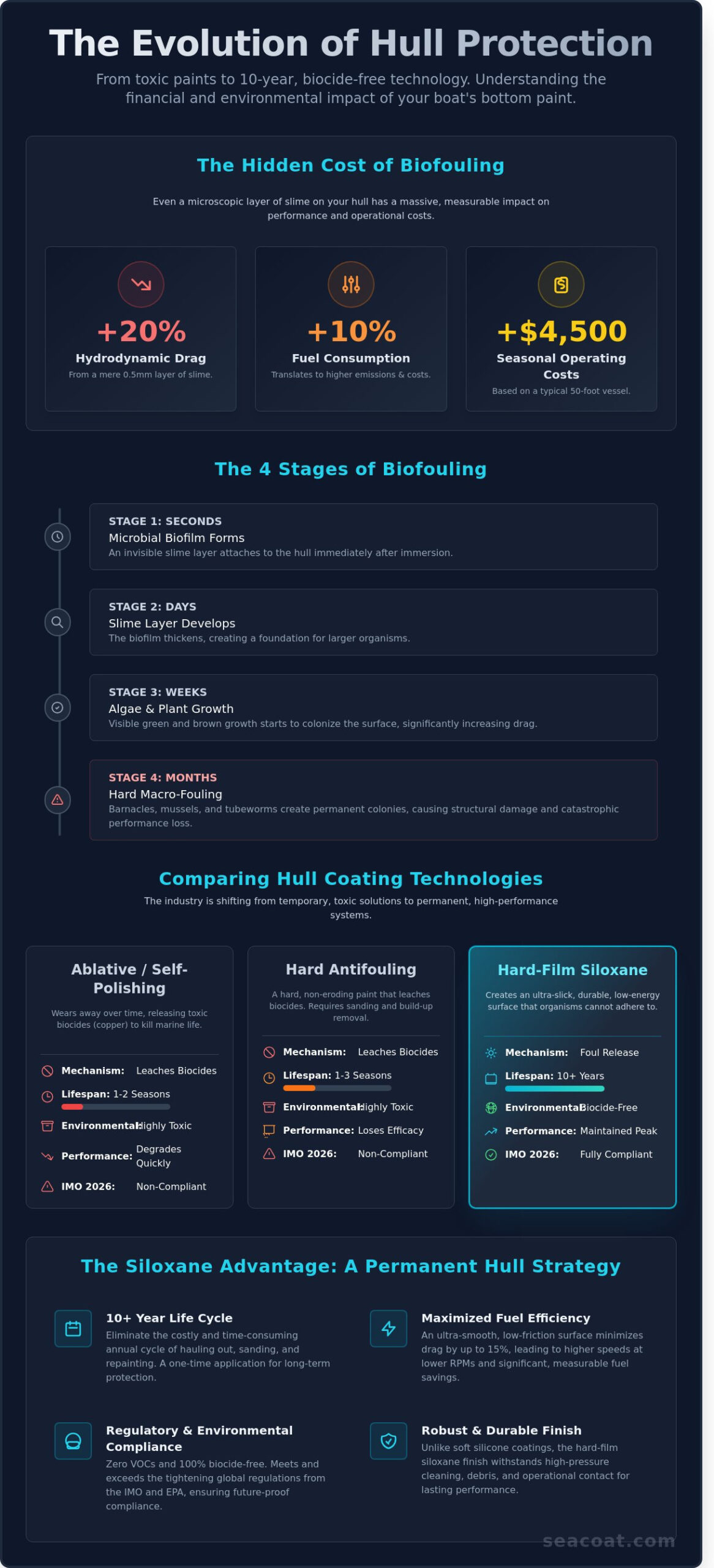
Did you know that a mere 0.5 millimeter layer of biofouling on your hull can increase hydrodynamic drag by up to 20 percent? For a 50 foot vessel, this translates to a 10 percent spike in fuel consumption and over $4,500 in additional seasonal operating costs. Selecting the right bottom paint boat system is no longer just about aesthetics; it’s a critical financial and environmental decision. We understand the frustration of the annual haul-out cycle and the mounting pressure of the 2026 IMO regulations on copper-based biocides. It’s a high-stakes environment where traditional methods often fail to meet modern performance standards.
You’ll master the technical and economic factors of marine hull protection to choose a system that maximizes speed, saves fuel, and protects the ocean. We provide a deep dive into the chemistry of biocide-free siloxane coatings, the economics of 10 year protection cycles, and the specific data points required for regulatory compliance. This guide examines the transition from abrasive antifouling to sophisticated foul release technology to ensure your vessel remains a high performing asset with a zero VOC footprint for the next decade.
Key Takeaways
- Understand the progression of marine biofouling and how selecting the right barrier prevents microbial biofilms from evolving into drag-inducing macro-fouling.
- Determine the most effective bottom paint boat configuration by comparing the durability of hard coatings against the self-polishing mechanisms of ablative paints.
- Discover the shift from traditional copper-based toxins to biocide-free foul release chemistry, ensuring regulatory compliance while preserving marine ecosystems.
- Learn how minimizing hull surface roughness directly translates to reduced engine load, higher knots at lower RPMs, and measurable fuel savings.
- Identify the strategic benefits of hard-film siloxane systems that provide a ten-year life cycle and withstand high-pressure cleaning for a permanent hull protection strategy.
Understanding Bottom Paint: Why Your Boat Hull Needs Protection
Bottom paint boat protection is no longer just a seasonal maintenance task; it’s a strategic necessity for vessel longevity. In its most technical sense, bottom paint acts as a specialized barrier designed to mitigate the colonization of marine organisms on submerged surfaces. This protection traditionally relies on either biocidal antifouling, which leaches toxins to kill organisms, or foul-release technology, which creates a low-friction surface that prevents attachment. Understanding the history of antifouling paint reveals a shift from toxic heavy metals to the advanced, biocide-free siloxane coatings that define the industry in 2026. Global regulatory bodies, including the IMO and EU REACH, have accelerated restrictions on copper and cybutryne, forcing a transition toward more sustainable, high-performance chemistries.
Biofouling begins within seconds of immersion as a microbial biofilm, or slime, forms on the hull. This microscopic layer creates a foundation for macro-fouling, where larger organisms like barnacles and mussels establish permanent colonies. If left untreated, these organisms compromise the hull’s integrity. They can lead to osmotic blistering, a process where water penetrates the gel coat and causes structural delamination. By 2026, global regulations like the IMO’s revised Biofouling Guidelines have made effective coating systems mandatory for port entry in many jurisdictions. Neglecting this layer doesn’t just slow the boat; it leads to permanent structural degradation that can devalue a vessel by 30% over a five-year period.
The Three Pillars of Hull Protection
- Physical protection: Creating a non-permeable layer prevents water ingress and osmotic blistering, which can extend a hull’s service life by up to 15 years.
- Fouling control: Systems must inhibit the settlement of marine larvae through chemical or mechanical means to prevent hard growth.
- Hydrodynamic efficiency: Maintaining an ultra-smooth surface minimizes skin friction, allowing the vessel to move through the water with minimal resistance.
Biofouling and Its Economic Impact
The financial cost of a neglected hull is immediate and measurable. Data from maritime researchers indicates that even a thin 1 millimeter layer of slime can increase fuel consumption by up to 10% due to added drag. Heavy calcareous growth can spike fuel costs by 40% or more. Beyond fuel, port authorities now enforce strict clean hull policies to prevent the transfer of invasive species across ecosystems. Biofouling is the biological colonization of submerged surfaces that compromises vessel performance.
Antifouling vs. Foul Release: The Shift Toward Non-Toxic Chemistry
For decades, the maritime industry relied on sacrificial coatings to manage hull biofouling. These traditional antifouling paints function by leaching heavy metals, primarily copper, into the water column to poison settling organisms. It’s a process that’s inherently unsustainable; the coating eventually depletes its biocide, loses effectiveness, and leaves behind a depleted, rough surface. By 2026, the transition toward foul release technology has become a strategic necessity for vessel owners. Unlike a traditional bottom paint boat solution, foul release coatings don’t use poisons. Instead, they utilize advanced surface chemistry to create a finish so slick that barnacles, algae, and biofilm cannot maintain a physical bond.
The Science of Silane-Siloxane Coatings
Silane-Siloxane technology represents the pinnacle of modern marine chemistry. These coatings create a low-surface-energy environment at a molecular level. While early foul release systems used soft silicones that were easily damaged by debris or pier contact, siloxane creates a robust, hard-film finish. This molecular structure provides the durability required for vessels traveling at 30 knots or commercial fleets with high operational tempos. The result is a hydrodynamic surface that reduces drag by up to 15%, which directly lowers fuel consumption and carbon emissions. It’s a permanent performance upgrade rather than a temporary chemical barrier.
Regulatory Compliance and the Biocide Ban
Global oversight is tightening as the environmental impact of heavy metals becomes undeniable. Organizations like the IMO and EPA are moving toward biocide-free waters to protect sensitive marine ecosystems from toxic accumulation. Understanding the evolution of environmental regulations on boat paint is critical for fleet managers who want to avoid the costs of future retrofitting. SeaCoat’s Zero VOC (Volatile Organic Compounds) formulations eliminate the release of harmful vapors, which improves shipyard safety and simplifies regulatory compliance. These coatings are engineered to exceed the 2026 standards, offering a 10-year service life that traditional copper paints cannot match.
Don’t confuse “non-toxic” with “non-effective.” The data shows that siloxane systems often outperform biocide-based paints in long-term fouling resistance. While copper paints lose potency as they leach, a foul release surface remains active as long as the film is intact. It’s a strategic asset for vessel management that prioritizes longevity and intelligence. You can evaluate our performance metrics to see how these hard-film systems maintain hull efficiency over a decade of continuous submersion.
Comparing Paint Types: Ablative, Hard, and Hard-Film Siloxane
Traditional bottom paint boat technology relies on controlled chemical leaching. Ablative paints, often categorized as self-polishing copolymers, function by eroding their surface as the vessel moves through the water. This mechanical wear ensures a fresh layer of biocide is always exposed, but it limits the coating’s functional lifespan to 12 or 24 months. Once the film thickness reaches zero, the hull loses all protection.
Hard antifouling coatings offer a different trade-off. These products use a high concentration of cuprous oxide held within a porous resin. They don’t wear away, making them ideal for high-speed vessels or trailered boats that face frequent abrasion. The problem lies in the spent resin “skeleton” left behind. As the biocides leach out, a brittle, cratered surface remains, requiring heavy sanding before any new application.
Recent shifts in marine chemistry have introduced hard-film siloxane systems like Sea-Speed V 10 X Ultra. Unlike soft silicone coatings, which are notorious for tearing upon contact with dock pilings or debris, hard-film siloxanes are physically robust. They provide a non-stick, low-energy surface that prevents organisms from forming a permanent bond. This technology moves away from “killing” marine life and toward a “foul release” mechanism that optimizes hydrodynamic efficiency.
Maintenance Cycles and Longevity
The operational gap between technologies is vast. While ablative paints require haul-outs every 18 months, Sea-Speed V 10 X Ultra is engineered for a 10-year lifecycle. Because it’s biocide-free, it allows for frequent in-water cleaning. Divers can scrub the hull without releasing heavy metals into the ecosystem. To identify your current bottom paint boat system, perform a “rub test.” If the color transfers to your hand, it’s ablative. If the surface is hard but chalky, it’s a traditional epoxy-based hard paint.
The “Paint Buildup” Trap
Traditional maintenance involves adding new layers of paint over old ones. This creates a cumulative weight gain and extreme surface roughness. Data from the International Maritime Organization (IMO) suggests that hull roughness alone can increase fuel consumption by 10% to 40%. Eventually, the paint layers become too thick and begin to delaminate. At this stage, the owner faces a mandatory “strip to gelcoat” procedure. In 2024, professional abrasive blasting and hull stripping costs average $150 to $250 per linear foot. Hard-film systems eliminate this recurring expense because they don’t require annual re-coating or build up over time.
The Economic Impact: How Bottom Paint Affects Speed and Fuel Efficiency
Hydrodynamic efficiency begins at the microscopic level, where Average Hull Roughness (AHR) dictates the behavior of the boundary layer. When selecting a bottom paint boat owners must consider that a surface measuring 300 microns in roughness generates substantially more frictional resistance than a precision-engineered surface at 100 microns. This friction forces the propulsion system to work harder to overcome drag, which increases engine load and thermal stress. A slicker hull profile allows a vessel to achieve higher knots at lower RPMs, effectively optimizing the power-to-speed ratio for long-term operational health and mechanical longevity.
Calculating Your Fuel ROI
Estimating your financial return requires a look at annual engine hours and fuel burn rates. For a motor yacht operating 250 hours annually with a 20 gallon-per-hour burn, a drag-optimized coating yields immediate dividends. A 10% reduction in drag can result in a 5-12% reduction in annual fuel expenditure. Performance sailboats also see a “speed gain” factor, where reduced skin friction allows for better acceleration in light air and more efficient pointing angles during upwind legs. These marginal gains accumulate into significant competitive advantages and cost reductions over a single season.
Reducing Dry-Dock and Maintenance Costs
The traditional biennial haul-out schedule represents a major recurring expense for any fleet. By utilizing advanced siloxane-based coatings, operators can extend these intervals from the standard 24 months to 120 months. This transition eliminates four entire dry-dock cycles over a decade, saving a 60-foot vessel owner approximately $22,000 in labor, materials, and lost operational time. Because these coatings create a low-energy surface, biofouling can’t form a permanent bond. Cleaning becomes a non-abrasive process that preserves the integrity of the bottom paint boat surface rather than requiring aggressive, destructive scraping that shortens the life of the substrate.
Implementing a Long-Term Hull Strategy with Sea-Speed V 10 X Ultra
Sea-Speed V 10 X Ultra represents the definitive evolution of silane-siloxane technology. It isn’t a temporary fix; it’s a permanent hydrodynamic solution designed for the rigorous demands of 2026. While traditional bottom paint boat options rely on ablative leaching, this technology creates a non-migratory, non-stick surface that optimizes vessel efficiency through advanced molecular engineering.
The “Hard-Film” advantage is central to this durability. Unlike soft coatings that erode over time, Sea-Speed provides a rigid barrier that withstands physical stressors. It remains intact during accidental groundings on sand or silt and handles high-pressure cleaning up to 2,500 PSI without degradation. This resilience transforms the hull from a maintenance liability into a high-performance surface that doesn’t require annual repainting.
Achieving a permanent bond requires a systematic approach. Seapoxy 73 serves as the critical primer, creating a high-build, corrosion-resistant foundation. This epoxy-polyamide bridge ensures the siloxane topcoat adheres at a molecular level. Without this specific chemistry, the system can’t reach its full 10-year potential. This transition moves vessel owners away from recurring maintenance headaches and toward a strategic asset management model where fuel savings and hull integrity are the primary metrics.
The Seacoat Advantage for 2026
Our formulation offers a 10-year expected service life while remaining 100% biocide-free. We manufacture every gallon in Tomball, Texas, ensuring strict quality control and reliable worldwide availability. For owners who value aesthetics, the “Ultra Clear” option allows the original hull color to show through while providing the same hydrodynamic benefits. It’s a zero-VOC solution that meets the strictest environmental standards globally without sacrificing speed or protection.
Next Steps: Consultation and Procurement
Optimizing your vessel starts with a thorough assessment of your current hull condition and long-term performance goals. Whether you’re managing a commercial fleet or a private yacht, we provide tailored solutions ranging from individual application kits to industrial bulk sales for large-scale operations. Consult with a Seacoat expert today to optimize your hull performance and secure a decade of protection for your bottom paint boat investment.
Securing Long-Term Performance on the Water
The transition toward advanced hull management is no longer a matter of simple maintenance; it’s a strategic necessity for the 2026 maritime landscape. You’ve seen how the shift from traditional biocides to hard-film siloxane technology directly impacts your vessel’s bottom line. By prioritizing a smooth, low-energy surface, you mitigate the hydrodynamic drag that typically compromises fuel efficiency. Selecting the high-performance bottom paint boat owners require means moving beyond the cycle of annual reapplications and environmental degradation.
Sea-Speed V 10 X Ultra represents the pinnacle of this evolution. This technology hasn’t just been tested in labs; it’s been in continuous commercial use since 2001. It delivers a Zero VOC and biocide-free profile that meets the strictest global regulations without sacrificing durability. You’ll realize a significant reduction in frictional drag, which translates to immediate fuel savings and a verified 10-year service life. It’s time to stop settling for temporary fixes and invest in a permanent asset for your hull.
Upgrade to the 10-Year, Non-Toxic Hull Solution: Sea-Speed V 10 X Ultra
Your commitment to high-performance engineering ensures a cleaner ocean and a more profitable voyage for years to come.
Once the serious work of protecting your vessel is handled, you can focus on enjoying the lifestyle, whether through your own boat or by trying out different watercraft with rental companies like Salty’s Water Sports. For those who bring a bold, humorous attitude to life on the water, check out Sasshole Clothing for apparel that matches that spirit.
Frequently Asked Questions
Is bottom paint necessary for boats kept on a trailer or lift?
Applying bottom paint boat coatings isn’t strictly necessary if the vessel remains on a trailer or lift for 100% of its idle time. However, if you leave the hull in the water for more than 48 hours, microscopic biofouling begins to colonize the surface immediately. A hard-film foul release coating ensures that even during temporary stays, marine growth cannot establish a permanent bond, preventing the 15% increase in drag seen after one week of submersion.
Can I apply foul release coating over my existing old bottom paint?
You can’t apply a high-performance foul release coating directly over existing ablative or leaching paint. For the coating to achieve its 10-year durability, you must remove 100% of the old material via media blasting or sanding to a near-white metal or gelcoat finish. This ensures a mechanical bond with a profile of 3 to 5 mils. Proper surface preparation is the only way to guarantee the zero-VOC siloxane technology functions without delamination.
How often should I clean a boat hull that has a hard-film foul release coating?
You should clean a hull protected by a hard-film foul release coating every 3 to 6 months to maintain peak hydrodynamic efficiency. Unlike traditional biocidal paints that require aggressive scrubbing, these surfaces only need a light wipe with a soft sponge or squeegee. This process takes 50% less time than cleaning toxic coatings. Regular maintenance ensures the surface roughness stays below 20 microns, which is essential for achieving 12% fuel savings.
Is copper-free bottom paint as effective as traditional copper-based paint?
Modern biocide-free coatings are more effective than traditional copper-based bottom paint boat products because they rely on surface energy rather than toxicity. While copper paints lose 25% of their efficacy annually as the biocide leaches out, siloxane technology maintains a stable, non-stick surface for a full 10-year cycle. By eliminating 100% of copper discharge, these coatings meet all 2026 environmental regulations while providing a lower coefficient of friction than traditional leaching paint.
Does bottom paint affect the top speed of my boat?
Bottom paint significantly impacts top speed by altering the hull’s hydrodynamic drag. Traditional ablative paints often increase surface roughness, but a hard-film foul release coating reduces skin friction by 40% to 60%. Owners typically report a 5% to 8% increase in top-end speed after switching from a rough biocidal paint to a smooth siloxane finish. This reduction in resistance means your engine achieves higher RPMs with less fuel consumption, directly improving performance metrics.
What is the difference between ablative and non-ablative bottom paint?
Ablative paints are designed to wear away over time, whereas non-ablative coatings provide a permanent, hard-film barrier. Ablatives require reapplication every 12 to 24 months as the material erodes into the water column. In contrast, non-ablative foul release systems use a non-toxic, non-leaching surface that stays intact for 10 years. This difference eliminates the cycle of sanding and repainting, which reduces long-term maintenance costs by approximately 60% over the vessel’s life.
How much bottom paint do I need for a 30-foot boat?
A standard 30-foot boat with a 10-foot beam requires approximately 2.5 gallons of coating to achieve the necessary dry film thickness. This estimate covers roughly 300 square feet of hull surface area when applying two coats. You’ll need to account for a 15% loss factor if you’re using an airless sprayer instead of a roller. Ensuring the correct thickness is vital for the coating to provide its full 120-month service life and maintain its smooth hydrodynamic properties.
Can I use Sea-Speed V 10 X Ultra on an aluminum boat hull?
Sea-Speed V 10 X Ultra is the ideal choice for aluminum hulls because it contains 0% copper or heavy metals. Traditional copper paints cause catastrophic galvanic corrosion on aluminum, but this siloxane-based coating is completely non-conductive and chemically inert. It provides a robust barrier that prevents oxidation while ensuring the hull remains free of biofouling. Using this biocide-free technology eliminates the need for specialized primers, streamlining the application process for all 5000 and 6000 series alloys.